Category Archives: Creativity

Why you should not spurn your daemon!

The award-winning author Susan Price and I are exchanging emails at the moment for a future entry on the ‘A conversation with’ page on her blog. By a delightful synchronicity, her latest response was a perfect illustration of the blog post I had just written last week, and she has agreed to let me publish it here.

Susan Price
 

There was a time in my life, when I was denying that ‘other’in my head, when I think my subconscious very deliberately worked against me.

I would say something quite innocent to someone – ‘Hello, how are you?’ for instance – and hear myself saying it in a tone, or with an inflexion that completely changed the meaning and made it insulting or aggressive. I had absolutely no conscious intention of insulting anyone, and would be as astonished as the person I’d just offended – but, of course, what could I say? – ‘I didn’t mean it like that! – That came out wrong!’

Sometimes people were polite, but I’d just bitten their heads off for no good reason. It was impossible to explain that the voice they’d just heard wasn’t mine. They would have thought I was mad. I occasionally thought I was mad.

I was at logger-heads with what I now call ‘my daemon’ because I was refusing to acknowledge that it existed, and so it fought me all the way. I would be writing something and would decide to make some change to the plot. What I now call the daemon would object, but I would refuse to listen because I didn’t recognise its voice. I put it down to a mere passing thought, and brushed it off because at that time I was certain that there was only one voice in my head: the ‘I’ voice, which I would now call ‘the editor’.

The daemon took its revenge by withdrawing. The piece of writing I was working on would turn to stone, or dry up, or fall over dead – whatever image you want to use. I had to learn that with writing – or, I think, any art – the daemon does the real work! The Editor may make some great editing decisions, once the real work is finished, but shouldn’t be allowed to interfere with the daemon.

A vengeful, spurned daemon is a dangerous thing, I think. Mine not only stymied my every effort at writing, it played those tricks to embarrass me. It was ingenious at finding ways to make such remarks as,“Yes, please,” and “Yes, I’ve heard of that,” nasty and cutting.

I had to learn that talk of ‘muses’ and ‘daemons’ was not the arty-farty nonsense I thought it, but simply a way of talking about something that we don’t quite understand, and don’t have an everyday vocabulary for. I began to solve problems with writing by summarising the problem and saying to the daemon,‘Solve this for me.’ And it did! The more I trusted it, the faster and more inventively it solved the problems.

I started to give way to it. If it insisted that a particular character should – or shouldn’t – die, I no longer argued, but humbly worked with it to make it so. I discovered that the more I worked with and trusted the daemon, the friendlier it became. It stopped playing those tricks on me!

As a result, I paid it more attention and ‘heard’ it more clearly. I started to see how a piece of writing that I’d ‘made up as I went along’ had sub-texts planted in it, and other subtleties that ‘I’ hadn’t written – so who had? And then I read Kipling’s description of his ‘daemon’ and knew what he was talking about right away.

If you’ve enjoyed reading this taster, watch out for our full conversation on Susan’s blog in the coming weeks. You may also like to check out her ‘Muse Monday’ guest post on Katherine Roberts’ lovely blog, Reclusive Muse, where she descibes her daemon and quotes the passage from Rudyard Kipling she refers to here.

It’s ‘the seat of creativity’ – so how can you find your Shadow?

Jung called the Shadow ‘the seat of creativity’ because it contains every potential in us, not just the qualities we identify with. Instead of being limited and narrow, like our ideas about who we are and what life is, it’s fluid and boundless, and messy like real life.

Meeting the Shadow is an experience of expansiveness; it releases energy which was previously tied up in holding the border between what we think of as ‘me’ and ‘not me’, what we think of as ‘how life is’ and how life really is.

It isn’t something you can understand by reading about it. Jung said the archetypes were not ideas but ‘pieces of life itself.’ You have to experience it, and you only know you’ve got it when you are changed by that experience.

An uncomfortable meeting

Meeting the Shadow is always uncomfortable. If it’s easy, you aren’t doing it right, because the Shadow is by definition the aspects of our self that we’re so uncomfortable with, we’ve disowned them.

This is not to say the Shadow is only negative. Positive potentials which may have been strong in us can be lost. For example, a strong-willed child may learn to identify that strength as a bad thing, and grow to suppress and deny it.

We can’t see the Shadow in ourselves; we have to look in the mirror of the world, where we have projected it out, and the clue is in our feelings.

Five obvious places to look

  1. Think about people who provoke an exaggerated emotional response in you, either positive or negative. These might be people you know personally or public figures. The things you dislike or admire about them could be undeveloped potentials in yourself.
  2. Think about your fictional heroes and villains – who’s your favourite character in the drama/sitcom you’re following? Which character do you most despise? Describe them in two words. Consider!
  3. Slips of the tongue. When you say something you didn’t mean – or someone takes something you’ve said in a way you didn’t mean – what would it say about you if you meant it?
  4. Notice what people say about you – both criticisms and compliments – anything you balk at could flag up qualities in you that you haven’t fully recognised.
  5. Consider anything which blocks your ego-desires, anything you normally fight against in life, as possibly carrying shadow aspects. Physical symptoms which stop you doing what you want, for example.

Letting go of how things ought to be – accepting how things are

Whatever you resist in life, rather than fighting it, see what happens if you side with it instead. Experiment, but don’t go at it like a sledge hammer. This isn’t about instant insights; it’s about attitude.

It’s about a way of being in the world, not demanding explanations, but opening to possibilities, being willing to let go of what you think you understand, without having to replace it with another understanding. It’s about amplifying your experience to accommodate uncertainty and confusion.

Judge by results. You’ll know whether the Shadow is at work by what happens when you stop resisting the things and people in life that you don’t like. The Shadow is an unwelcome visitor, but it comes to bring balance and wholeness.

For example, if you think of yourself as a hard worker, willing to put in all the hours, but back problems mean you keep having to take time off, the illness may be helping to bring balance. It may be forcing you to occupy more of your self, more than just the part that is hard-working. If you acknowledge it, loosen your identification with hard-working and swap some of your overtime for leisure activities, the Shadow’s happy and your back problems may start to improve.

Authors talk about writers’ block. But if instead of battling with it we accept it as part of the natural rhythm of writing, it ceases to be a problem and becomes enabling. Writing is more than time spent at the computer, and words written per day. Trying to push on when it isn’t flowing may mean the ideas aren’t firmed up enough, or you aren’t ready, and your block is forcing you to be patient and receptive.

If you want to explore shadow-work further, I recommend this book of short pieces by various authors – it’s both accessible and thought-provoking.

 
Have you ever realised something about yourself that you’d have preferred not to see?
Next week, the award-winning author Susan Price will be telling her own story about how engaging with the shadow – or daemon – helped her to release her creative power. Wonderful stuff – don’t miss it!

The Shadow and Jimmy Savile’s dirty secret

In Jungian psychology, the Shadow is one of the major archetypes of the Self. It represents all the things you have identified as ‘not me’ during your formative years, when you were building your sense of who you are. It’s the other side of the Persona archetype, which is your identity, or how you see yourself and expect other people to see you.

The classic Shadow story, which came to RL Stevenson in a dream

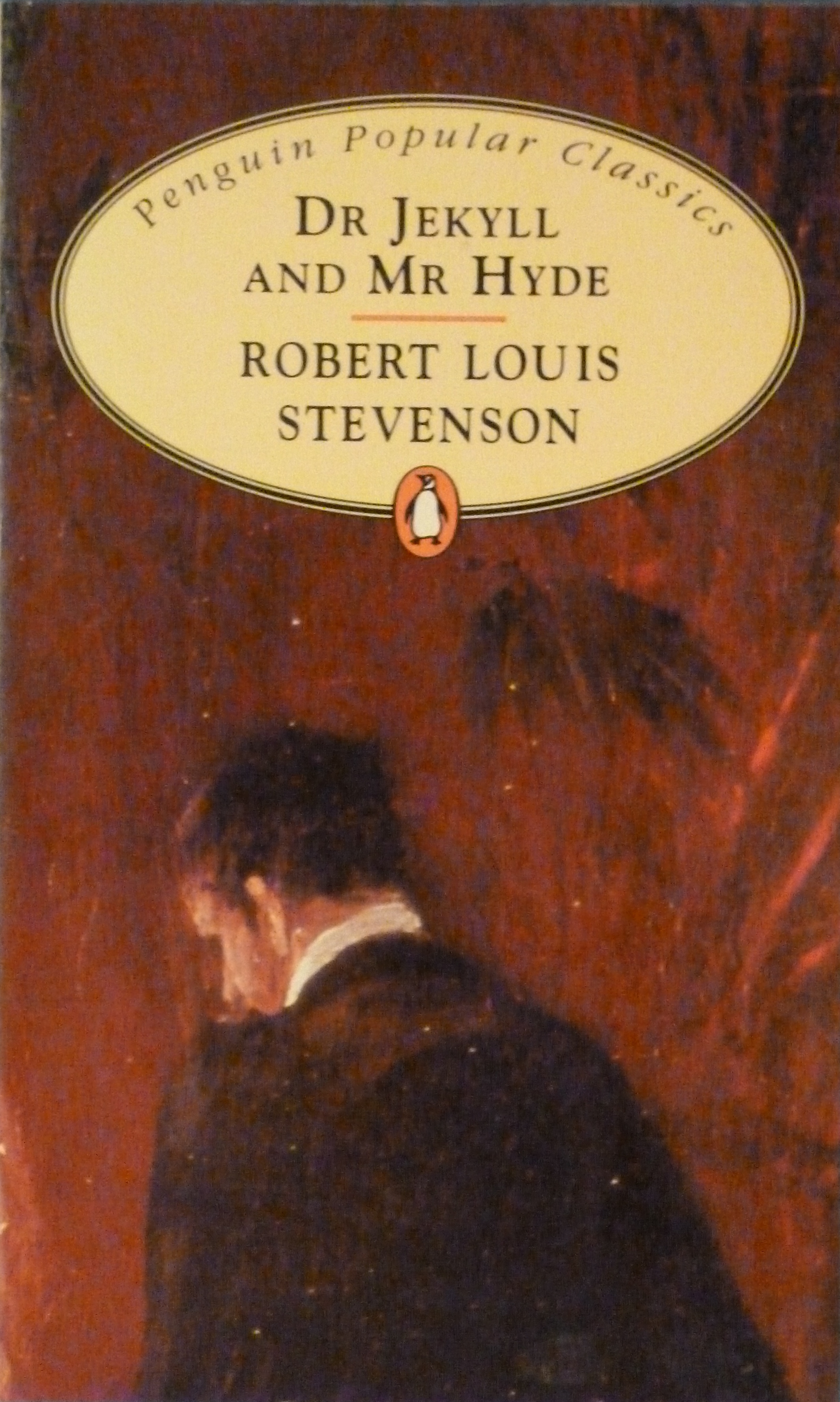
A classic depiction of the conflict between Persona and Shadow is ‘Dr Jekyll and Mr Hyde,’ by Robert Louis Stevenson, which came to him in a dream. In the story, Dr Jekyll is a respectable pillar of the community, but he has a secret other side – at night, he is addicted to the pleasures of debauchery.

He invents a potion which can completely change his physical appearance so that, as Mr Hyde, he is able to go out on the town and not worry about being discovered. Effectively, he turns himself into two people, one embodying his Persona, and the other his Shadow.

My version, for children – what can I say? I love that story!

Whatever we don’t identify with as ‘me’, we project out. We may disown it so completely that we can’t recognise it in ourselves at all. We can only see it in the mirror of the world.

One way we project undeveloped aspects of our Self is onto the people around us. A person who thinks of himself as hard-working and high-achieving may find other people lazy and unambitious. A person who thinks of herself as ugly may feel that virtually everyone else is good-looking.

In a couple, the tasks of personality are often shared out. One partner may be good with money, so the other can enjoy financial security without having to develop good money-sense themselves. One might be fun-loving and dizzy so the other can be sensible and steady, yet still enjoy a party lifestyle.

On a collective level, cultures, countries and sub-sections of society also have a Persona and a Shadow. In families, for example, it may mean one person becomes the black sheep, with all the family’s unacknowledged problems projected onto them.

Where there is Shadow projection, there is always emotion, because we’re defending our very existence, insofar as that is our idea of ourselves. Which brings me on to Jimmy Savile.

This was a man who appeared to be helping the young and vulnerable but was actually hurting and abusing them in secret. Quite rightly, there’s been huge public outrage, because nobody should have the slightest doubt that what he’s alleged to have done was heinous and wrong.

According to Jung, there may be another dimension to this natural disgust and condemnation – extreme public outcries of the dig-up-his-bones, may-he-rot-in-hell variety may be intensified by Shadow energy. ‘We’re not like that! We’re the opposite of that! We protect children from sexual abuse!’

So, do we? Young children are regularly exposed to highly sexualised music videos on daytime television, and sexual story-lines before the watershed. Magazines and video games which are targeted at children contain sexual content, and children’s clothing which could be seen as sexually provocative is sold in high street shops. A large proportion of primary age children have seen internet pornography. If you google ‘sexualising of children’ you’ll find page after page of examples.

Jung called the Shadow ‘the seat of creativity.’ Embracing the Shadow means letting go of fixed ideas about who we are and the way life is, opening to unconsidered possiblities and engaging with complications, so to create something new.

Something new is happening because of these horrific revelations. People who have kept their own experience of abuse to themselves for many years are suddenly speaking out. Not just the hundreds who were allegedly abused by Savile, but thousands more are flooding helplines with their stories. That in itself is the beginning of a major change.

I hope the high profile and new openness given to the problem of child sexual abuse because of this case will mean that the sexualising of children by adult society in recent years will come under proper scrutiny and be seen for what it is.

Jimmy Savile’s dirty secret may be holding the mirror up to ours,  showing us something about our society that we prefer not to acknowledge. Like all Shadow work, simply to acknowledge it is to begin the transformation.

More about the personal Shadow next week – where to look, and how to see it

Guest post: From making sense… to exploring the unconscious

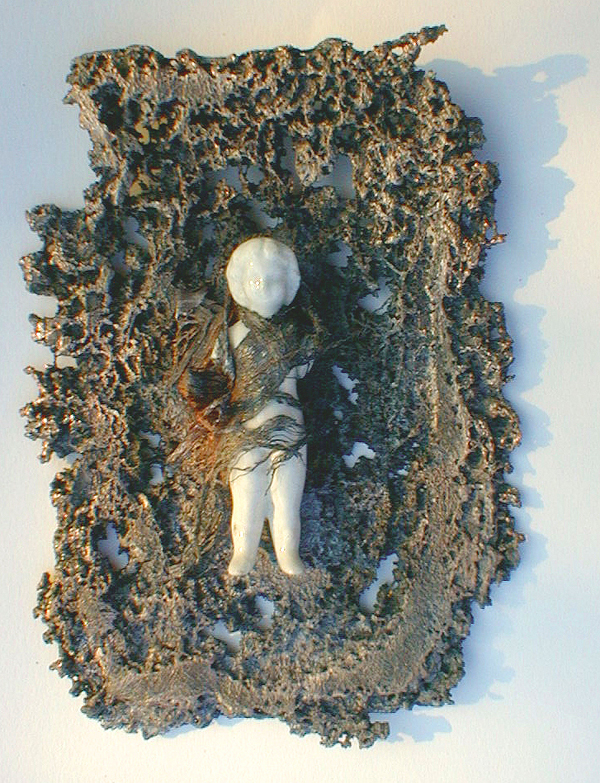
Penny Babies, by Melanie Benn

Melanie Benn

I love to dream, whether I’m asleep or looking out of a window. My dreams range from the mundane, as if sifting through a cupboard of the day’s events, to something more arcane. Sometimes I see an image or a scene, coupled with a strong emotion.

Once I dreamt I was standing on a shore at night, surrounded by rocks and watching tiny mouths in the water, gasping for air. I tried to scoop them out by turning my skirt into a cradle. I struggled to save them.

St Mary’s Church, Reculver
Some time later a local BBC radio station runs a competition and offers up the first line of a story: ‘Even now, the local historians speak of strange occurrences at St. Mary’s Church, Reculver’. I remember seeing the tall towers of this well-known landmark, standing next to the sea and I go off to do some research. I find reports of it being haunted, something more than wind sweeping round the church walls but babies crying.  I remember my dream and the second line comes to me: ‘sounds of crying or cooing they say, depending on your state of mind’.

Soon I start to weave the tale of shipwrecked babies, floating on the tide. ‘When they washed up on the shore they looked just like dolls,’ my Grandmother told me. ‘Like penny babies. Their bodies white and shiny, like alabaster, tied up in those long thin strips of cloth; not much bigger than the apron on my dress.’

‘Their bodies white and shiny, like alabaster…’

The story’s chosen and broadcast and then later produced for a stage version by a storytelling group in London. It occurs to me that our minds do more than just function when they are able to make connections; they begin to create. We’re able to move from just making sense of everyday events to exploring the unconscious.

Robert Moss, a writer and fascinating dream weaver says that dreams provide an ‘open vista’ of possibilities and for me, the way a story can come together feels like magic! But maybe it’s also the ability to re-imagine that holds the key. My dream brought with it an incredible feeling of sadness as I tried in vain to help the young lives drowning in the water. It spoke to me on another level and started me on a path to transform that feeling. A short story is just one way we might use our imagination to fuse different ideas together and bring something forward.

Melanie has an MA in Writing for Children and has been a previous winner of the London Writer’s Competition. She’s published in several anthologies and Penny Baby is now available to download from the short story mobile platform, Ether Books.

http://www.thewhiterabbit.org.uk/projects/are-you-sitting-comfortably/

http://etherbooks.com/

Here’s a dream question for you

A few nights ago, I dreamt about a row of old shops which had been boarded up with huge sheets of brown cardboard. Along the top, there was a big bright Tesco banner.

In my dream, I realised that when my dreams are set in man-made environments, they are always up-to-date. I very rarely dream about my own personal past, let alone further back in history.

I reflected that I’m a person who isn’t drawn to the past – I don’t write on historical themes, and I’m not fired by antiques, or costume dramas, or classical novels or paintings. Only last week, I bought a limited edition print of the Lidl in Brixton. It felt fresh and different – mean, how much Lidl-related art do you see?

Lidl in Brixton

Even when I did a few past-life regressions, they didn’t go further back than wartime Europe, but that’s another story.

I wondered about other people – antiques collectors, historical novelists, family archivists. People my spiritualist friend used to call ‘old souls.’ Did they have more dreams set in the past?

At the end of the dream, I dreamt I was recording this as a blog-post rather than an entry in my dream diary – and that’s what I’ve just done!

So this is my dream question – if you love old things, if you read or write historical books, do you have dreams that are set in the past? Or if, like me, you love the new, is that reflected in your dreams and writing too?

Gove levels – give me strength!

So here we are, facing yet another shake-up of the English education system, with the emphasis still on core academic subjects and rigorous testing. Ahem and excuse me, but what about that non-transferable and non-testable vital ingredient of a successful life – creativity?

When I examine myself and my methods of thought I come to the conclusion that the gift of fantasy has meant more to me than my talent for absorbing knowledge ~ Albert Einstein

Little children learn to be adults through imaginative role-play, pretending to be mummies and daddies, doctors, teachers, engine-drivers, soldiers, window-cleaners, cafe-owners…

Older children and adults make important decisions by imagining different outcomes – ‘If I did that course, I might become a chemist… then I’d work in a laboratory… or I might be a teacher… I could do that anywhere, in a city centre or a remote island… I could work overseas… or be an independent tutor…’

We make the most trivial of decisions in the same way. ‘If I go shopping right now, I might bump into Donna… she might be angry with me because I got the job she was going for… or she might be happy for me, if she didn’t really want it anyway… or I could go later when she’ll be picking up the kids… but by then they might have sold out of saffron buns…’

We make up stories all the time, quite unconsciously. They give us direction and certainty. If we develop this innate ability further through creative activities, we can explore more complicated issues; we can try on other people’s stories, which helps us to develop empathy and a deeper understanding of what life is.

Creative writing gives us access to experiences we would never have in our own lives.We can imagine ever further, extending the limits of our self.

Imagination is more important than knowledge. Knowledge is limited. Imagination encircles the world ~ Albert Einstein

Creative dreaming is the same. If we unhook dreams from the shackles of interpretation, they also become experience for the self, just like waking life, opportunities to go to places and meet people and have adventures and insights beyond our normal range.

You don’t have to teach creativity – you have to allow it; you have to nurture and value it. You can’t measure and assess it, the way you can test academic knowledge.

But imagination is the start point of everything in life, including learning. We shouldn’t be trying to cut children off from their inner world, by loading the curriculum with academic subjects and stealing more and more of their free time for homework and extra tuition. 

Children in the UK are among the least happy in the developed world, and they are also among the most tested. But even if happiness is low on our priorities, it makes no sense educationally to focus everything on academic subjects and intellectual skills, because the story-making mind is the seedbed from which knowledge and understanding grow.

The mind can proceed only so far upon what it knows and can prove. There comes a point where the mind takes a higher plane of knowledge, but can never prove how it got there. All great discoveries have involved such a leap ~ Albert Einstein

That’s it. I have nothing more to say. I’m completely fed up with politicians on both sides of the House narrowing our children’s abilities and aspirations, and harming their happiness, through their obsession with  ‘rigour’, ‘standards’ and testing. But please feel free to add your own views in the comments!

Create great plots by harnessing the power of myth

In our culture, because we have broken our conscious connection with myth, we tend to see our lives as separate and unique.

But every individual life follows paths and patterns which are universal. Each life story is built on a template of all human stories.

Through mythology, we can connect with the essence of our own life experience, and walk with greater consciousness the mythic pathways where we all are one.

Being aware of the archetypal dimension of experience can be particularly useful for writers. You can use mythic templates quite deliberately to help you construct stories which will have resonance with your readers.

I like to use the Hero’s Journey, the master-myth explored at length in Joseph Campbell’s book, ‘The Hero with a Thousand Faces’

In this story

  • the hero hears the call to adventure, which he at first refuses
  • something helps him to engage with the adventure and he sets out into the unfamiliar world
  • he meets allies and enemies
  • he’s tested
  • he has to muster all his inner resources to face his supreme ordeal
  • he finally claims his reward and takes it back to his community

This is a master myth because it isn’t limited to one area of human experience, such as becoming a mother or making the transition between middle and older age.

The Hero’s Journey explored through mythology and in the lives of women and writers – it is capable of endless applications

The Hero’s Journey describes every challenge we may have to face, however small or large; from the daily challenge of getting out of bed or learning something new to a greater challenge such as finding a new job or coming to terms with the death of a loved one.

Life continuously presents us with challenges, which we at first refuse, because we don’t want the effort and disruption of change. If we refuse, we get a nudge. We may seek the help and support of friends or strangers, books or teachers, and we may encounter unhelpful people who stand in the way.

Every time we engage with a challenge, we win a reward – new strength, new insight, new effectiveness in our world, which we can then ‘bring home’ and incorporate in our life.

You can use mythic templates in a deliberate way to construct strong stories, but simply being aware of the universal dimension in your characters’ stories will give them depth and new dimensions. As Dorothea Brande says, ninety percent of writing happens unconsciously, with us often finding things in our writing we did not consciously put there.

If you want to explore the Hero’s Journey in more depth, I’d recommend ‘The Writer’s Journey’ by Christopher Vogler, where he looks at various Hollywood blockbusters as versions of the hero myth.

August is all about archetypes here in the House of Dreams – next week, I’ll be telling you how I first encountered the archetypes in my dreams

Do you have a daily practice?

Many of the best books on writing, and pretty much every book on dreaming, recommend establishing a daily practice.

The Artist’s Way by Julia Cameron, and Becoming a Writer by Dorothea Brande, both propose the idea of ‘morning pages’ – setting aside half an hour first thing in the morning to write stream-of-consciousness, before your mind gets distracted by the mundane  concerns of the day.

The wonderful Writing down the Bones, by Nathalie Goldberg, develops this idea, comparing writing with Buddhist meditation practice.

The daily practice approach focuses on the process of writing rather than the products. It’s not instead of your books and stories, but as well; it’s the seed-bed from which your finished creative pieces grow. 

In the same way, writing down any dreams and dream fragments you remember upon waking isn’t just about big dreams and insights – it’s about deepening your awareness of the continuous dream-life that runs parallel with your life in the dayworld.

As with morning pages, you have to set aside value judgements and simply write, whatever comes, because that’s how you find and develop the authentic writer or dreamer that you are.

Betty Edwards, in Drawing on the Right Side of the Brain, says it doesn’t make any difference what you do – the point of any daily practice is the experience of ‘flow.’ Knitting, jogging and gardening are all a form of meditation, as are writing and other creative activities.

Anything in which you are able to lose yourself and the world, will change and enrich your life, and doing it every day makes this out-of-time experience part of you; it grounds you in something bigger than yourself.

Do you have a daily practice? What are its benefits in your life?

Guest post: The worlds where dreams may take us

Flying with Fairies, by Bob Cherny

Bob Cherney

We can analyze our dreams for what they say about us, fear them for what they might mean, take them for more than they are, merely enjoy them or follow them into the worlds where they may take us.

My book “Flying with Fairies” is this last. Born of a single brilliant full-color image, the first chapter turned into a second and then into a novel and then into a series. This book was a departure from what I had written previously and is unlike anything I have written since. But then, the dream that inspired it stood out from the other dreams for its visual clarity and symbolic obscurity. It was an opportunity to be exploited and a challenge to be faced. It spoke of pleasure and of hard work at the same time.

“Gatorbait”, a short story published in a Florida based regional publication, was also based on a single image. Where “Fairies” was based on a mid-air collision between a fairy and a flying human, “Gatorbait” was based on a young rodeo competitor and her flying horse.

I have a first chapter of a spy thriller that was so completely formed in my mind when I woke up, I could wait two days before writing it down. I have no idea what I will do with that chapter, but it’s there in case of whatever.

Everyone dreams, but remembering and exploiting dreams takes a willingness to step into a place where few of us are comfortable going. If you wish to write, go there. Take the risk. Exorcise the demons by writing them down and capturing them on the printed page where they can no longer do you any harm.

Do not work for your dreams. Make them work for you.

http://stagewalker.embarqspace.com/

My thanks to Bob for this glimpse into a wonderful dreaming and writing life, and for his insightful comments about exorcising personal demons by capturing them on the printed page. 

How do you make your dreams work for you?

Depression, dreams and the creative life

A few weeks ago, I heard author Matthew Johnstone talking about his experience of depression on the BBC World Service, and it got me thinking about the link between depression, dreams and the creative life.

Strikingly, Matthew said he would not change anything – his depression was part of him. Rather than try to kill the black dog, he had learnt how to tame it.

Matthew Johnstone’s book

In the West, we treat depression as an illness, a malfunction in the brain which needs to be cured with chemicals or brought under control by psychological explanations.

Depression challenges all our cultural values. It makes us antisocial in a world where naturally solitary types are labelled ‘poorly socialised’; it makes us still, in a world of manic activity.

Depression stops us from having what we want – which boils down to happiness – and we believe we should always be able to get what we want, because this is a secular world. Without God/fate/mystery, we expect to have control over our own lives.

Nobody would choose to feel depressed, but that is precisely the opportunity depression brings. It brings us to a standstill on our chosen track and, by stopping us from having what we think we want, it opens us up to something new and unexpected. It makes our life bigger.

It’s a well-documented fact that people dream more during periods of depression. Often these dreams are particularly vivid and memorable; they release a torrent of new images which, if we pay attention, can open doorways into new places of the mind, and inspire new directions in life. The loss of these life-giving dreams may be one of the most harmful side-effects of antidepressant drugs.

Many writers label their depression as ‘writer’s block.’ Suddenly the story they thought they had all planned out is stalled, or they can’t find any ideas for the next one. But this is the gift of the black dog for writers – it forces you to be still and receptive, so that new insights and inspirations can come in.

Writer’s block is simply impatience, which means literally the inability to tolerate suffering, delay, toil or vexation (from the Latin word meaning ‘to bear’)

Depression can feel dark and frightening, like a big black dog, but kicking him will make him mean. Don’t try to kill him, but don’t underestimate him either – if he hangs around your house, you need to tame him.

I think the black dog is a special danger for children and young people, before life has given them the perspective of time or put support systems in place. That’s why I wrote my children’s book, ‘How 2B Happy’, in which the very first principle is that we can’t be happy all the time; we have to accept unhappiness. But we can deal with it, and discover what gifts it brings.

In my last two posts, I’ve been talking about synchronicity, and needless to say several blog posts on dreams and depression have come to my attention this week. Toko-pa has written a passionate piece here, in which she talks about ‘the intelligence of our melancholia’ http://toko-pa.com/2007/03/08/bleed-joyfully-a-fresh-view-of-depression/#comment-497 You might also enjoy this piece from ispeakindreams http://ispeakindreams.wordpress.com/2012/06/26/the-beauty-of-our-dreams-healing-within-dreams/

Has a period of depression ever led to a breakthrough for you?