Tag Archives: inspiration

Writing the bright shadow

Lots of shadows in the House of Dreams lately, but before I leave this theme, an update from Toko-pa has prompted me to write a balancing article about the bright side of the Shadow.

I did mention the bright side in my article ‘It’s the seat of creativity – so how can you find your Shadow?’ but only in passing:

This is not to say the Shadow is only negative. Positive potentials which may have been strong in us can be lost. For example, a strong-willed child may learn to identify that strength as a bad thing, and grow to suppress and deny it.

The Shadow is everything we can’t see directly in ourselves. Toko-pa says 90% of that will be ‘pure gold’, but I feel the percentage will depend upon other aspects of your personality. A person with low self-esteem, for example, will be unconscious of many of their more positive qualities, strengths and potentials, whereas someone who feels they are ‘good’ may be suppressing or projecting out many of their own human weaknesses.

When we write, our protagonists express energies in our Self of which we may or may not be aware, and these are not only the dark energies of our villains but also the bright energies of our heroes.

In our heroes, we experience qualities we may not identify with in life, but which must exist in us because they are finding expression in our stories. My protagonists are usually resourceful, independent and brave, but I’ve only come to see where they are me through writing their stories. I used to think of myself as the very opposite of all that.

So there are bright lights hidden in these shadows which, if we follow them, can lead us into the most wonderful areas of the Self. The process may still feel challenging, because anything that shakes our beliefs about ourselves unsettles our world and forces a readjustment of both our memories and our future dreams.

And we have to walk this path lightly, not trying to understand or interpret, but listening for echoes, being aware.

Have you noticed key characteristics that run through most of your protagonists? Are they qualities you recognise in yourself?

Next week I’ll be giving my answer to a straightforward writing question: Is it easier to write for children?

Do you notice the hidden connections?

In interpreting dreams, we’re looking for the hidden connections between the dream and waking life. The clue is often in the emotional quality of the dream, which may resonate with the dreamer’s feelings about a waking life situation.

When we find the emotional echoes, we will often notice that the dream is a kind of alternative story-version of a daytime event or situation. ‘I felt shocked and anxious to stumble upon a shallow grave in my dream when I was wandering through a dark wood… and, come to think of it, I felt shocked and anxious to discover something I had previously been in the dark about…’

Wandering through a dark wood

The events of the dream are so different, we won’t usually notice the hidden connections unless we go looking for them, and it’s the same with writing.

The stories we write come from the same layers of the self as dreams, and like dreams they are usually symbolic versions of the stories we’re living in our ordinary life.

If we notice this at all, it will often be years later when we’ve gained some distance on both the real-life events and the story we’ve written. But it can be instant, as I experienced this week with the book I’m working on. I suddenly thought, ‘This character is me!’ and it was not a very sympathetic character (hello Shadow!)

Having clocked the mirror she was holding up to me, I really examined my attitude towards a situation I was struggling with. Then she was free and I changed her in the story.

I think there is a psychologically healing or self-developmental purpose to creative work in exactly the same way as there is to dreaming. Through these imagined stories, we rehearse our real-life problems and dilemmas; we experiment with different paths and processes in imagination, and explore all the possible outcomes.

I’ve used creative writing with children in schools in a deliberately problem-solving way to explore the issue of bullying, where the children will create a character who is being bullied and then develop their story by asking, ‘What can they do to make it stop?’

The character will try lots of ideas, until they find one that works. In the writing, the children are exploring a difficult real-life situation and imagining strategies they might use if they had to deal with it themselves.

When writing is free, and not a directed exercise like in my bullying workshops, writers will naturally put their protagonists in situations where they will be faced with emotional challenges and find solutions which might blaze a trail for the writer in real life.

Does this mean we should feel exposed by what we write? Not at all. Like dreams, our stories have hidden connections only we can see, because only we know the secret processes of our hearts and minds. Even people who know me well would not be able to identify the link between my shadow-character and what I had been thinking about during the week.

As Jung said, an interpretation tells more about the interpreter’s current state of mind than the dreamer’s, and any hidden connections readers might find in your stories will be connections with their own lives, not yours.

Have you ever had one of those a-ha moments about a piece of writing, when you suddenly realise, like waking from an obvious dream, ‘I know what that was about!’

Guest post: From making sense… to exploring the unconscious

Penny Babies, by Melanie Benn

Melanie Benn

I love to dream, whether I’m asleep or looking out of a window. My dreams range from the mundane, as if sifting through a cupboard of the day’s events, to something more arcane. Sometimes I see an image or a scene, coupled with a strong emotion.

Once I dreamt I was standing on a shore at night, surrounded by rocks and watching tiny mouths in the water, gasping for air. I tried to scoop them out by turning my skirt into a cradle. I struggled to save them.

St Mary’s Church, Reculver
Some time later a local BBC radio station runs a competition and offers up the first line of a story: ‘Even now, the local historians speak of strange occurrences at St. Mary’s Church, Reculver’. I remember seeing the tall towers of this well-known landmark, standing next to the sea and I go off to do some research. I find reports of it being haunted, something more than wind sweeping round the church walls but babies crying.  I remember my dream and the second line comes to me: ‘sounds of crying or cooing they say, depending on your state of mind’.

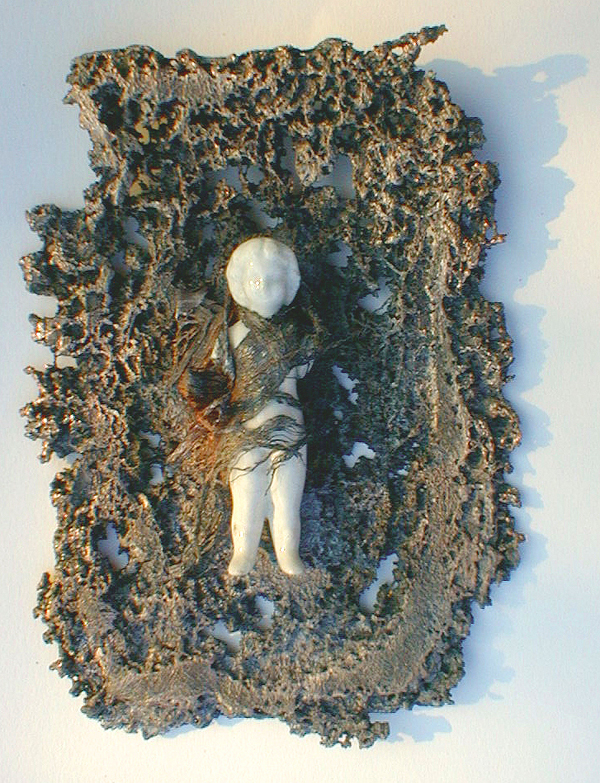
Soon I start to weave the tale of shipwrecked babies, floating on the tide. ‘When they washed up on the shore they looked just like dolls,’ my Grandmother told me. ‘Like penny babies. Their bodies white and shiny, like alabaster, tied up in those long thin strips of cloth; not much bigger than the apron on my dress.’

‘Their bodies white and shiny, like alabaster…’

The story’s chosen and broadcast and then later produced for a stage version by a storytelling group in London. It occurs to me that our minds do more than just function when they are able to make connections; they begin to create. We’re able to move from just making sense of everyday events to exploring the unconscious.

Robert Moss, a writer and fascinating dream weaver says that dreams provide an ‘open vista’ of possibilities and for me, the way a story can come together feels like magic! But maybe it’s also the ability to re-imagine that holds the key. My dream brought with it an incredible feeling of sadness as I tried in vain to help the young lives drowning in the water. It spoke to me on another level and started me on a path to transform that feeling. A short story is just one way we might use our imagination to fuse different ideas together and bring something forward.

Melanie has an MA in Writing for Children and has been a previous winner of the London Writer’s Competition. She’s published in several anthologies and Penny Baby is now available to download from the short story mobile platform, Ether Books.

http://www.thewhiterabbit.org.uk/projects/are-you-sitting-comfortably/

http://etherbooks.com/

What are the best writing prompts for daily practice?

The idea for this post was suggested to me by a comment about a previous article ‘Do you have a daily practice?’ 

lyndart wrote, ‘I have difficulty giving myself permission to let those creative juices flow… Any suggestion for a topic?’

Trees

You can use any random word such as ‘trees’ or ‘motor-bikes’ or ‘dinner-time’ for a writing prompt, and there are many sites which offer a fresh suggestion every day. I do this myself for warm-ups with groups, giving a random word and asking them to write freely about it, keeping the pen moving on the paper even if at times they find themselves writing things like, ‘I have absolutely nothing else to say on this topic, I don’t know why I’m doing this,’ until their mind finds its way back to the theme.

But the very best prompts for daily practice are the ones you come up with for yourself because, like dream images, whatever emerges spontaneously from your own relaxed mind will have emotional resonance and personal significance for you right now, whether it’s immediately obvious or not.

To find images which are active in you at the moment, sit comfortably with your notepad or laptop, close your eyes and take a few slow, steady breaths. Clear your mind. 

Think of an object – the first thing that comes to you. Don’t censor or try to find something ‘better.’ Write for five minutes, stream-of-consciousness, without pausing. Change direction when one stream runs out, allowing yourself to go where your thoughts take you, even if you stray from your starting-out point.

If you prefer, you can write a list of the first five things you think of, then choose one from your list to write about. You can write for ten or fifteen or even twenty minutes in this way if that’s your daily practice.

I love… my garden

Another way of finding prompts that have particular resonance for you is beginning with a phrase such as ‘I remember’ or ‘I wish’ or ‘I love’ or ‘I hate’ because these will take you immediately into areas that you care about.

I often use this kind of prompt in workshops, especially about childhood, which is the living root of every life. I give a topic such as ‘my mother’s kitchen’ or ‘my childhood bedroom.’ I’ve written about this on the wonderful girlsheartbooks blog, ‘What was your favourite toy when you were little?’ 

The key with daily writing practice, as with all creative endeavours, is pleasure. Writing about themes and topics which have personal resonance is always pleasurable and over time, it will deepen your understanding of yourself as a writer.

Have you got any suggestions for good writing prompts? Please share!

Guest post: The worlds where dreams may take us

Flying with Fairies, by Bob Cherny

Bob Cherney

We can analyze our dreams for what they say about us, fear them for what they might mean, take them for more than they are, merely enjoy them or follow them into the worlds where they may take us.

My book “Flying with Fairies” is this last. Born of a single brilliant full-color image, the first chapter turned into a second and then into a novel and then into a series. This book was a departure from what I had written previously and is unlike anything I have written since. But then, the dream that inspired it stood out from the other dreams for its visual clarity and symbolic obscurity. It was an opportunity to be exploited and a challenge to be faced. It spoke of pleasure and of hard work at the same time.

“Gatorbait”, a short story published in a Florida based regional publication, was also based on a single image. Where “Fairies” was based on a mid-air collision between a fairy and a flying human, “Gatorbait” was based on a young rodeo competitor and her flying horse.

I have a first chapter of a spy thriller that was so completely formed in my mind when I woke up, I could wait two days before writing it down. I have no idea what I will do with that chapter, but it’s there in case of whatever.

Everyone dreams, but remembering and exploiting dreams takes a willingness to step into a place where few of us are comfortable going. If you wish to write, go there. Take the risk. Exorcise the demons by writing them down and capturing them on the printed page where they can no longer do you any harm.

Do not work for your dreams. Make them work for you.

http://stagewalker.embarqspace.com/

My thanks to Bob for this glimpse into a wonderful dreaming and writing life, and for his insightful comments about exorcising personal demons by capturing them on the printed page. 

How do you make your dreams work for you?

Depression, dreams and the creative life

A few weeks ago, I heard author Matthew Johnstone talking about his experience of depression on the BBC World Service, and it got me thinking about the link between depression, dreams and the creative life.

Strikingly, Matthew said he would not change anything – his depression was part of him. Rather than try to kill the black dog, he had learnt how to tame it.

Matthew Johnstone’s book

In the West, we treat depression as an illness, a malfunction in the brain which needs to be cured with chemicals or brought under control by psychological explanations.

Depression challenges all our cultural values. It makes us antisocial in a world where naturally solitary types are labelled ‘poorly socialised’; it makes us still, in a world of manic activity.

Depression stops us from having what we want – which boils down to happiness – and we believe we should always be able to get what we want, because this is a secular world. Without God/fate/mystery, we expect to have control over our own lives.

Nobody would choose to feel depressed, but that is precisely the opportunity depression brings. It brings us to a standstill on our chosen track and, by stopping us from having what we think we want, it opens us up to something new and unexpected. It makes our life bigger.

It’s a well-documented fact that people dream more during periods of depression. Often these dreams are particularly vivid and memorable; they release a torrent of new images which, if we pay attention, can open doorways into new places of the mind, and inspire new directions in life. The loss of these life-giving dreams may be one of the most harmful side-effects of antidepressant drugs.

Many writers label their depression as ‘writer’s block.’ Suddenly the story they thought they had all planned out is stalled, or they can’t find any ideas for the next one. But this is the gift of the black dog for writers – it forces you to be still and receptive, so that new insights and inspirations can come in.

Writer’s block is simply impatience, which means literally the inability to tolerate suffering, delay, toil or vexation (from the Latin word meaning ‘to bear’)

Depression can feel dark and frightening, like a big black dog, but kicking him will make him mean. Don’t try to kill him, but don’t underestimate him either – if he hangs around your house, you need to tame him.

I think the black dog is a special danger for children and young people, before life has given them the perspective of time or put support systems in place. That’s why I wrote my children’s book, ‘How 2B Happy’, in which the very first principle is that we can’t be happy all the time; we have to accept unhappiness. But we can deal with it, and discover what gifts it brings.

In my last two posts, I’ve been talking about synchronicity, and needless to say several blog posts on dreams and depression have come to my attention this week. Toko-pa has written a passionate piece here, in which she talks about ‘the intelligence of our melancholia’ http://toko-pa.com/2007/03/08/bleed-joyfully-a-fresh-view-of-depression/#comment-497 You might also enjoy this piece from ispeakindreams http://ispeakindreams.wordpress.com/2012/06/26/the-beauty-of-our-dreams-healing-within-dreams/

Has a period of depression ever led to a breakthrough for you?

How a broken toilet seat solved a conundrum

In the four or five weeks since I delivered ‘Writing in the House of Dreams’ to my agent, my life has not been writing-friendly.

Between the nightmare chaos of having builders in to fix the roof and fit a new bathroom, and the fun chaos of lots of visitors, there simply hasn’t been time for work.

What I had been planning to do after everything quietened down last weekend was decorate the rooms where the leaky roof had done most damage, but I couldn’t face it – I just wanted to get back to my writing.

The problem was, I couldn’t decide what to write. I had two projects in development – a children’s series to follow my Peony Pinker books, and an adults’ book similar to ‘Writing in the House of Dreams.’ Both of these ideas felt interesting and exciting, in completely different ways.

My heart said do the latter, even though I didn’t have much more than a bunch of vague ideas and a few scribbled notes.  My head said do the former, because I had already written a full synopsis and half of the first story, and my agent had given it the thumbs-up. So I was faced with a conundrum.

I still hadn’t made up my mind the next morning, when my brand new toilet seat broke, dragging me away from my just-getting-back-to-normal life and dumping me back in the local B and Q, where I seemed to have spent most of the previous month.

I felt tetchy. I’d paid nearly thirty quid for that toilet seat, and you could have fashioned better fixings out of tin foil. I felt even more tetchy when the local store insisted that, as I’d bought it at a different branch an hour’s drive away, that’s where I would have to take it back to.

I bought a second toilet seat, tossed the faulty one in the boot, and set off for home. But it felt such an irritating waste of a morning that I took a diversion and drove out to the holy well at Saint Clether.

The holy well is a magical place, full of history and mystery, nestled in a beautiful valley. In my experience, it isn’t possible to stay confused, angry or upset for long, within its ancient walls.

St Clether holy well

As I tramped along the path, I suddenly remembered how I had come to the well before, when I was faced with exactly the same writing dilemma. My head had been telling me try and get a contract for another children’s series, but my heart wanted to throw common sense to the winds and focus on my dream book for a while.

The version of my dream book I was working on at that time was called ‘Pomegranate’, after the myth of Persephone. When I got to the well, I found lots of people celebrating the celtic festival of harvest, and among the coins and crystals left as offerings in the wall, someone had managed to perch a pomegranate.

I could not have been more astonished if the skies had opened and the voice of God boomed out, ‘Write “Pomegranate!”‘

I did, and I had never regretted that decision. So now I was alert for any signs or portents that might give me a heads-up this time. I went into the little chapel, picked up a candle to light, and just stood there. The working title of my current adults’ book idea is ‘Sixty Candles.’

When it comes to writing, I find that the heart usually does get its own way in the end, but often not before a fair few steps in the opposite direction, unless Life gives me a shove (I’ll be blogging about signs and portents next week)

If the toilet seat hadn’t broken, I wouldn’t have had to go to B and Q. If the local store had been willing to exchange it, I wouldn’t have felt so cross that I needed a calming diversion.

If I hadn’t gone to the well, I wouldn’t have remembered the last time I was faced with this exact conundrum. I probably would have gone on dithering between my two projects for weeks, instead of being able to throw myself whole-heartedly into one of them.

So my broken toilet seat solved a conundrum. What had seemed a completely irritating, bad thing, triggered a very positive train of events.

Have you ever had a bad experience that turned out to have been a good thing?

Nothing is ever good or bad, but thinking makes it so ~ Shakespeare

Guest post: The dream that became a fairy-tale

How a Dream Became a Fairy Tale – by Juanita Havill

I’ve kept dream journals for years and they provide inspiration, characters, and plots. One in particular, about a glass bed, led easily into a story…

The boy I was babysitting didn’t want to go to sleep. “I’m afraid,” he protested. He balked. I insisted. Still he wouldn’t move. So naturally I turned to an alternate bed, that is, a glass bed. I don’t recall exactly why I had the glass bed with me, but what a relief!

As soon as I rolled the heavy glass bed into his bedroom, he lay on it, stretched out, and fell asleep without the comfort of sheets, pillow, or blanket.

The headboard of the bed impressed me mightily. Thick glass, it was carved with images of children, youths, deer, rabbits, and foxes. I watched him snooze for a while to make sure that he was not feigning sleep. The warm glow from the little boy’s night light illuminated the glass carvings. Satisfied, I woke up.

I don’t always wake up from dreams satisfied. Often times I’m anxious, puzzled, or fearful, but not this time. I wrote a quick account of the dream in my journal, and a few years later I turned the dream into a short tale for a children’s magazine and “The Glass Bed” was published.

Such is the waking mind that the story became a fairy tale in which a young prince refuses to go to bed at night and neither king nor queen nor princess nor court wizard can come up with a solution.

Although the court jester’s idea of a glass bed is scoffed at, finally the transparent bed with its solid glass headboard is installed in the prince’s room.

The prince continues to have frightening dreams, but because he is no longer alone, he is able to sleep. Why isn’t he alone? Because everyone at court crowds into his bedroom to watch the prince’s scary dreams projected across the glass headboard.

Take the bones and build a story!

If you have ever tried to write a poem or short story directly from a dream, you will probably have come to the conclusion that it doesn’t really work. Dreams are pure subjective substance, which has to be transmuted into something a reader can share.

But although you can rarely use a dream exactly as it is in writing, dreams can be a great source of inspiration. They can energise your writing because they are fired by the very themes and emotions that are currently bubbling beneath the surface in your waking life.

One of the approaches I use in workshops for writing from dream material is to extract the bones of the dream and build it up into a story.


 Dream themes – building from the bones

Choose a recent dream if you would like to try this exercise because it will have more immediate resonance for you than one you had a while ago. It doesn’t need to be long or detailed. All you’re looking for is a moment of action.

Describe the dream in a single sentence beginning, ‘Someone is…’ Use non-specific nouns, ‘something’, ‘someone’, ‘somewhere’ – keep it as general as possible, with the focus on the verb. ‘Someone is cross with her husband,’ would be too specific. ‘Someone is cross with someone’ is the pure action, plain and simple, capable of supporting a whole new cast of characters.

Examples from workshops include, ‘Someone is searching for someone’, ‘Someone has forgotten something’, ‘Someone is asking questions’, ‘Someone is not what they seem…’

Write a few alternative verb-focused sentences for your dream, and then decide which one you’re going with. Don’t over-think it. You’re just playing about with some ideas.

Now forget the dream, take the sentence and build a new context around it. If your sentence is, ‘Someone is being chased,’ who is it? Who is being chased? Start by making a character sketch.

When you are creating a character, it helps to know their name, even if you aren’t going to mention it. When you’re thinking about their appearance, imagine you’re watching a video of them, or looking through their photo-album.

Then ask them a few questions to get to know them a bit. What do they like? What do they hate? What is their earliest memory? What was their childhood ambition? Ask as many questions as you need. Ask the things that you want to know.

You won’t use everything you know about your characters in any story, but knowing a lot about them gives you context; it makes the writing flow more easily, and feel more three-dimensional. Any story is like an iceberg; the bit the author shows you is just the tip of what they know.

Make character sketches for anyone else involved in the story – who is chasing them? Who gets in the way? Who helps them?

When you’ve got some good character sketches, think about the settings. Ask, ‘Where?’ Look around at the scenery. Use all your senses to be right there. Where are they running to? Where are they running from? Ask, ‘When?’ The season, weather, time of day and the historical era, are all part of the setting.

Then ask, ‘Why?’ Why are they being chased? Ask, ‘What is the issue? What is at stake? What happens if they don’t get away?’

Who, what, where, when, why, how… these are the prompts for imaginative play, and they will always take you straight into a story.

Fully imagine the scene, and when you are ready, write it. Don’t try to write well, just write. It’s a first draft. At this stage, being ‘good’ is not important. What you need is to be present.

*

Using dreams to spark creative writing not only guarantees you will find stories which feel enjoyable and meaningful to you, it is also a good way of deepening your understanding of the dream.

Furthermore, because dreams are related to waking life, writing stories from dream material can be a kind of rehearsal, a way of finding creative solutions to waking-life situations, and so feeling empowered.

‘Treat your dreams like lovers’ – talking to Toko-pa

Toko-pa Turner is an authority on dreams and dreamwork. I asked her to do an interview after watching her video tips on recalling dreams, in which she suggests, ‘Treat your dreams like lovers…’ I really liked that idea!

While I was pondering what I might ask her, I dreamt that she and I were in my living-room, with lots of people milling around at some kind of get-together; we were looking after someone’s baby, passing it between us in a delightful way, just like this process of question-and-answer.

Could you tell us a bit about your own personal journey in dreams, Toko-pa?

I grew up in a unique way, raised as a Sufi in a downtown Montreal commune. We lived in a giant but humble tenement with 18 rooms and 9 cats.  We ate vegetarian meals, practised yoga, meditation, did Sufi dancing and chanted zikr. As you can imagine, our bookshelves were crowded with poetry by Rumi and Tagore, herbal dictionaries, tomes on Tantra, crystals, Dreaming and endless manuals for spiritual enlightenment.

By the time I was 9 or 10, I was reading Carlos Casteneda and having out-of-body experiences. I remember being fixated with dreams – not just their significance, but that they emanated from a world beyond this world, from which beauty, monstrosity and intelligence were endlessly flowing.

When I was about 10, I was reading Journeys out of the Body by Robert Monroe and, while meditating with a quartz crystal, had my first astral projection. In the vision, I was shown an infinite hallway of doors, each marked with a different discipline or area of knowledge. I chose one at random and entered into a classroom where a teacher was waiting for me. He handed me a giant, ancient-looking book, not to read but to… download.

Metabolising the entirity of that teaching in a matter of seconds changed my life. While I have many times strayed off the Dreaming path, I have never forgotten that within each of us is a vast Innernet which contains the entire appendix of our experience as a species – maybe even our memories of the future.

What is the value of dream-recalling as part of everyday life?

In the Talmud, it is said that an uninterpreted dream is like a letter left unread. Dreams show us with staggering clarity and genius what we most need to bring to consciousness. They guide us to not only make excellent decisions in daily life but, like an acorn to the oak tree, they prompt us in the overall direction of our soul’s purpose.

When we are in alignment with our purpose, we are also making the greatest possible contribution to our tribe. Marion Woodman, a marvellous Jungian writer, teaches that the greatest tragedy we face as a culture is the loss of the symbolic life. So you see, each of us is grieving our own piece of that loss, whether we are aware of it or not.

As you forge a relationship with your dreams, that profound loneliness begins to dissipate, and you find your place in the ‘family of things.’ As a side-benefit, you’ll find synchronicity, love and other miracles start to line up to meet you.

I like your gentle approach to dreamwork – could you tell us a bit about your work with clients?

Well, it’s just about my favourite thing in the world. There’s nothing more intimate, fulfilling and magical that ‘touching souls’ with another being. Most people walk around for years without ever receiving a proper ‘Hello.’ What I mean by that, is that most of us have been taught from the earliest age to suppress and discount the tenderest, most creative part of ourselves. And while it is certainly possible to survive in this way, underneath the daily armour is an unabating hunger to be seen.

To connect, being-to-being, with that thing which is tired of fitting in, which wants to feel alive, which has something authentic to offer. Giving a proper Hello is to hold a subtle, unwavering presence for that thing to feel safe enough to emerge. Dreamwork is all about nurturing trust, not just between the Dreamer and Dreamworker, but between the Dreamer and his/her own soul.

Is all dream material related to the dreamer’s day-life, or are there different kinds of dreams?

While most dreams are responding to the events of our daily lives, occasionally one lucks out and gets a Big Dream. It has a tonal difference to it and feels more like an experience than a narrative. It is more vivid and sensual, and the characters & environments seem to exist independently of our being there. It’s as if these dreams are having us, instead of the other way around. Often in dreams like these, we receive transmissions or guidance which stays with us for a long time.

There are more kinds of dreams than I could ever cover in this interview, and likely more than I could even learn about. There are precognitive & premonitory dreams, creative dreams, visionary dreams, past-life dreams, healing & initiation dreams, recurring dreams, lucid dreams, telepathic dreams and many more.

But perhaps its most important to mention nightmares, because they are the reason most people choose not to remember their dreams. One of the most powerful things I get to witness in my work, is the moment when people realise that their nightmares are there to help them. Some spend a lifetime hiding shame and fear of their own dreams, believing they are broken or abnormal. But the truth is, nightmares are just dreams that have turned up their volume, trying devotedly to get our attention about something that is ready to be healed.

This blog is about using dreams as a creative resource. As an artist, writer and musician, how does your dreamlife feed your creativity?
Infinitely! As a songwriter and writer, I constantly use the symbols from my dreams to set the mood of a piece, or to convey a poetic paradox. For instance, I have a song called Medicine Music, whose chorus, “the poison is the medicine” came from a dream in which spiders were covering my arms and biting me. I was paralysed with fear but when the poison sunk into my bloodstream, I became filled with light and strength. This dream taught me that if I lean into those painful and scary places, they will no longer paralyse me, but become the source of my power.

What is your favourite book about dreams?

I love The Way of the Dream by Marie Louise von Franz, which is just a short transcript of an extraordinary ten hour film interview that von Franz did with fellow Jungian Fraser Boa. She has such a great mind and it is never at the expense of her feeling, so she simultaneously satisfies my inner mystic and nerd.

I always enjoy the quotations you post on your facebook page. Would you like to finish this interview with a quotation here?

From Marc Ian Barasch’s Healing Dreams: “Dreams uphold the soul’s values. They tell us that we — our ego selves — are not who we think we are. They encourage us to live truthfully, right now and always. Of course these messages might not be what we want to hear. Sometimes dreams may advocate for life changes that are challenging, to say the least. Dreams really have no time for niceties or for the stories we tell ourselves about who we are. In dreams our narrow selfhood is expanded — the dreams will not allow us to be so small.”

Toko-pa has a beautiful blog http://www.toko-pa.com and facebook page https://www.facebook.com/DreamworkWithTokopa

You can read another beautiful interview with Toko-pa here.