All posts by Jenny Alexander

I've written loads of children's stories and funny non-fiction books on useful topics such as how to be happy and how to handle bullies, bigmouths and so-called friends. My books for adults include five on the art and craft of writing, and I write a monthly column for Writing Magazine. I run creative workshops both as an independent and for organisations large and small.

Donald Trump and the Tower in Tarot

On Friday I listened to President Trump’s inaugural address; yesterday, I watched footage of the millions of people all over the globe coming out in protest at the policies and attitudes he represents, and last night I dreamt about the Donald.

I’m in a small group of journalists who have been invited to do a feature about Donald and Melania Trump. The venue is a swimming pool at the very top of a tall tower, all glass and steel and, when they arrive, it’s clear the reason why they’ve chosen this venue is because Donald wants to show off his trophy wife. They both arrive in robes over swimwear – ‘Just wait till you see what she’s wearing underneath,’ he says. ‘Her body is just sensational. Sensational!’

He goes first, with her behind him and the rest of us following, so that we can admire her legs. Her shoes are impossibly high heeled, and she will have to climb to the top of the tower in them. We can see how hard and painful that is, though she’s trying not to show it. How can he not realise how completely unimpressed anyone is by this? He’s the President, she’s the First Lady, and this is his whole agenda. It’s frightening.

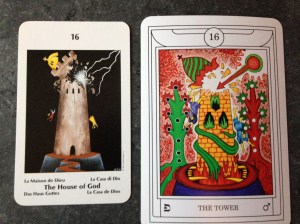
When I woke up, I immediately thought of the Tower archetype in Tarot, which I’ve blogged about previously in a post I called Death and Regeneration. The Tower card always looks alarming, with a tower being struck down, often by lightning, and people being thrown from the top.
img_3817

The Tower is change of a radical nature; not gentle evolution but complete destruction and rebuilding. It’s an archetypal principal, because change is the nature of life, and where systems are so powerful and entrenched that they can resist evolving, change will be thrust upon them.

We who remember the austerity of the post war years, the inequality of the class system, the oppression of women and the persecution of minorities are feeling scared, because all the wonderful developments we have striven for seem to be being swept away.

But beneath the legal protections we have put in place, the cultural repression of women continues –  pornography and plastic surgery are huge industries built upon it – and the inequality of opportunity is as great for people born into poverty now as it ever was for those born into working class families in former times. Racism and homophobia are still easy to stir up, as we’ve seen in all these anti-establishment movements going on in the Western world at the moment.

So there is still work to be done, but our sense of being able to have a voice in politics has been eroded so much in recent years that people have felt too despondent and disenfranchised to engage with it.

The election of Trump is galvanising people to stand up for the higher human values again, and the sheer force of numbers turning out on the streets all over the world yesterday shows the grassroots is not dead.

Where the tower falls, something new always springs up. There’s room, in my view, for some hope that the new order will be fuelled by this re-energised mass movement for social equality, but it will only happen if everyone who objects to Trump and his values stands up, speaks out and plays an active part.

I couldn’t march yesterday, but I’d like to thank everyone who did.

What are your thoughts about this new presidency? Have you had any Donald Trump dreams?


Diaries, Notebooks, Journals… Let’s Talk About Personal Writing!

Every year, in early January, I run a workshop called ‘Writing the New Year In.’ It’s one of my favourites, and I look forward to it. My goal is to help people experience the deep pleasure of personal writing, which can help you find your writing confidence and voice, and may become a seedbed for ideas that will grow into finished writing projects.

So what better time to launch my new occasional series of guest blogs about private writing?

Today, I’m delighted to welcome Karen Laura Steel to the House of Dreams to talk about her writing journals. Karen is a funeral celebrant – she takes naming ceremonies and weddings as well – who has also worked for 20 years singing to elderly and brain damaged people in residential settings.

Here is the story of her personal writing.

p1060607
Karen Laura Steel

I remember the first diary that allowed me to write more than childhood entries: “Went to school. Ate jam sandwich…”. It charmed me with its ornamental lock and pretty little key. I was 10, and it was a 5-Year diary, so I was aware it was something of a commitment, but the closely drawn lines and the never-ending feeling gave me a kind of hope. There weren’t many days over those 5 years that I didn’t write at least a small entry on how I was coping at new schools; having begun Comprehensive Education, only to move after 18 months, having to start O Level courses again. My diary listened as I missed old friends, found that cliques, once made, were hard to break into, and that friends we’d moved to be closer to weren’t necessarily worth the effort!

My teen-diaries received emotions on unrequited love, the excitement of prospective love-interests and despair when things went hopelessly wrong.

By the time I was beginning my degree, a plain notebook accompanied me everywhere, especially invaluable during my semester in America as I recorded first impressions of places and people every few hours at least. It was my 1980s version of fb, but private and didn’t need the approbation of others.

Battling depression in my twenties my journal received all my heart’s outpourings when no one else seemed interested or capable of understanding where I was coming from. In my thirties when finally receiving help, dream journals, notes on counselling sessions or discussions with helpful friends gave way to writing about new avenues of spirituality as I explored Yoga, its philosophy, and anything which gave a different perspective on the world.

Over time my journals have also generated other creative outlets, germinating ideas for songs or other writing.

Too much work ate into journal time last year, until I decided that life was far more enjoyable when I could jot down my problems and see the solutions emerging spontaneously.

Part of me wishes the notebooks were all the same size or of similar design, but the array of covers which have held my confidences are a testimony in themselves to my changing life, tastes and experience and are precious for that. I am writing once a week at the moment – and the desire to do it more often is encouraging me that I’m back on track!

p1060603
Some of Karen’s notebooks

You can find out more about Karen’s work by visiting her website or reading her blog, Diary of a Funeral Celebrant.

Do you have a practice of personal writing? If so, we’d love to hear about it here in the House of Dreams. Please email your piece, up to 400 words, a sentence or two about yourself and any links you’d like to include, to author@jennyalexander.co.uk. A photo of yourself would also be good, and possibly one of your journals.

I’m planning to make this an occasional series throughout 2017, welcoming a wide range of guests. Let’s celebrate personal writing!

How to make the best New Year resolutions

I’m a big fan of goals in life generally, and I always take a few days over New Year to consider what I want to achieve in the year to come, both in my personal life and my writing.

It takes a few days because it’s a broad field, if you don’t measure success only in terms of finances and career development, as we tend to do in our culture. There’s creative satisfaction, greater understanding, social engagement and every other aspect of life to consider.

So how do you narrow it down? Well, according to Alain de Botton on the radio this week, it helps to ponder your own mortality. Most people don’t really think about the prospect of dying until they’re in the 40s or 50s, but de Botton suggests we should all start to think about it from at least the age of 10.

Having faced the fact that you’re going to die, and it could happen at any time, then, says de Botton, it’s good to think about regrets. If you were to die tomorrow, what would you regret never having done? Maybe you’d wish you had travelled more, or read more, or written a book, or taken up a musical instrument, or learnt to fly. Or managed to master your temper better, or speak up for yourself, or say sorry, or tell someone you love them.

Whatever you would regret not having done in this life if you were to die tomorrow, those are the things you need to get on and do today. Even for things that are going to take much longer than just this coming year, you can still make a start.

Like any journey, once you start, you build momentum. You see the way unfolding ahead of you, and feel the excitement of working towards the place you want to be. It doesn’t matter whether you arrive or not – you will have extended yourself, and striven, and felt energised along the way. And discovered new goals to start going for, like unexpected signposts and turnings in the road.

So if you haven’t set any New Year resolutions yet, imagine the Grim Reaper were to come for you today – what would you wish you had done? Write a list of things you can do right away and things that could take a long time. Select two of each. With the long-term goals, make a start this week – write that email enquiry, make that phone call, start that conversation, do that search.

It feels good – and that’s why I’m a fan of goals and resolutions!


Get more from your dream life in 2017

As the old year comes to a close, it’s time to take stock and think about what you’d like the new one to bring. Intention is a powerful magnetic force, and focusing on what you want greatly increases your chances of achieving it.

The sharper the focus, the better the chance; having a vague notion of something you might like to achieve is like throwing a dart in the general direction of the darts board and hoping it’ll hit the bullseye. It could happen, but it it’s not very likely.

Once you’ve set a goal, you need to think of practical steps you can take to work towards it. As you’re reading this blog, I guess you’re interested in dreams, so here are my suggestions for anyone who’d like to get more from their dream life in 2017.

  1. Make dreams part of the conversation. Talk about dreams generally, with your family and friends, and share specific ones you happen to remember. Talking about dreams, whether you have regular recall or not, increases dream awareness even for experienced dreamers. The secret of happy dream talk is to treat your dreams like the experiences of waking life; keep it brief, keep it interesting, leave out any long-winded boring bits and, most important of all, don’t try to interpret, either your own or other people’s. One of the reasons we can feel reticent about sharing dreams is because we think they might reveal something about us, and focusing on finding meaning takes our attention away from the actual experience of the dream. Besides, as Alfred Adler wrote, The realm of meanings is the realm of mistakes. 

    img_0088
    Dream sharing in the family whatsapp from one of my children, the day before our Christmas get-together including new addition, one-year-old Daisy.
  2. Let go of psychological interpretation generally. If we value dreams only as a source of information about our waking life, that puts an automatic filter on our recall. We will tend to remember and write down only the dream material that we identify as important or relevant, and miss the good stuff that takes us outside our waking understanding and into the complete unknown. Letting go of trying to interpret dreams could be interesting for more experienced dreamers as well as beginners; try it for a few months, and see if your dream life changes.
  3. Keep a dream diary. I’ve put this one last because it’s what everyone says and I didn’t want you to roll your eyes and abandon me mid-post! But everyone says it for a reason; it works. It’s the power of intention again. By buying a lovely notebook and placing it beside your bed, you’re setting the intention to record something when you wake. At first, you may not have many narrative dreams, but just fragments or single images – however random, uninteresting or irrelevant they feel, write them down. Draw them. Value them. From these little scraps, dream recall will gradually develop. Have faith and stick at it. I recommend you set the intention for a manageable amount of time initially, say 6 weeks, to record something every day. You will need to set your alarm 15 minutes before you have to get up, so that you’ll have time to wake slowly and enjoy that gradual surfacing from sleep.

You can read more about creative dreaming – that is to say, experiencing dreams rather than trying to interpret them psychologically – in Patricia Garfield’s classic book, Creative Dreaming, or in my own Writing in the House of Dreams.

I’ll also be running my Writing in the House of Dreams course in Cornwall later in the year, so sign up for my newsletter if you’d like a heads-up when I set the dates, or contact me, without obligation, to discuss a one-day or residential workshop for your writing group further afield.

That’s one of my New Year intentions in place – to include creative dreaming in my 2017 workshops programme – now time to ponder some more.

Do you set intentions at New Year? Could one of them be to get more from your dream life?


What does Christmas mean to you?

Christmas can be the most wonderful time, or the most bleak, depending on what’s going on in your life. We associate the festive season with abundance, and as much as it can be an opportunity to celebrate all the good things we have, it can also heighten our awareness of what we lack.

Money, certainly, with so much pressure on us to buy, buy, buy. For some people, a home. Family maybe, or friends. Or a specific family member, now departed, or a specific friend. Like most people, I’ve had some very bleak Christmases in my life, but I’ve never stopped loving Christmas.

Because for me, Christmas is about love. The birth of love in the world, the symbolic baby which, in difficult times, is the gift of hope for a better future.

I think that in the modern world we can sometimes have too narrow an idea of love. We tend only to think of it in terms of other people – children, parents, siblings, wider family and friends. But love is much bigger than that.

We can experience a deep love and sense of connection with our environment, or our work, or our inner world, which is just as transforming as love within relationships.

Carl Jung says the creative mind plays with the objects it loves, and whatever else is going on in my life, I always love the beautiful objects of my imagination, which I meet on the page or in dreams. That love is a force behind all my work, including this blog.

Love of every kind enlarges us, holds and inspires us. When we’re with someone we love, or doing something we love, or in a place we love, we’re not thinking, we’re just being. Time future and past is gone, and we are truly present.

You can call it God, this context in which we lose our small self. You can call it Nature, Great Spirit, Soul, or simply Love. Whatever we love redeems us from the lonely responsibility of feeling we are all that there is.

Love does not depend on money, home, family, friends – it’s a force in the world, and in our human nature. More than ever in these turbulent times, when we can feel helpless and in despair, love is a choice we can always make.

For me, Christmas feels like a reminder of that, in case we forget.

2016-12-15-10-34-43

This Christmas, may you feel blessed. 


I dream, therefore I am

I enjoy reading about quantum physics because it’s basically an exploration into the nature  of reality – matter, energy, parallel universes – all the things that I myself love to explore through dreaming.

Recently, I stumbled upon an article in Mother Nature Network with the intriguing title, Parallel worlds exist and interact with our world, say physicists

It takes the theory of parallel worlds a step further, because it proposes that they might not only exist, but also affect our lives in this one and, here’s the exciting thing, we might therefore be able to investigate them.

Now there’s a new theory on the block, called the “many interacting worlds” hypothesis (MIW), and the idea is just as profound as it sounds. The theory suggests not only that parallel worlds exist, but that they interact with our world on the quantum level and are thus detectable.

When I read about this, it reminded me of discovering that science had proven matter is actually energy – a fact that dreamers, shamans and other psychic explorers have always taken as read. I feel that science is not about discovering phenomena so much as discovering rational explanations for them.

Of course, when I talk about dreaming, I’m not talking about the psychological – that is, scientific and rational – way of being a dreamer. As soon as you let go of the psychological model, you understand through creative dreaming that the psychological model is far too small.

We are much more than what we think and understand about our self and our life. Our world is much more too. From just this universe, to parallel universes and now to parallel universes that interact with the one we know, the doors of perception are being cleansed.

If the doors of perception were cleansed every thing would appear to man as it is, Infinite. For man has closed himself up, till he sees all things thro’ narrow chinks of his cavern~ William Blake

Dreaming is an opportunity to cross the borders into other worlds. We live in this world as if it’s our one and only life, but for a dreamer like me, it nests among other lives and way beyond, stretching to infinity.

It doesn’t matter to me whether this can be explained, or even whether it’s ‘real’ in the scientific sense. It is real because it makes my reality. I dream, therefore I am.


10 Fantastic Christmas Presents for Writers

It’s that time again, and the great thing about buying things for writers is that you can give them something that will provide weeks or months of writing pleasure and inspiration without breaking the bank.

Here are some suggestions for things your writing friends might like – or if you’re a writer, why not treat yourself?

Gorgeous Notebooks.

The name says it all, and they really are gorgeous. I’ve been using them for my writing journals for several years now, as readers of my newsletter will know. Great quality paper, beautiful binding, a useful ribbon to mark your place and a handy pocket at the back for bits and pieces.

2016-01-02-18-37-56

Disposable fountain pens.

They write just like a fountain pen but the ink doesn’t smudge, and they come in every colour. If you aren’t keen on sharpies for book-signing, these are a good alternative, as well as being excellent for writing in your gorgeous notebook, of course.

41jzf35lo2l-_ac_us160_

Coach Yourself to Writing Success

Whatever kind of writing you do, it helps to understand what’s most important to you and create writing goals that fit with your core values. That way, you’re both more likely to succeed and also more likely to enjoy your success when you do. My friend Penny Dolan recommended this book to me a while ago, and I’ve recommended it to other writer friends ever since.

2016-11-15-12-54-06

Go Stationery pocket notebooks

Even in these days of mobile phones, most writers like to carry a notebook somewhere about their person when they’re away from home, and these are perfect – not too big, bulky, or heavy to put in your pocket; soft but not flimsy covers; good quality unlined paper and attractive cover designs.

I got mine from Waterstones.

2016-11-15-13-16-19

100 Prized Poems

Not just writers, but everybody in the world can find solace, joy, companionship and inspiration in poetry, and this new book is full of wonderful poems. My thanks to Jackie Kay for recommending it during her brilliant workshop at the North Cornwall Book Festival 🙂

2016-11-15-12-52-28

6 A writing workshop – any writing workshop!

Speaking of Jackie Kay’s workshop, which was pure delight, a place on a writing workshop will please your writer friends or writer self, and it’ll be something to look forward to at the end of the Christmas festivities.

I love going on other people’s workshops, and I’ve yet to meet another writer who doesn’t. (I’ve added the link to mine, but you can just google writing workshops in your area to find ones local to you)

14962798_1144238522331567_584936133536179243_n

7 Probably my favourite book on writing ever

Being a writer isn’t just a way you pass your time – it’s a part of the way you are. Developing a practice of writing is a profound kind of self development, and Natalie Goldberg brings a Buddhist sensibility to it which I love.

img_3421

And speaking of self development…

8 Shamanic and Jungian tools for writers who want to rewrite their own story

This is a fascinating workbook with loads of writing exercises. Not for everyone, obviously, but I really enjoyed it.

img_3426

9 A day out to somewhere interesting

Most writers are more excited by experiences than things, so how about a ticket to somewhere that might spark their imagination, such as the Foundling Museum?

unspecified-14

10 And finally…

Two companionable books for writers from me, which both offer plenty of short writing tasks for you or your writer friends to take refuge in if you need to pace yourselves over the festive period.

img_1610

Happy Christmas shopping!

Have you got any recommendations for Christmas presents for writers? Please share!


What can you do when the black dog comes calling?

What can you do in the depths of depression? Nothing. That really is the point. You may be able to keep functioning for years, keeping the lid on the echo chamber of your heart, but if you fall through, your reason and senses, your energy and willpower, your connection with other people, everything that normally sustains you will be gone.

This is a terrifying experience and, while it’s still horribly fresh in my mind, I’d like to say a bit about what helped me, in case it happens to you.

When you fall:

  • be kind to yourself. Be aware that negative thoughts, especially about yourself, will rise like scum. Let them bubble over and be gone. Don’t drink them in.
  • explain to others what you need – they may not understand that detaching yourself feels frightening for you, and doesn’t even slightly mean you love or need them less. You need them more, but you need them to allow that distance, and hold the space.
  • bear it. Have faith that it will pass, because everything does; that’s the nature of life. It might come back, but then it will pass again.
  • believe and be alert. Look for treasure in the darkness, and be ready to embrace the opportunities it brings for balance and transformation.

After the crisis, as you begin to feel life stirring again:

  • try to connect with other people, especially in ways that may be helpful to them. At first, connecting with people you don’t know well could be easier, because you may still feel too fragile to cope with the powerful emotions you feel for your nearest and dearest.
  • surround yourself with beauty. This doesn’t mean you have to seek out beautiful things, but simply to notice the beauty in every single thing around you.
  • feel part of the natural world. In wild places, parks or your own back garden, feel the bare earth beneath you and the boundless sky above.
  • give yourself time. Don’t try to get back to normal as quickly as you possibly can, because a deep bout of depression changes you, and ‘normal’ might not be the same. In my experience, it will be better.

When I was able to get up again from my bed of tears, these were the things that helped and soothed me back to myself.

I couldn’t write books, but I could create new workshops, because I thought of them like gifts to other people. And as with every gift, I got back much more than I gave, in warmth and positive regard. I couldn’t walk far, but I spent hours on the beach or outside in the garden, just being.

Nobody wants a visit from the black dog of depression, but if he’s part of your nature, as he is for many creative people, trying to keep him out is fighting yourself. This is only my view, I should add. I know that other people prefer to hold the black dog at bay with drugs or therapy.

I would never suggest you shouldn’t seek medical or psychological help if you suffer from depression. I tried every therapy going throughout my teens and twenties, and beyond, and if anything had worked for me, I probably would never have taken the hard choice to stop trying to keep the black dog out, and learn to live with him. (I’ve blogged about ‘How I Tamed My Black Dog’ here)

But I’m glad I had to in the end, because through disrupting my known and normal life, he opens me up to change.

How do you respond when the black dog comes calling? Have you got any tips of your own to share?


A dream of darkness

A few days after I last blogged, way back in May, I went to Iceland. I’d always been drawn to the North, so Iceland had been on my must-see list for decades, but what made me actually go this year was a series of dreams I had around the time of my mother’s death last November. They were ‘big dreams’ – dreams that had a momentous quality, a deep sense of mystery and meaning.

They were a call to ancestors, to the place beyond death and, specifically, to Iceland. So like all dreamers, who have learnt how and when to listen, I followed the call of my dreams.

unspecified-11

Being in Iceland felt, to me, like being in a dream. I had completely underestimated the size of the island, and the sparseness of the population; I had not expected the vast tracts of volcanic deserts and inaccessible mountains. I hadn’t noticed that the key on my map had only three kinds of terrain – places where something’s growing, places where not much is growing, and places where basically nothing is growing at all, which was about 40 percent of the land.

unspecified-13

Ice, water – and fire too. In Iceland, the hot water in your shower smells of sulphur, because it’s piped straight out of the volcanic ground, and when you’re walking in some places, you can hear the gurgle of water boiling and bubbling, breathing out wafts of sulphurous steam, and then the earth feels like a living being. You can absolutely understand why Icelandic people believe in earth spirits – you can believe it yourself.

unspecified-12

Land of fire and ice, and of light and darkness too. I visited several art exhibitions which explored the creative sensibility of the peoples of the North, shaped by long dark winters and summer months of continuous light. They made explicit how this environment can drive a psychological rhythm between extremes of celebration and isolation, of joy and depression.

I felt these extremes in myself, the whole time I was there. On the surface, excited and enchanted by everything I saw and everyone I met, but sensing all the time, the darkness moving underneath. A few days in, I had this dream:

The car is packed for the next stage of my journey and I’m having a last cup of tea with my hosts. Looking out over Rekjavik through their big window, I see a sudden darkness coming across the sky – clouds?

I see black clouds rising along the edge of town, pouring up into the air from the ground, and as I watch, a sudden column of sparkling fire shoots up, exploding in a great shower of sparks, orange and red, filling the thick black cloud that’s covering everything.

‘What is that?’ I gasp.

‘The volcano’s erupting.’

Black soot is falling everywhere, covering everything, but it doesn’t matter. This is what I’ve come for. The darkness. Not just fun and distraction. I always knew it.

It was the beginning of what has been, for me, a difficult summer. I went to Iceland following the kind of dreams that will take you deep into your own darkness, as well as bringing you, eventually, to wonder and light.

I had expected to meet the black dog, but black dogs come in different shapes and sizes. This one turned out to be huge and hungry, feral and strong, and he was never going to settle for living in my house like a sad old labrador for just a few weeks or months.

It’s been a long and exhausting trek through his cold darkness but, last week, I woke one morning with a great sense of relief, after my first full night’s sleep for months, and a bright thought filled my mind like a sunrise, ‘It’s over now.’

I’m sorry I was away so long, but very happy to be back. 


Should writers read, read, read?

A participant on one of my recent writing workshops told us that she’d got stalled with the book she was working on, possibly because she had grown disheartened after reading several particularly wonderful books in the same genre.

It made me think about the advice most authors give new writers, to learn from the best and read, read, read.

I realised that although I do read a lot, it’s never in the same genre as I’m currently writing. When I was a new graduate working in a public library, I gorged myself on children’s fiction, catching up on all the books I’d missed as a non-reading child, but when I started writing children’s fiction in my late thirties, I  moved away from reading children’s books and immersed myself in adults’ books about self-help and popular psychology.

By the time I started writing self-help for children in my forties, I’d stopped reading it and moved on to books about spirituality, dreams and the creative process.

Over the last few years, when I’ve been writing mostly about dreams and creativity, and working on my first dream-inspired fantasy fiction, my reading has been mostly memoir, and I have a few ideas for autobiographical writing firming up in the back of my mind at the moment, which I think may be my next big writing project.

Of course, by the time I start to write any memoirs of my own, I’m sure I’ll be reading in some new genre altogether.

I think I’ve always instinctively avoided reading the same kind of book as I’m writing, in order not to be influenced or discouraged by other people’s work. I’m inspired by it, but usually in the months and years before I decide to have a go myself.

I’ve no idea what my longer-term future writing will be,  but it occurs to me now that the clue will be in whatever I find myself reading while I’m working on these fiction and memoir ideas.

This is how it works for me, and my first advice to would-be writers would not be read, read, read so much as write, write, write. Diaries, articles, poems, stories – write whatever you fancy writing. Write your way into your own voice.

Read whatever you fancy reading too; don’t feel you have to stick to the same kind of thing as you want to write, because you never know where inspiration might come from. Enjoy other people’s writing, but take a break if it puts you off doing your own.

When it comes to what I’m reading and writing at any given time, I prefer different genres. How about you?