I've written loads of children's stories and funny non-fiction books on useful topics such as how to be happy and how to handle bullies, bigmouths and so-called friends. My books for adults include five on the art and craft of writing, and I write a monthly column for Writing Magazine. I run creative workshops both as an independent and for organisations large and small.
I’ve blogged about dream places here in the House of Dreams, so I was delighted to find this recent post by Victoria Field on her Poetry Therapy News, which is one of my favourite blogs. I was double delighted when I found that it includes a lovely mention of my book!
Most Sunday mornings, I cycle home from a zumba class soon after ten. After crossing the railway, I tentatively signal right, cross the traffic, and then follow a path around what was once the village green of St Stephens, Hackington. It’s now a suburb of Canterbury, just under a mile from the cathedral. The green is bordered by an old wall, giant beech trees, with a little playground next to the church on the side away from the main road. The Sunday Eucharist is at 10.30 so, as I pedal home, the church bells are usually ringing. And I often end up making a little video on my phone of the trees, variously bare, or in the full leaf of early summer, or the glory of autumn, or just looking splendid against the sky.
Why do I like this little patch of earth so much? What is it…
Any experienced dreamer will recognise the recurring symbols and scenes that characterise their personal dreamworld, but have you noticed how that happens in your writing life as well?
This has been an unfolding awareness for me because with writing as with dreams, we enter the unconscious world and only see the patterns as they emerge, often weeks, months or even years later.
I’d written several books before I noticed that there always seemed to be an old person who played an important role, in giving support or guidance to my young protagonist.
In my first book, Looking After Auntie, it was Great Aunt Fontaine, and in my second, Miss Fischer’s Jewels, it was the lovely old lady who lived next door. In Car-mad Jack, it’s Grannie Bright, and in Peony Pinker, another lovely neighbour, old Mr Kaminski.
I’d noticed also that my protagonists always had certain character traits in common; they often felt disempowered and had to find ways of gaining control. A lot of my stories present some kind of bullying situation, although I wasn’t thinking about bullying as such at the time of writing.
These big ticket items are easy to spot, but this week I’ve been thinking about covers for my YA novel ‘Drift’ and trying to choose an iconic image from one of the scenes or settings.
In doing so, I noticed how even very particular images recur in my writing. In Miss Fischer’s Jewels there is a run down potting shed where the protagonist goes when she feels upset. In ‘Drift’, which I wrote more than 20 years later, there is also an old potting shed. In both books, key scenes are set in the potting shed.
In ‘Drift’ there is a big scene involving a bonfire, where symbolic objects are burnt. Symbolic objects are also put on a bonfire in my upcoming children’s novel, The Binding.
My burning bin
I realise as I’m writing this that in my life as well, I’ve marked endings in the same way, by placing symbolic objects in the flames.
In Writing in the House of Dreams, I talk about these recurring symbols as the guiding structure rather than random ornaments in dreams, writing and our individual lives.
I knew from trying to write my autobiography, that life wasn’t a tidy line of events. It was a pattern of themes and characters, plots and subplots, twists and coincidences; of past, present and future, all interwoven.
It was a fabric with a scattering of strong images that stood out from the rest – a dusty ditch, a dead rat, a dancing ballerina. Threads and specks of pink, a jacket, a strawberry. Patches of brilliant aquamarine. An iridescent fleck of dragonfly.
Symbols are not static, but develop in the developing psyche, so uncovering and working with our guiding symbols is a life-long journey, full of new discoveries.
Have you noticed the big and little scenes and symbols that guide your life and writing?
My guest today is writer, Julie Newman. She did NaNoWriMo last year and she’s come into the House of Dreams to tell us all about it.
Julie Newman reading at the Vital Spark in Liskeard
The NaNoWriMo experience, by Julie Newman
On a late October afternoon at The Writers and Illustrators group in Liskeard, we all decided to have a go at the National Novel Writing Month in November. We all signed up and became ‘writing buddies’ on the NaNoWriMo website, hoping that by watching one another’s progress and competing, it would make us write. And write we did! Even the members who are usually reluctant to write regularly achieved much more by joining in.
As for myself, I didn’t expect it to take over my life. To start with I only had a rough plot outline of a fragmented family. I didn’t have the time to do any research so I used the old adage – ‘write what you know’ – so some of the plot came from my family history. We had the whole of November to complete a novel of 50,000 words. This meant on average writing 1700 words a day. Some days I wrote more than this, sometimes less, but I completed it in 27 days and although I felt as if I was chained to the computer most of the time, what came out of it was amazing. My characters blossomed and told me what they wanted to happen. I lived and breathed the novel. Everywhere I went I took my note book; I even went to bed with it and wrote down the ideas as they came to me and the same when I woke up in the morning. Fortunately my husband was understanding and encouraged me to stick with it!
When I finished I had an amazing sense of achievement; even more so when I read the novel through from beginning to end. It was as though the story had written itself, somewhere in my subconscious, but I didn’t expect it to be so rounded. There seems to be something very honest about writing like this.
I think what I gained from NaNoWriMo is to know that I can write without editing as I go, and to leave my inner critic at the door. But in the process I lost most of November living in another world.
On the website, one of the perks for the ‘winners’ is a hard cover book of our novel, and even though it’s only a first draft in a plain blue cover, it’s wonderful to be able to hold it in my hand.
As for doing it again, I think I would try and plan it better prior to November 1st so I didn’t have to spend so much time at the computer!
Julie Newman has had seven magazine articles published, the first of which, ‘A Day Trip to Ely’ was sparked by a non-fiction exercise in one of my workshops. You can read her article ‘Bodmin Moor’on the Cornwall Life website and her story, ‘Open all hours’ here. Julie’s other published work includes short stories in The Caradon Writers’ anthologies – ‘Mining For Words’ and ‘Write To Remember.’ She’s currently working on a memoir called ‘No One Comes Close.’
When I read Tzivia Gover’s blog post a few days ago about asking a dream symbol, ‘What is your purpose?’ it felt timely for me because I had just dreamt about an image that recurs fairly frequently in my dreams, so I had an obvious one to try the technique on.
In the dream, I was walking along a cliff path, looking out across the clear blue water. I felt happy and full of energy. As I came down towards the bay, I saw a woman in a bright floral summer’s dress lying languidly in a wide shallow boat, gently rocking.
I noticed an enormous fish, almost as big as the boat, swimming around in the water nearby. There was no sense of danger. It was, as I recorded in my dream diary, simply ‘extraordinary and remarkable.’
I walked on, and saw several more of these huge colourful fish, as I came down onto the beach and crossed a wide rushing stream.
These days, I don’t usually try to interpret individual symbols in my dreams, I just enjoy them, but today I asked the enormous fish, ‘What is your purpose?’
Nothing came to me immediately, so while I was waiting for a reply I pondered, ‘What is it about this enormous fish? It’s not scary, it’s just swimming around in its natural element of water. Yet it is a remarkable fish.’
Then I realised, ‘What is the purpose of this remarkable fish? To be remarkable!’
I feel my life is remarkable, as anyone who has close contact with their dreams and imaginary worlds will feel. I seek the remarkable in my work, always trying to break new ground.
My book Bullies, Bigmouths and So-called Friends, was identified by the Independent critic as the first real self-help book for children; Writing in the House of Dreamsand the book I’m working on at the moment, When a Writer Isn’t Writing: How to beat your blocks and find your flow, both mix themes to make unusual hybrids.
My fish is an ordinary fish in its ordinary element and yet it feels remarkable. My life is an ordinary life but my purpose is to find the extra-ordinary within it. That’s what brings me pleasure, the same as when these enormous fishes swim into my dreams.
You can find your symbol too; you don’t have to wait for a dream. Simply sit quietly for a few moments and take a few slow breaths. Still your mind.
Lower or close your eyes, and move into your inner space. Ask, ‘What is my life’s purpose?’ and let the question float away, as you take a few more slow easy breaths.
Now think of an object, and accept the very first thing that drops into your mind. Don’t judge or rationalise it away.
Examine your object from every angle, noticing its particular characteristics. I notice that my huge fish is always brightly coloured, always swimming in clear water and always on its own.
Ask your object, ‘What is your purpose?’
Again, don’t censor or rationalise; go with the first answer that pops into your head.
If you try this, because my purpose is to find and celebrate remarkable things, please share! What was your symbol, and what insight did it bring?
One quick way to unlock the messages in a dream is to consider the objects or characters in a dream and ask each one: “What’s your purpose?”
This question can be asked of any object in a dream: a rhinosaurus, a bicycle, a loaf of bread, an elevator, or a cloud.
For example, I had a dream about a coffee pot sometime back. I don’t drink coffee, nor do I own a coffee pot. So what was such an object doing in my dream? Using “active imagination” I simply thought about the coffee pot in my dream, and asked, “What is you purpose?”
I don’t have a coffee pot in my kitchen. But one turned up in my dreams.
A coffee pot is something I use (and borrow) only when company comes to visit. Brewing a pot of coffee makes people feel warm and welcomed. The one that…
I loved Abi Burlingham’s post Diary of 2014 so I’m shamelessly nicking the idea for the House of Dreams.
At the turning of the New Year, I always look back and take stock of the old, as well as focusing my goals for the year to come. In day-to-day life, it can sometimes feel like work is the most important thing, but when I look back, I can clearly see it isn’t.
So here are my highlights of 2014.
January
I started the year with a new experiment – two Saturday workshops, ‘Writing the New Year In’ and ‘Under the Ice: Writing in the Chilly Heart of Winter.’ I always enjoy bringing people round my kitchen table to write, and eating together in the middle of a whole day’s writing turned out to be icing on the cake.
I met up with lots of writing friends at the Scattered Authors Conference in Peterborough. Peterborough’s a long way from Cornwall but the drive took me within a hop skip and a jump of Oxford, so I stopped off on the way home to spend the afternoon with my younger daughter.
Wittenham Clumps
We had the most delightful evening walk on Wittenham Clumps and supper in a riverside pub.
March
My birthday is in March, and I love my birthdays, however many I have. All my kids came down to Cornwall, plus their partners, and we had a really fun few days just messing around.
My cake – fresh strawberries and cream, and very glam candles
April
In April, I finally decided enough was enough with trying to get permissions for all the quotations I wanted to use in Writing in the House of Dreams, which was a great relief.
I substituted the ones I hadn’t been able to get permission for with some quotes from older books which were out of copyright. I will never write another book with lots of quotations – I’ve blogged about it here.
I joyfully embarked upon the actual publishing process, finding an editor and a designer for the covers and layouts.
May
A trip up to London to visit my sons was definitely the highlight of May, and while I was there I stayed one night with some great friends who years ago were my editors, and had lunch the next day with writing friend, Jennie Walters.
June
Time to shake out the tent for the first camping trip of the year! I met up with some friends down at the far end of Cornwall in Treen. The last time we camped together was a couple of years ago at Scourie, on the North West coast of Scotland.
Fabulous campsite, fabulous beaches, fabulous night at the Minack, just a short walk across Porthcurno beach from the site. I also felt comparatively efficient for a change, because they forgot their tent poles!
Walking down to one of the beaches near Treen
July
July started with the Scattered Authors’ retreat at Charney Manor in Oxfordshire and finished with a glorious couple of baking hot weeks in the tent on Coll and Tiree.
Last evening on Coll – a good book and a comfy cafe. Bliss!
When I’m camping on my own, I find lots of people talk to me, so it can be surprisingly sociable.
August
On up from Coll and Tiree to Orkney to stay with my older daughter and her partner, before cramming ourselves and all our camping gear into her little car and taking the ferry to Shetland.
Westsandwick beach on Yell, where we spent a few hours instead of walkingg on, because I fell down a rabbit hole and hurt my leg 😦
Baltasound in Unst, where we were camping, made the national papers for rainfall the first night we were there. But on the upside, we happened to be camping in the garden of a hostel with a warm kitchen and a big washing machine, so we had lots of tea and toast through the small hours with other campers who had also got flooded out.
I got the covers and edits for my next children’s book, The Binding and remembered how much easier it is being published when you’re not doing everything yourself!
October
My book launch! Three of my children made it, coming down from Orkney and London, and so did my ex husband, from Brighton. Our youngest had just started a new job and unfortunately couldn’t get any time off.
I was really grateful to have them there because launching my child-of-the-heart book into the world turned out to be really emotional.
November
Some very enjoyable promotional events for Writing in the House of Dreams, including a day in Totnes Library and an evening at View the Gallery, two of my favourite places, run by two of my favourite people.
Then there was a weekend at Daymer Bay with a dozen friends, which was brilliant, and a weekend of sacred and spiritual singing at Cullacott Manor with ace singing teacher Abbie Lathe, where we chanted by candle light for an hour or more between workshops. Magical.
Chanting by candlelight
December
Well, December’s all about Christmas, isn’t it? Family and friends. Looking back over my year I guess it’s pretty clear that those are, as they always have been, my most important things.
This year’s tree – I’m going for the understated look!
When I started this post, I was intending to tell you about the highs and lows of my working year, but you already know about that if you’ve been following my blog.
The main problem in 2014 when it comes to work has been that I haven’t managed to finish the book I began writing in January When a Writer Isn’t Writing: How to beat Your Blocks and Find Your Flow because of all the new things I’ve had to get my head around with learning how to self-publish (ironic, given the subject matter!)
I’m not sorry I put so much time and effort into learning about self-publishing. I think it will free up and enable my writing from here on in, because I won’t have to be so tied to trying to please the market. I can be more adventurous.
But I feel very frustrated that I’ve only had a few months in the whole of the year when I was able to fully immerse myself in new writing.
I can’t wait to get back to it in 2015.
Thank you for visiting the House of Dreams this year. May 2015 bring you lots of happiness and new creative adventures.
I had a complicated relationship with my mother for many years, although we’re a little closer now. So it was wonderful to have this gift of a dream in the run-up to Christmas.
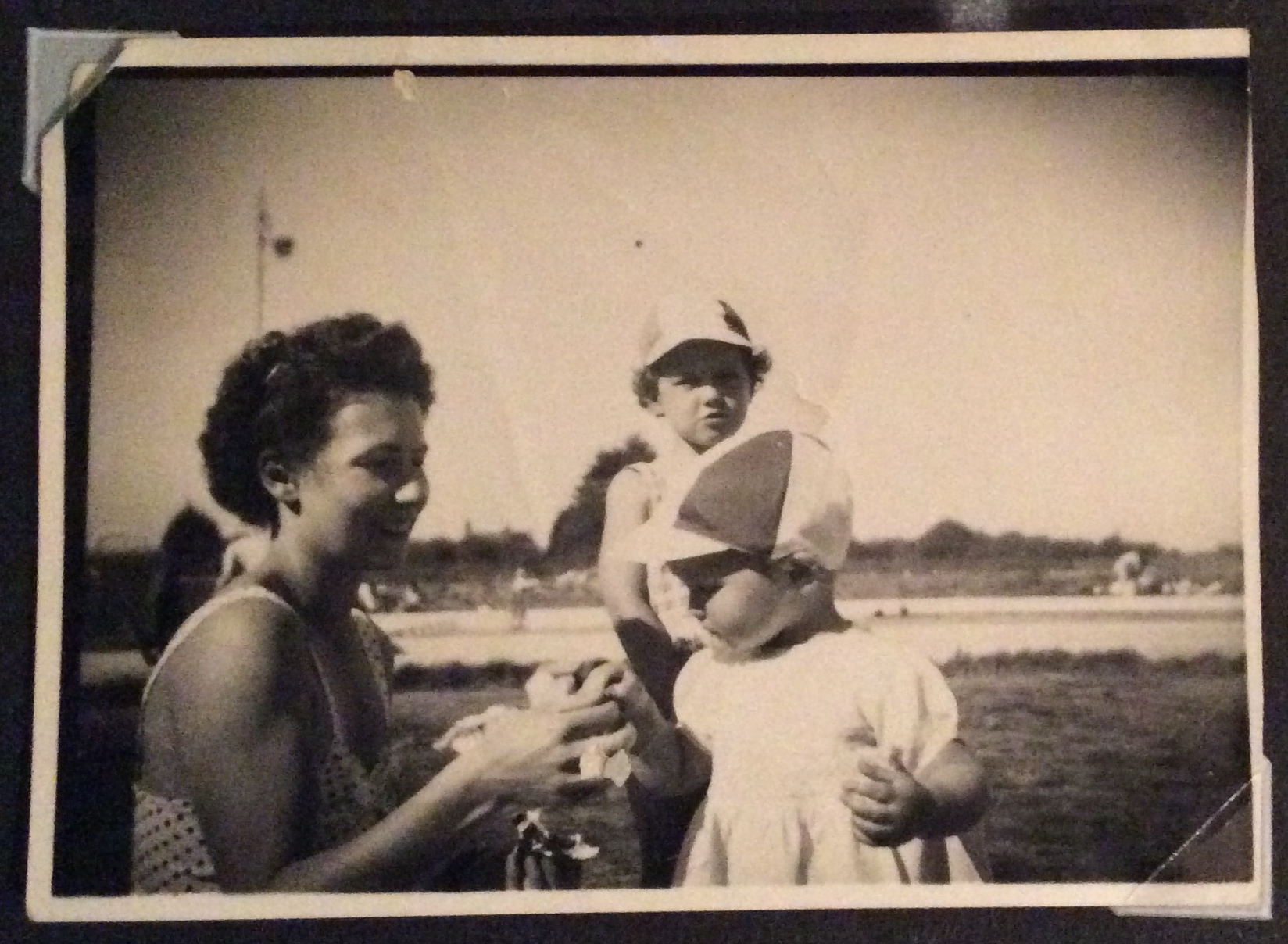
My mother when she was young
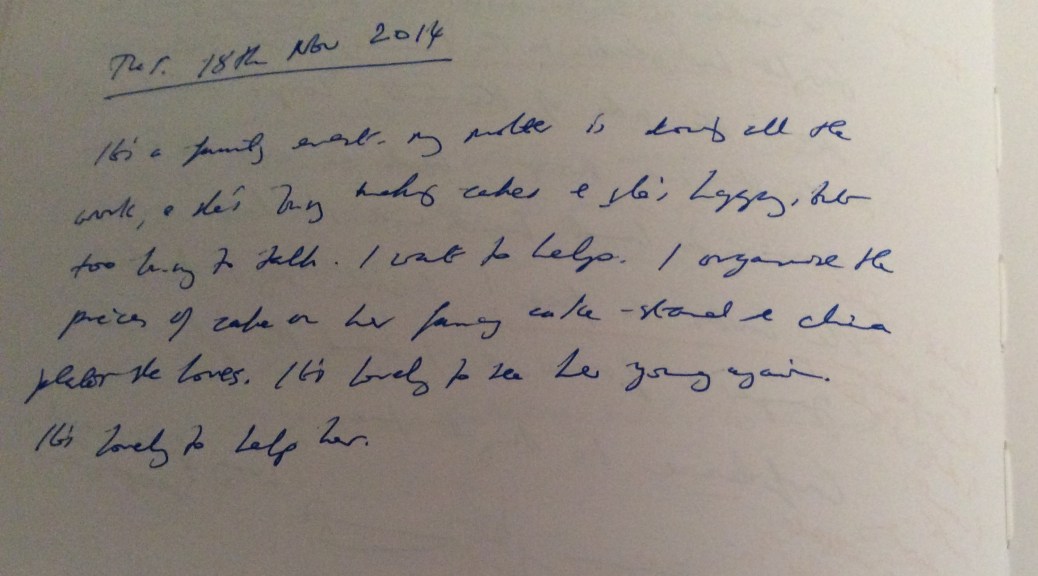
It was just a cameo, the briefest of scenes, but very vivid. We were in an open field on a bright sunny day, my mother and me, with green grass and meadow flowers all around.
In the middle of the field, there was a big scrubbed wooden kitchen table, a free-standing cooker and another smaller table with a red and white checked tablecloth flapping in the breeze.
My mother was making cakes, stirring the mixture, spooning it into the tins, putting them into the oven and bringing the ones that had finished cooking out.
She was too busy to talk to me, or even look at me, but I felt very happy to be there, helping. I cut the freshly baked cakes into squares and arranged them on my mother’s beautiful cake stands and favourite china plates.
The ‘I’ in the dream was so happy that I, the dreamer, noticed it and realised why. It was because my mother was young again, just like when I was little. I looked more closely, I savoured the moment.
A dream like this is a gift because when you are aware in the dream, you experience it exactly as if it was real life. I didn’t just dream about my mother; I was with her in a bright meadow, making cakes.
It reminded me of Christmases when I was little. My mother was always frantically busy, because she worked full time and had four children to look after, yet every Christmas day the whole family came to our house; uncles and aunties, cousins and grandparents, all squeezed in around every table and chair we could find or borrow.
Those childhood Christmases were my mother’s gifts to me, and I’m sure they were the seeds of my love for all things Christmassy today even though, because of our long estrangement, I planted them so far away.
I’ve gone for understated this year!
Happy Christmas everyone. May your Christmas dreams be sweet.
Both my daughters are poets and one of them also writes non-fiction articles and chapters related to her job. I think they’re lucky because they come to writing with the gift of knowing the real fiscal facts of a writer’s life. They have no illusions.
They know that even a hard-working writer like me, with lots of published books and a long track record, foreign editions, fabulous reviews in the national media, would be better off financially working in the local supermarket. Harsh but true.
They know that even to make ends meet, I’ve had to develop various related income streams from things like teaching workshops, working for a literary consultancy and doing school visits, all of which take chunks of time away from the writing.
only 11% of professional authors (those who dedicate the majority of their time to writing) earn their whole living from writing
the typical income of a professional author is £11,000 a year, less than two thirds of the Joseph Rowntree Foundation’s Minimum Income Standard
Novelist Joanne Harris commented, ‘It’s good to see that finally we are becoming aware of just how little the average author earns.’
Poet Wendy Cope commented, ‘Most people know that a few writers make a lot of money. This survey tells us about the vast majority of writers, who don’t. It’s important that the public should understand this.’
It wasn’t always so. When I started out more than twenty years ago nearly half of professional authors could make their whole (if basic) living from writing.
On the upside, we now have the self-publishing option, but we need to approach that with our eyes open too. As you’ll know if you’ve been following this blog, I was very much guided in my recent self-publishing venture by the advice of Diana Kimpton at www.helpwithpublishing.com. She says only spend what you could afford to lose.
This really needs considering. With self-publishing, you are not only likely to earn little, you may very well make an actual loss.
I would never suggest to anyone that they give up the day job and commit a hundred percent to writing; I would never encourage them to believe they will ever be able to do so, unless they have an extraordinary stroke of luck.
If you want to be a published author, travel hopefully by all means, but be aware that the chance of earning a basic living from writing alone is low, and the chance of making a good living from it is very low indeed.
All of which is not to say don’t go for publication, just don’t go for it with your eyes closed, or you’ll bump into some hard facts down the line.
I’m looking forward to the day when my daughters have their collections published – I’d love them to do a collection together. That would be completely amazing!
Being published won’t mean they can give up the day job, at least not without years of hard graft and good fortune, and if they ever do want to make writing their main occupation, they will probably have to supplement it with other work.
But what being published will mean is that they are honouring and sharing their gifts, and opening to new opportunities as writers.
If you approach publication in that spirit, rather than as a chance to quit the day job, you will not be disappointed.
Here’s a wonderful, clear and thorough assessment of the current financial situation for authors by Emma Darwin on her brilliant blog This Itch of Writing.
In my personal life, as in my professional life as an author, I can’t help wondering when our culture became so… well… shouty.
Until a few years ago, I always used to follow a soap – The Archers and Eastenders in my twenties, Neighbours in my thirties and forties, Doctors in my fifties. I liked getting to know the characters over a long period of time, and sharing the minutiae of their everyday lives.
I lost interest when the minutiae got squeezed out, and each of these soaps became a continuous onslaught of extraordinary events. Arson, beatings, kidnappings, murder… black and white characters, dastardly villains with no redeeming features… The third time the coffee shop got burned down, that’s when Neighbours got boring for me.
I stopped watching the News too, as it gradually began to feel more like clips from an action movie, or a disaster movie. Even the weather reports seem to be plagued by the same need to sensationalise everything. This week, for example, we have apparently been hit by a ‘weather bomb.’
I find it frustrating because for me, ordinary people and ordinary life are endlessly fascinating. I relate to real life stories; I want to read and to tell the stories of ordinary people like me.
Professionally, this is a problem, because it means I’m ‘too quiet for the market.’ If you want to get a publisher to take on a book these days it has to have a ‘strong hook,’ which generally means be out-of-the-ordinary in some striking way.
I wrote my YA novel, ‘Drift,’ because I wanted to help other survivors of sibling suicide feel less alone in that already extraordinary grief. The whole point of my book was that it should feel real; it should feel like any young person’s life, suddenly disrupted by something that could happen to anyone.
‘Drift’ was deemed ‘too quiet for the market’ although all the editors were very positive about it. One suggested I read a current best-seller about teen suicide, which had a great hook. This book was built around a series of suicide notes the dead person had left in which he blamed various family members and friends for what he was about to do.
Interesting, maybe. A hook, certainly. But a real story that could be your story or mine?
Another MS of mine that has been rejected on grounds that it’s ‘too quiet’ is about a child who has been home-educated, starting mainstream school for the first time at the age of twelve.
The current bestseller on that theme is about a boy who has been home-educated because he is hideously disfigured. ‘My name is August. I won’t describe what I look like. Whatever you’re thinking, it’s probably worse.’
The book has masses of enthusiastic reviews, and I’m sure it’s wonderful, but I personally was put off by the big hook of his disfigurement. Home-schoolers entering regular school – that’s interesting enough for me. I don’t want the added distraction.
I always used to wonder what ‘too quiet’ meant – none of my agents ever seemed able to explain it satisfactorily. Then a writer friend said ‘they’re looking for a stonking great story.’ I could see what she meant – and could understand why that was what publishers wanted since they are always on the hunt for the next blockbuster, even though they have no idea what that might be – but it struck me that I don’t always want to read a stonking great story. Sometimes – quite often really – I want some Barbara Pym or similar.
When I’m looking for something new to read or watch or write, I sometimes feel like someone in a crowded room full of people shouting at the top of their voices; I wish they would quieten down and talk to me properly.
Talking to a friend on the phone yesterday, I asked if she’d heard from a mutual friend who had just got back from a trip up-country to visit her family.
‘I dreamt about her while she was away,’ she said. ‘It was just a glimpse, but she was really happy and smiling. I rang her to say welcome home and how did it go, and she said she’d had a wonderful time.’
Last week, I had a similarly short, vivid dream about one of my children, only he wasn’t happy and smiling, so I phoned the next day to touch base with him.
If you dream about close family or friends, it’s always good to follow up that dream with a phone call, visit or email. You don’t have to say why, but just that you’ve been thinking about them. Nine times out of ten, you’ll find your dream has exactly conveyed to you their emotional frame of mind.
Experienced dreamers know that there’s a telepathic connection on the unconscious level, but it doesn’t only work with dreams. Daydreams and random thoughts that pop into your head come from the same source in the self, and can carry the same information.
So if you have a vivid thought about somebody close to you during the daytime, follow it up with a quick call. Something will be happening that means this person wants to make a connection.
Telepathy works on the instinctual level; it isn’t logical, but emotional. It’s a natural ability in all of us which, especially in the developed world, is virtually unused.
The more you use it, the stronger it gets, in the same way that training your rational thinking processes increases your ability to reason.
You aren’t creating connections but simply becoming aware of them, because on the unconscious level we are all connected to our loved ones, swimming in the same streams of consciousness and emotions.
These connections are most obvious and easy to find between family members and close friends, but everything is connected, and being sensitive to the connections makes for a much more joined-up way of living.
Are you aware of telepathic connections between yourself and the people close to you? I’d love to hear your stories.









 Jenny Alexander's blog: Writing in the House of Dreams