Category Archives: Creativity

‘Writing, for me, is liberating…’

Today, I’m delighted to welcome Judy Dinnen in the House of Dreams to talk about her personal writing, as part of my occasional series of guest blogs on journaling. Judy has an MA in creative writing from Cardiff university and is ordained in the Church of England. Some of her poems have been published in magazines or resource books.

image1
Judy Dinnen

I write because I need to, because some story or story seed beckons. I think pen and paper is best and sometimes it’s in my book of skies, so I write around clouds or through sunsets. You can see this notebook on a stone on the north Wales coast.
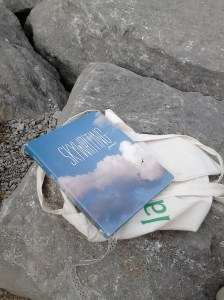
image1

These clouds might seep into my words but not always. Now I have a book of walls and I wonder how this will constrain or inspire my writing. In the first year of Trump, I have reservations about the effects of walls. I need to become a graffiti writer out in the open air.

I write sporadically, often in holidays or trips to new or interesting places. For example I went to the Nazi parade ground in Nürnberg last year and was moved by the scattered names of prisoners on railway tracks. That’ s a bit like piggybacking on the artwork of others, but I’m glad to say I wasn’t on the trains to Auschwitz. It was the names that spoke to me, that shocked me, so many, yet each one recorded for eternity.

I often pick up on moving words or personal stories and turn an event into poem. I sometimes write freely and carelessly when faced by some problem or angst. I first wrote like this the night my mother died. I never turned that into a poem but it did serve to show how releasing writing can be. I felt also that she had given me this gift of poetry.

Writing for me is liberating; it helps me to think, to feel, to untangle conundrums. That’s why I belong to Lapidus and to The Creative Arts Retreat Movement, or CARM. I have led workshops with the homeless, bereaved and village groups and in this new phase of my life I lead poetry retreats with CARM.

In these retreats I offer Christian prayer, space, poems, writing prompts and plenty of time for punters to explore words. They might explore the joy and value of words, words placed alongside each other, words echoing or enhancing each other, crying together or arguing.

Sometimes I’m just a writer on these retreats and then I use lovely surroundings to inspire me. In that place in North Wales I like to sit on the sea-shore and listen to the waves. They tell me what to write. In that house of prayer there is an intriguing labyrinth and walking round and in and back is a metaphor for life. Scope for raising questions; scope for adventures too!

I love that Judy felt her mother had given her the gift of poetry. That is a wonderful gift indeed.

You can find out more about CARM retreats here

If you keep a diary, journal or notebook, we would love to hear your story. Please send a piece of about 500 words, some pics of you and your journals, plus any links you’d like to include to  author@jennyalexander.co.uk

Leave Judy a comment if you have enjoyed her contribution. 

When it Comes to Writing Journals, Why Stop at One?

Today, for the second in my occasional series of guest posts on journaling, I’m delighted to welcome Diane Woodrow in the House of Dreams. Diane is a writer, blogger, workshop facilitator wife, mother of twenty-somethings, dog walker and renter of rooms via Airbnb and word-of-mouth, who loves encouraging and talking to people. She moved to North Wales nearly a year ago.

What I love about her story is that she has so many notepads on the go, all at the same time! I’ve only met one other person who does that, in all my years of writing.

So, over to Diane…

graduation-day-17th-july-2014-1
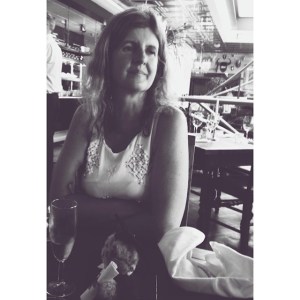
Diane Woodrow

I have been doing personal writings for as long as I can remember. I’m really disappointed now that I’m older that I do not have my teenager diaries and journals and other writing that I did. I am thinking I either threw them away at that stage of “growing up” when you think all your teenage writing is angsty rubbish or that they are hidden in a box in my mum’s attic and I’ll find them when I clear it out after she’s died.

I got back into regular personal writing twenty-five years ago when my son was born and I also became a Christian. I had so many questions about my new faith that I just had to write. The when and how I write has changed a lot over the last twenty-five years but I still have a need to write a journal every morning and a diary every night.

The start of my day is used to deal with something that has been bugging me on waking. As I write I often reach a conclusion or solution to the issues and it helps me then to plan my day. For the last couple of weeks I’ve been writing 2-5 pages in a horrid A5 notebook that I found in my daughter’s pile of things when we were packing to move. I’m using it because I was feeling broke at the time and that I was being self-indulgent regarding things I was buying because of the move. Even though I do see writing as vital to my life I also often see it as self-indulgent and do not spoil myself with lovely journals. But I am determined to fill this latest book so that then I can buy myself a nicer one for next time.

carnations-coloured-pens-and-creativity
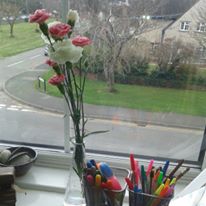
The view from Diane’s study window

My evening diary is a page-a-day diary which I started the year my son was born and since he has been sixteen my son has bought for me every Christmas, which then makes them extra special. I really do find solace in putting down my thoughts and feelings at the end of the day. If I am travelling light so don’t have the space for that diary or camping where the lights are out once it’s dark I find it hard to sleep as though there are still things that need to be removed from my brain.

During the day I do have a nice notebook I carry with me for inspirational things, poems, thoughts and feelings. At the moment there is one that lives in my handbag and another that lives on the little table in my study. They take more than a year to fill but they are the ones that I take things from to write further with – whether poetry or stories. I would never take anything from either the morning or evening writings. Those are very much unloading places. In fact I rarely look back at either of them; though at times I might look back through the night time one if my husband has brought up something to continue and argument about. It is then interesting how I have written down my day.

You can find out more about Diane’s work and writing here and here

What do you think – could you keep a morning journal and an evening journal going at the same time? Are you tempted to give it a go?


Diaries, Notebooks, Journals… Let’s Talk About Personal Writing!

Every year, in early January, I run a workshop called ‘Writing the New Year In.’ It’s one of my favourites, and I look forward to it. My goal is to help people experience the deep pleasure of personal writing, which can help you find your writing confidence and voice, and may become a seedbed for ideas that will grow into finished writing projects.

So what better time to launch my new occasional series of guest blogs about private writing?

Today, I’m delighted to welcome Karen Laura Steel to the House of Dreams to talk about her writing journals. Karen is a funeral celebrant – she takes naming ceremonies and weddings as well – who has also worked for 20 years singing to elderly and brain damaged people in residential settings.

Here is the story of her personal writing.

p1060607
Karen Laura Steel

I remember the first diary that allowed me to write more than childhood entries: “Went to school. Ate jam sandwich…”. It charmed me with its ornamental lock and pretty little key. I was 10, and it was a 5-Year diary, so I was aware it was something of a commitment, but the closely drawn lines and the never-ending feeling gave me a kind of hope. There weren’t many days over those 5 years that I didn’t write at least a small entry on how I was coping at new schools; having begun Comprehensive Education, only to move after 18 months, having to start O Level courses again. My diary listened as I missed old friends, found that cliques, once made, were hard to break into, and that friends we’d moved to be closer to weren’t necessarily worth the effort!

My teen-diaries received emotions on unrequited love, the excitement of prospective love-interests and despair when things went hopelessly wrong.

By the time I was beginning my degree, a plain notebook accompanied me everywhere, especially invaluable during my semester in America as I recorded first impressions of places and people every few hours at least. It was my 1980s version of fb, but private and didn’t need the approbation of others.

Battling depression in my twenties my journal received all my heart’s outpourings when no one else seemed interested or capable of understanding where I was coming from. In my thirties when finally receiving help, dream journals, notes on counselling sessions or discussions with helpful friends gave way to writing about new avenues of spirituality as I explored Yoga, its philosophy, and anything which gave a different perspective on the world.

Over time my journals have also generated other creative outlets, germinating ideas for songs or other writing.

Too much work ate into journal time last year, until I decided that life was far more enjoyable when I could jot down my problems and see the solutions emerging spontaneously.

Part of me wishes the notebooks were all the same size or of similar design, but the array of covers which have held my confidences are a testimony in themselves to my changing life, tastes and experience and are precious for that. I am writing once a week at the moment – and the desire to do it more often is encouraging me that I’m back on track!

p1060603
Some of Karen’s notebooks

You can find out more about Karen’s work by visiting her website or reading her blog, Diary of a Funeral Celebrant.

Do you have a practice of personal writing? If so, we’d love to hear about it here in the House of Dreams. Please email your piece, up to 400 words, a sentence or two about yourself and any links you’d like to include, to author@jennyalexander.co.uk. A photo of yourself would also be good, and possibly one of your journals.

I’m planning to make this an occasional series throughout 2017, welcoming a wide range of guests. Let’s celebrate personal writing!

Get more from your dream life in 2017

As the old year comes to a close, it’s time to take stock and think about what you’d like the new one to bring. Intention is a powerful magnetic force, and focusing on what you want greatly increases your chances of achieving it.

The sharper the focus, the better the chance; having a vague notion of something you might like to achieve is like throwing a dart in the general direction of the darts board and hoping it’ll hit the bullseye. It could happen, but it it’s not very likely.

Once you’ve set a goal, you need to think of practical steps you can take to work towards it. As you’re reading this blog, I guess you’re interested in dreams, so here are my suggestions for anyone who’d like to get more from their dream life in 2017.

  1. Make dreams part of the conversation. Talk about dreams generally, with your family and friends, and share specific ones you happen to remember. Talking about dreams, whether you have regular recall or not, increases dream awareness even for experienced dreamers. The secret of happy dream talk is to treat your dreams like the experiences of waking life; keep it brief, keep it interesting, leave out any long-winded boring bits and, most important of all, don’t try to interpret, either your own or other people’s. One of the reasons we can feel reticent about sharing dreams is because we think they might reveal something about us, and focusing on finding meaning takes our attention away from the actual experience of the dream. Besides, as Alfred Adler wrote, The realm of meanings is the realm of mistakes. 

    img_0088
    Dream sharing in the family whatsapp from one of my children, the day before our Christmas get-together including new addition, one-year-old Daisy.
  2. Let go of psychological interpretation generally. If we value dreams only as a source of information about our waking life, that puts an automatic filter on our recall. We will tend to remember and write down only the dream material that we identify as important or relevant, and miss the good stuff that takes us outside our waking understanding and into the complete unknown. Letting go of trying to interpret dreams could be interesting for more experienced dreamers as well as beginners; try it for a few months, and see if your dream life changes.
  3. Keep a dream diary. I’ve put this one last because it’s what everyone says and I didn’t want you to roll your eyes and abandon me mid-post! But everyone says it for a reason; it works. It’s the power of intention again. By buying a lovely notebook and placing it beside your bed, you’re setting the intention to record something when you wake. At first, you may not have many narrative dreams, but just fragments or single images – however random, uninteresting or irrelevant they feel, write them down. Draw them. Value them. From these little scraps, dream recall will gradually develop. Have faith and stick at it. I recommend you set the intention for a manageable amount of time initially, say 6 weeks, to record something every day. You will need to set your alarm 15 minutes before you have to get up, so that you’ll have time to wake slowly and enjoy that gradual surfacing from sleep.

You can read more about creative dreaming – that is to say, experiencing dreams rather than trying to interpret them psychologically – in Patricia Garfield’s classic book, Creative Dreaming, or in my own Writing in the House of Dreams.

I’ll also be running my Writing in the House of Dreams course in Cornwall later in the year, so sign up for my newsletter if you’d like a heads-up when I set the dates, or contact me, without obligation, to discuss a one-day or residential workshop for your writing group further afield.

That’s one of my New Year intentions in place – to include creative dreaming in my 2017 workshops programme – now time to ponder some more.

Do you set intentions at New Year? Could one of them be to get more from your dream life?


What does Christmas mean to you?

Christmas can be the most wonderful time, or the most bleak, depending on what’s going on in your life. We associate the festive season with abundance, and as much as it can be an opportunity to celebrate all the good things we have, it can also heighten our awareness of what we lack.

Money, certainly, with so much pressure on us to buy, buy, buy. For some people, a home. Family maybe, or friends. Or a specific family member, now departed, or a specific friend. Like most people, I’ve had some very bleak Christmases in my life, but I’ve never stopped loving Christmas.

Because for me, Christmas is about love. The birth of love in the world, the symbolic baby which, in difficult times, is the gift of hope for a better future.

I think that in the modern world we can sometimes have too narrow an idea of love. We tend only to think of it in terms of other people – children, parents, siblings, wider family and friends. But love is much bigger than that.

We can experience a deep love and sense of connection with our environment, or our work, or our inner world, which is just as transforming as love within relationships.

Carl Jung says the creative mind plays with the objects it loves, and whatever else is going on in my life, I always love the beautiful objects of my imagination, which I meet on the page or in dreams. That love is a force behind all my work, including this blog.

Love of every kind enlarges us, holds and inspires us. When we’re with someone we love, or doing something we love, or in a place we love, we’re not thinking, we’re just being. Time future and past is gone, and we are truly present.

You can call it God, this context in which we lose our small self. You can call it Nature, Great Spirit, Soul, or simply Love. Whatever we love redeems us from the lonely responsibility of feeling we are all that there is.

Love does not depend on money, home, family, friends – it’s a force in the world, and in our human nature. More than ever in these turbulent times, when we can feel helpless and in despair, love is a choice we can always make.

For me, Christmas feels like a reminder of that, in case we forget.

2016-12-15-10-34-43

This Christmas, may you feel blessed. 


10 Fantastic Christmas Presents for Writers

It’s that time again, and the great thing about buying things for writers is that you can give them something that will provide weeks or months of writing pleasure and inspiration without breaking the bank.

Here are some suggestions for things your writing friends might like – or if you’re a writer, why not treat yourself?

Gorgeous Notebooks.

The name says it all, and they really are gorgeous. I’ve been using them for my writing journals for several years now, as readers of my newsletter will know. Great quality paper, beautiful binding, a useful ribbon to mark your place and a handy pocket at the back for bits and pieces.

2016-01-02-18-37-56

Disposable fountain pens.

They write just like a fountain pen but the ink doesn’t smudge, and they come in every colour. If you aren’t keen on sharpies for book-signing, these are a good alternative, as well as being excellent for writing in your gorgeous notebook, of course.

41jzf35lo2l-_ac_us160_

Coach Yourself to Writing Success

Whatever kind of writing you do, it helps to understand what’s most important to you and create writing goals that fit with your core values. That way, you’re both more likely to succeed and also more likely to enjoy your success when you do. My friend Penny Dolan recommended this book to me a while ago, and I’ve recommended it to other writer friends ever since.

2016-11-15-12-54-06

Go Stationery pocket notebooks

Even in these days of mobile phones, most writers like to carry a notebook somewhere about their person when they’re away from home, and these are perfect – not too big, bulky, or heavy to put in your pocket; soft but not flimsy covers; good quality unlined paper and attractive cover designs.

I got mine from Waterstones.

2016-11-15-13-16-19

100 Prized Poems

Not just writers, but everybody in the world can find solace, joy, companionship and inspiration in poetry, and this new book is full of wonderful poems. My thanks to Jackie Kay for recommending it during her brilliant workshop at the North Cornwall Book Festival 🙂

2016-11-15-12-52-28

6 A writing workshop – any writing workshop!

Speaking of Jackie Kay’s workshop, which was pure delight, a place on a writing workshop will please your writer friends or writer self, and it’ll be something to look forward to at the end of the Christmas festivities.

I love going on other people’s workshops, and I’ve yet to meet another writer who doesn’t. (I’ve added the link to mine, but you can just google writing workshops in your area to find ones local to you)

14962798_1144238522331567_584936133536179243_n

7 Probably my favourite book on writing ever

Being a writer isn’t just a way you pass your time – it’s a part of the way you are. Developing a practice of writing is a profound kind of self development, and Natalie Goldberg brings a Buddhist sensibility to it which I love.

img_3421

And speaking of self development…

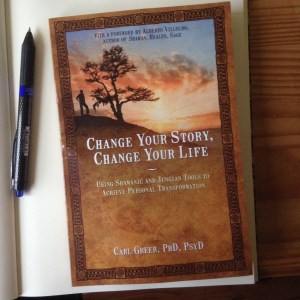
8 Shamanic and Jungian tools for writers who want to rewrite their own story

This is a fascinating workbook with loads of writing exercises. Not for everyone, obviously, but I really enjoyed it.

img_3426

9 A day out to somewhere interesting

Most writers are more excited by experiences than things, so how about a ticket to somewhere that might spark their imagination, such as the Foundling Museum?

unspecified-14

10 And finally…

Two companionable books for writers from me, which both offer plenty of short writing tasks for you or your writer friends to take refuge in if you need to pace yourselves over the festive period.

img_1610

Happy Christmas shopping!

Have you got any recommendations for Christmas presents for writers? Please share!


What can you do when the black dog comes calling?

What can you do in the depths of depression? Nothing. That really is the point. You may be able to keep functioning for years, keeping the lid on the echo chamber of your heart, but if you fall through, your reason and senses, your energy and willpower, your connection with other people, everything that normally sustains you will be gone.

This is a terrifying experience and, while it’s still horribly fresh in my mind, I’d like to say a bit about what helped me, in case it happens to you.

When you fall:

  • be kind to yourself. Be aware that negative thoughts, especially about yourself, will rise like scum. Let them bubble over and be gone. Don’t drink them in.
  • explain to others what you need – they may not understand that detaching yourself feels frightening for you, and doesn’t even slightly mean you love or need them less. You need them more, but you need them to allow that distance, and hold the space.
  • bear it. Have faith that it will pass, because everything does; that’s the nature of life. It might come back, but then it will pass again.
  • believe and be alert. Look for treasure in the darkness, and be ready to embrace the opportunities it brings for balance and transformation.

After the crisis, as you begin to feel life stirring again:

  • try to connect with other people, especially in ways that may be helpful to them. At first, connecting with people you don’t know well could be easier, because you may still feel too fragile to cope with the powerful emotions you feel for your nearest and dearest.
  • surround yourself with beauty. This doesn’t mean you have to seek out beautiful things, but simply to notice the beauty in every single thing around you.
  • feel part of the natural world. In wild places, parks or your own back garden, feel the bare earth beneath you and the boundless sky above.
  • give yourself time. Don’t try to get back to normal as quickly as you possibly can, because a deep bout of depression changes you, and ‘normal’ might not be the same. In my experience, it will be better.

When I was able to get up again from my bed of tears, these were the things that helped and soothed me back to myself.

I couldn’t write books, but I could create new workshops, because I thought of them like gifts to other people. And as with every gift, I got back much more than I gave, in warmth and positive regard. I couldn’t walk far, but I spent hours on the beach or outside in the garden, just being.

Nobody wants a visit from the black dog of depression, but if he’s part of your nature, as he is for many creative people, trying to keep him out is fighting yourself. This is only my view, I should add. I know that other people prefer to hold the black dog at bay with drugs or therapy.

I would never suggest you shouldn’t seek medical or psychological help if you suffer from depression. I tried every therapy going throughout my teens and twenties, and beyond, and if anything had worked for me, I probably would never have taken the hard choice to stop trying to keep the black dog out, and learn to live with him. (I’ve blogged about ‘How I Tamed My Black Dog’ here)

But I’m glad I had to in the end, because through disrupting my known and normal life, he opens me up to change.

How do you respond when the black dog comes calling? Have you got any tips of your own to share?


A dream of darkness

A few days after I last blogged, way back in May, I went to Iceland. I’d always been drawn to the North, so Iceland had been on my must-see list for decades, but what made me actually go this year was a series of dreams I had around the time of my mother’s death last November. They were ‘big dreams’ – dreams that had a momentous quality, a deep sense of mystery and meaning.

They were a call to ancestors, to the place beyond death and, specifically, to Iceland. So like all dreamers, who have learnt how and when to listen, I followed the call of my dreams.

unspecified-11

Being in Iceland felt, to me, like being in a dream. I had completely underestimated the size of the island, and the sparseness of the population; I had not expected the vast tracts of volcanic deserts and inaccessible mountains. I hadn’t noticed that the key on my map had only three kinds of terrain – places where something’s growing, places where not much is growing, and places where basically nothing is growing at all, which was about 40 percent of the land.

unspecified-13

Ice, water – and fire too. In Iceland, the hot water in your shower smells of sulphur, because it’s piped straight out of the volcanic ground, and when you’re walking in some places, you can hear the gurgle of water boiling and bubbling, breathing out wafts of sulphurous steam, and then the earth feels like a living being. You can absolutely understand why Icelandic people believe in earth spirits – you can believe it yourself.

unspecified-12

Land of fire and ice, and of light and darkness too. I visited several art exhibitions which explored the creative sensibility of the peoples of the North, shaped by long dark winters and summer months of continuous light. They made explicit how this environment can drive a psychological rhythm between extremes of celebration and isolation, of joy and depression.

I felt these extremes in myself, the whole time I was there. On the surface, excited and enchanted by everything I saw and everyone I met, but sensing all the time, the darkness moving underneath. A few days in, I had this dream:

The car is packed for the next stage of my journey and I’m having a last cup of tea with my hosts. Looking out over Rekjavik through their big window, I see a sudden darkness coming across the sky – clouds?

I see black clouds rising along the edge of town, pouring up into the air from the ground, and as I watch, a sudden column of sparkling fire shoots up, exploding in a great shower of sparks, orange and red, filling the thick black cloud that’s covering everything.

‘What is that?’ I gasp.

‘The volcano’s erupting.’

Black soot is falling everywhere, covering everything, but it doesn’t matter. This is what I’ve come for. The darkness. Not just fun and distraction. I always knew it.

It was the beginning of what has been, for me, a difficult summer. I went to Iceland following the kind of dreams that will take you deep into your own darkness, as well as bringing you, eventually, to wonder and light.

I had expected to meet the black dog, but black dogs come in different shapes and sizes. This one turned out to be huge and hungry, feral and strong, and he was never going to settle for living in my house like a sad old labrador for just a few weeks or months.

It’s been a long and exhausting trek through his cold darkness but, last week, I woke one morning with a great sense of relief, after my first full night’s sleep for months, and a bright thought filled my mind like a sunrise, ‘It’s over now.’

I’m sorry I was away so long, but very happy to be back. 


Why you should never read someone else’s journal

In the long hiatus between my mother’s death on October 19th and her funeral last Friday, I wasn’t able to focus on work much at all, and that felt OK and appropriate. I slept a lot, dreamt a lot, read non-fiction books and wrote in my journal.

I was working through some of the exercises in Change Your Story, Change Your Life: Using Shamanic and Jungian Tools to Achieve Personal Transformation by Carl Greer one morning, when it occurred to me that anyone reading my journal after I died might not understand, as I do in the writing, that it’s an experiment, and not a report.

Slow start warning: I nearly gave up on this book after the first chapter, which felt like puff and waffle. Glad I didn't.
Slow start warning: I nearly gave up on this book after the first chapter, which felt like puff and waffle. A few chapters in, I’m glad I didn’t.

Actually, my whole journal is a perpetual work-in-progress. Every page I write is part of a creative exploration. It isn’t me – it’s a kaleidoscope of all the possibilities of me, and I’m aware of that when I’m writing in it in much the same way as when I’m gathering notes for a work of fiction, knowing all the time that many of my ideas won’t fit the story and will have to be discarded.

A journal or diary is a first encounter with ideas and events, before you’ve had a chance to ponder and decide what you think of them. To get a true sense of a person’s life, I guess you’d need to read their autobiography, because there you have a completed work. Where a journal is a mess of notes, often contradictory or inconsequential, an autobiography is an expression of the writer’s identity, his or her choice of what’s important and how they understand what’s happened.

I was struck by something in Natalie Goldberg’s book on memoir-writing Old Friend from Far Away last week; she says we shouldn’t think we have to be old before we can write a memoir. We don’t need the whole story all in one go, at the end. We can write memoirs from time to time throughout a long life, and each one will be the most complete expression of who we are and how we understand our lives up to that point.

In that sense, I guess autobiography could be seen as a work-in-progress too, but the difference is that in autobiography we are writing what we know about ourselves and our life, whereas in journalling we are feeling our way along the borders of our knowledge, and what we find must be judged as me or not-me, accepted or discarded, as part of the process of becoming.

If you read someone’s journal – as well as the obvious problem that it is private writing and they did not intend it to be read – you will not find the person there, and thinking that you will could give you every which kind of wrong impression, like listening to someone’s dreams and believing you can interpret them. A good dream therapist will simply hold the dream so that the dreamer can look at it from different angles, because only the dreamer can find out what it means.

I love my journals
I love my journals

I include all sorts of things in my journals – dreams, ideas, experiences, book reviews, quotations, drawings, writing exercises and creative experiments. I love them, just as I love my dreams, specifically because they don’t define me.

With both, there’s a feeling of infinite possibility, a continuously forming sense of direction, so that even at the end of a lifetime of journalling and dreaming, I’m sure there will be no conclusion, because the conclusion is always up ahead.

IMG_1508

My children have strict instructions to burn my diaries without reading them when I die. What would you like to happen to yours?

When was the last time you felt really happy? Write for 10 minutes…

I’m reading Nathalie Goldberg’s book on writing memoir, which goes under the wonderful title of Old Friend from Far Away. As you might expect with Goldberg, it’s full of practical writing exercises, and when I came to this one, I was briefly stalled: When was the last time you felt really, really happy?

IMG_0073

I’ve done the exercise before – I can’t remember now what prompted it – and it was really easy. Having fresh blueberries on my morning muesli – that had made me happy. Watching an old episode of Frasier while I was eating it – happy, happy, happy. My normal approach to life is celebratory and thankful, so happiness always feels close to the surface.

But today I found myself having to cast my mind back, across the numb times of these past few weeks, during which my mother was given a diagnosis of leukaemia, developed pneumonia and died, all within ten days. She approached the end of her life the way she approached every part of it, with stoicism, taking care of the practicalities and being clear about her preferences and decisions.

She was 90 years old, and had been ready to go for several years, as her physical condition deteriorated; she was not at all afraid of dying. She died in her own home, having steadfastly refused all life-extending treatments, with her family at her bedside, on her wedding anniversary, so in many ways it felt like a blessed death.

In this interval between my mother dying and her funeral, I’ve been mostly sleeping, walking and reading – books like the Nathalie Goldberg.

When was the last time I felt really, really happy? I suddenly remembered my book launch, at my friend Gill’s art gallery in Devon. My younger daughter was staying with me, and she raised the toast for one of the books I was launching. One of my oldest friends raised the second toast. I did some readings.

P1290965

It was a stunning, beautiful evening, a full moon over Dartmoor, and a happy throng inside the bright gallery, among the paintings and artefacts. Everything flowed.

A happy throng
A happy throng

Afterwards, my daughter stayed on for a few days. The weather was hot, as it often is in Cornwall in the last days of September, and we walked the coastal path together.

12019852_10153626600030030_5704215196115227108_n

So that’s what I’ve just written about, and now the last time I felt really happy was half an hour ago.

Such is the transforming magic of writing. When you use all your senses to immerse yourself in the creative experience and allow your body to feel the emotions, you are creating or re-creating real experience for the self.

Right now, I can’t manage to push forward into new worlds with fiction and my current work-in-progress, but writing into the more familiar territory of my own life feels easy and affirming.

I’m looking forward to offering a new course in memoir writing in 2016