Category Archives: Creativity

Acquainted with the night, by Victoria Field

I’m delighted to welcome writer, poetry therapist and tutor Victoria Field into the House of Dreams today. I’ve attended several of her poetry therapy workshops over the past few years, which I can highly recommend, and I always look forward to reading her blog

Victoria Field
Victoria Field

I have always been aware of my dreams.  I still remember one from my pre-school years in which I went to watch a Punch and Judy show at the bottom of the hill where I lived.  I sat on my tricycle and was both drawn and repelled by what I saw happening on the stage of the booth and feared I’d be sucked in.  I’m not sure I’d ever seen Punch and Judy in real life.

It seems dreams are informed by more than direct experience.   I know that on residential courses, participants report shared dreams and that when I was married, my husband and I somehow occupied the same dream space as we shared a bed.  As a student, I often dreamed of tents.  I loved back-packing but there was also something mysterious about my dream tents and when I recently sat in a Bedouin tent in Kuwait, it felt familiar.

Many of my poems begin with a dream image and they find their way into prose too.  Several years ago, I began writing down an exceptionally vivid dream that centred around finding a white horse in my tiny kitchen in a terraced house in Chester.  As I wrote, the dream took on a life of its own and eventually turned into a novella of 16,000 words recounting what happened next.  The white horse can stand for many things in my life and like all dream images is mutable and outside time.  Writing happens in a liminal space and to my surprise, the horse surfaced again in a comic short story. 

I’m also aware that dream-work happens without our conscious mind being involved.  I often tell an anecdote when people ask how I became involved in poetry therapy.   My first encounter with the practice was when John Fox, an eminent practitioner based in the US gave a workshop in London in 1999. It was a two day workshop and on the second day, I felt utterly unable to keep my eyes open, in spite of being fascinated by the work.  I’d had a leg injury and was on pain-killers which I blamed for my sleepiness.  I excused myself and found somewhere to put my head down and went into a deep sleep for a couple of hours. I can’t recall any dreams but I woke up thinking utterly clearly, ‘I want to be a poetry therapist’.  And so began my journey of the past decade and more.

So, if people fall asleep on my courses, I never object.  Important work is being done as we sleep, whether we know it or not!

9781906742614
Victoria’s latest collection

Victoria Field is a writer and poetry therapist.  More information is available here http://www.poetrypf.co.uk/victoriafieldpage.shtml  and she blogs at www.poetrytherapynews.wordpress.com

Not everyone loves ‘morning pages’

I usually mention the idea of ‘morning pages’ in writing workshops because I think a regular writing practice is a really good thing for authors and I know a lot of writers who love doing them, either on the long term or for a few weeks to help them get unstuck when they feel blocked.

I’ve personally never used ‘morning pages’ because my daily practice is my dream journal so I was interested to read ‘Morning pages may not be the artist’s way’ by Maria C McCarthy. She and several commenters suggest that ‘morning pages’ can easily turn into an outpouring of ‘negative and angry stuff’ going over and over the same concerns day after day.

Two great writing books that recommend morning pages

Her criticism of the book that made the idea popular ‘The Artist’s Way’ is that the author, Julia Cameron, offers it as the solution for every writer. My problem with that book is that I don’t think it acknowledges the earlier bestseller, ‘Becoming a Writer’ by Dorothea Brande, which describes exactly the same practice, but that’s a separate issue.

Maria McCarthy suggests adapting the ‘morning pages’ idea by not making it totally free, but rather focusing it around a topic. Specifically, she talks about John Siddique’s idea of free writing around the ideas in Stephen R Covey’s  ‘The Seven Habits of Highly Successful People.’

I sometimes suggest using writing prompts which are self-generated for daily writing and I think this also circumvents the grinding wheels of our discontents, shifting the focus to images and themes that interest us.

Having read that for some people completely free writing may turn into a sump of misery, I may be including a health warning next time I discuss the idea of ‘morning pages’ with a group.

Related posts – ‘Daily pages vs dreams’ , ‘Do you have a daily practice’ and ‘What are the best writing prompts for daily practice?’

Have you ever tried writing ‘morning pages’? Or do you have a different daily practice you could recommend? 

Mind-magic for writers – harnessing the power of the circle

The circle is an archetype for wholeness and integration, a universal pattern in nature and the human psyche which is also a template for the stories of life and fiction. You can use the  power of the circle archetype in writing, deliberately placing it in your mind by making mandalas.

The Power of the World always works in circles, and everything tries to be round. The sky is round, and I have heard that the earth is round like a ball, and so are all the stars. The wind, in its greatest power, whirls. Birds make their nests in circles, for theirs is the same religion as ours. Even the seasons form a great circle in their changing, and always come back again to where they were. The life of a man is a circle from childhood to childhood, and so it is in everything where power moves ~ Black Elk

003
Ice in a circular hollow

Stories naturally make circles. The protagonist sets off, achieves or learns something in the course of the action, and returns changed. Often the work of redrafting is about refining the beginning and ending to tie everything into a satisfying whole. The crafting of a story is a process of perfecting the circle.

Dorothea Brande (‘Becoming a Writer’) says the unconscious is not only the source of our creativity, but also the home of form. This is why, when you have plot problems, new ways of fitting things together can naturally spring up in your mind as soon as you stop consciously trying to force them.

When I’m planning or redrafting a story I will often draw mandalas while I ponder.

One of my working mandalas

‘Mandala’ comes from the Sanskrit word meaning ‘circle.’ It signifies a geometrical pattern based on a circle, and it’s used in every spiritual tradition as a focus for contemplation, meditation, protection, healing or prayer.

In its most basic form, the mandala is a simple circle, and if you’d like to try making some you can start by drawing circles. I recommend you do this free-hand, although your first attempts may look like lumpy lozenges. Keep working at it until you can do one that looks reasonably round. The process of this will anyway help attune your mind to the archetype.

When you have drawn your circle, you can incorporate other geometrical forms into it and around it. You could put a triangle inside it, crossed by another triangle to make a six-pointed star. You could put your circle inside a square, or squares inside your circle.

Choose any geometrical shapes you like, but try to achieve balance, so that the sides and segments of the circle are the same. Drawing geometric shapes also settles your mind into the beautiful reality of numbers. 

Treat the whole process like doodling, not trying to create art, but simply to play and allow your mind to idle. Keep building mandalas until you get one you really like.

Shading or colouring your mandala is a way of staying with the archetype for longer, and allowing it to work upon you. When you have finished, bring the energy of the circle with you into your writing. Bear it in mind as a template for your story, and see whether it gives you a greater sense of direction and clarity.

 What creative activities do you use as part of your writing process?

Check out these lovely prayer-flag mandalas by Toko-pa Turner http://toko-pa.com/2013/11/29/mandalas/

How tiny dreams can be big openings into writing, by Nicole Tilde

One of the reasons I love having guests in the House of Dreams is because they can surprise me with a new angle on writing and dreams. Here, Nicole Tilde talks about the creative treasure that can be found in what I call dream fragments, or ‘tiny dreams.’

Nicole Tilde
Nicole Tilde

She said to me in a dream, “Give me your knees child!”

And I did.

It got me thinking about poetry And how it starts with the knees

If I were to teach a poetry class

We would begin with the knees

I would teach the importance

Not of kneeling

But in hard work In finding your true north

We would walk through tall grass

And find the mud

That sinks

Deep Into the lines

Of our skin We would clear paths

And uncover ourselves

From beneath the bloodstone

And polished quartz

We would wander in silence

And not write a thing

And wait

Wait for that moment

When the healing of the work

Runs through your skin

Like a shimmering blue skink In the mapled wind

This poem was inspired by a Tiny DreamTiny dreams are the little vignettes or scenes that are often ignored or discarded as random. Tiny Dreams come to me as colors, objects, phrases, or flashes of feelings. They are not always connected to plot, place or scene.

One of the most common comments I hear from people is that their dreams are random or meaningless. But I wonder what a random dreamer might think of someone grabbing their knees and saying, “Give me your knees, child!” For me, the meaning in this short dream segment was large, full and sweeping. It was a window, a door, a threshold into poetry. We can find these openings everywhere if we are open to the experience.

What do I know about knees? Why would I give the power of my knees over to anyone? Unless perhaps, she came to heal me. Unless she was the crone who visits me so often, the Baba Yaga of my personal myth. The one with the faces of many.

I opened myself to the message. I let the window sash fly.

I garden on my knees. I might greet the wonder of the sun on my knees. I might approach someone younger than me on my knees. I could pray on my knees. We get on our knees to do the hard work. When I am full of regret or spinning off my center of conviction, I might lose the strength to stand on my own two feet, become weak in the knees. I might also become weak in the knees when I’m falling in love.

Knees are pretty important. I could see the significance of what I was asked to give in this dream. It was not random at all.

Just as we give ourselves over in our dreams, in poetry there is a moment of giving the writing over to the story beneath the story, to the river of awen. And beyond this there is a process of collecting the objects, events or dream symbols we’ve noticed, and then connecting the pieces.

I went to the river.

During the days prior to this dream I had worked in the yard, cutting paths through a corner of the property. I had been in the garden a lot, and I was reminiscing about how the hard work of gardening was a lot like writing. The pieces from this experience connected with the meaning of ‘giving over my knees,’ and I sat down and wrote this piece, ‘Poetry Class.’

What kind of class would that be, just wandering in silence, not writing a thing? What kind of poetry class offers you the chance to notice the blue skinks, this is what we call the blue lizards here in Georgia, and the maple leaves dancing in the wind? But this is exactly what I would teach. Afterwards, I might send everyone home with the instructions to dream.

Poetry is about noticing, collecting, tiny-dreams, the stories that drift beneath the stories. It’s about being present. It’s not about analyzing, but letting the events of our lives sink in and run all over our skin.

And the hard work? We give over our knees by doing the daily work of being a writer, a poet, an artist, by doing the hard work every day. To find true north we walk every day towards the star of our desire.  One step. One word. One line. One sentence.

She said to me in a dream, “Give me your knees, child!” And I did.

Nicole Tilde is a prose writer. Her work echoes the many storytellers who have gone before her. The storytellers who have unknowingly pitched for emotion by opening readers to feelings they thought were lost.  Her stories are of the everyday, of finding the sacred in the mundane and recognizing everyday objects as talismans. She publishes within her membership site at dream-speak.com You can find samples of her writing at nicoletilde.com or you can connect with her on her Facebook page.  


The new year, synchronicity and my next book

I like to start every new year with a brand new piece of writing so every autumn I put together a short-list of ideas for my next book and then watch for synchronicities to help me decide which one to go with. This year, as usual, life has given me some prompts.

2013 got off to a cracking start for me when I tutored my first ever Arvon course on ‘Writing for Children.’ I had never previously taught children’s writing because it seemed to me that writing for children was pretty much the same as writing for adults – all the elements of fiction such as plot, settings and characters work in the same way, and whoever you’re writing for you have to target your particular reader.

But being asked to teach writing for children meant I had to really think about not only what is the same but also what is different, and teaching the course turned out to be pure pleasure. I enjoyed it so much that I wrote a new series of evening workshops on writing for children which I taught at the end of 2013.

At the first session, I dug out various books I thought people might like to read, including the very latest book on writing for children, by Linda Newbery and Yvonne Coppard.

008
Writing Children’s Fiction, by Yvonne Coppard and Linda Newbery

Flicking through the back matter for more ideas, I discovered that Writing in the House of Dreams is included in the recommended writing blogs, the only one by an individual among half a dozen group blogs. That felt most affirming!

007

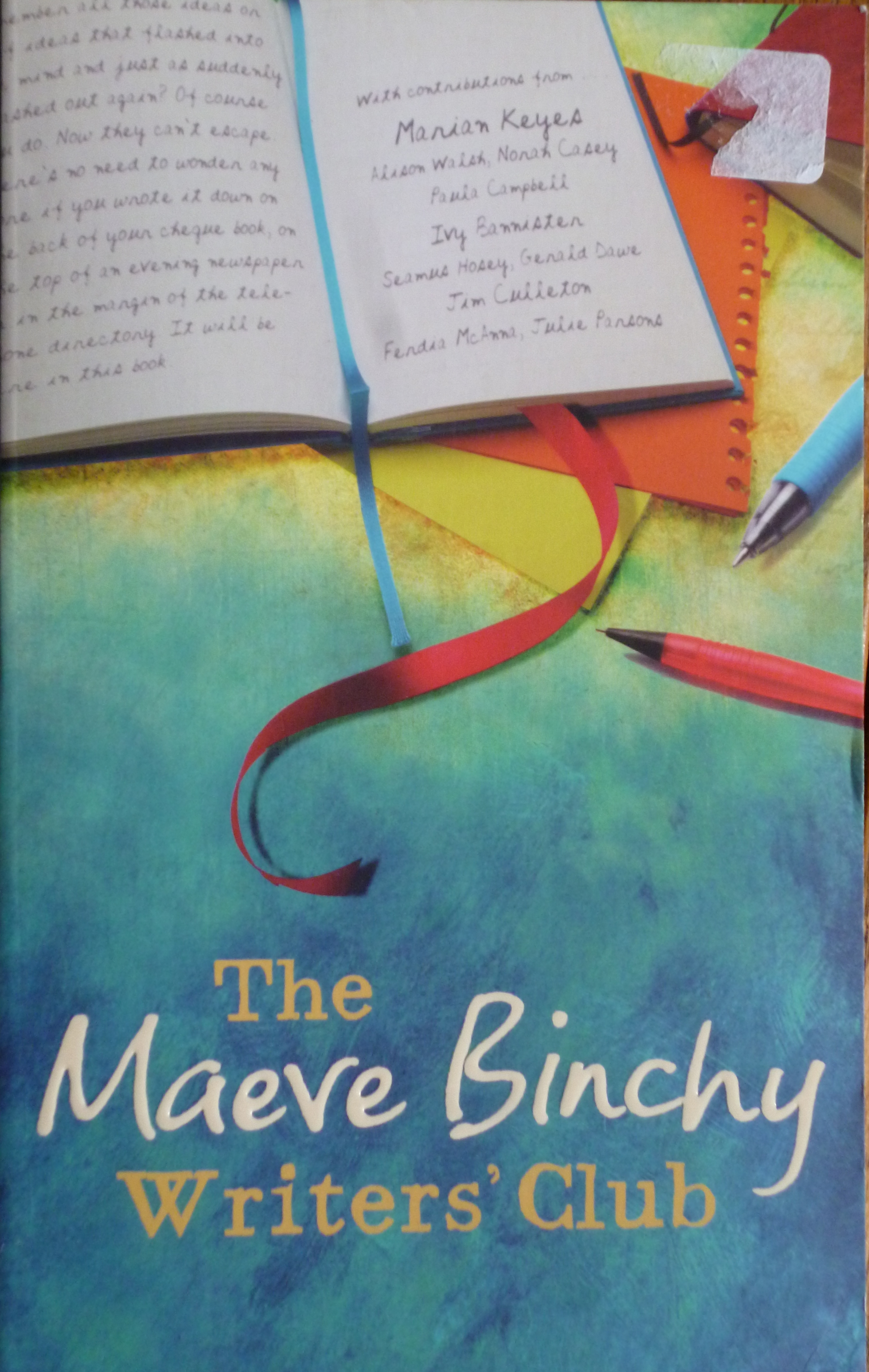
Then, at the last workshop session, one of the participants mentioned that she’d seen my children’s book, ‘How to be a Brilliant Writer’ in Maeve Binchy’s recommended reading list at the back of her book on writing.

004

The Maeve Binchy Writers' Club
The Maeve Binchy Writers’ Club

One of the ideas I’d been mulling over for my next project was a book for adults about writing – just writing, not in relation to dreams. But although I’d wanted to do that for ages, it didn’t seem sensible because there were already so many books out there by writers about writing .

I always follow life’s promptings, however, so with a gleeful click of the heels I’ll be up, up and away writing an adult book about writing to go with my children’s one in the New Year. The various other projects I’ve been mulling over will have to wait until their time is ripe.

What new projects are you looking forward to in 2014? Have you felt prompted by life?

Christmas archetypes – the dark intruder and the wondrous baby

I think of them as the nameless or faceless one – archetypal images which carry the pure power of a universal human experience. In pantheistic cultures they may be represented by gods and goddesses. In our secular world, we encounter them most directly in dreams.

A few weeks ago, I had a series of nightmares about an intruder in my house. I never saw his face because fear woke me up, but rather than feeling disturbed, I felt attentive, because like the Death card in tarot or the Tower, the dark intruder is a messenger of change.

Major changes are always unsettling and being unsettled is always unwelcome. Even if we’re actively seeking new ways of being and want to move forward into new areas of experience, there will still be resistance because change involves letting go of the familiar, and the outcome is never certain. Better the devil you know than the devil you don’t know.

These dark intruder dreams were swiftly followed by a series of dreams about babies. Like the dark intruder, the archetypal baby provokes a powerful emotional response, but rather than fear and anxiety, it’s an outpouring of love, hope and happiness.

It occurred to me to wonder whether baby dreams often follow dark intruders; they kind of should, because they are both aspects of change, the one full of initial fears and the other moving forward into joyfully anticipation.

Our major Christmas archetypes are Santa Claus, the intruder who brings gifts, and the Christian symbol of the wondrous baby who brings redemption, light after darkness at the turning of the year.

010

Happy Christmas everyone, and may all your challenges in 2014 bring blessed new beginnings.

The gifts of writing – 3

So Christmas is nearly here, this great celebration of loving and giving – the perfect time to talk about the third gift that writing gives us, the gift of empathy.

When I wrote my children’s book about writing, How to be a Brilliant Writer, I asked my friends in the Scattered Authors Society if they would like to send me a few sentences on what they loved about writing. This is what Enid Richmont sent me:

A writing game I sometimes play when I’m trying to bring one of my characters to life is body-swapping! I pick a stranger – in the bus perhaps, or the supermarket – then I try to become that person. I feel the wrinkles on my skin, I walk with a limp, I look at my long scarlet fingernails or I run my fingers over my shiny bald head. Right now, I’m being a squirrel! I like to think, as well, that ‘becoming’ other people, or creatures, also helps me to understand them.

In fiction, we create characters and give them big problems to deal with. There’s always going to be struggle, conflict, pain because if everyone’s happy there’s no impulse for change, no movement, no story.

As we imagine what it feels like to be homeless, or orphaned, or bullied, or bereft, we feel everything our character is feeling – we have to, because otherwise we can’t know how they will behave, and our story will feel hollow and unconvincing.

It takes emotional toughness to do this work, and everyone has to find their own way. I personally have usually opted to put my characters in situations that are difficult but not overwhelming, and I use humour to leaven the hard parts. If my reader – and I – feel like crying at times, I want to make them feel like laughing too.

Other authors I know are braver and tougher than me, going into dark areas of experience such as criminal gangs, drugs, self-harming, eating disorders, abuse – which are part of real life that older children need to know about, and reading serious fiction by responsible authors is probably the safest way of gaining this knowledge.

Writers are used to imagining another person’s story, looking beneath the surface, feeling their joys and pains.  We do it in imagination, and that spills over into real life. I think that’s why most writers I know enjoy hanging out in cafes on their own, people-watching.

I like to think, as Enid says, that ‘becoming’ other people might help us to learn to be less quick to judge and more aware that sometimes it can take real courage and faith to get through the vicissitudes of even an ordinary life.

So there they are – stillness, awareness, empathy –  the three greatest gifts I think I get from writing. What does writing give to you?          

The gifts of writing – 2

In this, the second of my pre-Christmas posts on the three gifts of writing, I’m thinking about the gift of awareness.

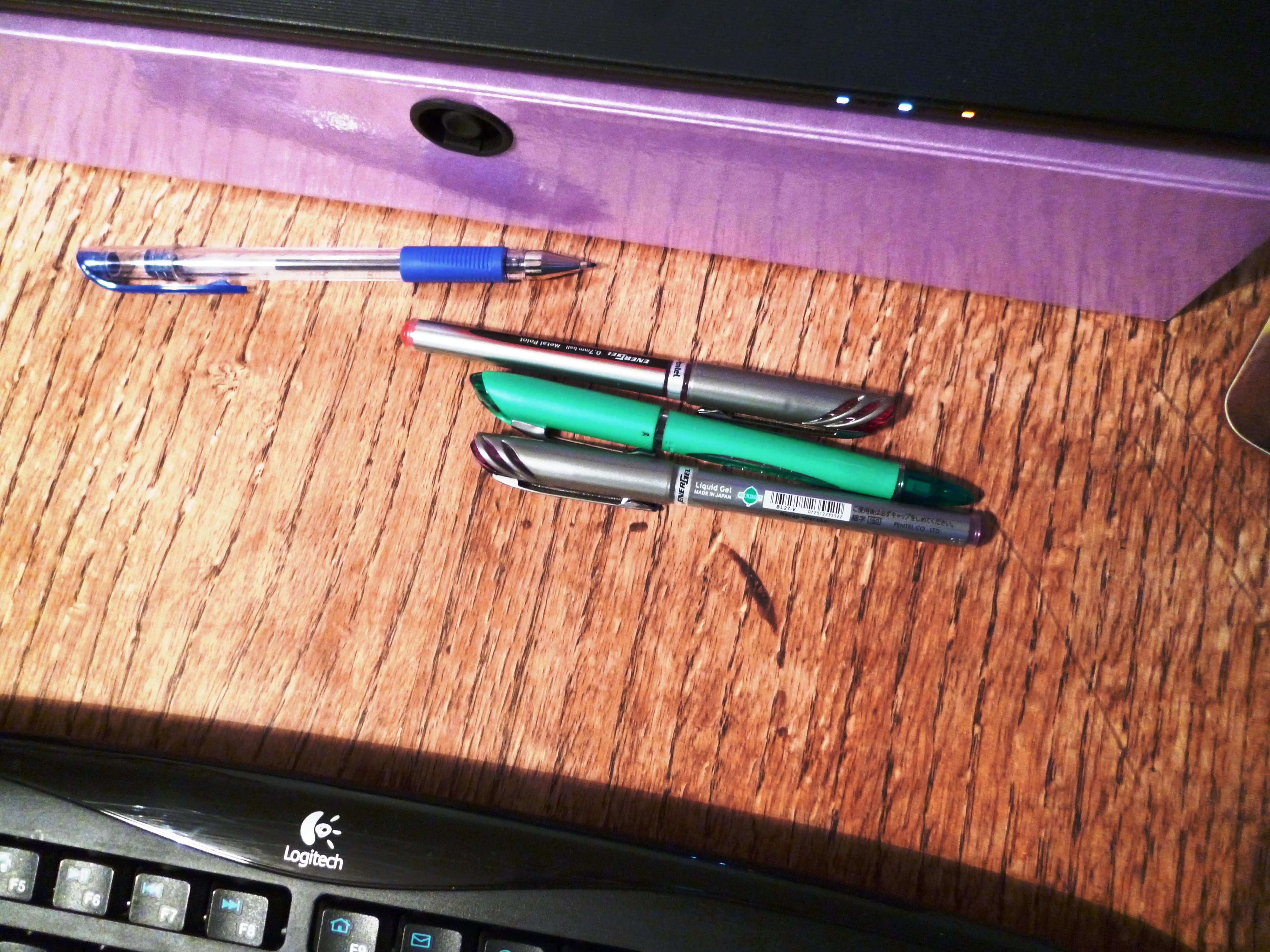
In ordinary life, a lot of what we experience is subliminal. We engage with the world through our senses, but barely notice what we are feeling. For example, sitting here at my computer I’m only really seeing the keyboard and screen, unless I take a moment to deliberately notice the four different colours of gel pen right in front of me, one of them a very vibrant green, the particular blue of the walls, the dark grain of the old table, the torn or crumpled bits of paper in the basket beside my chair.

pens

When we write, we picture the scene. We use all our senses to fully imagine it. We notice the detail of our protagonist’s clothing, the colour of their eyes, the quality of their voice. We notice the smell of the air, sharp and clear on a winter’s morning, close and musty in an old drawing-room, or wafting from a warm kitchen carrying cinnamon, or cabbage, or toast.

Our senses are the gateway to the world of our story, and describing what we can see, touch, hear, taste and smell there is how we bring our readers in too.

In writing, in imagination, we can experience life more fully and intensely, and that vibrancy spills over into our experience of real life.

Another thing that we do in writing, which is part of show-don’t-tell, is to notice and describe our characters’ emotions through their bodily sensations. When they are angry, we imagine where they might feel that in their body, and so experience it in our own. Again, this habit in imagination spills over into real life, and we become more aware of how emotion is expressed in the body.


Writing non-fiction also brings an increased awareness, not of what we experience through the body but of what we know, the life of the mind. When you write non-fiction, you become aware of knowledge you don’t normally notice or think about – it’s just there, part of the scenery, like the background details I never notice when I’m working in my study.

How to look after a rabbit; how to write a biography; how to grow plants from pips – these are some of the subjects I’ve written about. Others include the skills you learn just by being alive for a long time, such as cultivating happiness, building self-esteem and handling bullying. I’ve never done much research because I write the things I know about through my own experience, and in writing them, I notice what I know.

Shintie -sweet source of all the know-how in my little book, 'Rabbittalk - How to make friends with your Rabbit'
Shintie -sweet source of all the know-how in my little book, ‘Rabbittalk – How to make friends with your Rabbit’

This increased awareness of the knowledge and experience we normally take for granted and stop noticing is my second great gift of writing. Next week, I’ll close this little series with Gift Number Three.

Do Negative Emotions Sharpen Perception?

Here’s a lovely post by Sharon Rawlette which came out of chatting here in the comments in the House of Dreams

Sharon Rawlette's avatarSharon Hewitt Rawlette, PhD

Blurry LightsLots of people carry in their heads the image of the tortured artist: the writer/painter/musician whose brilliant artistic achievements spring from a soil rich with personal failures, miseries, addictions, and/or mental illnesses. Writing guru Julia Cameron persuasively argues that creativity does not require depression. Or agony. That well-adjusted artists are, actually, quite successful and productive–maybe even more so than the sorry cases the media likes to latch onto. And I do think that Cameron is right that building a career in a creative field requires a substantial level of mental health. It’s one’s rationally optimistic side that keeps one sitting down to work day after day, gives pep talks when needed, and also makes sure that one is well-fed, well-rested, and otherwise fueled for the creative act.

But I am not quite ready to let go of the tortured artist archetype. I am glowing with mental health these days (or so it seems to me), and I have been…

View original post 653 more words

The gifts of writing – 1

I’m constantly aware of the ways that being a writer enriches my experience of life, and the run-up to Christmas feels like a great time to think about three gifts of writing in the House of Dreams. Today, the gift of stillness.  

Years ago, a friend of mine told me she’d seen me in the supermarket, but hadn’t said hello. She said I was just looking at the apples, but with such a quality of stillness and concentration that she didn’t want to break the spell.

When she said it, I remembered that moment. I had been looking at the apples, but I wasn’t thinking about them. Their shapes and colours had caught my eye and held me there, but my mind was open, unfocused, receptive.

The great American writer, Henry Miller, said that an artist was someone who had antennae, who knew how to ‘hook up to the cosmos.’ The elements that made up a poem or novel or any work of art were already in the air, waiting to be given voice, and that explained why themes and discoveries tended to break at the same time in different parts of the world.

Writing teaches you to be receptive. The more you do it, the more sensitive your antennae become. In dreams and daydreams we can more easily ‘hook up to the cosmos’ but it can happen any time, even when we’re doing the most ordinary things, such as supermarket shopping.

In these moments, time disappears; there is nothing but openness, and presence. You are completely ‘in the now,’ not thinking about the past or the future or your shopping list; not thinking about other people, or yourself. Not thinking about your writing, or work, or any of the things that usually anchor your mind.

You would not want this to happen all the time – that would be madness – but in this busy, busy world, for a lot of people it never happens at all. If you want to be happier, they say, ‘Slow down,’ be more ‘in the now.’ When a writer’s mind puts its antennae up, that is a little bit of bliss.

Next week I’ll be giving thanks for another of the gifts of writing. I do hope you’ll call by.

In the meantime, writers, do you have these ‘apple’ moments too?