Last night, I dreamt about Anne. She was my closest friend in Shetland, where I lived for most of my twenties, and when I moved away we spoke maybe once or twice a year on the phone and met up every five years or so. That was enough to keep the connection alive, because it was a very strong connection.
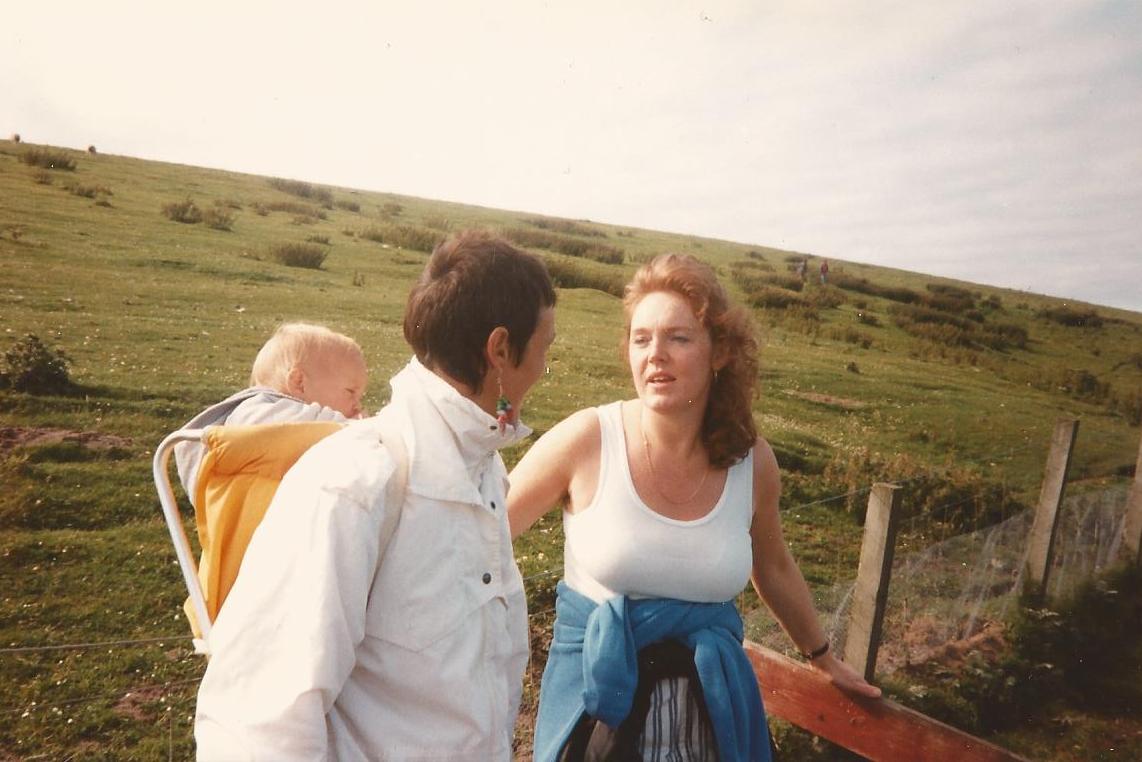
Anne with me and my youngest child, on a visit to Shetland (you can tell I’d got de-acclimatised by then!)
When we first met, I had been estranged from my family for several years, and my big sister had recently killed herself. I was in the middle of a meltdown; Anne was warm and kind.
I’m sitting on the grass opposite a house, but rather than a road between us, there’s a channel of water. Two seals swim up to the house and a young woman comes out to play with them. For several minutes, I watch this magical scene.
The woman comes across and I ask if the seals will let me play with them too, and she says why not? So I go, and we play, and then she invites me into her house for tea.
Inside her house, the young woman is Anne. She gives me a long, lovely hug and I tell her I love her. ‘We go way, way back,’ I say to her new partner, who seems a bit wary of me…
The rest of the dream was our tea-time together in her chaotic house, with her children running around – just exactly as our visits used to be. When I left to go on with my journey, we hugged again, such a comfortable hug, and when I woke I could still feel the warmth of her body and the smell of her hair.
It took me several moments to realise it had been a dream, and several more to remember that Anne was dead – she died nearly ten years ago.
Then I thought, what a wonderful gift that dream was, because it was as real as if we had really met; it was just as pleasurable and loving as at any other time we were together. It was also a complete surprise. I hadn’t asked for this dream, or expected it – it was given to me, by grace.
When I first met Anne, those decades ago, I had no concept of karma or past lives, but I felt that I had always known her. It wasn’t a spark of interest and a getting to know, but a moment of recognition and a reconnecting.
Now, I probably see her once every five years or so in my dreams, just as we saw each other when she was alive, and I expect I’ll meet her in some other future life… if that doesn’t sound too mad.
Have you ever had a vivid dream about someone who’s died? Or felt a karmic connection?
Carolyn Hughes is a writer with an interest in addiction and mental health issues. Her popular blog is The Hurt Healer and she has a lively and rapidly growing following on facebook and twitter
Carolyn Hughes
I must also have a dark side if I am to be whole ~ Jung
Like many writers I want my work to be recognisable by its unique and individual style. For me, it’s crucial that what and how I write reflects my authentic self. Anyone who has read my blog The Hurt Healer will be familiar with the fact that I share from the heart. It’s a deliberate approach to enable readers to relate to and hopefully be encouraged by my words. Authenticity means being genuine and real. Much as I would love to reveal only my good side, to be true to my work I have to disclose my whole self.
It is no coincidence that I am only now finding my writing voice as it has taken a long time to find myself. Years of battling with depression and alcoholism meant that I had very little idea of who I was. How I presented to the outside world was very different to how I felt inside. It was only through having the courage to challenge my past at every level that I was able to start the journey to healing and so begin to find personal identity and my authentic self.
My aim though isn’t just to be authentic, but to be authentically creative. And the key to writing both authentically and creatively lies with the unconscious. For me the unconscious is a limitless place in my mind where my spirit and soul meet. It is a place where I can visit those painful issues that used to torment me. But instead of being overwhelmed I can now bring them into my conscious, safe from their power to harm me. So as I communicate from my unconscious, so I hope to reach the unconscious of others and in doing so share a collective moment of authenticity.
The interpretation of dreams is the royal road to a knowledge of the unconscious activities of the mind ~ Freud
Recently I’ve been looking at how I can reach further into the depths of my unconscious and take my writing to a new level of creativity. I’ve started to look at the constituents of my dreams. This is a wonderful way to tap into those hidden thoughts and images that make up the psyche, as well as exposing my inner truth.
Examining my dreams however has only been possible from a position of emotional recovery and psychological stability. In those dark days of depression and alcoholism my night-time experiences were fraught with darkness and fear. The erratic and terrifying nightmares that emerged reflected my complete inability at the time to manage my physical and mental anguish.
Jung once remarked that nothing was ever lost in the psyche. That is an horrendous thought for anyone who has tried to block out the past in the hope that the pain would stop. The idea that all thoughts, memories and emotions never disappear but remain forever can be frightening. Yet I found that there was indeed a freedom to be found in allowing the unconscious to simply ‘ be’. I stopped fighting the emergence of the dark side and celebrated the arrival of the good side. By no longer fearing my thoughts and dreams I was free to live authentically and to write openly too.
Il ne faut jamais regarder quelqu’un qui dort. C’est comme si on ouvrait une lettre qui ne vous est pas addressee ~ Sacha Guitry
I couldn’t mention dreams without including one of my favourite quotes. A general translation of this is; “You should never look at someone who is sleeping. It is like opening a letter that isn’t addressed to you.”
It is a quote I came across many years ago at a time when I was experiencing my first love. After one of those deep conversations that you have in such relationships I remember feeling that he hadn’t been entirely truthful. As I watched him sleeping I remembered the quote and realised that I had been right to doubt him. His real emotions were disclosed on his face as he slept. So dreams aren’t just for the benefit of the dreamer!
Dreams are often most profound when they seem the most crazy ~ Freud
Being new to noting my dreams, I must admit that at first they did appear to be made up of bizarre representations that made little sense and made no contribution to my creativity. But as I made more of a conscious effort to remember them and to focus on not just what they were about but how I felt, they became significant.
Very often it’s in that winding down time between waking and sleeping that a word, phrase, image that comes into my mind and gives the essence to a piece of writing. Other times it’s a complete dream that a memory from the past, an issue of the present or an aspiration for the future.
Sometimes this works better than others depending on the obscurity or relevance of my dreams. Yet the importance lies in allowing that writing to happen regardless of whether it makes sense at the time. So although I may have rearranged the words to make them flow, I haven’t messed with the essence of what my soul may have whispered to me.
I may never reach the purest form of authenticity or be famed for my creativity, but I will continue to write from the heart with my unconscious and dreams as my guides.
People often ask me for writing advice, and they’re surprised when the first thing I tell them is to keep a dream journal… keeping a dream journal is perfectly sound, if neglected, writing advice ~Andrew Blackman on writetodone
This extract is from a blog post I read last week which had me punching the air – yes! The author says even people who don’t normally remember their dreams can become dream-recallers through practice. He recommends
recording whatever you can remember immediately upon waking
not trying to judge or analyse your dreams
Then he outlines the advantages for authors in keeping a dream journal, which boil down to inspiration, breaking through blocks and seeing the world differently.
I couldn’t have put it better, but there are a few things I might add about the dream journal itself.
My two most recent journals – they have to look and feel beautiful!
When I first started recording my dreams over forty years ago, I wrote them in school exercise books, just the dreams, packed together with no extra content except the date. I’m not knocking it – that’s all you need in order to establish great dream-recall.
Then I studied dream interpretation using the Western psychological model, and began to include some brief details about what was going on in my waking life, so in effect my journal recorded two parallel lives, waking and dreaming. This threw up some real insights into how both dreams and waking life work, but I wouldn’t necessarily recommend it if you’re looking to use your dreams as a creative resource.
Interpreting comes naturally with experience, in the same way as experience of life deepens our understanding, but if we approach dreams with this primary focus it’s easy to lose the bigger picture. Understanding dreams only as expressions of the waking life would be like understanding every piece of fiction you write as autobiography. It might be, but if you examine that too closely you can lose sight of the story and its own life.
My diaries have evolved: dreams, drawings, bits stuck in…
Gradually, my dream journals have evolved so that although the core of them is my daily record of my dreams, and brief notes about events and preoccupations in my waking like, I’m also recording lots of other stuff such as
thoughts and observations that have engaged me during the day
sketches
plans
story ideas
tarot readings
notes on books I’m reading
quotations
scraps of paper stuck in with cellotape if I’ve jotted ideas down when I’m away from the house
This may sound like a mess, but it’s actually rather lovely, because I use different colour gel pens for the various different kinds of entry.
It may also sound like a major commitment of time but it isn’t. The only regular writing I do is the dreams – all the rest is random, and I’d be doing it anyway, only previously it was scattered about in various nooks and notebooks.
Pulling it all together means it adds up to a rich and satisfying record of my life, both inner and outer, which seems to provide a rich seed-bed in which my various writing projects can easily root and grow.
Just after Christmas, when I had finished my story set on a remote island, I had a brief hiatus, so I asked for a dream.
I’m in Cunningsburgh, in Shetland, but the coast is completely different. Instead of the wide flat apron of land around the voe, it’s high and mountainous.
Cunninsburgh, looking out towards the voe
We go to the top of the cliffs and start our familiar walk, down the narrow path which clings to the side of the steep slope down to the sea. We normally make this a circular walk, but when we reach the water and look up at the path ahead, it looks too long and hazardous. So we double back the way we came, and return to the top once again.
When I wrote the dream down, I knew I’d dreamt about this place before, and done the walk in other dreams; I also remembered that it almost always coincided with this stage in my writing, when I had finished one MS and not yet started another.
After I finish a book, I need a fallow time to rest and recover, refocus and regroup. I play with lots of ideas and then, just when I’m starting to feel impatient, one of them grabs me.
My dream of going down to the water reminds me of an idea I’ve read in books on writing, that writers need to take time out and ‘go down to the well’ to keep refreshing their ideas. Julia Cameron talks about it in her ‘writer’s date’ suggestion in ‘The Artist’s Way.’
Julia Cameron recommends taking time out every week, but I find my writing pattern is such that when I’m in the flow I just want to write 24:7 till I reach the end, and then take a chunk of time out to recover (and get some sleep!)
After this dream, and a period of rest, what eventually grabbed me was a return to the world of Peony Pinker, the protagonist of my latest published series. I guess that’s why I doubled back in my dream.
It’s only through writing down your dreams and noting alongside them the main things that are happening in your waking life, that you start to see patterns and parallels emerging. Certain themes and situations in your dreamworld may become familiar, as they reflect recurring themes and situations in your waking life.
I’ve just delivered my follow-up story to Peony Pinker, ‘Me and my big mouth, by Maddy Monday,’ so I won’t be surprised if I find myself walking back down to the water in my dreams these next few weeks.
If you’re a dreamer, are you aware of a recurring link between a dream situation and a waking one in your own life?
If you’re a writer, how often do you ‘go down to the well’ – for a few hours every week, or for longer periods between writing projects?
The prolific Belgian author, Georges Simenon, famously said, ‘Writing is not a profession but a vocation of unhappiness.’
Writing is certainly a vocation. Many professional authors have been doing it for years on top of the nine to five before they start to make any money from it, and most say they’d continue to write even if their income from it completely dried up.
Like any other vocation, this hunger to create comes at a cost; it takes time and energy away from social life and other interests, and puts personal challenges upon us which we might otherwise prefer to avoid, such as developing the ability to deal with criticism and rejection.
But because it’s a vocation, that inner drive enables us to overcome our setbacks and difficulties and keeps us moving forward towards a growing sense of doing what we were born to do.
I used to think that dreaming was a vocation of unhappiness too. It felt like a compulsion which had me in its grip. Over the years, it has taken me to all sorts of places where I’ve felt confused and frightened, and out of my depth. It has given me insights and information I did not want to know.
Ignorance is bliss, and dreams are a road to understanding. Writing is hard, and for most of us it will not lead to a life of material abundance. But if you have a vocation you have to find and follow your inner compass, because that is the only way to achieve the supreme happiness of coming home to the self.
A year ago I set up a facebook page for Writing in the House of Dreams, but then I didn’t do anything about it. I didn’t start posting updates, or drawing people’s attention to it, because I wasn’t sure what the value-added would be when I already had – and loved – this blog.
readers can initiate topics and conversations rather than just responding to the content
readers can post pictures as well as comments
I can flag up news such as this blog getting a mention in Victoria Field’s excellent poetrytherapynews last week
you can flag up your own relevant news – Victoria could have posted her link on my fb page herself
it’s a great place for me to share quotes, brief insights and even dreams
it’s somewhere you can share your own quotes, brief insights and even dreams
it’s more immediate, especially for a once-a-week blogger like me
A limitation with facebook pages is that ‘likers’ no longer see all the updates in their timeline unless the admin pays a fee, whereas every email follower of a blog will receive notification whenever a new post goes up.
So my conclusion is that neither is best – facebook pages and blogging can simply do different things. That’s the theory, and now I’m ready to try it out in practice, so I’ve added the link to my Writing in the House of Dreams facebook page to the widgets at the right hand side of this blog.
I do hope you’ll ‘like’ the new page and go on to become part of its active community. If you really do like it, please tell your friends!
Last week I was talking about the comfort of dreams, and how dreaming can provide pleasurable experiences for the self which may be ‘only dreams’ in waking life.
This happens spontaneously, but we can replay and deliberately go back into such dreams either in daytime fantasies or as we fall asleep.
Writing can work in the same way, which I’m particularly thankful for at times when I’m not sleeping well. If I feel out of sorts with the world for any reason, and maybe my mind’s gone into overdrive, I’ll get up and write for two or three hours in the middle of the night.
I’ve had a couple of nights like that this week, when I’ve made myself a cup of tea and left the cares and irritations of my daily life to immerse myself in Maddy Monday’s, whose world is colourful, lively and distracting.
My bright and delightful work-in-progress
The joy of writing is that we can choose the worlds we wish to inhabit during the writing time, and even though we will meet all sorts of challenges and difficulties in those worlds – no problem, no story – we are always able to solve them.
Sweet dreams everyone, this week – or failing that, happy writing!
When I interviewed Brenda Mallon here in the House of Dreams a few weeks ago, she touched upon the way that dreaming about a lost loved one can bring great comfort for the bereaved.
These dreams happen when a person is most in need of comforting, but dreams can bring comfort in less extreme times too.
When I was about five years old, I dreamt I was riding along my street in a horse-and-cart, on a lovely summer day. The horse was trotting happily, and the cart was full-to-overflowing with gold coins which jumped and jingled, and sparkled in the sun.
Everyone came out of their houses to wave as I went by, and I knew I ought to throw pennies to the poor, but I didn’t. That gold was mine, all mine!
I liked that dream so much I used to deliberately go back into it every night, as soon as I closed my eyes. It made me fall asleep with a smile on my face.
I used to think that dream showed what a horrible person I was – it was a guilty pleasure. But looking back now, I see it’s just the dream of a child in a large family with little money, where clothes were passed down and everything – even the bath water – had to be shared. It was the pure pleasure of experiencing something which was completely my own.
You can re-enter enjoyable dreams any time you like, by simply closing your eyes and imagining, in the same sort of way as you might revisit pleasurable fantasies in waking life.
It isn’t the only function of dreaming and imagination, but bringing comfort and pleasure is one way these experiences can enrich a person’s life.
Have you ever deliberately imagined your way back into a pleasurable dream on subsequent nights?
I met Brenda Mallon at a conference of children’s authors and she kindly agreed to read the MS of my book, ‘Writing in the House of Dreams’ and to be interviewed for this blog.
Brenda has over thirty years experience of working with dreams as a researcher, teacher and therapist. She has written 18 books on the subject, presented a Channel Four series ‘In your Dreams’ and sat on the board of directors of the International Association for the Study of Dreams.
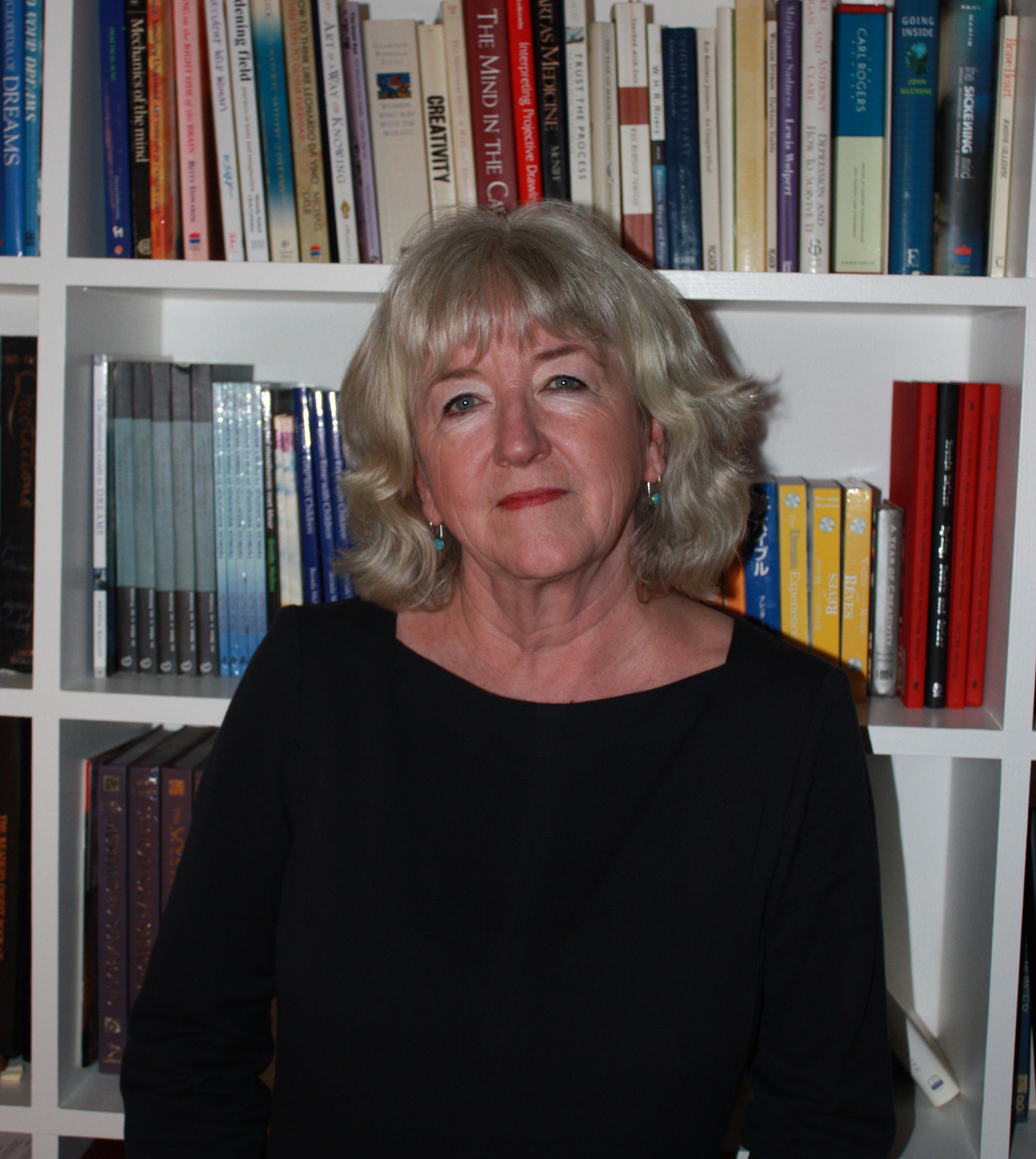
Brenda in her study
Could you tell us a bit about your own personal journey in dreams, Brenda? How and why did you start to remember them, and how has your relationship with dreams developed over the years?
I can recall dreams from my childhood that have stayed with me. I was probably influenced to some extent by my mother. She talked about her dreams and had dreams which were precognitive. She didn’t call them that but would say, ‘You watch, it will happen.’ I think she was psychic in many ways and dreams were just one aspect of that ability. So, over the years I was fascinated by dreams . When I was completing my Diploma in Counselling I based my dissertation dreams. I recorded and worked on my dreams over a sixth month period and was amazed by what they revealed. After that I wanted to focus on working with and researching dreams and to find out what other people’s dreams meant to them, so when I wasn’t working in my full time job in the Child Guidance Centre, I was sending out questionnaires and interviewing woman about their dreams. Over 900 woman took part and the findings were covered in my first book ‘Women Dreaming’ which was published by Harper Collins.
I greatly enjoyed your Channel 4 series, ‘In your dreams.’ Could you talk about how you work with dreams as a therapist?
Thanks, I enjoyed working on the series and meeting such a variety of people who were not coming for therapy but to discuss their dream life in general.
As a therapist, my role, I believe, it to accompany people as they seek to find a way to resolve issues that are distressing and to help them find their own way forward. I generally ask clients to write down their dreams when they recall them and to bring them to the sessions. I should add here, that not all clients do remember their dreams so I work in other ways if that is the case. When a client talks about a dream I ask them if they can make a connections to their waking life and explore the emotional aspects of the dream as well as the symbolic significance of the content. Sometimes, I ask the client to draw their dream and use that as a basis for our work. These techniques, including recording your dreams, using metaphors and symbols, taking the dream forward and dream amplification are detailed in ‘The Dream Bible’ (Godsfield/Octopus)
I like working with dreams because they empower the client to work on their own dreams once they get used to the techniques. This can take just a few sessions and it is something they can access on their own for the rest of their lives, if they wish to. Also, I have specialized in working with people who have been bereaved and, in many cases, dreams can bring great comfort. They form part of the continuing bond we have with those who have died. In ‘Dying, Death and Grief: Working with adult bereavement’ (SAGE) I show how valuable such dreams can be.
As a children’s author, I’m interested in your work with children’s dreams. What would you say are the main differences between talking with children about their dreams and talking with adults?
I think younger children are more open to talking about their dreams and less concerned about how others might view them. I remember, one four year old I spoke to told me that dreams were ‘pictures in my pillow’. His dreams were in his pillow which came into his head when he slept. (In fact, I later used it in ‘Children Dreaming: Pictures in my pillow’ (Penguin). So, small children feel they have little if any control over dreams and their content and are less defensive than adults sometimes are.
Children are usually happy to enter into the playful aspect of dream work. For example, a girl whose brother had died, had a distressing dream in which a lion came into her bedroom and wanted to eat her and her brother, who was alive in the dream, She talked about what frightened her and how she was sad that her brother no longer came into her room to play. She drew the dream, including the fierce lion. I asked her what she would change in the dream if she could change it. She thought for a while and said, ‘The lion could turn out to be nice and then it could go away. I could play with my brother again and that would be lovely.’ So, we talked about what they would play and games they used to play. She then did another drawing of herself and her bother playing as they had done in the past. She knew her brother was dead and would not return to her home and family but talking about him and playing with him gave her comfort and a chance to recall happy times in the past, which is part of the grieving and healing process.
Working with adults is also a pleasure. Adults however may have more pre-conceived ideas about dream interpretation which may lead to being more guarded about what dreams they share. However, once they understand dreams are powerful tools to help them through their crisis or distress, they truly value them, even those nightmare ‘wake up’ calls.
This blog is mostly about using dreams as a creative resource. I know you also teach creativity and writing workshops – do dreams feature in that work as well?
Artists, writers, scientists, musicians and actors speak of the importance of dreams as a source of creativity. I use dreams in my own writing and many members of the creative writing courses I teach use dreams as the springboard for their writing. Sometimes an image will be so vivid that the dreamer cannot get it out of their mind. This kernel of an idea then grows to encompass characters, plot, further imagery and a developed story line. In other cases, the whole story or song appears in the dream. Robin Gibb, of the Bee Gees, told me his song ‘Stayin’ Alive’ came in one of his dreams as did Paul McCartney’s ‘Yesterday’.
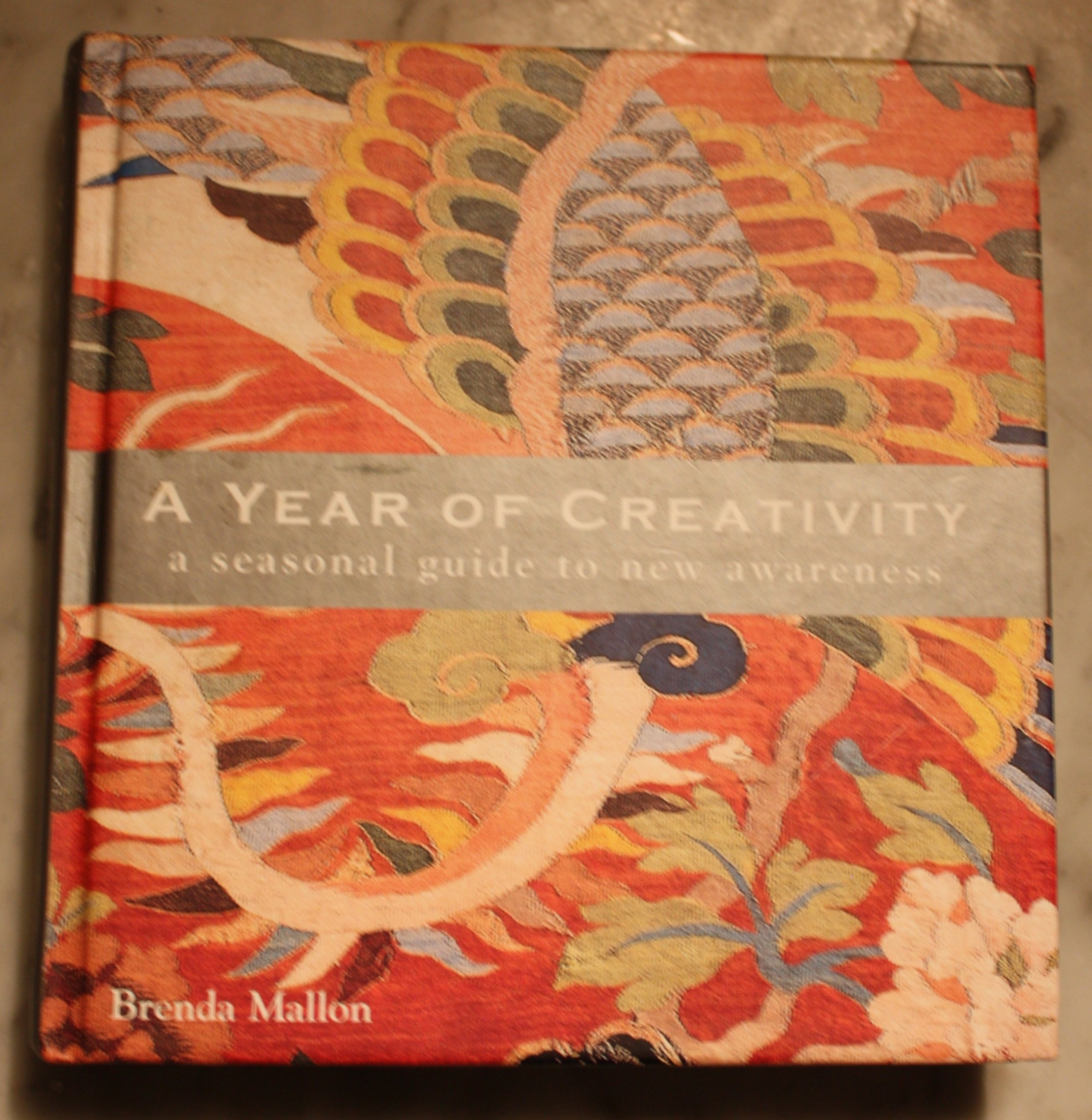
I include sections on creative writing and creative dreaming in ‘A Year of Creativity’ (MQ Publications) as I think dreams are central to our creativity. The more we pay attention to our internal treasure trove of dreams the more enriched we are.
Who is your favourite author on the subject of dreams?
I like the work of Kelly Bulkeley, Robert Van De Castle and Patricia Gardfield. All members of the International Association for the Study of Dreams who have made vitally important , accessible contributions to the understanding of dreams. Also, Carl Gustav Jung, who could leave him out!
And your favourite book?
This is a hard one to answer. Probably because it is one of the earliest books I read that introduced me to the significance of symbolism in dreams is ‘Man and His Symbols’ by C.G. Jung.
As an author yourself, which of your own books are you most glad to have written?
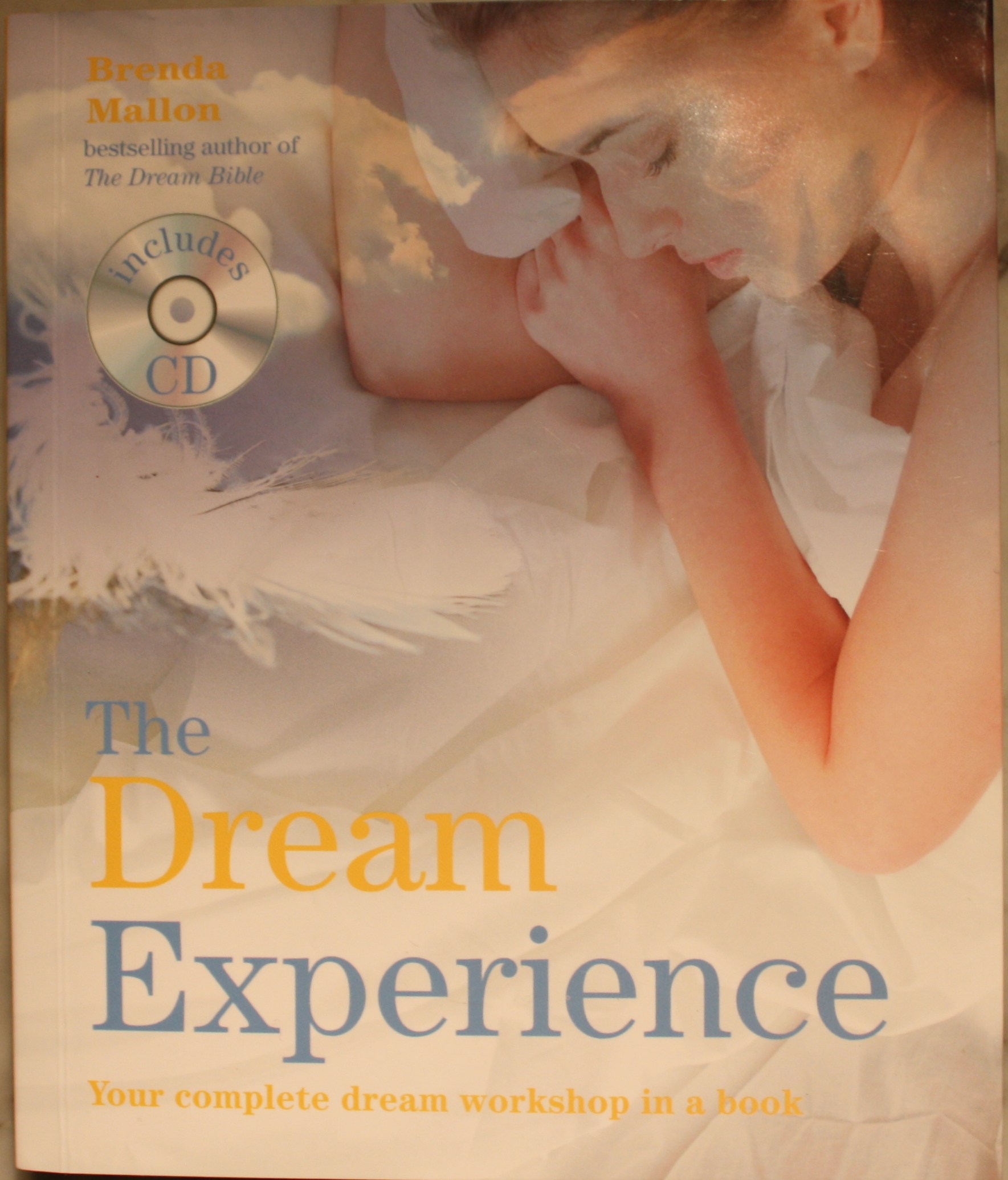
Another difficult question! As a therapist, I think ‘Dreams, Counselling and Healing’ was an important book because I was able to put down my experience of working with clients and to show how powerful working with dreams is and to share techniques so others could use them. My latest dream book ‘The Dream Experience: Your complete dream workshop in a book ‘, which includes a CD featuring exercises and inspirational music, is interactive and is, I hope, a guide to deepen awareness of the creative heart of dreaming.
Jung said that dreams don’t only happen when we’re asleep, but all the time, waking and sleeping, throughout our lives. The unconscious mind is continuously producing images and narratives, but we’re only aware of it during sleep because then the distractions of waking life are stilled.
The movement between the conscious and unconscious areas of the mind is like a breathing in and out. Products of the unconscious mind emerge into consciousness – inklings, intuitions, emotions, instincts, senses, desires, before we have had time to formulate them into conscious ideas – and everything you have ever consciously known but don’t currently need to remember sinks into your unconscious mind, where it may lie undisturbed for years.
Because everything you have ever known is in there somewhere, it isn’t uncommon to have the experience of a name or piece of information you vaguely recognise but can’t recall where from suddenly popping up in your mind in response to something that’s happening in your life.
‘Women who run with the wolves’ – highly recommended
This happened to me recently when I was planning some new courses. One of the ideas I was considering was an all-women group, and another was writing from myths – I do a couple of sessions on myth in my ‘Writing in the House of Dreams’ workshops, but not a whole course. That night, I dreamt about someone called Pinkola Estes.
The name rang a bell, and I looked it up, to discover that Clarissa Pinkola Estes was the author of a book from the nineteen-nineties exploring myths and stories, ‘Women who run with the wolves.’ I recalled a friend recommending the book to me two decades before, but as I didn’t like the title I had never followed it up.
I hadn’t thought of Clarissa Pinkola Estes once in the intervening years – to all intents and purposes, I had completely forgotten about her. She had only ever been, after all, a fleeting mention. But I bought the book, and am finding it very useful as I develop this new workshop series.
I have dreamt the names of books, authors, gods and goddesses, which I may have come across long ago or sometimes can’t recall ever having heard of before, and it always happens at a time when following them up proves to be fruitful.
Have you ever suddenly recalled to mind something you had effectively forgotten?




 Jenny Alexander's blog: Writing in the House of Dreams