Writing can be therapeutic even when it appears to have nothing at all to do with the events of our lives. Here’s how.
In my last post I was talking about the healing power of dreams to ground us physically and emotionally when we get over-stressed and too much ‘in our head.’ Since then, I’ve been to a Lapidus workshop in Bristol which has made me want to share my thoughts on the healing power of creative writing.
Lapidus – ‘words for well-being’
Lapidus is an organisation for writing therapists; it includes mental health practitioners who use creative writing within their clinical practice and authors who teach writing in non-clinical settings as a route to greater understanding of the self and the world.
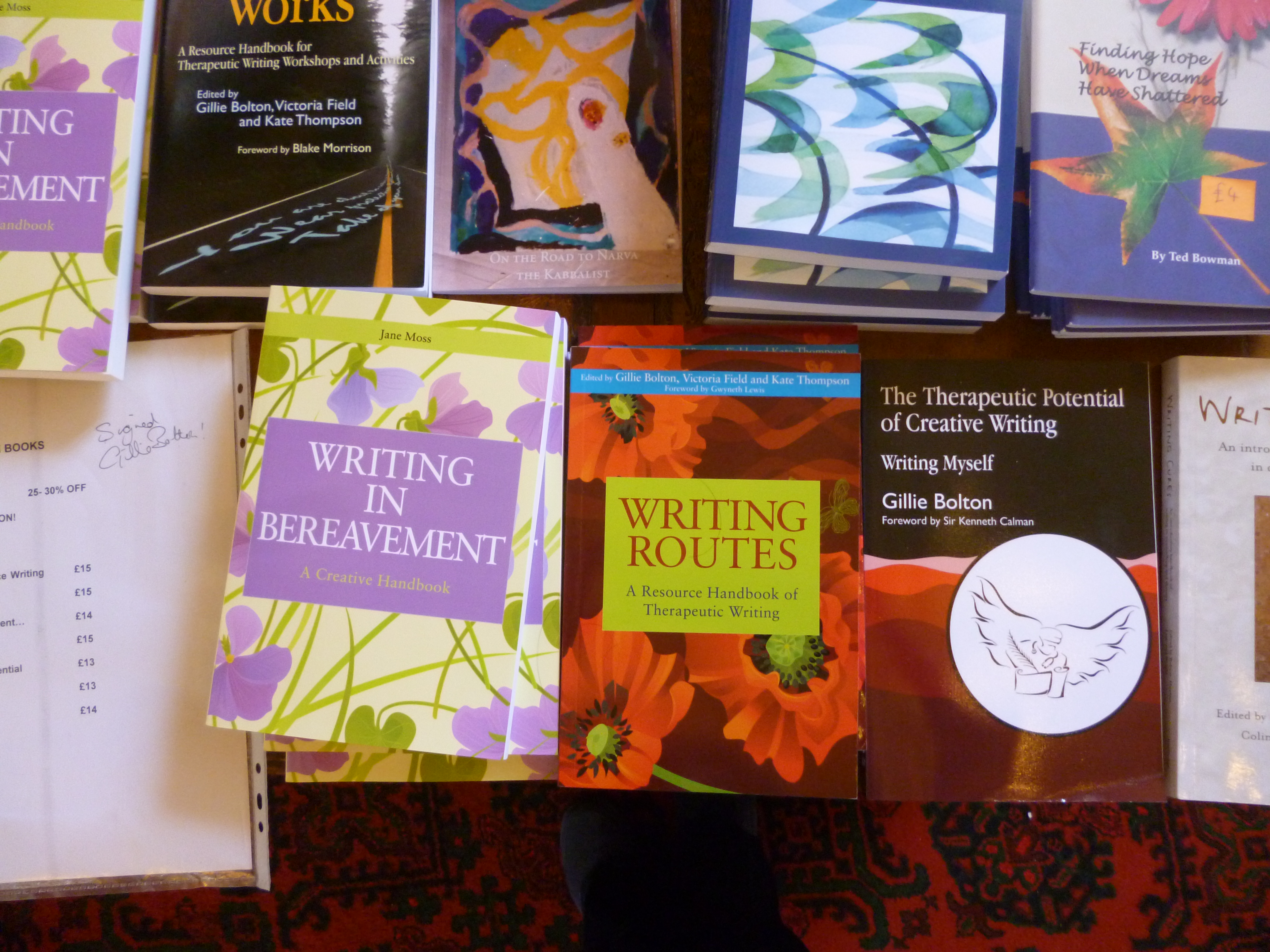
Some of the wonderful books on offer at the Lapidus conference
Most of the Lapidus workshops I’ve attended have involved writing about our real-life personal experiences, and they have felt rather like counselling sessions, where the theoretical base seems to be about moving towards catharsis or reframing difficult life events or relationships.
One of the great tools of writing therapy is ‘journaling.’ This is a regular practice of personal writing reflecting on personal insights, day-to-day experiences, dreams and inspirations; it’s pretty much what my dream-diaries have evolved into over the years and I can highly recommend it.
But creative writing doesn’t have to be autobiographical in order to be therapeutic. Every poem or piece of fiction we write connects us to our authentic emotions, like the sad dream I was talking about in my last post; it takes us beyond the narrow limits of what we are capable of understanding about ourselves and releases us into the wide, fast flow of emotional and imaginal experiences that make us who we are.
Do you keep a writing journal? Or have you experienced the healing power of writing in other ways? I love to hear about your thoughts and experiences
A sad dream can make you feelout of sorts all through the following day, but it may be Nature’s way of helping you to cope with stress. Here’s how it worked for me.
As I mentioned in my last post back in July, I decided to take the whole of August off, and headed North for four glorious weeks living mostly under canvas. All that fresh air and freedom… when the time came, I did not want to come back.
Paddling across to Oransay from Colonsay at low tide with Barbara Gay from New Zealand. Fun!
I had been redrafting 24:7 right up until the day before I went on holiday, so I arrived home to a messy house and a garden full of weeds, as well as a stack of paperwork in my study that I had been putting off for months.
Top of my to-do list was my tax return. Enough said. Two days of hair-tearing and tedium.
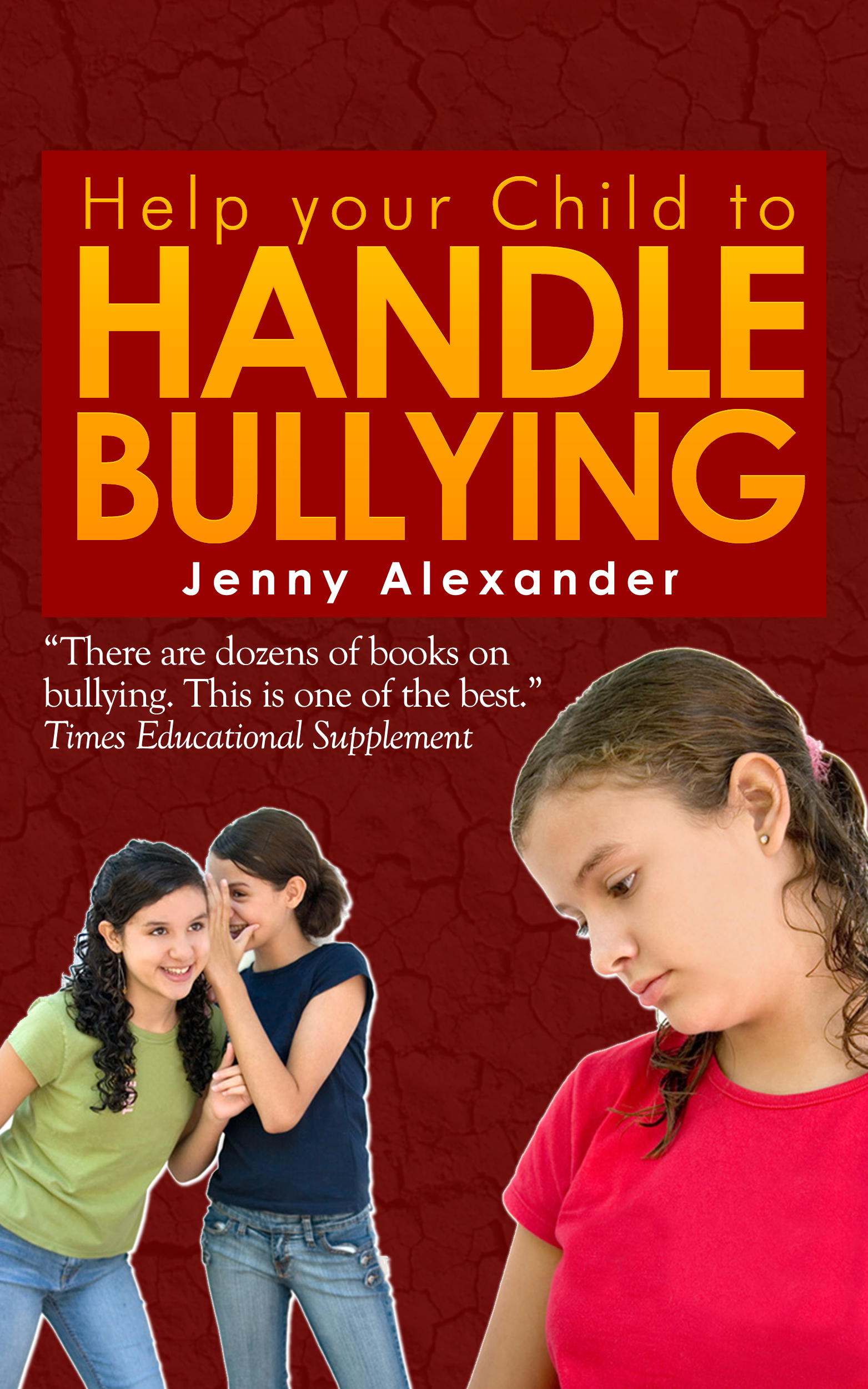
Second was my self-publishing venture, a new e-book edition of Help your child to handle bullying, which I had abandoned back in June. Everything about it made me feel anxious, and there were endless technical problems with the formatting that had to be ironed out (thank-you draft2digital – you were very patient)
Even deciding which endorsement to use on the cover was stressful
Frazzled and still fed up about not being still on holiday, I moved on to seeking copyright permissions for the forty or so quotes I want to use in my child-of-the-heart book, ‘Writing in the House of Dreams.’ This entailed days and days of tracking down publishers and agents, writing emails and filling in lengthy forms.
More stress. Would I be able to trace all the copyright holders? Would they grant permission? Would they demand a fee I couldn’t afford?
And what was the best way of producing the book and bringing it to market? Alongside seeking permissions I began doing research, which turned up a bewildering array of possibilities. I opened discussions, asked questions, discovered even more possibilities. More stress.
All the time, I was aware of the other things on the list, including coming back to my blog. I decided to quit the team on girlsheartbooks, where I’d been blogging once a month, and thought about taking this one down.
There were lots of lovely things on the calendar, as usual, those first weeks home from my holiday, but I was still cross about being back at work and stressed out by all the things I had to get through on my list.
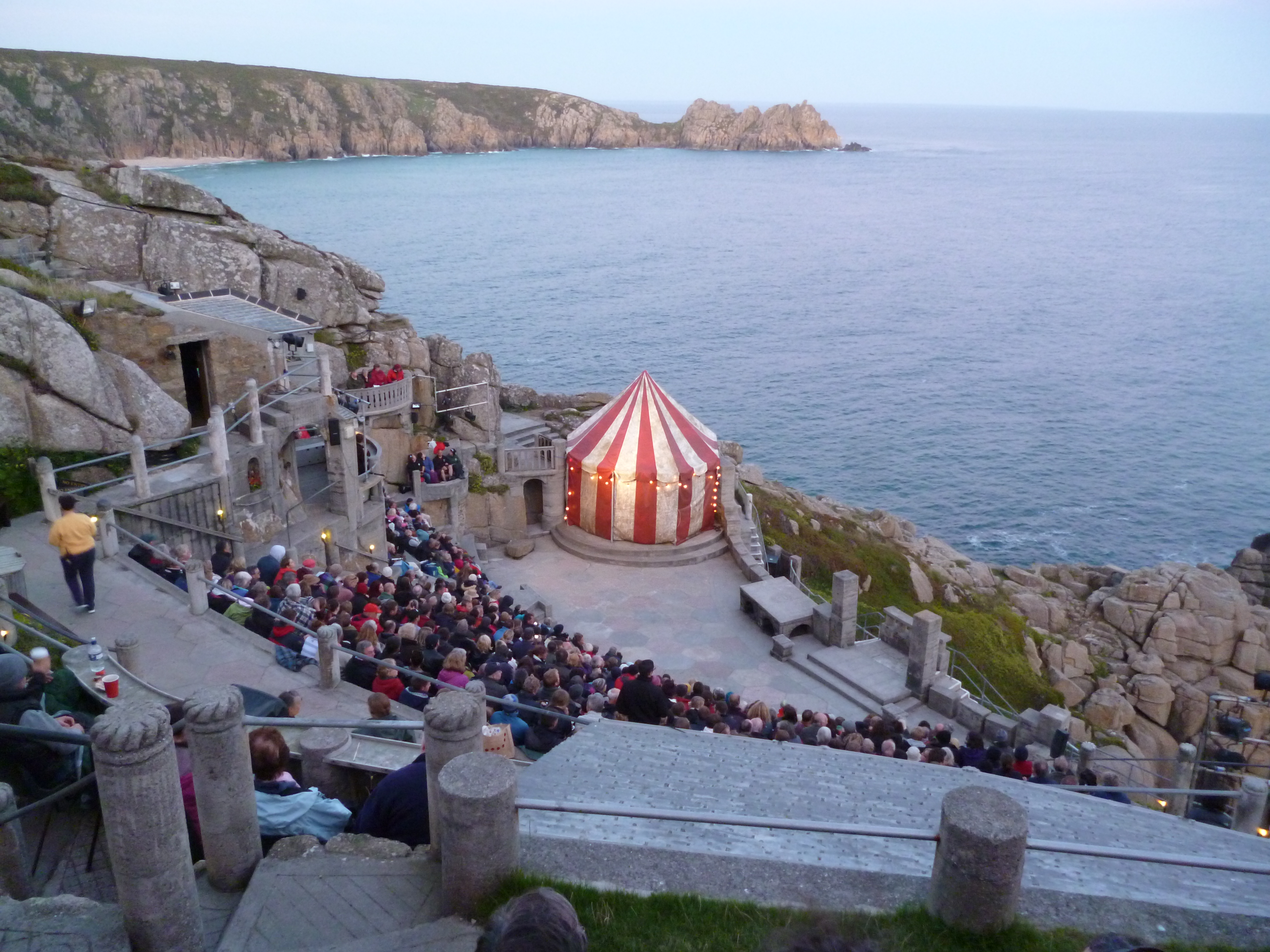
‘The Taming of the Shrew’ by an all-female cast at the Minack theatre – one of the lovely things on the calendar
Then one morning I woke up in tears, from a really, really sad dream. I don’t remember now what it was about, just that the sadness carried over into the day. I lost the will to start work, or the energy to stick at it. I read a bit, walked a bit, sat in the garden. Sighed and cried. Watched the birds.
That night, I slept better than I had for weeks and woke up feeling calm and clear, like the rain-washed sky after a storm.
Stress, like drink and drugs, can be an avoidance of ‘legitimate suffering.’ Life is hard sometimes, as well as wonderful, and one way of coping is by shutting the feelings out.
When you’re stressed, your whole focus is in your head; you spiral up into thoughts and ideas about what you should be doing, and push yourself so hard that you have no time to think about anything else.
Dreams connect you with your emotions, whether they are sad, frightening or euphorically happy ones. When you’re spiralling into stress and stuck in your head, it may take a very powerful dream that spills over into your waking life to slow you down and bring you back into your heart and body.
Instead of letting myself wallow as I had wanted to when I got home from my amazing holiday, I decided to ‘pull myself together’ and ‘stop being silly’ and get on with what needed to be done. My dream forced me to feel the feelings I had been avoiding.
Coming back to my blog after, as it’s turned out, two months away, feels really lovely. I’ve given it a new look, which I hope you’ll like, and got lots of lovely articles planned which I’m looking forward to writing.
The list can wait.
Have you ever had a dream that’s brought you down or lifted you up when you really needed it? I love to hear your thoughts and comments.
My work is emotionally autobiographical. It has no relationship to the actual events of my life, but it reflects the emotional currents of my life ~Tennessee Williams
This quotation from Tenessee Williams seems to me to encapsulate where dreams and creative writing are the same.
Being literal-minded, if we try to relate the writing to the author we only do it in a direct way, wondering whether the people in the story are based on real people or the events are things the author has actually experienced.
We do the same with dreams, especially if we focus only on the symbols and not the emotions.
But even where we don’t find any obvious connection between the story and the author, the dream and the dreamer, it is powerfully there because dreams, like fiction, are simply story-versions of the dreamer’s or author’s emotional experiences.
Have you ever written a story that seemed to have nothing to do with your own life, only to realise later that it was ’emotionally autobiographical’?
Carolyn Hughes is a writer with an interest in addiction and mental health issues. Her popular blog is The Hurt Healer and she has a lively and rapidly growing following on facebook and twitter
Carolyn Hughes
I must also have a dark side if I am to be whole ~ Jung
Like many writers I want my work to be recognisable by its unique and individual style. For me, it’s crucial that what and how I write reflects my authentic self. Anyone who has read my blog The Hurt Healer will be familiar with the fact that I share from the heart. It’s a deliberate approach to enable readers to relate to and hopefully be encouraged by my words. Authenticity means being genuine and real. Much as I would love to reveal only my good side, to be true to my work I have to disclose my whole self.
It is no coincidence that I am only now finding my writing voice as it has taken a long time to find myself. Years of battling with depression and alcoholism meant that I had very little idea of who I was. How I presented to the outside world was very different to how I felt inside. It was only through having the courage to challenge my past at every level that I was able to start the journey to healing and so begin to find personal identity and my authentic self.
My aim though isn’t just to be authentic, but to be authentically creative. And the key to writing both authentically and creatively lies with the unconscious. For me the unconscious is a limitless place in my mind where my spirit and soul meet. It is a place where I can visit those painful issues that used to torment me. But instead of being overwhelmed I can now bring them into my conscious, safe from their power to harm me. So as I communicate from my unconscious, so I hope to reach the unconscious of others and in doing so share a collective moment of authenticity.
The interpretation of dreams is the royal road to a knowledge of the unconscious activities of the mind ~ Freud
Recently I’ve been looking at how I can reach further into the depths of my unconscious and take my writing to a new level of creativity. I’ve started to look at the constituents of my dreams. This is a wonderful way to tap into those hidden thoughts and images that make up the psyche, as well as exposing my inner truth.
Examining my dreams however has only been possible from a position of emotional recovery and psychological stability. In those dark days of depression and alcoholism my night-time experiences were fraught with darkness and fear. The erratic and terrifying nightmares that emerged reflected my complete inability at the time to manage my physical and mental anguish.
Jung once remarked that nothing was ever lost in the psyche. That is an horrendous thought for anyone who has tried to block out the past in the hope that the pain would stop. The idea that all thoughts, memories and emotions never disappear but remain forever can be frightening. Yet I found that there was indeed a freedom to be found in allowing the unconscious to simply ‘ be’. I stopped fighting the emergence of the dark side and celebrated the arrival of the good side. By no longer fearing my thoughts and dreams I was free to live authentically and to write openly too.
Il ne faut jamais regarder quelqu’un qui dort. C’est comme si on ouvrait une lettre qui ne vous est pas addressee ~ Sacha Guitry
I couldn’t mention dreams without including one of my favourite quotes. A general translation of this is; “You should never look at someone who is sleeping. It is like opening a letter that isn’t addressed to you.”
It is a quote I came across many years ago at a time when I was experiencing my first love. After one of those deep conversations that you have in such relationships I remember feeling that he hadn’t been entirely truthful. As I watched him sleeping I remembered the quote and realised that I had been right to doubt him. His real emotions were disclosed on his face as he slept. So dreams aren’t just for the benefit of the dreamer!
Dreams are often most profound when they seem the most crazy ~ Freud
Being new to noting my dreams, I must admit that at first they did appear to be made up of bizarre representations that made little sense and made no contribution to my creativity. But as I made more of a conscious effort to remember them and to focus on not just what they were about but how I felt, they became significant.
Very often it’s in that winding down time between waking and sleeping that a word, phrase, image that comes into my mind and gives the essence to a piece of writing. Other times it’s a complete dream that a memory from the past, an issue of the present or an aspiration for the future.
Sometimes this works better than others depending on the obscurity or relevance of my dreams. Yet the importance lies in allowing that writing to happen regardless of whether it makes sense at the time. So although I may have rearranged the words to make them flow, I haven’t messed with the essence of what my soul may have whispered to me.
I may never reach the purest form of authenticity or be famed for my creativity, but I will continue to write from the heart with my unconscious and dreams as my guides.
The creative writer does the same as the child at play. He creates a world of phantasy which he takes very seriously — that is, which he invests with large amounts of emotion — while separating it sharply from reality ~ Sigmund Freud
Over the years, several people coming new to writing workshops have remarked that they feel like they’re in playschool, when they had been expecting something much more difficult and demanding. ‘It’s very enjoyable,’ they say, ‘but when are we going to get to the nitty gritty?’
The ability to be playful is the nitty gritty – it’s the key to creating the dreamlike fantasies of fiction, and it’s an ability that many of us lose as part of the natural process of growing up and engaging with the ‘real’ world.
Freud says we actually distance ourselves from the fantasies of our inner lives to the extent of feeling fearful and ashamed. The writer’s gift may be that in being able to sustain the playful attention and emotional attachment that children do to their dreams and fantasies, he or she provides an acceptable way for readers to indulge in the same activity vicariously.
And there’s more.
…our actual enjoyment of an imaginative work proceeds from a liberation of tensions in our minds. It may even be that not a little of this effect is due to the writer’s enabling us thenceforward to enjoy our own day-dreams without self-reproach or shame ~ Sigmund Freud
In overcoming their ‘grown-up’ rejection of the dreams and fantasies of their inner world, writers may also be giving a kind of permission for readers to explore and engage with their own.
I’ve always thought of myself as a very happy writer. I used to put it down purely to the fact that I was a dreamer first, and therefore completely used to coming and going across the threshold of consciousness, which meant I never experienced any kind of writing angst about getting blocked or running out of ideas.
Penny was right – I love this kind of book. I enjoy doing practical exercises that help me to arrive at different ways of looking at things. I’m a great fan of life coaching too, having had some life-changing sessions with astrological life coach, Pat Neill, a few years ago and more recently a brilliant group session with a writing coach at a Lapidusnetworking day.
What has become clearer for me through reading this book is that another reason I’m very happy in my writing is that my goals are perfectly attuned to my core values.
We commonly measure writing success in terms of sales and celebrity, but I have never felt any of that is important; I haven’t felt jealous, anxious or disheartened about having less of a public profile than many of my writing friends.
My core values, it turns out, are in order of importance:
Nature/health. I love the writing life because it means I can live somewhere remote and go walking in nature every day
Loving/caring/sociability. I enjoy the connection with readers, for example here on my blog, although it’s medium-profile and profit-free. One of my main drives in writing for children is to suggest ideas which might help them create positive experiences and deal with difficult ones
Originality/self-expression. The parable of the talents has always informed my life, and it feels very important to me that we explore, uncover and develop our God-given gifts, whatever they might be
Spirituality/solitariness. This was the surprising one, because I’d have thought it would rank higher, but when I did the next exercise, expanding upon these core values, I discovered that all of the first four boil down to ways of celebrating the divine, in myself, the world and other people
You are more likely to achieve your writing goals if they fit with your core values in life. Should you manage to achieve goals that don’t, your success is less likely to make you feel happy.
That is not to say you are limited forever to where you are today, because core values can change and evolve. Like you yourself, they are a work-in-progress.
But for this moment and this step, understanding how your current writing goals relate to what your soul wants is empowering and may be a revelation. Like Penny, I can totally recommend this book.
Have you ever thought about how well your writing goals tie in with your core values?
The prolific Belgian author, Georges Simenon, famously said, ‘Writing is not a profession but a vocation of unhappiness.’
Writing is certainly a vocation. Many professional authors have been doing it for years on top of the nine to five before they start to make any money from it, and most say they’d continue to write even if their income from it completely dried up.
Like any other vocation, this hunger to create comes at a cost; it takes time and energy away from social life and other interests, and puts personal challenges upon us which we might otherwise prefer to avoid, such as developing the ability to deal with criticism and rejection.
But because it’s a vocation, that inner drive enables us to overcome our setbacks and difficulties and keeps us moving forward towards a growing sense of doing what we were born to do.
I used to think that dreaming was a vocation of unhappiness too. It felt like a compulsion which had me in its grip. Over the years, it has taken me to all sorts of places where I’ve felt confused and frightened, and out of my depth. It has given me insights and information I did not want to know.
Ignorance is bliss, and dreams are a road to understanding. Writing is hard, and for most of us it will not lead to a life of material abundance. But if you have a vocation you have to find and follow your inner compass, because that is the only way to achieve the supreme happiness of coming home to the self.
Jung said that dreams don’t only happen when we’re asleep, but all the time, waking and sleeping, throughout our lives. The unconscious mind is continuously producing images and narratives, but we’re only aware of it during sleep because then the distractions of waking life are stilled.
The movement between the conscious and unconscious areas of the mind is like a breathing in and out. Products of the unconscious mind emerge into consciousness – inklings, intuitions, emotions, instincts, senses, desires, before we have had time to formulate them into conscious ideas – and everything you have ever consciously known but don’t currently need to remember sinks into your unconscious mind, where it may lie undisturbed for years.
Because everything you have ever known is in there somewhere, it isn’t uncommon to have the experience of a name or piece of information you vaguely recognise but can’t recall where from suddenly popping up in your mind in response to something that’s happening in your life.
‘Women who run with the wolves’ – highly recommended
This happened to me recently when I was planning some new courses. One of the ideas I was considering was an all-women group, and another was writing from myths – I do a couple of sessions on myth in my ‘Writing in the House of Dreams’ workshops, but not a whole course. That night, I dreamt about someone called Pinkola Estes.
The name rang a bell, and I looked it up, to discover that Clarissa Pinkola Estes was the author of a book from the nineteen-nineties exploring myths and stories, ‘Women who run with the wolves.’ I recalled a friend recommending the book to me two decades before, but as I didn’t like the title I had never followed it up.
I hadn’t thought of Clarissa Pinkola Estes once in the intervening years – to all intents and purposes, I had completely forgotten about her. She had only ever been, after all, a fleeting mention. But I bought the book, and am finding it very useful as I develop this new workshop series.
I have dreamt the names of books, authors, gods and goddesses, which I may have come across long ago or sometimes can’t recall ever having heard of before, and it always happens at a time when following them up proves to be fruitful.
Have you ever suddenly recalled to mind something you had effectively forgotten?
Last week, I delivered a children’s book to my agent which I first conceived more than ten years ago. It had been through several complete versions, one of which a previous agent had actually sent to a publisher, as much as anything in the hope of getting some useful feedback, as she and I agreed that it probably wasn’t quite there, though we couldn’t see what was missing.
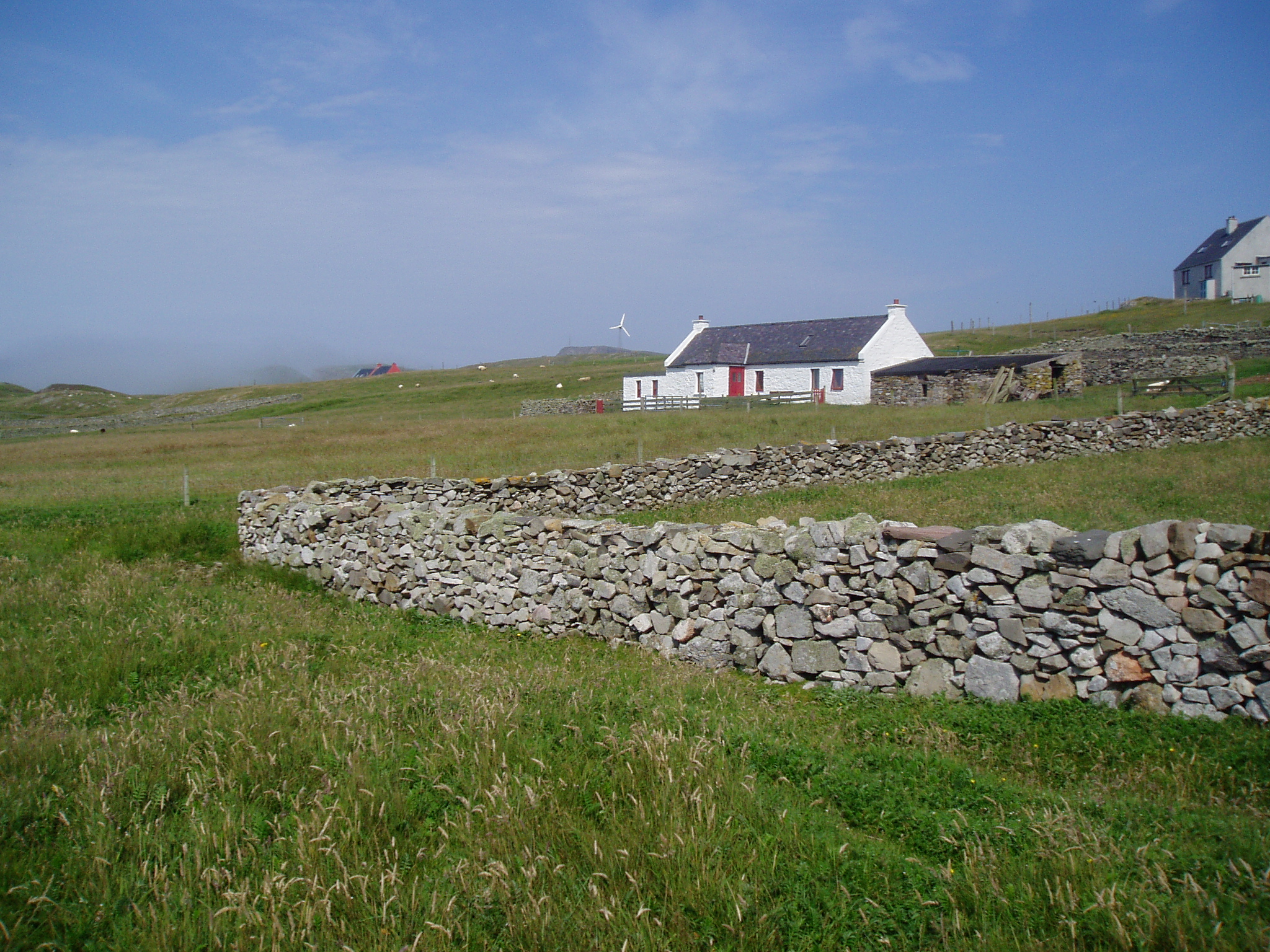
The book was set on a small island – research took me to Foula and Fair Isle in 2003
It wasn’t quite there, but it didn’t go away, and when I had flu before Christmas, it re-emerged quite unexpectedly, to announce that it was ready.
I had lost all my previous notes and versions, but I knew the story, and this time the planning and writing came easy and complete, like a jigsaw falling into place, all the missing pieces found.
Now, starting work on another new book, I’ve discovered that this story also took root in me more than a decade ago, and the same thing is happening. Where it once felt stuck and abandoned, now it’s emerging fully-formed, and all I’m having to do is write it down.
Two versions, ten years between
Last night I dreamt I was at a Scattered Authors conference, talking to other authors about this moment in a piece of work, when the book is inside you, fully-formed, like a shadow book, and your task is to bring it out, not harming or disturbing it, but as whole, which it already is.
You change yourself, your face, your mouth, stretching it wide, until gradually the book emerges out of your mouth, transforming from shadow to solid and real. I demonstrate it. I say how exciting this is, knowing the book is there, then opening yourself up and allowing it to come into the world so that everyone can see what it is.
I thought, ‘What if a life is like a book? Already complete in shadow form, and gradually emerging into the world, a little misshapen in its birthing, perhaps, a few edges knocked off in its early years, but still… when nature is ready, the matter inhabits the shadow.
Jerome Bruner’s thoughtful autobiography
Then I woke up and saw the book I’d been reading before I fell asleep, ‘In Search of Mind: Essays in Autobiography’ by Jerome Bruner, which begins with his thoughts about whether it is our history which shapes us or our destiny, and I smiled.
I love this layering-up of daytime activity, dreams and ideas. The material, the imaginal and the rational, playing alongside each other; themes and variations, music of the mind.
Have you ever had a book or story that took years between the first spark and the final realisation?
One of the great things about teaching workshops is that you get to meet some very talented, interesting and likeable people. With the kind of workshops I do, such as ‘Writing the Tarot’ and ‘Writing in the House of Dreams’, most of the people who come also have a real sense of adventure.
Cue Paul Farrington, a keen traveller and talented young writer and photographer, who has done a number of courses with me now. At the last workshop before Christmas, Paul brought me a present, and here it is – a large print of a photo he took in America.
Dream house photo by Paul Farrington
I’ve been contemplating this picture over the holidays – how we can see the outside in wonderful detail, but we can only imagine what lies inside that spacious interior. The dark windows reveal nothing; they only reflect back the world outside.
We are the House of Dreams – the outer life so clear and familiar, the inner world often caught only in glimpses, or sometimes completely ignored. Dream-recalling and creative work of every kind are keys to getting right inside, having a proper look around and making yourself at home.
That’s the great joy of writing for me. It enables you to inhabit more of your Self. Dreamworking does the same thing.
Thank-you for following, commenting, tweeting and sharing on facebook throughout 2012, and may your 2013 be rich with wonderful dreams and writing.







 Jenny Alexander's blog: Writing in the House of Dreams