Lots of shadows in the House of Dreams lately, but before I leave this theme, an update from Toko-pa has prompted me to write a balancing article about the bright side of the Shadow.
I did mention the bright side in my article ‘It’s the seat of creativity – so how can you find your Shadow?’ but only in passing:
This is not to say the Shadow is only negative. Positive potentials which may have been strong in us can be lost. For example, a strong-willed child may learn to identify that strength as a bad thing, and grow to suppress and deny it.
The Shadow is everything we can’t see directly in ourselves. Toko-pa says 90% of that will be ‘pure gold’, but I feel the percentage will depend upon other aspects of your personality. A person with low self-esteem, for example, will be unconscious of many of their more positive qualities, strengths and potentials, whereas someone who feels they are ‘good’ may be suppressing or projecting out many of their own human weaknesses.
When we write, our protagonists express energies in our Self of which we may or may not be aware, and these are not only the dark energies of our villains but also the bright energies of our heroes.
In our heroes, we experience qualities we may not identify with in life, but which must exist in us because they are finding expression in our stories. My protagonists are usually resourceful, independent and brave, but I’ve only come to see where they are me through writing their stories. I used to think of myself as the very opposite of all that.
So there are bright lights hidden in these shadows which, if we follow them, can lead us into the most wonderful areas of the Self. The process may still feel challenging, because anything that shakes our beliefs about ourselves unsettles our world and forces a readjustment of both our memories and our future dreams.
And we have to walk this path lightly, not trying to understand or interpret, but listening for echoes, being aware.
Have you noticed key characteristics that run through most of your protagonists? Are they qualities you recognise in yourself?
Next week I’ll be giving my answer to a straightforward writing question: Is it easier to write for children?
The award-winning author Susan Price and I are exchanging emails at the moment for a future entry on the ‘A conversation with’ page on her blog. By a delightful synchronicity, her latest response was a perfect illustration of the blog post I had just written last week, and she has agreed to let me publish it here.
Susan Price
There was a time in my life, when I was denying that ‘other’in my head, when I think my subconscious very deliberately worked against me.
I would say something quite innocent to someone – ‘Hello, how are you?’ for instance – and hear myself saying it in a tone, or with an inflexion that completely changed the meaning and made it insulting or aggressive. I had absolutely no conscious intention of insulting anyone, and would be as astonished as the person I’d just offended – but, of course, what could I say? – ‘I didn’t mean it like that! – That came out wrong!’
Sometimes people were polite, but I’d just bitten their heads off for no good reason. It was impossible to explain that the voice they’d just heard wasn’t mine. They would have thought I was mad. I occasionally thought I was mad.
I was at logger-heads with what I now call ‘my daemon’ because I was refusing to acknowledge that it existed, and so it fought me all the way. I would be writing something and would decide to make some change to the plot. What I now call the daemon would object, but I would refuse to listen because I didn’t recognise its voice. I put it down to a mere passing thought, and brushed it off because at that time I was certain that there was only one voice in my head: the ‘I’ voice, which I would now call ‘the editor’.
The daemon took its revenge by withdrawing. The piece of writing I was working on would turn to stone, or dry up, or fall over dead – whatever image you want to use. I had to learn that with writing – or, I think, any art – the daemon does the real work! The Editor may make some great editing decisions, once the real work is finished, but shouldn’t be allowed to interfere with the daemon.
A vengeful, spurned daemon is a dangerous thing, I think. Mine not only stymied my every effort at writing, it played those tricks to embarrass me. It was ingenious at finding ways to make such remarks as,“Yes, please,” and “Yes, I’ve heard of that,” nasty and cutting.
I had to learn that talk of ‘muses’ and ‘daemons’ was not the arty-farty nonsense I thought it, but simply a way of talking about something that we don’t quite understand, and don’t have an everyday vocabulary for. I began to solve problems with writing by summarising the problem and saying to the daemon,‘Solve this for me.’ And it did! The more I trusted it, the faster and more inventively it solved the problems.
I started to give way to it. If it insisted that a particular character should – or shouldn’t – die, I no longer argued, but humbly worked with it to make it so. I discovered that the more I worked with and trusted the daemon, the friendlier it became. It stopped playing those tricks on me!
As a result, I paid it more attention and ‘heard’ it more clearly. I started to see how a piece of writing that I’d ‘made up as I went along’ had sub-texts planted in it, and other subtleties that ‘I’ hadn’t written – so who had? And then I read Kipling’s description of his ‘daemon’ and knew what he was talking about right away.
If you’ve enjoyed reading this taster, watch out for our full conversation on Susan’s blog in the coming weeks. You may also like to check out her ‘Muse Monday’ guest post on Katherine Roberts’ lovely blog, Reclusive Muse, where she descibes her daemon and quotes the passage from Rudyard Kipling she refers to here.
In Jungian psychology, the Shadow is one of the major archetypes of the Self. It represents all the things you have identified as ‘not me’ during your formative years, when you were building your sense of who you are. It’s the other side of the Persona archetype, which is your identity, or how you see yourself and expect other people to see you.
The classic Shadow story, which came to RL Stevenson in a dream
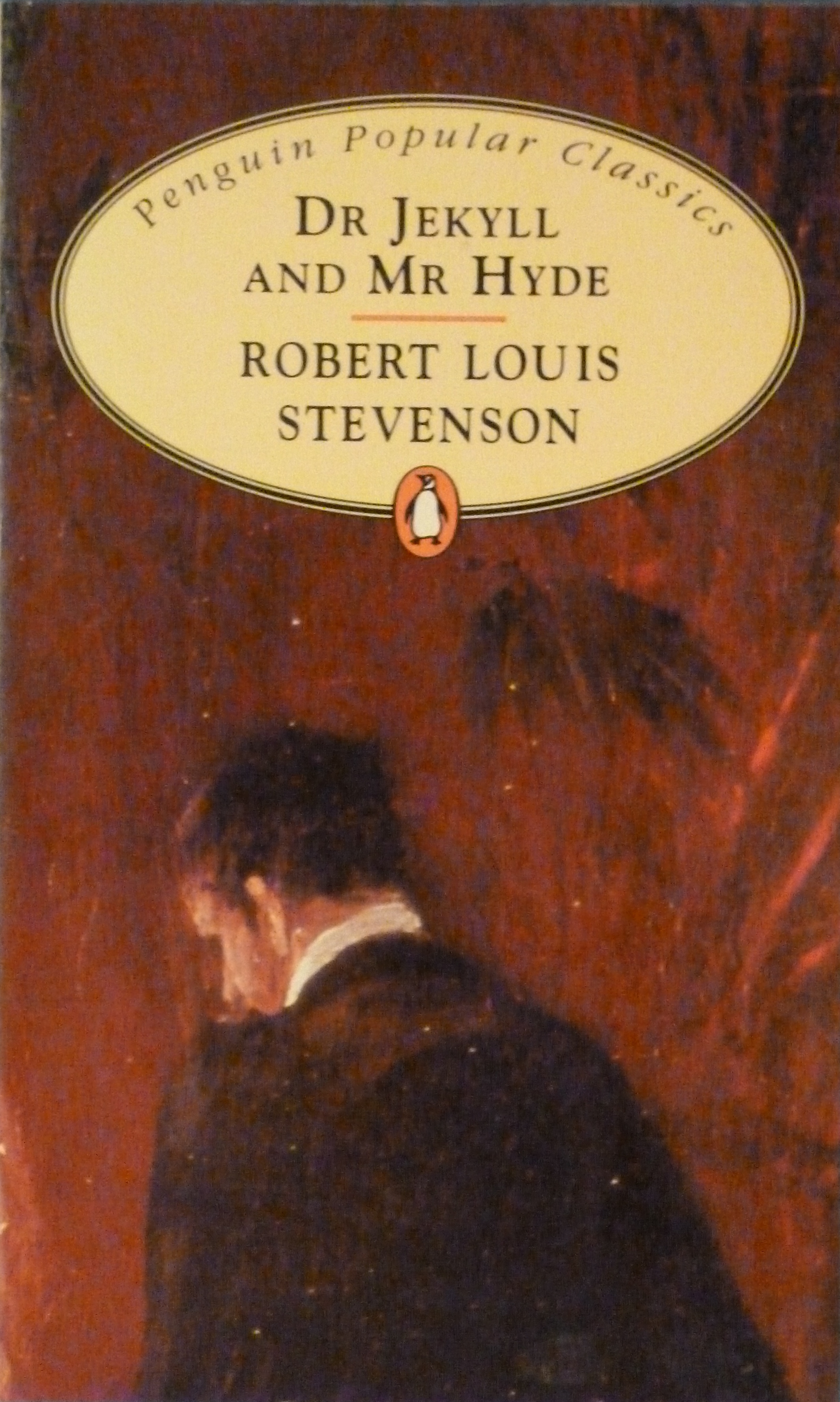
A classic depiction of the conflict between Persona and Shadow is ‘Dr Jekyll and Mr Hyde,’ by Robert Louis Stevenson, which came to him in a dream. In the story, Dr Jekyll is a respectable pillar of the community, but he has a secret other side – at night, he is addicted to the pleasures of debauchery.
He invents a potion which can completely change his physical appearance so that, as Mr Hyde, he is able to go out on the town and not worry about being discovered. Effectively, he turns himself into two people, one embodying his Persona, and the other his Shadow.
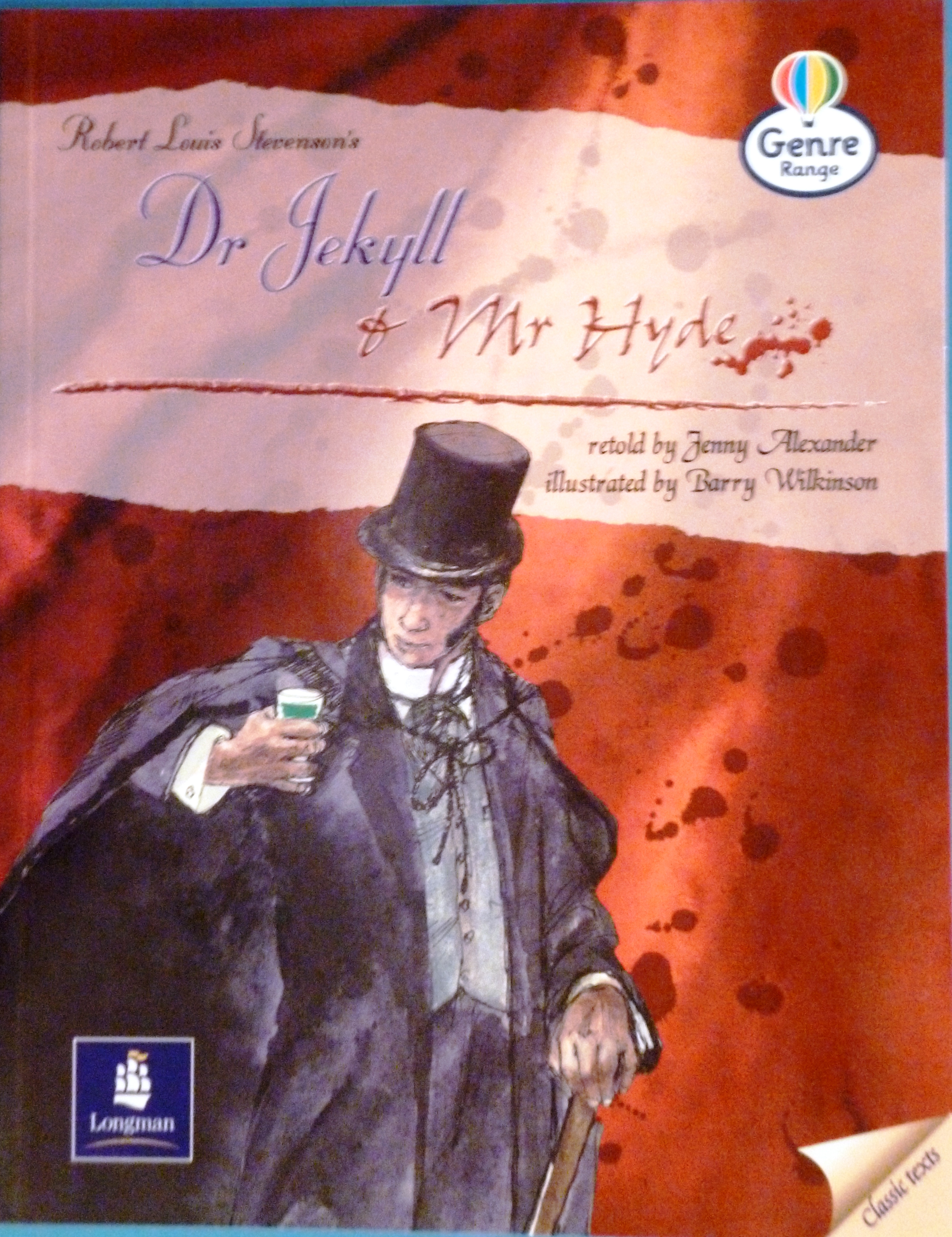
My version, for children – what can I say? I love that story!
Whatever we don’t identify with as ‘me’, we project out. We may disown it so completely that we can’t recognise it in ourselves at all. We can only see it in the mirror of the world.
One way we project undeveloped aspects of our Self is onto the people around us. A person who thinks of himself as hard-working and high-achieving may find other people lazy and unambitious. A person who thinks of herself as ugly may feel that virtually everyone else is good-looking.
In a couple, the tasks of personality are often shared out. One partner may be good with money, so the other can enjoy financial security without having to develop good money-sense themselves. One might be fun-loving and dizzy so the other can be sensible and steady, yet still enjoy a party lifestyle.
On a collective level, cultures, countries and sub-sections of society also have a Persona and a Shadow. In families, for example, it may mean one person becomes the black sheep, with all the family’s unacknowledged problems projected onto them.
Where there is Shadow projection, there is always emotion, because we’re defending our very existence, insofar as that is our idea of ourselves. Which brings me on to Jimmy Savile.
This was a man who appeared to be helping the young and vulnerable but was actually hurting and abusing them in secret. Quite rightly, there’s been huge public outrage, because nobody should have the slightest doubt that what he’s alleged to have done was heinous and wrong.
According to Jung, there may be another dimension to this natural disgust and condemnation – extreme public outcries of the dig-up-his-bones, may-he-rot-in-hell variety may be intensified by Shadow energy. ‘We’re not like that! We’re the opposite of that! We protect children from sexual abuse!’
So, do we? Young children are regularly exposed to highly sexualised music videos on daytime television, and sexual story-lines before the watershed. Magazines and video games which are targeted at children contain sexual content, and children’s clothing which could be seen as sexually provocative is sold in high street shops. A large proportion of primary age children have seen internet pornography. If you google ‘sexualising of children’ you’ll find page after page of examples.
Jung called the Shadow ‘the seat of creativity.’ Embracing the Shadow means letting go of fixed ideas about who we are and the way life is, opening to unconsidered possiblities and engaging with complications, so to create something new.
Something new is happening because of these horrific revelations. People who have kept their own experience of abuse to themselves for many years are suddenly speaking out. Not just the hundreds who were allegedly abused by Savile, but thousands more are flooding helplines with their stories. That in itself is the beginning of a major change.
I hope the high profile and new openness given to the problem of child sexual abuse because of this case will mean that the sexualising of children by adult society in recent years will come under proper scrutiny and be seen for what it is.
Jimmy Savile’s dirty secret may be holding the mirror up to ours, showing us something about our society that we prefer not to acknowledge. Like all Shadow work, simply to acknowledge it is to begin the transformation.
More about the personal Shadow next week – where to look, and how to see it
A few nights ago, I dreamt about a row of old shops which had been boarded up with huge sheets of brown cardboard. Along the top, there was a big bright Tesco banner.
In my dream, I realised that when my dreams are set in man-made environments, they are always up-to-date. I very rarely dream about my own personal past, let alone further back in history.
I reflected that I’m a person who isn’t drawn to the past – I don’t write on historical themes, and I’m not fired by antiques, or costume dramas, or classical novels or paintings. Only last week, I bought a limited edition print of the Lidl in Brixton. It felt fresh and different – mean, how much Lidl-related art do you see?
Lidl in Brixton
Even when I did a few past-life regressions, they didn’t go further back than wartime Europe, but that’s another story.
I wondered about other people – antiques collectors, historical novelists, family archivists. People my spiritualist friend used to call ‘old souls.’ Did they have more dreams set in the past?
At the end of the dream, I dreamt I was recording this as a blog-post rather than an entry in my dream diary – and that’s what I’ve just done!
So this is my dream question – if you love old things, if you read or write historical books, do you have dreams that are set in the past? Or if, like me, you love the new, is that reflected in your dreams and writing too?
‘Deja vu’ means ‘already seen’ or ‘seen before.’ It’s when we feel a strong sense of recognition in a new place, as if we’ve been there before but can’t remember when.
It can occur even in places we know for certain we have never visited in the past. We may actually find that we know the layout of the rooms, or what’s round the corner in the road.
Often, ‘deja vu’ is accompanied by a strong emotional reaction to the place we recognise – perhaps a warm sense of belonging, or a feeling of sadness, or a desire to get away.
A scientific explanation of this phenomenon is that it’s some kind of blip in the brain – a disturbance in the electrical activity which causes a momentary illusion that we’ve seen the place previously when in fact we’re seeing it for the first time.
A more metaphysical explanation is that ‘deja vu’ is connected with past lives – we recognise a place because we were there in a former life. But how could that account for feelings of ‘deja vu’ which arise in a modern environment?
Larking around outside the old Town Hall in Wimbledon – part of a shopping centre now
Years ago, I revisited the town I grew up in, Wimbledon, with an old friend from school. Before the visit, I dreamt I was walking from my childhood home into the town centre, and when I got there, I was surprised to find the old Town Hall was now a shopping centre.
When we arrived, I found the town centre was exactly as I had dreamt it. You may say I must have heard about the redevelopment in the media or something, and simply forgotten. But this sort of thing happens quite often, in relation to places which have never been in the media.
Five years ago, I wanted to move house, and I was looking at cul-de-sac bungalows within a certain area. I happened upon the house I eventually found quite by chance, on an evening out – it was in the wrong place, but I viewed it on a whim, and as soon as I walked in the door, it just felt like my house.
Recently, reading back through some old dream diaries, I discovered that I had dreamt I took a detour on a house-finding mission, to view a little miner’s cottage in the middle of a terrace on the edge of the moor – I had actually dreamt about this house.
I don’t know if there is a definitive explanation for ‘deja vu’, but my own experience suggests that when we feel we have been in a place before, we have – in our dreams.
Have you ever experienced ‘deja vu’? What do you think is the explanantion?
In everyday life we belong to groups – most closely, our immediate family, fanning out to our extended family, our region, our nation, our continent, our culture; ultimately all of humanity. On the dreaming level of consciousness we have access to the collective experience and archetypal symbols of all our dreaming tribes.
My friend and fellow-author, Katherine Langrish, told me the extraordinary story of her family dream over dinner at a conference some years ago, and I’m delighted she has agreed to share it here.
Roughs and smooths, by Katherine Langrish
Katherine LangrishWhen I was a child, I used to have a recurrent dream – or nightmare – in which I would be lying in bed, apparently awake, and see a thing like a stone or boulder come rolling from one corner of the ceiling (and yet as if from a million miles away) – and as it came, everything went crumpled. It would roll and roll across the ceiling, and with it came a sickening sensation as if I was seeing the skin of the world pulled off and chaos underneath. Then it would roll back again and everything would go smooth, but the feeling remained, because I knew that underneath the appearance of smoothness, the sickening crumples were still there.
It was a dream that was often repeated, and the feeling often heralded it, so that it was possible to say to myself, Oh, it’s coming. As I grew older the feeling would sometimes come without the dream, and after the age of about 11 or 12, it vanished for ever.
While I was still having them, I told my mother about them, and she said, “Oh, do you get those too? I used to have them, and so did my father; he called them roughs and smooths.” My mother’s and grandfather’s versions were slightly different. I think she said my grandfather saw ‘it’ as something like a barrel. For herself she said, “something came towards me rolling, and everything broke up. But you stop getting them when you’re about twelve.” I remember feeling a mild but real relief that she knew what I was talking about.
I never told my own children about the dream, because I didn’t want them to have it, and I didn’t want to suggest anything to them which might influence them into having it, but they both did get variants after all, and one daughter in particular was prone to them. Aged about seven, having woken upset, she told me, “I see squiggly lines” – she drew one in the air with a finger, “squiggly lines, and it all goes wrong.” Asked next morning, she said she’d be half asleep, half awake, and see “squiggly lines, jagged lines, calm lines. They come and go. There’s a horrible feeling with them.”
I reassured her that she’d simply got the family dream, and it wasn’t anything to worry about, and would take itself off when she was about twelve. And it did. I don’t know if anyone else has ever had an inherited dream, and I feel it’s got to be something to do with brain patterns, but I’m happy to leave it at that and not know anything more about it. I hope it doesn’t get handed down any further – as a family heirloom, it’s one we could well do without.
‘Forsaken’ by Katherine LangrishKatherine’s blog, Seven Miles of Steel Thistles, dips deep into the realm of myths and fairy-tales, and her books likewise have a wonderfully mythic feel. You can see a brilliant trailer for her new book, ‘Forsaken’ onher website
I was talking last week about the faceless ones in my dreams, figures who had no individual characteristics but represented the pure power of the archetype. Other words for these pure powers might be energies, or spirits.
When peoples throughout the ages have sought to engage with these spirits, they have given them faces and names. Different traditions choose different faces and names, according to their culture, to represent the same essential qualities.
So, for example, in Ancient Greece Demeter was the goddess of harvest, but in Ancient Egypt this essence of harvest/mother/nature was called Isis.
After my first encounters with the faceless ones, I began to dream about gods and goddesses. Often, their names were unfamiliar to me in waking life, so it felt as if I was dipping a deeper stream. This experience will be familiar to a lot of dreamers, of words we have no conscious knowledge of coming to us for the first time in dreams.
One night I dreamt that Thoth was in my study. I had a vague notion that Thoth sounded like some kind of devil, so it spooked me. But when I looked him up, I found he was, amongst other things, the Ancient Egyptian god of scribes. The universal spirit of writing, in the shape of Thoth, had taken up residence in my writing room. Sweet!
A week later, by a happy synchronicity, I found a figurine of Thoth in a seaside nick-nacks shop, amongst the beach mats and sunglasses. I brought him home and now, if I ever feel disheartened or directionless as a writer, he inspires me with the pure power of writing.
Have you ever dreamt about gods, goddesses or other religious symbols?
In our culture, because we have broken our conscious connection with myth, we tend to see our lives as separate and unique.
But every individual life follows paths and patterns which are universal. Each life story is built on a template of all human stories.
Through mythology, we can connect with the essence of our own life experience, and walk with greater consciousness the mythic pathways where we all are one.
Being aware of the archetypal dimension of experience can be particularly useful for writers. You can use mythic templates quite deliberately to help you construct stories which will have resonance with your readers.
I like to use the Hero’s Journey, the master-myth explored at length in Joseph Campbell’s book, ‘The Hero with a Thousand Faces’
In this story
the hero hears the call to adventure, which he at first refuses
something helps him to engage with the adventure and he sets out into the unfamiliar world
he meets allies and enemies
he’s tested
he has to muster all his inner resources to face his supreme ordeal
he finally claims his reward and takes it back to his community
This is a master myth because it isn’t limited to one area of human experience, such as becoming a mother or making the transition between middle and older age.
The Hero’s Journey explored through mythology and in the lives of women and writers – it is capable of endless applications
The Hero’s Journey describes every challenge we may have to face, however small or large; from the daily challenge of getting out of bed or learning something new to a greater challenge such as finding a new job or coming to terms with the death of a loved one.
Life continuously presents us with challenges, which we at first refuse, because we don’t want the effort and disruption of change. If we refuse, we get a nudge. We may seek the help and support of friends or strangers, books or teachers, and we may encounter unhelpful people who stand in the way.
Every time we engage with a challenge, we win a reward – new strength, new insight, new effectiveness in our world, which we can then ‘bring home’ and incorporate in our life.
You can use mythic templates in a deliberate way to construct strong stories, but simply being aware of the universal dimension in your characters’ stories will give them depth and new dimensions. As Dorothea Brande says, ninety percent of writing happens unconsciously, with us often finding things in our writing we did not consciously put there.
If you want to explore the Hero’s Journey in more depth, I’d recommend ‘The Writer’s Journey’ by Christopher Vogler, where he looks at various Hollywood blockbusters as versions of the hero myth.
August is all about archetypes here in the House of Dreams – next week, I’ll be telling you how I first encountered the archetypes in my dreams





 Jenny Alexander's blog: Writing in the House of Dreams