I’m constantly aware of the ways that being a writer enriches my experience of life, and the run-up to Christmas feels like a great time to think about three gifts of writing in the House of Dreams. Today, the gift of stillness.
Years ago, a friend of mine told me she’d seen me in the supermarket, but hadn’t said hello. She said I was just looking at the apples, but with such a quality of stillness and concentration that she didn’t want to break the spell.
When she said it, I remembered that moment. I had been looking at the apples, but I wasn’t thinking about them. Their shapes and colours had caught my eye and held me there, but my mind was open, unfocused, receptive.
The great American writer, Henry Miller, said that an artist was someone who had antennae, who knew how to ‘hook up to the cosmos.’ The elements that made up a poem or novel or any work of art were already in the air, waiting to be given voice, and that explained why themes and discoveries tended to break at the same time in different parts of the world.
Writing teaches you to be receptive. The more you do it, the more sensitive your antennae become. In dreams and daydreams we can more easily ‘hook up to the cosmos’ but it can happen any time, even when we’re doing the most ordinary things, such as supermarket shopping.
In these moments, time disappears; there is nothing but openness, and presence. You are completely ‘in the now,’ not thinking about the past or the future or your shopping list; not thinking about other people, or yourself. Not thinking about your writing, or work, or any of the things that usually anchor your mind.
You would not want this to happen all the time – that would be madness – but in this busy, busy world, for a lot of people it never happens at all. If you want to be happier, they say, ‘Slow down,’ be more ‘in the now.’ When a writer’s mind puts its antennae up, that is a little bit of bliss.
Next week I’ll be giving thanks for another of the gifts of writing. I do hope you’ll call by.
In the meantime, writers, do you have these ‘apple’ moments too?
Copyright is an important protection for authors’ creative property but the rules are hard to fathom, especially in the internet age. I’ve been doing some research…
The first task I’m having to tackle in self-publishing ‘Writing in the House of Dreams’ is gaining permission to include quotations from other books.
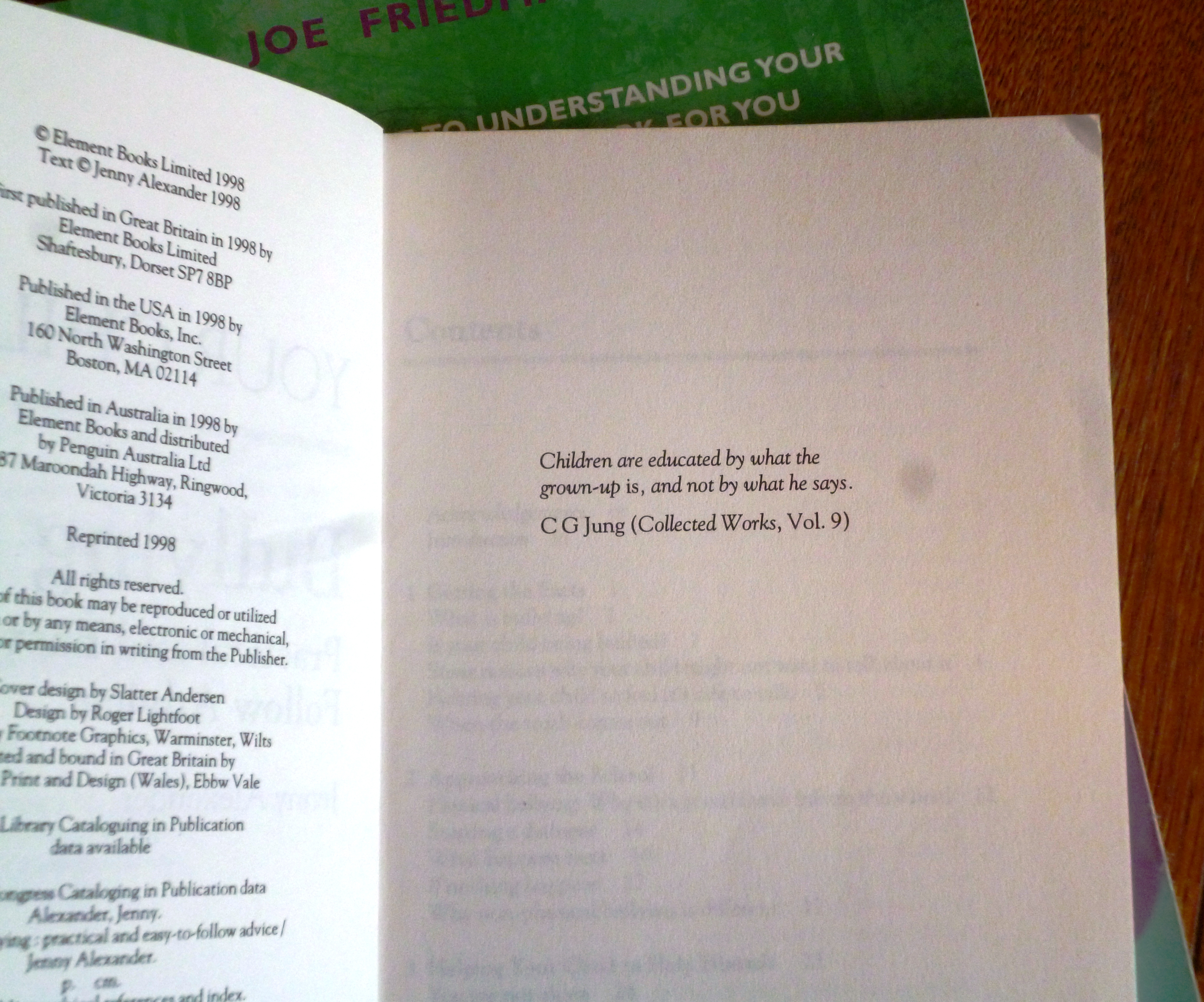
I’ve only had to do this once before, when I wanted to use a sentence from the work of CG Jung in my book for adults about bullying. Permission was granted, but there was a fee of £40 to pay, and this was a decade ago. Other authors have approached my agent for permission to use extracts from my books and the fees we have charged have been between £75 and £150, but these were for quite sizeable chunks.
The only permission I’ve sought before now, for my book, ‘Your Child: Bullying’ back in 1998
My dream book includes forty-seven quotations of varying lengths, so having whipped out my trusty calculator and updated the likely fees to take into account inflation I considered abandoning the idea of including quotations at all, or at least cutting the number right down.
But the quotations I’ve chosen are all wonderful and I didn’t want to lose a single one of them, so I did some research. It seemed to me that perhaps copyright laws might be less rigid now with the internet, where loads of people use quotations freely in blogs and fb pages. I asked several of the most high-profile bloggers and fb pages I follow whether they sought permission for the quotations they use, but not a single one of them replied.
So I looked up copyright permissions in the Writers’ and Artists’ Yearbook, and discovered that here in the UK you don’t need permission to quote from someone who has been dead for more than 70 years, although the cut-off time may vary in other territories. That straight away meant I could take eight of the quotations off my list. I felt encouraged!
One of the quotes I can use freely, being outside copyright (Rilke died in 1926)
Unfortunately, most of the rest of the information felt frustratingly vague, so I then emailed the Society of Authors with a list of questions. Since most of my quotations were very short, I thought I might not need to seek permission at all because a big issue seemed to be how much you wanted to use, and there was something called ‘fair use’ for little snippets.
I’ve since discovered that different publishers have different interpretations of the term ‘fair use’, and there’s no actual rule about how many words you want to use before you have to seek permission.
My agent advised me to seek permission for everything, even if it was only a few words, and hope that publishers would not charge me a fee for quotations that were barely more than a name-drop for their authors.
When you seek permission, you have to contact the first publisher of the book you want to quote from. I found this wasn’t always easy especially when the publisher had gone out of business or the author had died and I couldn’t easily find out who owned their copyrights. But everyone I contacted was very helpful, pointing me towards agents or in some cases individuals who might be able to grant the permissions I was seeking.
It’s felt like detective work – long-winded but rewarding. I’ve sent dozens of email enquiries, one postal enquiry where I couldn’t track down an email address and another one where the rights-holder didn’t possess a computer or use the internet. I’ve had to fill in complicated forms for larger publishers and send sections of my book to publishers who have wanted to vet it before granting permission for their authors’ work to be included. Sometimes I’ve had to contact separate rights-holders who hold different rights in the same work, say e-book rights or paperback rights, world rights or only certain territories.
Straightforward it is not. But so far, thirty or so rights-holders have granted my request and only six of them have charged me a fee, so it looks as if I’ll be able to include most of the quotations I want to use in ‘Writing in the House of Dreams.’
There have been unexpected bonuses in having to seek all these permissions, which initially seemed such a chore
because I’m a scribble-in-the-margins kind of reader rather than an organised note-taker, it’s meant flicking through some books I haven’t read for years in order to track down quotations and realising how deeply their wisdom has since affected my life
it’s drawn my attention to related organisations and further reading that I now want to investigate
it’s meant I’ve had interesting email exchanges with lots of different people, including one of my all-time dream-heroes, Patricia Garfield
one publisher I sought permission from has asked to see my whole MS
Have you ever had to seek or grant permissions? Can you add to my understanding of copyright?
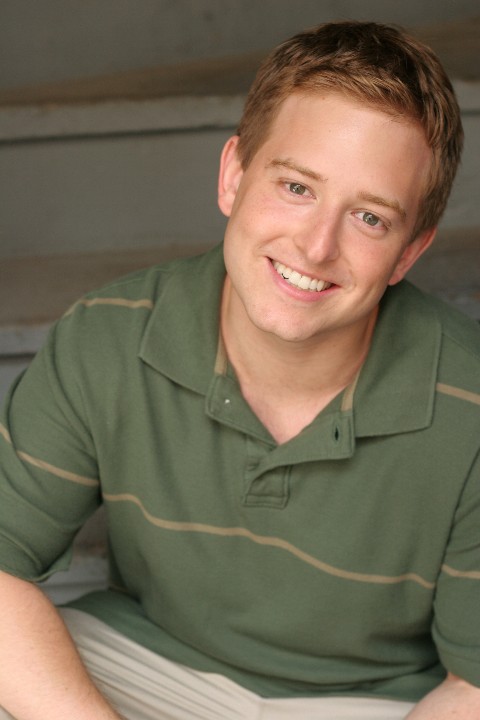
I’m delighted to welcome my guest today, successful self-publisher, creativity coach and actor, Bryan Cohen, who is tapping the unconscious in the House of Dreams.
Bryan Cohen
The unconscious mind has ways of making you stop. You have a deadline and only a certain number of hours to write a certain number of words. And yet, despite all that pressure, the cursor or blank page is staring at you with all its emptiness. It’s writer’s block, that all encompassing, vague term describing why you can’t get the thoughts you know are in your head onto the page. Writer’s block can strike, even when you’re in a seemingly perfect writing situation. You can have writer’s block even when you have a comfortable chair, a mahogany writing desk and a closed door to keep out all the distractions. The problem of writer’s block seems to exist in the unconscious mind.
In writing and self-publishing 32 books to Amazon, I’ve found one of the tricks to unearthing this unconscious problem. The trick to stopping your unconscious hurdles to writing is to go into your unconscious to determine how to knock them down.
People use freewriting or stream-of-consciousness writing for all sorts of purposes. Freewriting can be an emotional release or it can be a way to capture your thoughts at a particular moment. This activity can also be used to answer a question. If you’re experiencing writer’s block at a subconscious level, you can use freewriting to ask yourself how to defeat the problem.
Setup your freewriting session by sitting in a quiet place with as few distractions as possible. Turn off your phone and switch off the internet on your laptop. Set a timer for 15 minutes (though you can always write longer if desired). Start with a simple question or a “prompt” if you will. For instance, you can ask something along the lines of, “Why do I have issues writing in the afternoon?” Write the first thing that comes into your mind over and continue to write down the thoughts that naturally follow the first thought. Don’t edit yourself, even to correct spelling errors. Let one thought flow into the other. Even if you get off the topic of writers block, let yourself take the trip to keep yourself in stream-of-consciousness mode. If you find yourself looking at the timer or otherwise not writing, get yourself back in the game as quickly as possible. Don’t stop. Push yourself. Even if what you’re writing doesn’t make any sense, keep going at least until the timer goes off.
Here’s what I find happens in nearly all my free writing sessions that begin with a question. I take at least 3 tangents. I also retread a lot of what I’ve said out loud on that particular subject. But in all of that, I find at least one actionable step I can take to solve the problem. It’s a banner day when I come up with three or four possible solutions, but even one method for solving my issue is good enough. Besides, it’s easier to put just one idea into practice anyway.
When I put one of these steam-of-consciousness-generated solutions into practice, it almost always makes an immediate impact. In my opinion, this proves that most unconscious issues have an unconscious solution lying around in your brain alongside it. You just need to do a little digging.
Try starting a free writing session with a question that’s been nagging at you. It could be about writer’s block, weight loss, your relationships, your bank statement or anything at all. As long as you trust yourself to write without censorship during your session, you’re bound to find at least one solution to your unconscious issue.
Try a session on for size and discuss what you come up with in the comments!
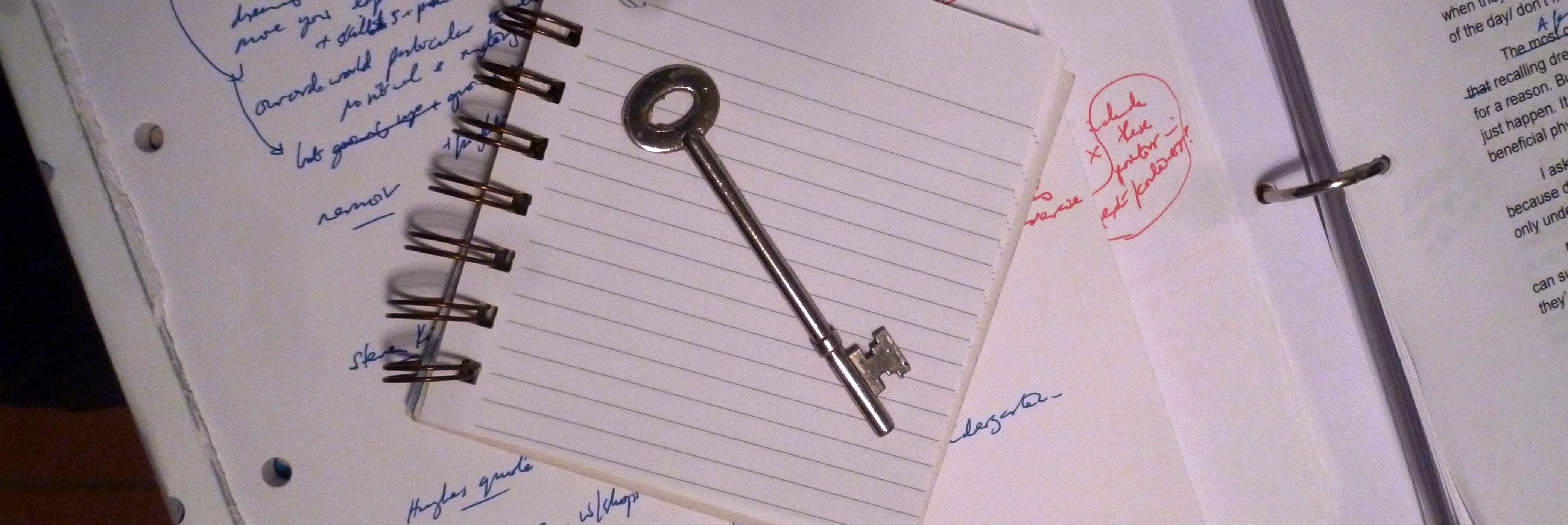
a) What’s it about? b) Who’s it for? c) Why should they trust me? Writing an introduction should be as easy as abc, but if you get stuck with yours like I did, I think I’ve found the key.
For a while now, I’ve been working on the final draft of ‘Writing in the House of Dreams.’ It took me three weeks to go through the whole text, making tweaks and adjustments, so when I decided to re-write the introduction I thought it would take me a few days at most.
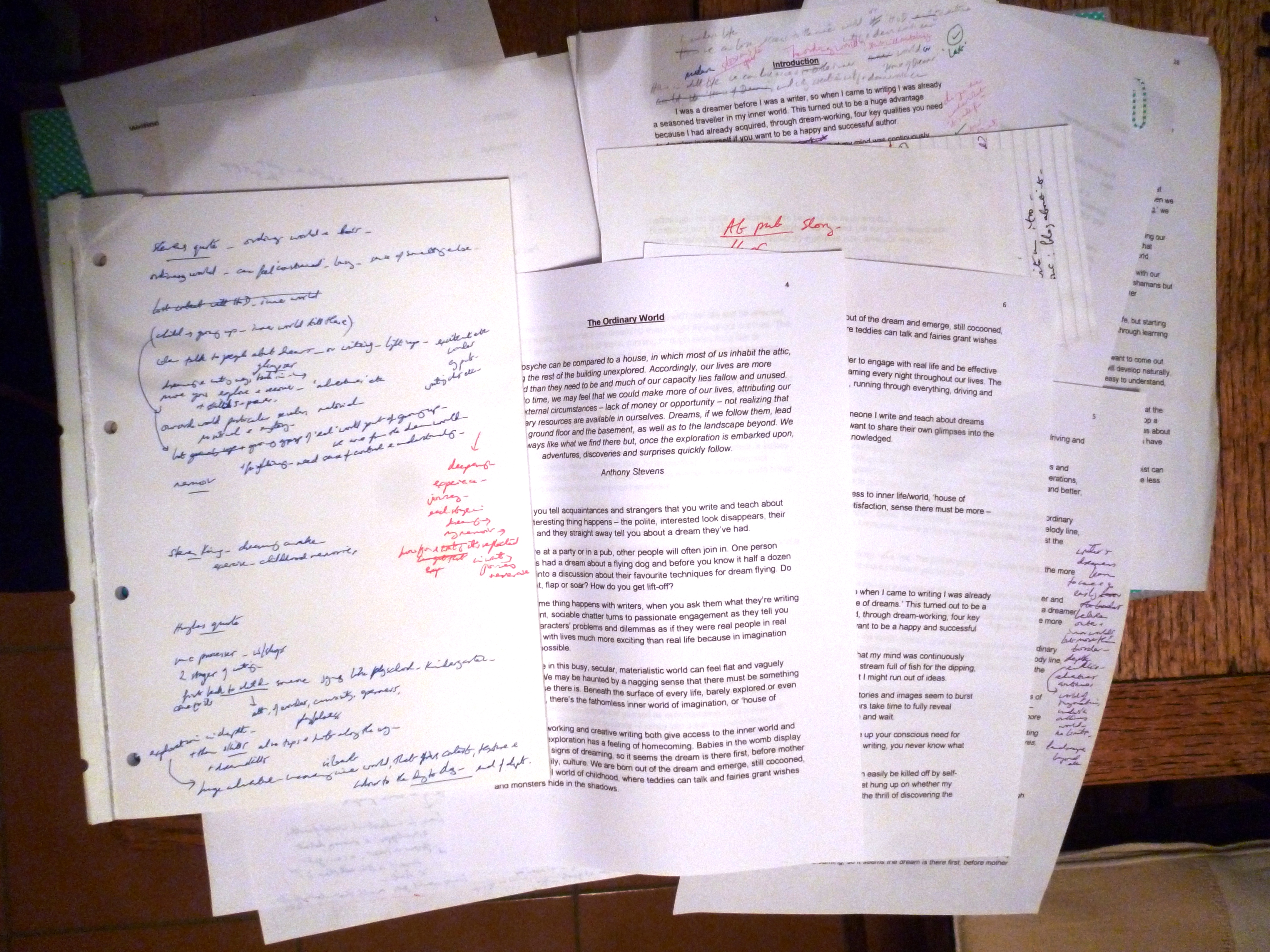
Ten days later, I had a huge and growing heap of notes and a brain like knotted spaghetti.
A growing heap of notes
When I thought about who my book was for, the answer was obvious – dreamers and writers. But what do dreamers and writers want to read about? It seemed to me that the answer to that was interpretations and publishing deals.
When I thought about what my book was about, it certainly wasn’t mainly interpreting and writing techniques, although those did come into it.
What I’m most interested in, what makes my book so ‘niche’, is how dream-awareness and writing can transform your reality, because they both mean learning to come and go easily between the inner and outer world, making ordinary life feel bigger, more exciting, more resonant.
I’m interested in how that ability to come and go across the border can take you ever deeper and wider, because imagination has no limits. I like that the more you understand, the more your sense of mystery grows.
I love the feeling that you can take your explorations as far as you want to go, into layers of myth and beyond, pushing back the limits of your courage, curiosity and skills.
So what is my book about? Adventures in the inner world. Discoveries. Secrets and treasures we can bring back to enrich and inspire our everyday life.
Who is it for? Dreamers and writers, at every level of experience, who are interested in the adventure for its own sake, and not only in writing as a career or dreaming as a source of insights into waking life.
That sounds pretty clear, doesn’t it? That sounds succinct and honest. But I had to come here to my blog, in order to unravel all the strands and identify what the main ones were. On a blog, you haven’t got 75,000 words to explore your themes; you’ve got a few paragraphs to make a point.
When you blog, you’re very conscious of your readers because they’re real people, individuals who might comment on what you’ve written as soon as it goes up.
Yesterday I got the essence of the book by drafting this blog post, and then a happy synchronicity this morning affirmed the focus for the rest of the opening chapter, which is about the leaving the magical world of childhood and learning later to engage with it again.
Someone had posted a comment on my article ‘The dream and the writer’s trance’ which said, ‘I used to slip into the writer’s trance rather easily when I was a child but now I find it harder to get to that state’ (thank-you, Sehena)
So if you know the abc of writing an introduction but you just can’t seem to boil it down, write a blog. That was the key for me.
Someone in the book business recently asked me ‘What’s the point in self-publishing a book, when it won’t get any promotion without a major publisher behind it?’ For me, as a much-published author, this is the point…
I’ve had scores of books published and worked with a dozen different publishers in the course of my writing career but I’m currently in the throes of self-publishing ‘Writing in the House of Dreams.’
Earlier in the year, my agent sent the MS out to publishers, and their feed-back was overwhelmingly positive. ‘An inspirational idea’ said one; ‘a rich feast that sets off all sorts of sparks and recognitions in the reader’ said another; ‘very readable indeed’ said a third, ‘I read it in one sitting.’
So here are the reasons they didn’t take it on (although it went to an acquisitions meeting with one publisher and another said, ‘It was close.’)
‘Too niche’, ‘Too tough for us to sell enough copies’, ‘with such a niche topic we’d struggle to get a good number of copies into shops’, ‘the sales would be too modest’,’a company the size of ours can’t make enough of a go of books on this subject as they would need to.’
One of the big changes I’ve seen since I started in this business is that where previously the decision to take on a book lay with editors, who were generally driven by a passion for reading and discovering interesting writers, now it rests firmly with marketing departments.
I first came to this realisation a few years ago when I proposed an idea for a children’s series to an editor I’d worked with, and she was blown away by it. Bursting with enthusiasm, she asked for six story outlines, then for twelve, to take to the acquisitions meeting, but the series was not taken up because she couldn’t persuade the marketing department. When she told me how disappointed she felt I realised how tough this situation might be for editors as well as authors.
The thing to bear in mind is that marketing people will not usually have read your manuscript, so your book succeeds or fails on how well they think the concept and title will sell. A yes or no doesn’t necessarily reflect the quality of your writing, but just how easily it will fit into the market.
I know ‘Writing in the House of Dreams’ is a bit off-the-wall and ‘in many ways a brave book’ as one publisher rather unnervingly remarked, but I also feel that it’s good. I’ve worked for a reading agency and have a lot of writing experience now, and my own judgement has been backed up by the half-dozen authors, psychologists and dream-workers who have read it.
I’ve been working on it alongside my children’s books ever since I was first published; it’s my child-of-the-heart book, the secret pearl I’ve been feeding with all the writing skills and experience I’ve worked so hard to build up.
I know my book won’t appeal to millions of readers but hopefully it will appeal to some. Five years ago, no-one would ever have got to read it if no major publisher had taken it on and the MS would have stayed on my shelf forever, gathering dust. It would have felt devastating.
It’s better to have some readers than no readers at all – that is the point of self-publishing. It’s also better to carry on show-casing your work to publishers who may happen upon it on the web, rather than putting it away for several years before sending it out again.
Now that authors can be publishers too we can write our passion in the reassuring knowledge that our work may still bloom surprisingly at the edge of a difficult market like a little poppy at the edge of a big field of corn.
If you’re interested in self-publishing, Nicola Morgan (who was one of my lovely readers) is doing a series of interviews with authors who have gone down that road on her blog – well worth a look
Writing can be therapeutic even when it appears to have nothing at all to do with the events of our lives. Here’s how.
In my last post I was talking about the healing power of dreams to ground us physically and emotionally when we get over-stressed and too much ‘in our head.’ Since then, I’ve been to a Lapidus workshop in Bristol which has made me want to share my thoughts on the healing power of creative writing.
Lapidus – ‘words for well-being’
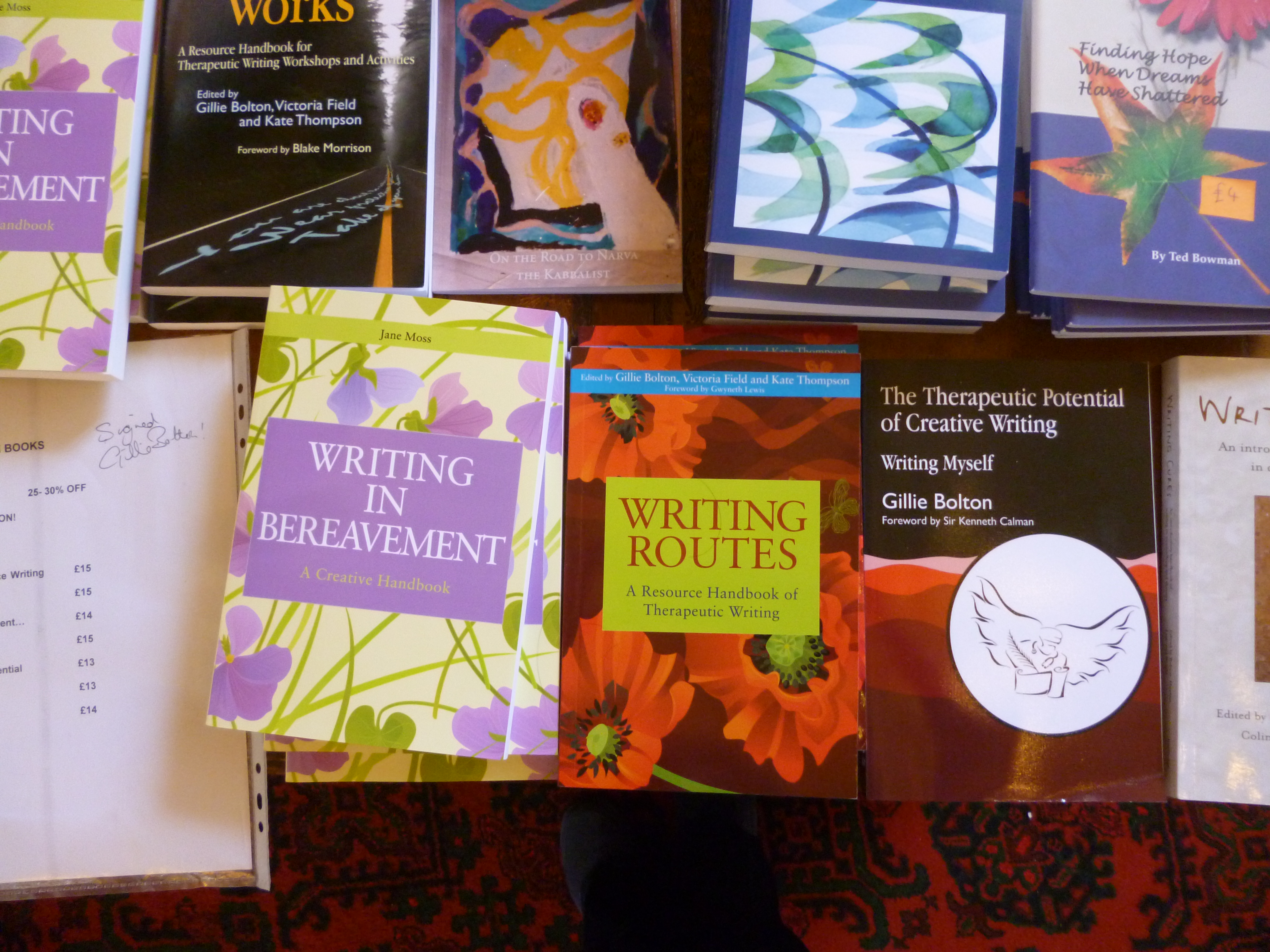
Lapidus is an organisation for writing therapists; it includes mental health practitioners who use creative writing within their clinical practice and authors who teach writing in non-clinical settings as a route to greater understanding of the self and the world.
Some of the wonderful books on offer at the Lapidus conference
Most of the Lapidus workshops I’ve attended have involved writing about our real-life personal experiences, and they have felt rather like counselling sessions, where the theoretical base seems to be about moving towards catharsis or reframing difficult life events or relationships.
One of the great tools of writing therapy is ‘journaling.’ This is a regular practice of personal writing reflecting on personal insights, day-to-day experiences, dreams and inspirations; it’s pretty much what my dream-diaries have evolved into over the years and I can highly recommend it.
But creative writing doesn’t have to be autobiographical in order to be therapeutic. Every poem or piece of fiction we write connects us to our authentic emotions, like the sad dream I was talking about in my last post; it takes us beyond the narrow limits of what we are capable of understanding about ourselves and releases us into the wide, fast flow of emotional and imaginal experiences that make us who we are.
Do you keep a writing journal? Or have you experienced the healing power of writing in other ways? I love to hear about your thoughts and experiences
A sad dream can make you feelout of sorts all through the following day, but it may be Nature’s way of helping you to cope with stress. Here’s how it worked for me.
As I mentioned in my last post back in July, I decided to take the whole of August off, and headed North for four glorious weeks living mostly under canvas. All that fresh air and freedom… when the time came, I did not want to come back.
Paddling across to Oransay from Colonsay at low tide with Barbara Gay from New Zealand. Fun!
I had been redrafting 24:7 right up until the day before I went on holiday, so I arrived home to a messy house and a garden full of weeds, as well as a stack of paperwork in my study that I had been putting off for months.
Top of my to-do list was my tax return. Enough said. Two days of hair-tearing and tedium.
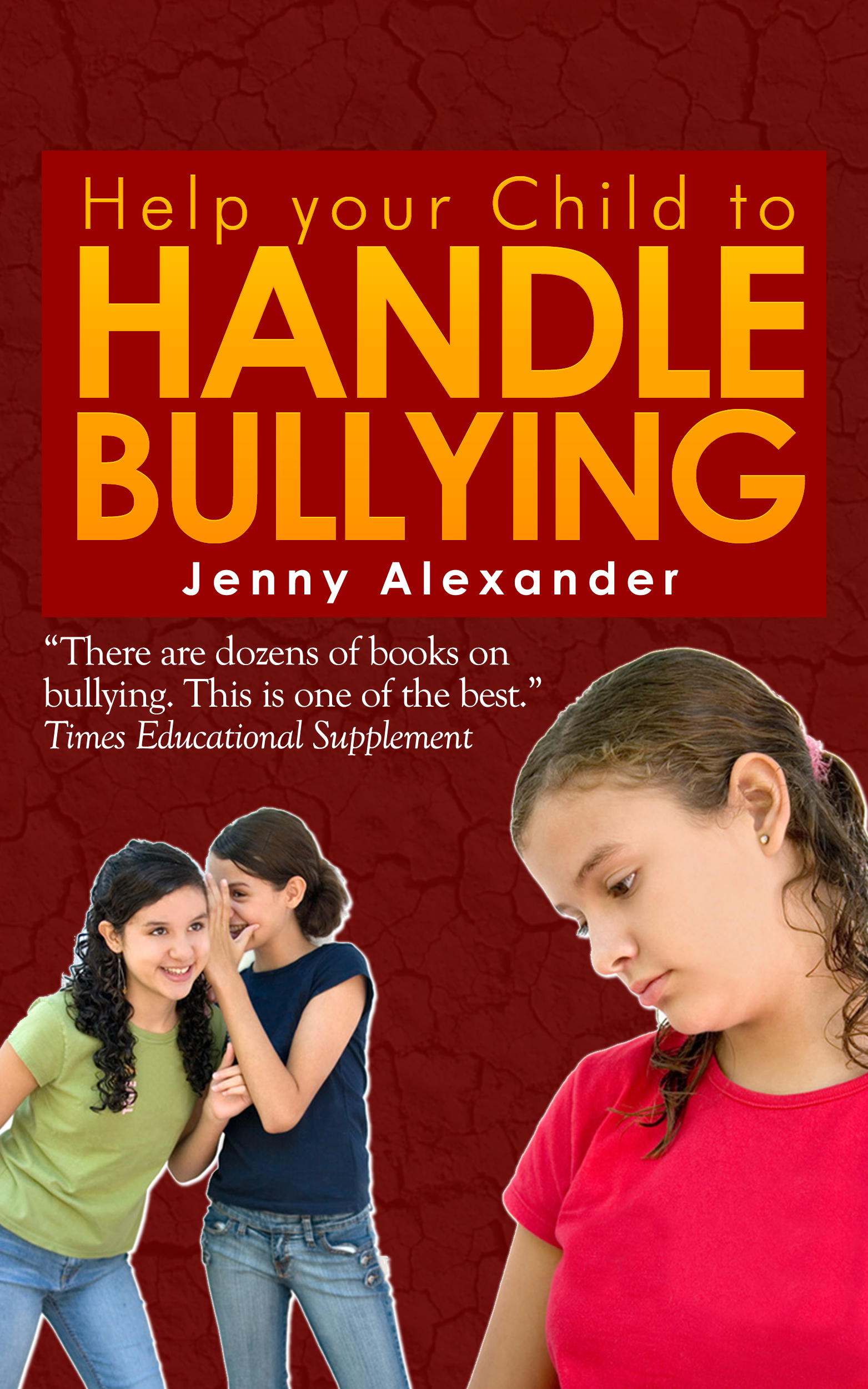
Second was my self-publishing venture, a new e-book edition of Help your child to handle bullying, which I had abandoned back in June. Everything about it made me feel anxious, and there were endless technical problems with the formatting that had to be ironed out (thank-you draft2digital – you were very patient)
Even deciding which endorsement to use on the cover was stressful
Frazzled and still fed up about not being still on holiday, I moved on to seeking copyright permissions for the forty or so quotes I want to use in my child-of-the-heart book, ‘Writing in the House of Dreams.’ This entailed days and days of tracking down publishers and agents, writing emails and filling in lengthy forms.
More stress. Would I be able to trace all the copyright holders? Would they grant permission? Would they demand a fee I couldn’t afford?
And what was the best way of producing the book and bringing it to market? Alongside seeking permissions I began doing research, which turned up a bewildering array of possibilities. I opened discussions, asked questions, discovered even more possibilities. More stress.
All the time, I was aware of the other things on the list, including coming back to my blog. I decided to quit the team on girlsheartbooks, where I’d been blogging once a month, and thought about taking this one down.
There were lots of lovely things on the calendar, as usual, those first weeks home from my holiday, but I was still cross about being back at work and stressed out by all the things I had to get through on my list.
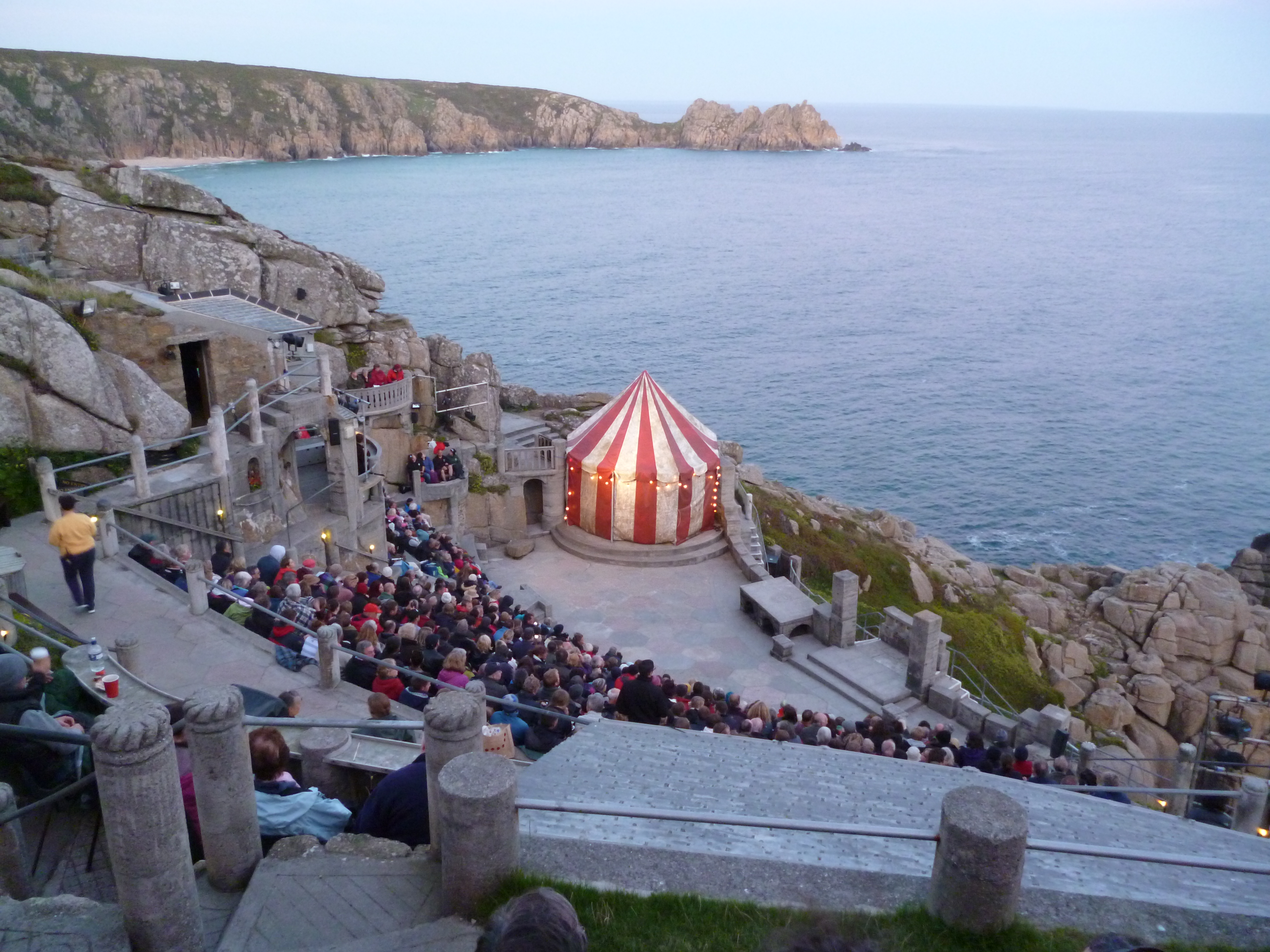
‘The Taming of the Shrew’ by an all-female cast at the Minack theatre – one of the lovely things on the calendar
Then one morning I woke up in tears, from a really, really sad dream. I don’t remember now what it was about, just that the sadness carried over into the day. I lost the will to start work, or the energy to stick at it. I read a bit, walked a bit, sat in the garden. Sighed and cried. Watched the birds.
That night, I slept better than I had for weeks and woke up feeling calm and clear, like the rain-washed sky after a storm.
Stress, like drink and drugs, can be an avoidance of ‘legitimate suffering.’ Life is hard sometimes, as well as wonderful, and one way of coping is by shutting the feelings out.
When you’re stressed, your whole focus is in your head; you spiral up into thoughts and ideas about what you should be doing, and push yourself so hard that you have no time to think about anything else.
Dreams connect you with your emotions, whether they are sad, frightening or euphorically happy ones. When you’re spiralling into stress and stuck in your head, it may take a very powerful dream that spills over into your waking life to slow you down and bring you back into your heart and body.
Instead of letting myself wallow as I had wanted to when I got home from my amazing holiday, I decided to ‘pull myself together’ and ‘stop being silly’ and get on with what needed to be done. My dream forced me to feel the feelings I had been avoiding.
Coming back to my blog after, as it’s turned out, two months away, feels really lovely. I’ve given it a new look, which I hope you’ll like, and got lots of lovely articles planned which I’m looking forward to writing.
The list can wait.
Have you ever had a dream that’s brought you down or lifted you up when you really needed it? I love to hear your thoughts and comments.
The title says it all – I’ve decided to take the whole of August off from blogging/facebookpaging/tweeting and everything else that keeps me at the computer.
I worked 24:7 redrafting my YA novel when the sun was shining last week, and now it’s delivered I intend to get some serious beach time!
It’s important for writers to ‘go down to the well’ and allow fallow time between projects, and being out and about with a notepad and pen is pure joy when the weather’s so warm.
A stroll from Looe to Polperro brought me ‘Peony Pinker’ a few years ago, and camping on a Shetland beach last summer brought me back to ‘The Binding.’ I wonder what this summer’s time out will bring.
I’ll be back in House of Dreams in September, starting with my blog birthday on the 4th, when I’ll be reflecting on my second full year of blogging.
In the meantime, happy holidays everyone. May the sun shine on you, wherever you are!
I didn’t post last week because I was on retreat at Charney Manor in deepest Oxfordshire with the Scattered Authors Society.
Pimms o’clock in the Charney garden
As retreats go, this annual adventure is a very lively one – among this year’s sessions we had comedy improv, yoga, e-publishing, drawing, developing the work-in-progress, searching for the iron-age fort and the traditional Charney Quiz.
It’s got to be around here somewhere!Quiz night – my team was The Naughty Corner (we lost by less than usual)
One of my offerings was an afternoon workshop on writing the tarot. Tarot is useful, like dreams, because the cards you draw will be synchronistically connected with your current emotions and preoccupations, so the themes and characters they suggest will feel relevant and immediate to explore in your writing.
However, in an introductory workshop it can be easier if everyone’s working on the same image, so I like to start at the beginning with number 0, The Fool. Katherine Roberts has described the session on her lovely blog, Riding the Unicorn, if you’d like to find out more.
I’ll be offering a one-day workshop in Cornwall on writing the tarot in the autumn. In the meantime, check out the workshops page on this blog if you think you might fancy some dreaming-and-writing in Surrey this October, and please spread the word if you know anyone else who might be interested.
Cheers!
My session, with Celia Rees, on steering a happy course in a difficult market
My work is emotionally autobiographical. It has no relationship to the actual events of my life, but it reflects the emotional currents of my life ~Tennessee Williams
This quotation from Tenessee Williams seems to me to encapsulate where dreams and creative writing are the same.
Being literal-minded, if we try to relate the writing to the author we only do it in a direct way, wondering whether the people in the story are based on real people or the events are things the author has actually experienced.
We do the same with dreams, especially if we focus only on the symbols and not the emotions.
But even where we don’t find any obvious connection between the story and the author, the dream and the dreamer, it is powerfully there because dreams, like fiction, are simply story-versions of the dreamer’s or author’s emotional experiences.
Have you ever written a story that seemed to have nothing to do with your own life, only to realise later that it was ’emotionally autobiographical’?



![615px-Poppies_by_field_gate_-_geograph.org.uk_-_846634[1]](http://commons.wikimedia.org/wiki/File:Poppies_by_field_gate_-_geograph.org.uk_-_846634.jpg?uselang=en-gb)




 Jenny Alexander's blog: Writing in the House of Dreams