Category Archives: Writing

Live dangerously – do some writing!

A few weeks ago, I received a lovely email from someone who had been here for my Autumn workshop day. Its subject line was ‘Poem inspired by your tablecloth.’

The email was a kind of goodbye, because the writer was about to leave the area and move to Spain. In it, she said,  ‘I think I mightn’t have done all this life changing stuff if it wasn’t for the experiences I’ve shared over the years on your courses and workshops.’

Much as I’d like to think that discovering a new sense of adventure is a particular benefit of my workshops, I imagine it’s a common side-effect of doing lots of writing.

When we write stories, instead of focusing on what is, we’re adjusting our focus to consider ‘what if?’

Any habit of thought creates pathways in the brain; old ways of thinking fall into disuse like overgrown tracks as we favour and carve out new ones.

As well as changing the way we think, writing can change the way we  feel, because when we put our protagonists through trials and troubles which mean they have to be brave and bold, we are experiencing that courage and mastery in our self.

Things we might not previously have dreamt about begin to feel possible and survivable, and simply feeling that we could do something new if we wanted to can make the current status quo feel like a choice, and not a trap. Writing creatively leads to living more creatively too.

Of course, if you dare to dream, there’s always a risk you might just go and make that big life change, and change carries risk. New adventures always involve some element of difficulty, and they can go horribly wrong.

But they will also bring colour and excitement, learning and opportunity. I’m looking forward to following Lizzylarkwhistle’s adventures in Spain when she starts her new blog – all I can tell you so far is that she has met Jesus and Gabriel, and I can’t wait to hear more.

I’ll post the link when I have it but, in the meantime, here is her poem, written in the workshop, at my table. She chose a dead umbellifer from the tray of Autumn offerings I found in my garden.

The Picked Umbellifer

I hope to stay here now.
In some quiet corner, shadowed by firelight
Dreaming of my old roots.

Back on the shifting cliff in Spring,
New, eager growth will push through my old ways.
White, sea scented sprays,
Soon hardened by salty air and beaten by gales and rain,
To a brassy, brittle, bone coloured thing,
A trophy.
As delicate as the cobwebs spun between its flowers,
Flinching from dogs and booted feet
Or a gust that may toss it into the sea.

After all that has passed, I’m glad to be here,
Spun slowly by a gentle hand,
safe in a house, above a table squared
With the colours of summer.

Lizzylarkwhistle

Do you feel writing has helped you to live more creatively?

The Journey

Here’s a beautiful, thoughtful post on keeping a diary/journal, which I think you will enjoy.

Lichen Weaver's avatarVitalWrite

Anne Frank

I have kept a diary from the age of about eight. I used to start each day with: Dear Kizzy, and write as if to a friend. Sadly most of my teenage diaries were destroyed because my older self didn’t like that previous expression of angst. And even later diaries were destroyed, but those ones in a ceremonial fire – I realised how much bitterness and anger from my divorce they contained, and wanted to let that go.

Five years ago I started referring to my diary as a journal, I don’t know if that word is a little more serious, or if I just needed a change of term for a change in the style of entry. In the past re-reading diaries was painful because the pages were filled with all the bad things that happened so this made my life seem incredibly unbalanced, although it wasn’t at all…

View original post 277 more words

Book Review: ‘Art from Dreams’ by Susan Levin

Today, it’s my pleasure to review this new book by Susan Levin, ‘Art from Dreams: My Jungian Journey in Collage, Assemblage and Poetry.’

As a seasoned traveller in the inner world myself, I love reading about other people’s dream adventures, and one of my all-time favourite books is CG Jung’s Memories, Dreams, Reflections, for that  reason.

There isn’t very much to read in Susan Levin’s book,  just a one-page introduction and ten short poems, but I really like the way the brevity of the text brings the focus strongly back to the images and makes the book, in itself, a dreamlike experience. Levin lets the pictures tell their own stories, and give an impression of the  journey overall.

The first half of the book is called ‘My Jungian Dreams.’ Here the poems expand on the images, exploring the artist’s thoughts about consciousness and experience in an open, direct way.

2014-11-05 10.21.00

In the second half of the book, ‘Nocturnes,’ there are no poems, just a set of striking images with intriguing titles such as ‘Message from horse and snake’ and ‘Ship of souls.’

2014-11-05 11.07.49

The mixed media and collage approach feels to me an exactly appropriate way of conveying the quality of a dream, this bringing together of disparate objects into a unified experience of colour, tone and feeling.

The night after I read Art from Dreams I had a very visual dream which reminded me of one of Susan’s collages. At the bottom of the picture, me with a glass of sparkling wine; above that my Writing in the House of Dreams book launch cake, and flying above that in the clear blue sky, a young woman on a brightly-coloured hang-glider.

The book is beautifully produced and bound, a lovely object which readers will return to, and take inspiration.

Tomorrow, Susan will talk about the process of one of the artworks in the book here in the House of Dreams. Don’t miss it!


Organising a book launch – your 10 point check-list

It’s a common misconception that if your book secures a deal with a major publisher they will organise a lavish book launch and all you’ll have to do is show up in a new frock and graciously accept the toast. This can happen, but only for the chosen few books that get the lion’s share of the marketing spend. The majority of traditionally published authors have to organise their own book launches, although publishers are often happy to make some kind of contribution. If you’re self-published, of course,  you’re on your own.

A book launch is a major undertaking and to be honest I haven’t bothered with it for every book but, when I have, I’ve always felt glad I made the effort. After all, a book is a major personal achievement and one that’s worth celebrating. If you’re organising a book launch, here’s what needs to be on your check-list:

  1. Notify your publisher if you have one and ask if they would be willing to help by, for example, providing promotional bookmarks and cards, designing the invitations or contributing towards the cost. Don’t think this is cheeky. You and your publisher are a team, and they’ll be delighted to know you’re making an effort to help promote your new book.
  2. Plan your guest list and send out invitations well in advance.
  3. Choose a venue that is appropriate to the kind of event – small and intimate, big and showy or possibly themed to the book, such as a historic building if it’s a historical novel or a railway station if it’s about travel or a cake shop if one of your themes is food. Be creative!
  4. Set a time and date. Most launches tend to be early evening, say 6-8, during the week, so that people can come by after work and you don’t have to provide a meal.
  5. Think about the catering. As well as sparkling wine for the toast, what other drinks are you going to provide? If a lot of people are likely to be coming by car, remember to lay on plenty of soft drinks too. Can the venue provide a cash bar, to top up your offer?For food, you could get a caterer to lay on a variety of canapés or provide something simple like cheese and olives yourself. Most launches these days seem to involve a fancy themed cake, but that’s still optional. Remember you’ll need someone to serve the drinks and nibbles.
  6. Think about setting out the room. Don’t have too many chairs – just one or two for those who can’t stand for long periods, or else people will not circulate. You’ll want flowers and possibly some kind of display, with posters of the book cover, you doing events or whatever. You could have a colour scheme, such as pink and sparkly for a children’s fairy book, which could extend to the food and drinks as well as the tables and displays.
  7. Arrange for a local bookseller or friend to handle sales of your book on the night (a bookseller will normally charge 30% of your takings)
  8. Arrange for at least one person to take some photos and possibly video your speech/readings (Liz Kessler took mine, including the ones in this blog post – thank-you, Liz!)
  9. Decide whether you’re going to do a talk and/or readings and practice in advance. Check there’s an elevated spot such as a step to stand on, or take a footstool for yourself so that everyone can see you.
  10. Ask someone to propose the toast – this could be your agent or publisher, a fellow author or someone else who has some connection to the book.
Remember to take your signing pen!

The way you tackle these points will depend upon your goal in having a book launch. For example, if you’re having it to get publicity and make lots of sales, your guest list will include local media, any movers and shakers you know and as many people as you can bring in, via leafletting and social media. If you take this approach, ask people to let you know if they intend to come along, so that you’ll have some idea how many you’re catering for.

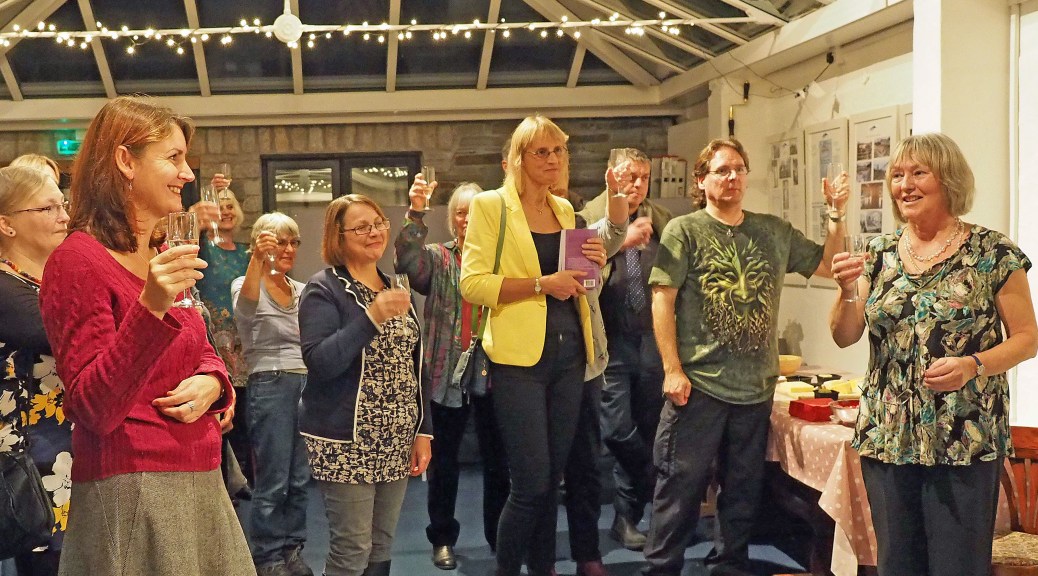
But publicity and sales are not the only reasons for having a launch.  There may be times when something more personal could feel more appropriate. For example, my book launch for Writing in the House of Dreams last week came from a deep desire to thank my family and friends for all the support they’ve given me over the years with this child-of-my-heart book.

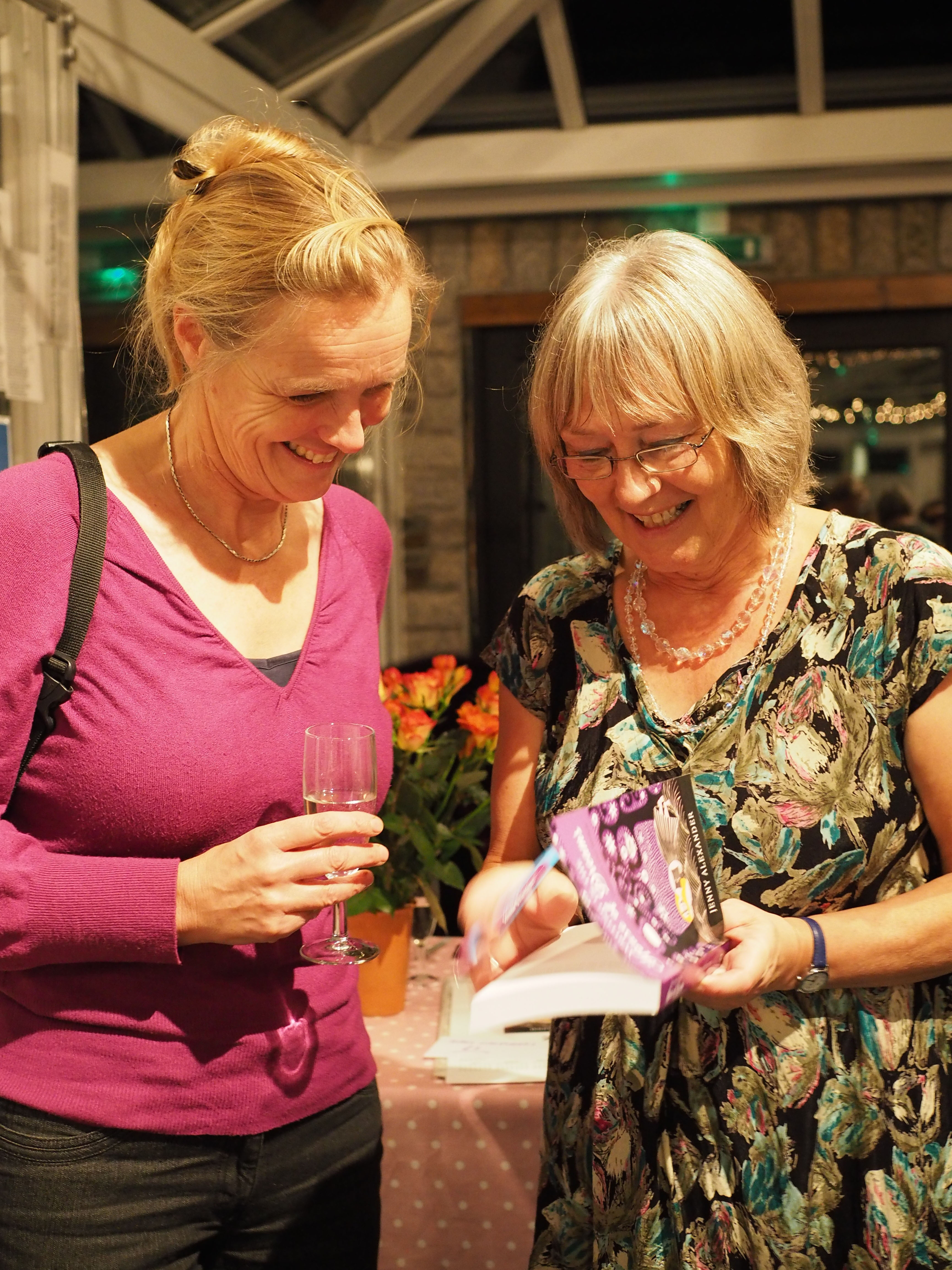
Me and Liz
Liz Kessler and me

I didn’t invite any press and I chose the little cafe at the open-air theatre in my village for the venue. Those of my children who could get time off work and my ex husband travelled from Orkney, London and Brighton to celebrate with me; my friend Liz Kessler came up from St Ives, my friend-and-editor Helen Greathead came from Plymouth.

Family came to celebrate with me

Among my local friends, there were Cornish Crones, Gospel singers, counsellors and some of the people who have been on my dreaming and writing workshops, all of whom, in some way or another, have been present for me during the often-difficult writing of this book.

I did a speech! I don’t normally do that, but Writing in the House of Dreams isn’t my normal kind of book. I wanted to explain what writing it had meant to me, and express my gratitude for the help and encouragement I had received. The book was available to buy, but I would not have been upset if nobody had bought it – actually, I might have been relieved. It’s a personal book and a bit out there, and although I’m happy for strangers to read it I was worried what people who know me might think.

Launching it felt like a kind of coming out, and it has been liberating. Before the launch, I had three weeks of technology meltdown, with both my computers and my mobile phone all giving up the ghost, so I couldn’t  do the publicity I had planned.

Sometimes the outer world expresses what’s going on inside, and I think maybe I had to announce the arrival of my book-baby and show it off to my family and friends before I could feel really ready to take it out into the world.

Have you ever organised a book launch? Is there anything I’ve missed from my check-list? Is there anything you might do differently next time?

Two kinds of writer – which kind are you?

I’ve met and chatted with scores of authors and been to dozens of writing conferences and residentials in the course of my career and it strikes me that there are two kinds of writers.

Some writers start from the dreaming, intuitive mind, which creates spaces and populates them with an easy natural flow, and they don’t try to take control of the idea until it’s virtually fully formed in their imagination.

This can be a long process – it sets its own pace, and the author’s task is to watch and wait, and be willing to explore all the paths that open up, and see where they might lead.

This way of writing is rooted in a long period of gestation, when nothing appears to be happening and nothing seems to be achieved, but once the writing stage is reached it tends to come quickly and relatively easily.

Other writers work in a more methodical way, starting with a basic idea and building it up one block at a time. For this kind of writer, fixed work-times and word-counts can be a useful tool, keeping them focused on the task from beginning to end, and the writing progresses at a steady pace.

Either way works, depending upon the writer’s personality. You can find out more about your own natural style by doing the Myers Briggs Personality Types Indicator test.

Culturally, we value the practical, rational approach and mistrust the intuitive, which can mean that the more intuitive type of writer may undervalue the patient pondering stage which is part of their own process.

I write for those writers, to honour and celebrate their way of writing, where that long period of daydreaming, rambling, chatting, reading is as much a practical part of the work as sitting at the computer, producing words.

Which kind of writer are you? Is your process a slow daydreaming and a rapid writing, or a steady progress from start to finish?


Finding my place: poetry and migration

Cracking post here from my daughter, Rosie, where she talks about using creative writing as a way of connecting to place. I hope she’ll share the whole presentation soon.

Rosie Alexander's avatarDr Rosie Alexander

Something you may not know about me is that as well as being a careers adviser and studying for a PhD, I am also a poet. Over the last six months or so I have been thinking about creative writing, and exploring potential connections with narrative and biographical approaches to careers and migration. This thinking culminated in a paper that I presented last week at the Creative Orkney conference.

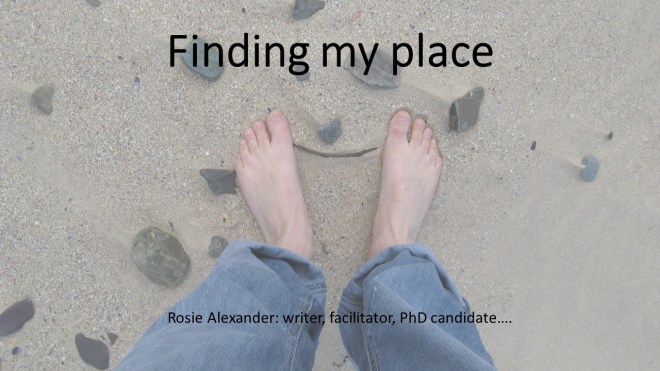
Finding my place Title slide from my presentation at the conference

In this paper I examined my own use of creative writing during my geographical migration from Cornwall to Orkney. I started by discussing the terminology of ‘place’ and identifying how place is ‘space invested with meaning’ (Cresswell, 2004). I then discussed how creative writing is an excellent tool for generating meaning, and therefore may be used to develop an attachment to a new place. In addition because creative writing requires us to be…

View original post 199 more words

On becoming a fully-fledged hybrid author

It’s been a steep learning curve, but I’ve finally arrived – it’s publication day! In this, the last of the five dreams I’ve shared here about my self-publishing journey, I’m looking at the road ahead.

I’ve done a talk about being an author, including the difficulties of getting stocked in bookshops and making enough sales. Not that I’m complaining – I do have enough. As I chat outside with the organisers, they’re waiting for the next author – and it’s a really famous one.

Here she comes in her little yellow car. She’s a friend and I’m delighted to see her, delighted to see the eager anticipation in her young fans’ faces.

As she walks towards us, I notice the little creature I’ve found and been looking after has caught the attention of a crow-like bird. The creature is small and furry, some kind of hybrid, strange and very sweet. And feisty! He isn’t afraid of the crow, although it’s much bigger than him.

I shoo the crow-like bird away and pick up the creature – he isn’t hurt or even shaken. It’s happened before – cats have chased him as well as birds, foxes too – but I think they’re more curious about him, than wanting to eat him.

It’s odd how he’s come into my cave, but I’m glad, because he’s a lovely little thing and I like looking after him. 

It’s been stressful, it’s been full-on, it’s been emotional. I won’t lie. Learning how to self-publish has taken up most of my energies these last six months, one way and another.

If you’ve read my last four posts, you’ll see that having embarked upon it, I soon learnt to love it though. I even came to choose it for the book I’m working on now, When a Writer Isn’t Writing.

I got swept up in the buzz of being free to make my own choices and decisions, and push forward in my own time and at my own pace. I felt like William Blake, inventing his very own printing system to publish his own books, but without even having to be a genius or inventor.

I felt like the child I once was, never happier than when I was writing projects and making them into books, doing all my own binding and illustrations.

In my dream, it felt odd the way this funny little creature had come into my cave. As a technophobe, I would never have had a strong enough desire to learn how to self-publish if I hadn’t had a book I cared so much about that didn’t have anywhere else to go.

I protected my little fledgling hybrid from every attack – crows, cats, foxes; other people’s judgements and my own self-doubts.

But what I also learnt, in the course of self-publishing, was how much traditional publishers do that we authors tend to take for granted.

I discovered how much I still wanted that to be part of my writing career. Looking forward to 2015, I’m delighted to have a book coming out in February with A and C Black, as well my self-published writing book.

This funny, furry little creature was the beginning of my new career as a hybrid author, and I’ve blogged about it in a post called Why I’m a Happy Hybrid for An Awfully Big Blog Adventure, where I lay out my pros and cons of self-publishing vs being traditionally published.

So now it just remains for me to ask you to raise your glasses please to Writing in the House of Dreams. If you buy it and enjoy it, please review it, but if you think it stinks, please don’t!


Are you temperamentally suited to self-publishing?

Dream 4 in the countdown to publication! Last week’s dream highlighted how I felt when I started self-publishing; this week’s showed me why I felt that way. 

I’ve got on a bus to go to London and a few hours later the bus stops in the early morning mist and I see we’ve come to Camborne. Instead of going East, we’ve been going West. I get out and look at the misty hills of the far West, so wild and beautiful, but so much not where I expected to wake up, and I think having got up so early and set out so hopefully, now it’s too late to get to London.

Now I’m writing about an adventure on a train. I see other authors – Liz and Elen and some others – have got together to write adventures on trains, and get publicity, and they’ll sell much better – but the fact is, I prefer to work on my own.

When I finished Writing in the House of Dreams, the first thing I did was ‘go to London.’ I sent it to my agent, she liked it, she sent it out to major mind-body-spirit publishers.

When it didn’t get a contract I realised that where I had been heading all along was home, towards publishing it here, myself, and I experienced a mixture of feelings.

I was disappointed, certainly, having set off so hopefully, believing in the book, armed with wonderful feedback from my expert readers and feeling sure that it would find a publisher.

But I also felt excited about the ‘wild and beautiful’ vista of self-publishing that was opening up in front of me instead.

My dream went on to acknowledge that the mainstream way would certainly give me a higher profile and sales, but going it alone could actually suit me better.

In my career, fame and fortune have never been main drivers; my passion is the writing, and I’ve never sought the kind of success that would take me away from it on things like book tours and festivals.

My career goal, now as ever, is to make enough money from my writing to keep on doing it, without having to worry about the bills or trying to fit all my work into a marketable brand.

Last week, I asked whether you had ever self-published, and how you felt about it once you got started. Not everyone will feel the same; this dream suggests it might just suit my temperament and fit my writing goals.

Next week the countdown ends! Meet me back here to celebrate publication day and hear about dream number 5, which involves a sweet little furry animal and a curious crow.

Self-publishing – why every author should try it at least once.

‘Writing in the House of Dreams’, the book – dream 3 today on the countdown to publication! This one came when I was working out my publishing schedule. 

Before, you had to take your story and wait for them to see you, like waiting at the doctor’s. Hours, days you might be waiting there, because every story had to be checked and verified, and they might have questions for you.

Now, you can just post your story online, and if they’ve got questions, they can research online, and you don’t even have to go. It feels liberating!

When you’re thinking about trying something new, first you feel excited. Then anxieties flood in, to stop you acting impulsively and make sure your head is in line with your heart on the  adventure.

Once your hopes and fears are all in the mix, you can stir it up and see what rises to the surface. In the post before last, I described how  what was important to me when I was first thinking about self-publishing rose to the surface in a dream.

Weighing up the pros and cons can bring you to the threshold of a new venture, but you don’t know what it will feel like until you actually begin.

Before I decided to commit to self-publishing Writing in the House of Dreams I had viewed it purely as a fall-back if I couldn’t get a traditional publisher.  Although I was glad it was an option, I would not have chosen it.

But as soon as I got started on the work of self-publishing, I felt how different it was from my previous experience as a traditionally-published author, and it was a very positive difference.

Having a manuscript under consideration with traditional publishers you’re full of impatience, helplessness and anticipation about what they’re going to say, just like when you’re waiting to go in and see the doctor.

It usually takes months; it can take longer. One of my books got an offer a year after we started sending it out.

Now suddenly, with self-publishing, there’s no need to wait. You can crack on with it as soon as you want to, and that feels exhilarating.

Research is just data; what fires creativity is emotion, and until I experienced the emotional difference between that doctor’s waiting-room feeling  and that unexpected exhilaration, I would always have thought of self-publishing as second best.

I have no plan to submit my follow-up book When a Writer Isn’t Writing to traditional publishers. Although I still very much hope to go on being traditionally published, it no longer feels like the route of choice for every book, and I want to feel the buzz of doing it myself again.

I think that’s why Orna Ross, who set up the wonderful Alliance of Independent Authors says every author should try self-publishing at least once.

Have you ever tried self-publishing? How did it feel to you?


When your to-do list is freaking you out

Five posts to publication, five dreams – here’s the second. It came when I’d made some decisions and started the ball rolling with self-publishing Writing in the House of Dreams, and was worried about the enormity of the task I was taking on.

Sat 8th Feb, 2014

I’m in a cafe with my grown-up son. It’s a formica tables and plastic chairs kind of place, and he looks completely incongruous in a wide-shouldered, pale-coloured overcoat which makes him look like a cross between a fat-cat businessman and a mafia godfather.

I’m talking about Writing in the House of Dreams. ‘There have been times,’ I say, ‘when I would have loved to just give up and, if I hadn’t loved it so much, I would have done.’

He says, ‘What you need to do is pray!’ I see he’s also a preacher of some kind now. Before I can say, ‘I do pray. That’s how I’ve got this far,’ he whips a little music machine out of his pocket, puts on some loud gospel music and yells ‘Halleluyah!’ Everyone in the café jumps up and joins in, dancing, clapping and singing along.

This is one of those dreams that feels like a gift when you’ve gone to bed feeling anxious, because it wakes you up in the morning with a smile on your face. That, in itself, puts your anxieties in perspective, even before you get to the sense of the dream.

As an author who has always been traditionally published, one of the things that surprised me about self-publishing was how challenging it could be to keep up my stamina and confidence without the back-up of a hard-working and confident publisher.

Normally, I don’t have to think about the book once it’s with the publisher – I just get on with writing the next thing. But when you’re self-publishing, you have to go on working with the manuscript long after the decision to publish is made. You have a massive to-do list, and doubts can start to set in.

Have you got enough time and energy to see it through? Is the book actually worth all that time and energy? Are you capable anyway of doing a good enough job?

One way to get past worry is by lifting your focus from every individual problem to the bigger picture; from what you’ve got to do to why you want to do it; from yourself to what is bigger than yourself.

You can call it what you like, it doesn’t have to be God. You can call it Love. Whatever you love is bigger than yourself. It lifts you above selfishness and laziness and bends you to its work. The reason I write is because I love writing. I want to be better for writing. I’m willing to give up other things I’d like to do for the love of writing.

Prayer is perspective. My dream reminded me that I couldn’t give up, because of that love.

Laughter is perspective too. My dream told me not to take it all so seriously. I could only do my best, and the rest was down to luck, or grace, and out of my control. O happy day!

What helps you get a sense of perspective when your to-do list is freaking you out?