My guest in the House of Dreams this month is the author Alison Boyle, who attended one of my workshops a while ago. I love the idea of ‘writing in the space between sleeping and waking.’
Alison Boyle
In the space between sleeping and waking I found a way of expressing the internal voice of a main character in my latest book ‘from Pakistan to Preston’.
‘From Pakistan to Preston’
Most of the narrative is in the third person, and I’d been looking for a convincing internal voice for Tommy O’Reilly that exposed the indecisions whirring round his head. Tommy’s self-expressive flights, which I scribbled on scraps of paper at the moment they occurred to me and not a moment later, bring a change of tone and perspective to the story. Through this voice I hope that readers feel they understand – and feel – Tommy’s struggles in loving Sunehri Saleem.
The rest of the book is quite grounded, featuring the unusual work setting of an artificial silk factory in the North of England.
I found that the signposts in Jenny’s dream workshop allowed me to travel a little more confidently down some imaginative pathways I had only tentatively explored through my writing before. The biggest surprise was finding that her workshop didn’t activate a warning beep on my ‘Is this new age nonsense?’ monitor.
At the Manchester Literature Festival, Northern Debuts
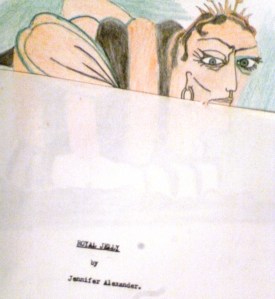
When I decided to try and make a career of writing in my early forties my first stumbling block was that I had no idea what kind of writer I wanted to be. I’d written a number of adult novels in my teens and early twenties, and sent a sample of the last one to six big publishers, four of whom had asked to see the whole MS. They all went on to send me encouraging letters of rejection, the concensus being that my book was too ‘experimental.’
Royal Jelly – too experimental!
Like lots of writers dipping their toe in the market for the first time, I didn’t notice the encouragement, or indeed clock what a good sign it was that four out of six major publishers wanted to read my whole manuscript. I took the fact that they’d all rejected it as a sign that I wasn’t good enough.
In the long gap between those early novels and my decision to try and be an author, I’d also discovered a great enthusiasm for children’s books through reading billions of them to my own children. So I wrote an adult novel, a whodunnit and several children’s stories and sent them to several agents.
The agent who took me on said she thought I could be published as both an adults’ and a children’s author, but advised me to start with children’s stories. She stressed that it wasn’t easier to write for children but, purely because of the much shorter length, it was quicker. I might spend five years writing an adult book and then not find a publisher, which would be crushing, whereas I could do a lot of children’s stories in that time and, even if I got rejections, I might well still hit the market quicker.
I was happy with that. Writing shorter pieces was easier to fit into my daily routine of grabbing a few hours to write in the mornings when all the children were at school or playgroup. I enjoyed it hugely, but I assumed it was a phase – I thought the reason I could write children’s stories was because I had children at home, so I was kind of in the zone. When they grew up, my writing would surely grow up too.
But since my children have flown the nest, I’ve discovered that there’s this lively ten-year-old in me, and she’s the one I’ve been writing for all along. She’s both my reader and my protagonist, and she loves funny stories, with lots of action and chaos.
I don’t think it’s outer circumstances that make a children’s writer, but what’s inside. If you haven’t got that vocal, living inner child demanding and driving your story, you’ll get the voice wrong, you’ll speak down as your adult self and your readers won’t connect with what you’ve written.
In that case, I’d say personally that it would be easier to write for adults.
Lots of shadows in the House of Dreams lately, but before I leave this theme, an update from Toko-pa has prompted me to write a balancing article about the bright side of the Shadow.
I did mention the bright side in my article ‘It’s the seat of creativity – so how can you find your Shadow?’ but only in passing:
This is not to say the Shadow is only negative. Positive potentials which may have been strong in us can be lost. For example, a strong-willed child may learn to identify that strength as a bad thing, and grow to suppress and deny it.
The Shadow is everything we can’t see directly in ourselves. Toko-pa says 90% of that will be ‘pure gold’, but I feel the percentage will depend upon other aspects of your personality. A person with low self-esteem, for example, will be unconscious of many of their more positive qualities, strengths and potentials, whereas someone who feels they are ‘good’ may be suppressing or projecting out many of their own human weaknesses.
When we write, our protagonists express energies in our Self of which we may or may not be aware, and these are not only the dark energies of our villains but also the bright energies of our heroes.
In our heroes, we experience qualities we may not identify with in life, but which must exist in us because they are finding expression in our stories. My protagonists are usually resourceful, independent and brave, but I’ve only come to see where they are me through writing their stories. I used to think of myself as the very opposite of all that.
So there are bright lights hidden in these shadows which, if we follow them, can lead us into the most wonderful areas of the Self. The process may still feel challenging, because anything that shakes our beliefs about ourselves unsettles our world and forces a readjustment of both our memories and our future dreams.
And we have to walk this path lightly, not trying to understand or interpret, but listening for echoes, being aware.
Have you noticed key characteristics that run through most of your protagonists? Are they qualities you recognise in yourself?
Next week I’ll be giving my answer to a straightforward writing question: Is it easier to write for children?
My complete conversation with award-winning author Susan Price – she of the vengeful, spurned daemon – has gone live on her blog today. It’s got darkness and daemons, death and delight… all the stuff you’d expect in a chat about writing and dreaming. Take a look!
Plus the added bonus with Susan’s lovely blog, you get Blott 🙂
In interpreting dreams, we’re looking for the hidden connections between the dream and waking life. The clue is often in the emotional quality of the dream, which may resonate with the dreamer’s feelings about a waking life situation.
When we find the emotional echoes, we will often notice that the dream is a kind of alternative story-version of a daytime event or situation. ‘I felt shocked and anxious to stumble upon a shallow grave in my dream when I was wandering through a dark wood… and, come to think of it, I felt shocked and anxious to discover something I had previously been in the dark about…’
Wandering through a dark wood
The events of the dream are so different, we won’t usually notice the hidden connections unless we go looking for them, and it’s the same with writing.
The stories we write come from the same layers of the self as dreams, and like dreams they are usually symbolic versions of the stories we’re living in our ordinary life.
If we notice this at all, it will often be years later when we’ve gained some distance on both the real-life events and the story we’ve written. But it can be instant, as I experienced this week with the book I’m working on. I suddenly thought, ‘This character is me!’ and it was not a very sympathetic character (hello Shadow!)
Having clocked the mirror she was holding up to me, I really examined my attitude towards a situation I was struggling with. Then she was free and I changed her in the story.
I think there is a psychologically healing or self-developmental purpose to creative work in exactly the same way as there is to dreaming. Through these imagined stories, we rehearse our real-life problems and dilemmas; we experiment with different paths and processes in imagination, and explore all the possible outcomes.
I’ve used creative writing with children in schools in a deliberately problem-solving way to explore the issue of bullying, where the children will create a character who is being bullied and then develop their story by asking, ‘What can they do to make it stop?’
The character will try lots of ideas, until they find one that works. In the writing, the children are exploring a difficult real-life situation and imagining strategies they might use if they had to deal with it themselves.
When writing is free, and not a directed exercise like in my bullying workshops, writers will naturally put their protagonists in situations where they will be faced with emotional challenges and find solutions which might blaze a trail for the writer in real life.
Does this mean we should feel exposed by what we write? Not at all. Like dreams, our stories have hidden connections only we can see, because only we know the secret processes of our hearts and minds. Even people who know me well would not be able to identify the link between my shadow-character and what I had been thinking about during the week.
As Jung said, an interpretation tells more about the interpreter’s current state of mind than the dreamer’s, and any hidden connections readers might find in your stories will be connections with their own lives, not yours.
Have you ever had one of those a-ha moments about a piece of writing, when you suddenly realise, like waking from an obvious dream, ‘I know what that was about!’
The award-winning author Susan Price and I are exchanging emails at the moment for a future entry on the ‘A conversation with’ page on her blog. By a delightful synchronicity, her latest response was a perfect illustration of the blog post I had just written last week, and she has agreed to let me publish it here.
Susan Price
There was a time in my life, when I was denying that ‘other’in my head, when I think my subconscious very deliberately worked against me.
I would say something quite innocent to someone – ‘Hello, how are you?’ for instance – and hear myself saying it in a tone, or with an inflexion that completely changed the meaning and made it insulting or aggressive. I had absolutely no conscious intention of insulting anyone, and would be as astonished as the person I’d just offended – but, of course, what could I say? – ‘I didn’t mean it like that! – That came out wrong!’
Sometimes people were polite, but I’d just bitten their heads off for no good reason. It was impossible to explain that the voice they’d just heard wasn’t mine. They would have thought I was mad. I occasionally thought I was mad.
I was at logger-heads with what I now call ‘my daemon’ because I was refusing to acknowledge that it existed, and so it fought me all the way. I would be writing something and would decide to make some change to the plot. What I now call the daemon would object, but I would refuse to listen because I didn’t recognise its voice. I put it down to a mere passing thought, and brushed it off because at that time I was certain that there was only one voice in my head: the ‘I’ voice, which I would now call ‘the editor’.
The daemon took its revenge by withdrawing. The piece of writing I was working on would turn to stone, or dry up, or fall over dead – whatever image you want to use. I had to learn that with writing – or, I think, any art – the daemon does the real work! The Editor may make some great editing decisions, once the real work is finished, but shouldn’t be allowed to interfere with the daemon.
A vengeful, spurned daemon is a dangerous thing, I think. Mine not only stymied my every effort at writing, it played those tricks to embarrass me. It was ingenious at finding ways to make such remarks as,“Yes, please,” and “Yes, I’ve heard of that,” nasty and cutting.
I had to learn that talk of ‘muses’ and ‘daemons’ was not the arty-farty nonsense I thought it, but simply a way of talking about something that we don’t quite understand, and don’t have an everyday vocabulary for. I began to solve problems with writing by summarising the problem and saying to the daemon,‘Solve this for me.’ And it did! The more I trusted it, the faster and more inventively it solved the problems.
I started to give way to it. If it insisted that a particular character should – or shouldn’t – die, I no longer argued, but humbly worked with it to make it so. I discovered that the more I worked with and trusted the daemon, the friendlier it became. It stopped playing those tricks on me!
As a result, I paid it more attention and ‘heard’ it more clearly. I started to see how a piece of writing that I’d ‘made up as I went along’ had sub-texts planted in it, and other subtleties that ‘I’ hadn’t written – so who had? And then I read Kipling’s description of his ‘daemon’ and knew what he was talking about right away.
If you’ve enjoyed reading this taster, watch out for our full conversation on Susan’s blog in the coming weeks. You may also like to check out her ‘Muse Monday’ guest post on Katherine Roberts’ lovely blog, Reclusive Muse, where she descibes her daemon and quotes the passage from Rudyard Kipling she refers to here.
Jung called the Shadow ‘the seat of creativity’ because it contains every potential in us, not just the qualities we identify with. Instead of being limited and narrow, like our ideas about who we are and what life is, it’s fluid and boundless, and messy like real life.
Meeting the Shadow is an experience of expansiveness; it releases energy which was previously tied up in holding the border between what we think of as ‘me’ and ‘not me’, what we think of as ‘how life is’ and how life really is.
It isn’t something you can understand by reading about it. Jung said the archetypes were not ideas but ‘pieces of life itself.’ You have to experience it, and you only know you’ve got it when you are changed by that experience.
An uncomfortable meeting
Meeting the Shadow is always uncomfortable. If it’s easy, you aren’t doing it right, because the Shadow is by definition the aspects of our self that we’re so uncomfortable with, we’ve disowned them.
This is not to say the Shadow is only negative. Positive potentials which may have been strong in us can be lost. For example, a strong-willed child may learn to identify that strength as a bad thing, and grow to suppress and deny it.
We can’t see the Shadow in ourselves; we have to look in the mirror of the world, where we have projected it out, and the clue is in our feelings.
Five obvious places to look
Think about people who provoke an exaggerated emotional response in you, either positive or negative. These might be people you know personally or public figures. The things you dislike or admire about them could be undeveloped potentials in yourself.
Think about your fictional heroes and villains – who’s your favourite character in the drama/sitcom you’re following? Which character do you most despise? Describe them in two words. Consider!
Slips of the tongue. When you say something you didn’t mean – or someone takes something you’ve said in a way you didn’t mean – what would it say about you if you meant it?
Notice what people say about you – both criticisms and compliments – anything you balk at could flag up qualities in you that you haven’t fully recognised.
Consider anything which blocks your ego-desires, anything you normally fight against in life, as possibly carrying shadow aspects. Physical symptoms which stop you doing what you want, for example.
Letting go of how things ought to be – accepting how things are
Whatever you resist in life, rather than fighting it, see what happens if you side with it instead. Experiment, but don’t go at it like a sledge hammer. This isn’t about instant insights; it’s about attitude.
It’s about a way of being in the world, not demanding explanations, but opening to possibilities, being willing to let go of what you think you understand, without having to replace it with another understanding. It’s about amplifying your experience to accommodate uncertainty and confusion.
Judge by results. You’ll know whether the Shadow is at work by what happens when you stop resisting the things and people in life that you don’t like. The Shadow is an unwelcome visitor, but it comes to bring balance and wholeness.
For example, if you think of yourself as a hard worker, willing to put in all the hours, but back problems mean you keep having to take time off, the illness may be helping to bring balance. It may be forcing you to occupy more of your self, more than just the part that is hard-working. If you acknowledge it, loosen your identification with hard-working and swap some of your overtime for leisure activities, the Shadow’s happy and your back problems may start to improve.
Authors talk about writers’ block. But if instead of battling with it we accept it as part of the natural rhythm of writing, it ceases to be a problem and becomes enabling. Writing is more than time spent at the computer, and words written per day. Trying to push on when it isn’t flowing may mean the ideas aren’t firmed up enough, or you aren’t ready, and your block is forcing you to be patient and receptive.
If you want to explore shadow-work further, I recommend this book of short pieces by various authors – it’s both accessible and thought-provoking.
Have you ever realised something about yourself that you’d have preferred not to see?
Next week, the award-winning author Susan Price will be telling her own story about how engaging with the shadow – or daemon – helped her to release her creative power. Wonderful stuff – don’t miss it!
In Jungian psychology, the Shadow is one of the major archetypes of the Self. It represents all the things you have identified as ‘not me’ during your formative years, when you were building your sense of who you are. It’s the other side of the Persona archetype, which is your identity, or how you see yourself and expect other people to see you.
The classic Shadow story, which came to RL Stevenson in a dream
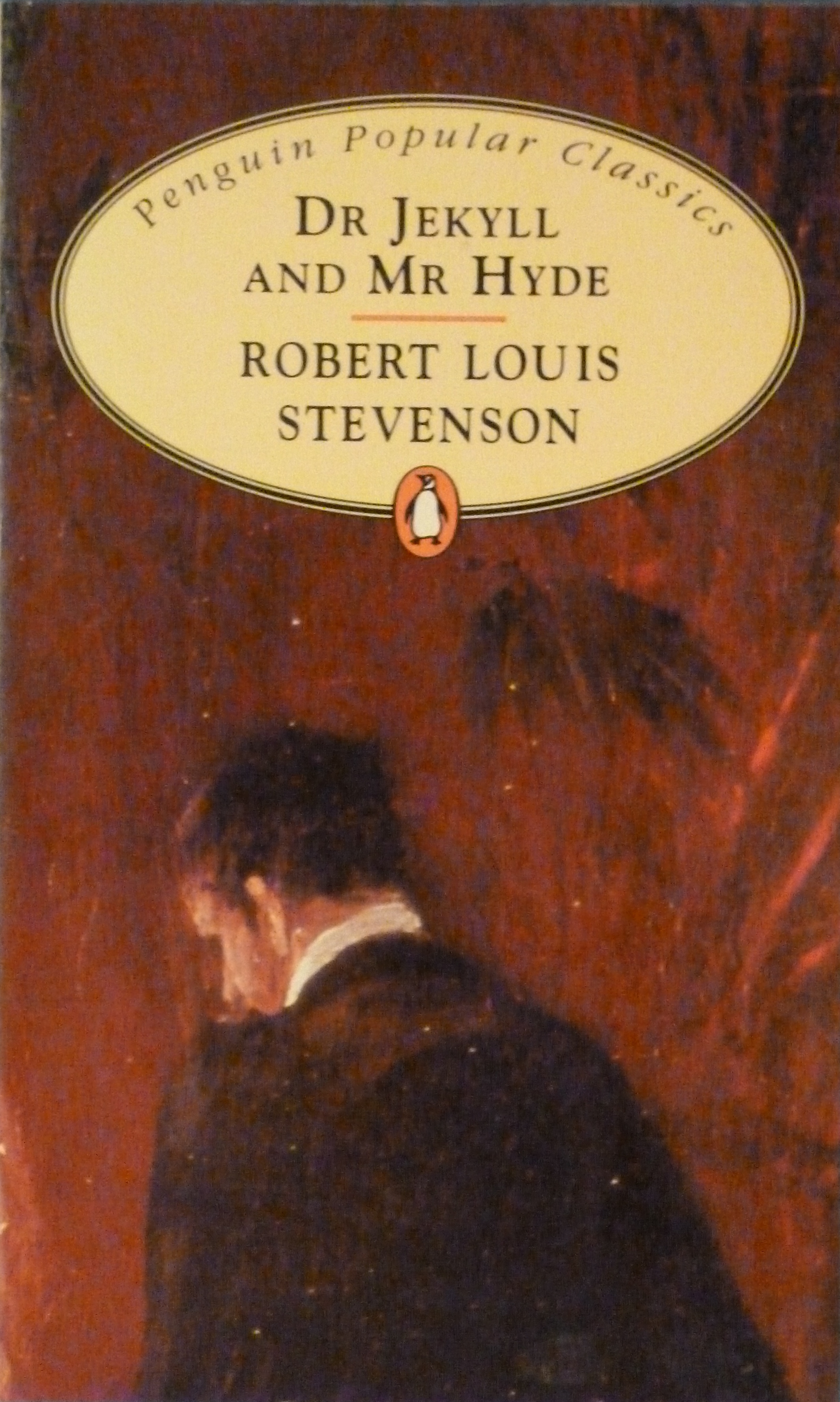
A classic depiction of the conflict between Persona and Shadow is ‘Dr Jekyll and Mr Hyde,’ by Robert Louis Stevenson, which came to him in a dream. In the story, Dr Jekyll is a respectable pillar of the community, but he has a secret other side – at night, he is addicted to the pleasures of debauchery.
He invents a potion which can completely change his physical appearance so that, as Mr Hyde, he is able to go out on the town and not worry about being discovered. Effectively, he turns himself into two people, one embodying his Persona, and the other his Shadow.
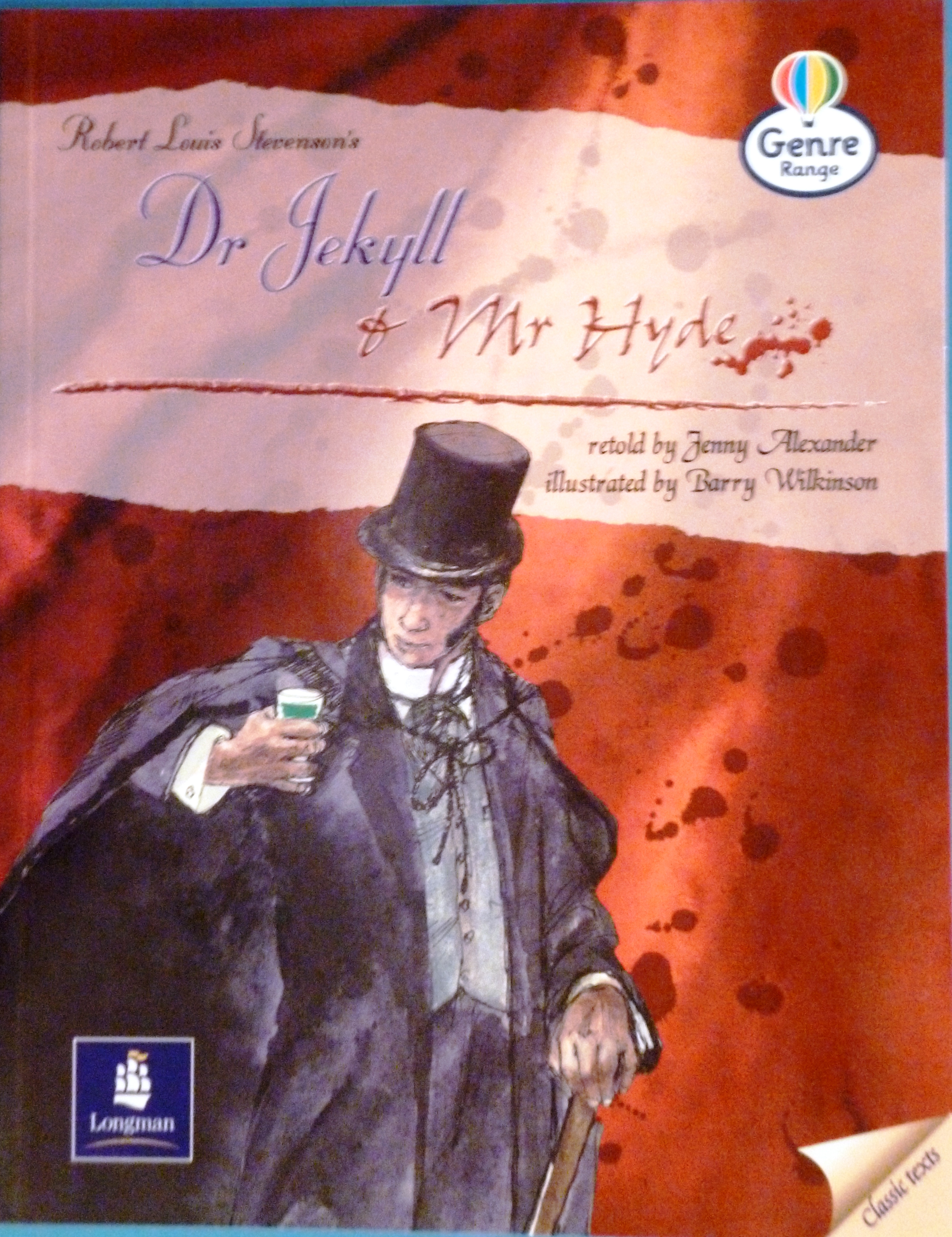
My version, for children – what can I say? I love that story!
Whatever we don’t identify with as ‘me’, we project out. We may disown it so completely that we can’t recognise it in ourselves at all. We can only see it in the mirror of the world.
One way we project undeveloped aspects of our Self is onto the people around us. A person who thinks of himself as hard-working and high-achieving may find other people lazy and unambitious. A person who thinks of herself as ugly may feel that virtually everyone else is good-looking.
In a couple, the tasks of personality are often shared out. One partner may be good with money, so the other can enjoy financial security without having to develop good money-sense themselves. One might be fun-loving and dizzy so the other can be sensible and steady, yet still enjoy a party lifestyle.
On a collective level, cultures, countries and sub-sections of society also have a Persona and a Shadow. In families, for example, it may mean one person becomes the black sheep, with all the family’s unacknowledged problems projected onto them.
Where there is Shadow projection, there is always emotion, because we’re defending our very existence, insofar as that is our idea of ourselves. Which brings me on to Jimmy Savile.
This was a man who appeared to be helping the young and vulnerable but was actually hurting and abusing them in secret. Quite rightly, there’s been huge public outrage, because nobody should have the slightest doubt that what he’s alleged to have done was heinous and wrong.
According to Jung, there may be another dimension to this natural disgust and condemnation – extreme public outcries of the dig-up-his-bones, may-he-rot-in-hell variety may be intensified by Shadow energy. ‘We’re not like that! We’re the opposite of that! We protect children from sexual abuse!’
So, do we? Young children are regularly exposed to highly sexualised music videos on daytime television, and sexual story-lines before the watershed. Magazines and video games which are targeted at children contain sexual content, and children’s clothing which could be seen as sexually provocative is sold in high street shops. A large proportion of primary age children have seen internet pornography. If you google ‘sexualising of children’ you’ll find page after page of examples.
Jung called the Shadow ‘the seat of creativity.’ Embracing the Shadow means letting go of fixed ideas about who we are and the way life is, opening to unconsidered possiblities and engaging with complications, so to create something new.
Something new is happening because of these horrific revelations. People who have kept their own experience of abuse to themselves for many years are suddenly speaking out. Not just the hundreds who were allegedly abused by Savile, but thousands more are flooding helplines with their stories. That in itself is the beginning of a major change.
I hope the high profile and new openness given to the problem of child sexual abuse because of this case will mean that the sexualising of children by adult society in recent years will come under proper scrutiny and be seen for what it is.
Jimmy Savile’s dirty secret may be holding the mirror up to ours, showing us something about our society that we prefer not to acknowledge. Like all Shadow work, simply to acknowledge it is to begin the transformation.
More about the personal Shadow next week – where to look, and how to see it
I love to dream, whether I’m asleep or looking out of a window. My dreams range from the mundane, as if sifting through a cupboard of the day’s events, to something more arcane. Sometimes I see an image or a scene, coupled with a strong emotion.
Once I dreamt I was standing on a shore at night, surrounded by rocks and watching tiny mouths in the water, gasping for air. I tried to scoop them out by turning my skirt into a cradle. I struggled to save them.
St Mary’s Church, ReculverSome time later a local BBC radio station runs a competition and offers up the first line of a story: ‘Even now, the local historians speak of strange occurrences at St. Mary’s Church, Reculver’. I remember seeing the tall towers of this well-known landmark, standing next to the sea and I go off to do some research. I find reports of it being haunted, something more than wind sweeping round the church walls but babies crying. I remember my dream and the second line comes to me: ‘sounds of crying or cooing they say, depending on your state of mind’.
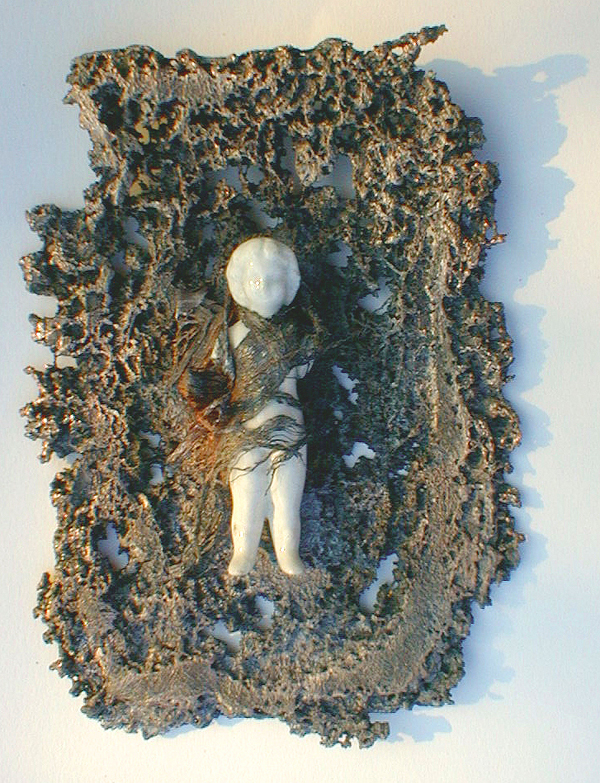
Soon I start to weave the tale of shipwrecked babies, floating on the tide. ‘When they washed up on the shore they looked just like dolls,’ my Grandmother told me. ‘Like penny babies. Their bodies white and shiny, like alabaster, tied up in those long thin strips of cloth; not much bigger than the apron on my dress.’
‘Their bodies white and shiny, like alabaster…’
The story’s chosen and broadcast and then later produced for a stage version by a storytelling group in London. It occurs to me that our minds do more than just function when they are able to make connections; they begin to create. We’re able to move from just making sense of everyday events to exploring the unconscious.
Robert Moss, a writer and fascinating dream weaver says that dreams provide an ‘open vista’ of possibilities and for me, the way a story can come together feels like magic! But maybe it’s also the ability to re-imagine that holds the key. My dream brought with it an incredible feeling of sadness as I tried in vain to help the young lives drowning in the water. It spoke to me on another level and started me on a path to transform that feeling. A short story is just one way we might use our imagination to fuse different ideas together and bring something forward.
Melanie has an MA in Writing for Children and has been a previous winner of the London Writer’s Competition. She’s published in several anthologies and Penny Baby is now available to download from the short story mobile platform, Ether Books.
A few nights ago, I dreamt about a row of old shops which had been boarded up with huge sheets of brown cardboard. Along the top, there was a big bright Tesco banner.
In my dream, I realised that when my dreams are set in man-made environments, they are always up-to-date. I very rarely dream about my own personal past, let alone further back in history.
I reflected that I’m a person who isn’t drawn to the past – I don’t write on historical themes, and I’m not fired by antiques, or costume dramas, or classical novels or paintings. Only last week, I bought a limited edition print of the Lidl in Brixton. It felt fresh and different – mean, how much Lidl-related art do you see?
Lidl in Brixton
Even when I did a few past-life regressions, they didn’t go further back than wartime Europe, but that’s another story.
I wondered about other people – antiques collectors, historical novelists, family archivists. People my spiritualist friend used to call ‘old souls.’ Did they have more dreams set in the past?
At the end of the dream, I dreamt I was recording this as a blog-post rather than an entry in my dream diary – and that’s what I’ve just done!
So this is my dream question – if you love old things, if you read or write historical books, do you have dreams that are set in the past? Or if, like me, you love the new, is that reflected in your dreams and writing too?








 Jenny Alexander's blog: Writing in the House of Dreams