Tag Archives: dayworld

Why symbols dictionaries don’t work

There’s a popular idea that you can decode dreams in the same way as you might translate from a foreign language, by using a symbols dictionary. If you’ve ever tried it, you may have found it less than enlightening.

The point about symbols is that, unlike signs, they have no fixed or universal meaning. For example, a dog would mean something very different symbolically to someone who has been bitten as a child and always avoided them, and a dog-lover brought up in a dog-loving family.

For me, roses always carry connotations of my grandmother’s garden – the smell, the velvety petals, the dark dusky colours – and they have added resonance from all the happy and sad occasions when I played in her garden as a child. Roses are, for me, what madeleines were for Proust.


For someone whose first real awareness of roses was as lovers’ gifts, they might be a symbol of romantic love, or they might conjur negative memories for someone whose abusing partner always bought roses to express remorse, for example.

Meaning isn’t only different for different dreamers; it evolves over time within the individual consciousness. The same person who thinks of roses as symbols of love and romance at twenty might also associate them with violence and betrayal at forty.

When I was a child, I ate some berries which made me very sick, and got into a lot of trouble for it. Berries meant Bad. My first encounters with wild blackberries and blueberries were deeply mistrustful, but ultimately positive, so now berries have much wider symbolic potential.


In the same way, a culture’s symbols are always developing. The swastica  carried positive significance before the Nazis adopted it as their emblem. The Union Jack has been tainted by association with extreme right-wing groups in the UK.


When I was a child, cigarette-smoking was considered a healthy activity, associated with youth, beauty and the great outdoors. Now, all those connotations have completely disappeared.

The objects in dreams don’t have a set meaning; they have personal resonance. If you want to understand more about them, don’t look in a book of definitions. Look in your own life and experiences; notice your own emotional responses to them.

Having said that, there is a kind of dream book which can sometimes throw some light on what dreams mean. I’ll be blogging about it next week.

Do you dream about your job?

A friend of mine made an interesting comment in facebook last week, in response to my post about the ants on the rat.

She said, ‘Since working at the vet’s, I am having a lot of animal dreams!!!! Am just thinking of places I wouldn’t want to work!!!’

I hadn’t really given much thought to work-related dreams, probably at least in part because most of my job these days consists of day-dreaming.

But I straight away realised that lots of people do report having workplace-related dreams, and not just big-ticket dreams about interviews or major projects; often these dreams feel like a continuation of everyday routines.


It struck me that this could be a double whammy, if you were doing a job that didn’t fire you and then having dreams about it that didn’t fire you either.

Which brought me to the wider question – is one way of making your dream-life more satisfying by trying to inject more fun and challenges into the day? I’ve seen this suggestion in a number of dream books over the years, but never felt convinced by it.

It seems to me that although the things of the dayworld are undeniably reflected in dreams, the practical, objective, outer life is very much the minor part of what the dayworld is. You can have a waking life which seems narrow and small, with very little variety and travel, yet your dream life be rich and amazing.

The day world is much more than external events; it is also the inner world of ideas and imagination, and dreams reflect the objects and qualities of both outer and inner daytime experience.

Therefore, although working at the vet’s might make me dream more about animals, so might reading animal stories or surrounding myself with animal pictures.

And if I got my nightmare job, taking the money in a toll booth say, then maybe listening to adventure stories on the ipod or grabbing a few pages in quiet times or jotting down ideas in my breaks might save me from dreaming, ‘One-fifty, please… thank you… one fifty please… thank-you…’

This suddenly makes me think of William Carlos Williams scribbling his poems on the back of a prescription pad between patients.

Confession coming up.

I didn’t have a medical problem when I was working in my various ‘proper’ jobs… I had the lid down, reading!

My spiritual path of dreams

I’m a guest on the inpsychotherapy blog today – talking about dreams as a spiritual path http://inpsychotherapy.org/2012/03/25/my-spiritual-path-of-dreams/

How dream emotions can energise your writing

In Naomi Epel’s book, ‘Writers Dreaming,’ several of the authors interviewed say that dreams are a way they can connect with very dark places and intense emotions.

My favourite interview in the book is with Sue Grafton. She says – among many other interesting things – that she has engineered the world so that she doesn’t have to face bad guys and monsters in waking life, as everyone does. Therefore one of the ways in which dreams energise her writing is by connecting her to ‘often very visceral experiences.’

In dreams, anything can happen. We can have extremely frightening, exciting or pleasurable experiences, as we did when we were children, before we knew how to engineer our world. That means we will feel the full force of our emotions, as we did back then.

Pure emotion produces strong effects in the body. That’s what makes these experiences ‘visceral.’ Dream situations may be the only opportunity you have in adult life to truly feel the physical effects of extreme fear, dread or murderous rage; of bodily power or spiritual transcendance.

As writers, we say ‘show don’t tell.’ Rather than describing how our characters are feeling emotionally, we describe where the emotion is in their body. We make it physical, so that the reader can feel it in their body too.

Sitting at the computer, we can imagine what it is to feel these super-strength emotions, but in dreams we can actually experience it. A dream recalled is like a memory of waking life; remembering it will bring the emotions flooding back with the same physicality as when you recall events from your dayworld.

Living your dreamlife with awareness means you have more emotional experience to draw upon, as well as more situations and events. Often, the emotion is so strong it carries over into waking life even though the events of the dream may be hazy. That intensity of emotion may spark your creativity as powerfully as the actual images and narratives in your dreams.

You can only draw on these memories of dream emotions if you remember your dreams. Check out my Tips page for info about recalling and recording dreams.

Book Review

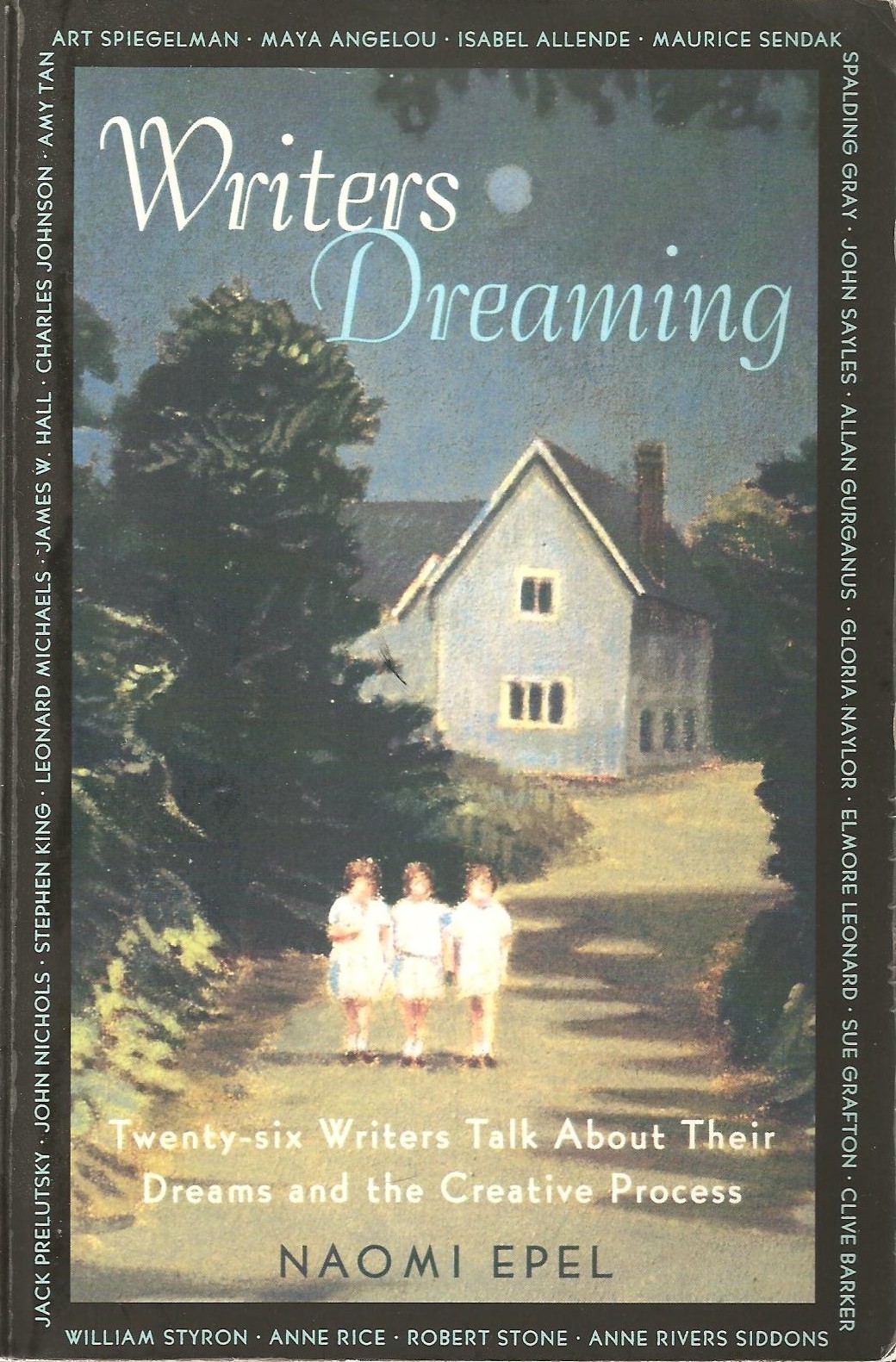
Writers Dreaming, by Naomi Epel

The Vintage paperback cover

You won’t be surprised to hear that I love this book. It consists of twenty-six interviews with high-profile authors, sharing their thoughts about dreams and the creative process.

Probably my favourite is Sue Grafton, because she talks about the edgy nature of dreams and creative work, the ‘sense of jeopardy’ that comes with handing yourself over completely to the inner world of imagination. She describes the feeling of something mystical powering the writing process. She does not believe that all dreams have psychological meaning.

I love the way Stephen King compares his writing process with dreaming. He talks about his preparations for writing being like a bedtime ritual; of entering the writing being like falling asleep to the world, and finishing like emerging from the dream state in the morning.

Maya Angelou talks about the small mind and the large mind, which is very much my experience of dreaming and writing. They both take you into worlds without limits, and add a new dimension to waking life that makes it feel feel much bigger.

There are so many fascinating insights in this book, and it’s one you can dip in and out of if you’re busy, although I have to say I was so gripped I read it over one sunny day in London, on trains and park benches and in cafes.

A five-star read for writers and dreamers.