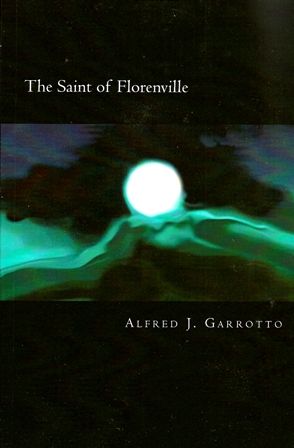
On the morning of July 26, 2010, something quite unexpected happened to me. I had published five novels, the most recent in 2005. Since then I had turned my attention to nonfiction projects. I thought I’d told all the stories I had in me, except for one half-finished and dead-in-the-water novel.
That’s why I was surprised to wake up from a dream that July morning with a rough, but complete, narrative arc in my head, plus three strong characters who would carry the story from beginning to end. I even had a working title, A Train to Bruges (later discarded).
For the next six weeks, I continued to awaken most mornings with additional snippets of story and characterization, all of which I scribbled in a notebook I keep by my bedside, just in case (rarely) I think of something brilliant during the night.
As always, writing the first draft was exhilarating. My “dreamed-up” characters came to life. My villain was insanely evil. Best of all, I knew from Day 1 how the story would end.
Studying the completed first draft, I realized as most novelists do in that situation, that all I had in hand was a skeleton. My story needed flesh, which came only with grinding effort through subsequent drafts.
I embarked on the research I needed to make the settings ( Brussels , Bruges , and Florenville , Belgium ) and my characters (an American priest, a Belgian nun, a young female reporter, and a psychopathic villain) jump off the page.
By mid-July, 2011, I had arrived at Draft 9 and could finally add the # # # symbols, indicating that I had come to “The End.”Somewhere along the way, my working title had yielded to the published title, The Saint of Florenville: A Love Story.
Last week, in the comments, Abi said she wished she could visit her dream house more often, and I suggested she might try incubating a dream.
Creative dreaming is all about ‘flying on the wings of intent,’ to borrow a phrase from Carlos Casteneda. Setting an intention is how we start to establish regular dream-recall, as I explain here https://jenalexanderbooks.wordpress.com/tips/
Once we have begun to experience regular recall, we can use intention in the same way, to incubate a dream on a particular topic. I sometimes do this with a group.
The first time I did it, I asked my workshop participants to intend to dream about a tree. Of the six people in that group, five reported tree dreams the following week.
Two people dreamt about saplings, and another about ‘baby trees.’ I dreamt about a tree-lined avenue. The fifth person, frustrated by a marked no-show of trees for the first few nights, wrote a poem about a tree to help set her intention, and then dreamt she was on a ranch in America, where she saw a single tree in the distance which looked like a child’s drawing of a tree.
This person thought, either in her dream or upon waking – she couldn’t tell which – ‘There was a tree!’ The same thing happened in my dream, where I thought, ‘Ooh… lots of trees!’
This is the waking ‘I’ being aware during the dream, and an interesting bonus of dream-incubation is that you’re likely to become lucid at the point where the dream meets the conscious expectation.
I incubate dreams to resolve plot problems and develop my writing ideas, as well as to gain insights into anything which might be bothering me in my everyday life.
If you want to try it, think about your dream intention at points throughout the day, affirming, ‘Tonight, I will dream about…’ Repeat your intention as you go to sleep.
You can reinforce your intention by writing it down, or drawing an image to represent it. Promise yourself that you will record any and every dream you recall when you wake up.
This last point is important. If you don’t automatically record everything, your conscious rational mind can click in too early and push your dreams away.
Besides, if you’ve asked for a dream, it would feel rude not to note down the answer. The dream will not co-operate if it thinks you’re just messing around.
As I was writing the introduction to Katherine Roberts’ guest post last week, I suddenly remembered that a workshop exercise I did with the Scattered Authors Society on another occasion had in fact previously appeared in a book*
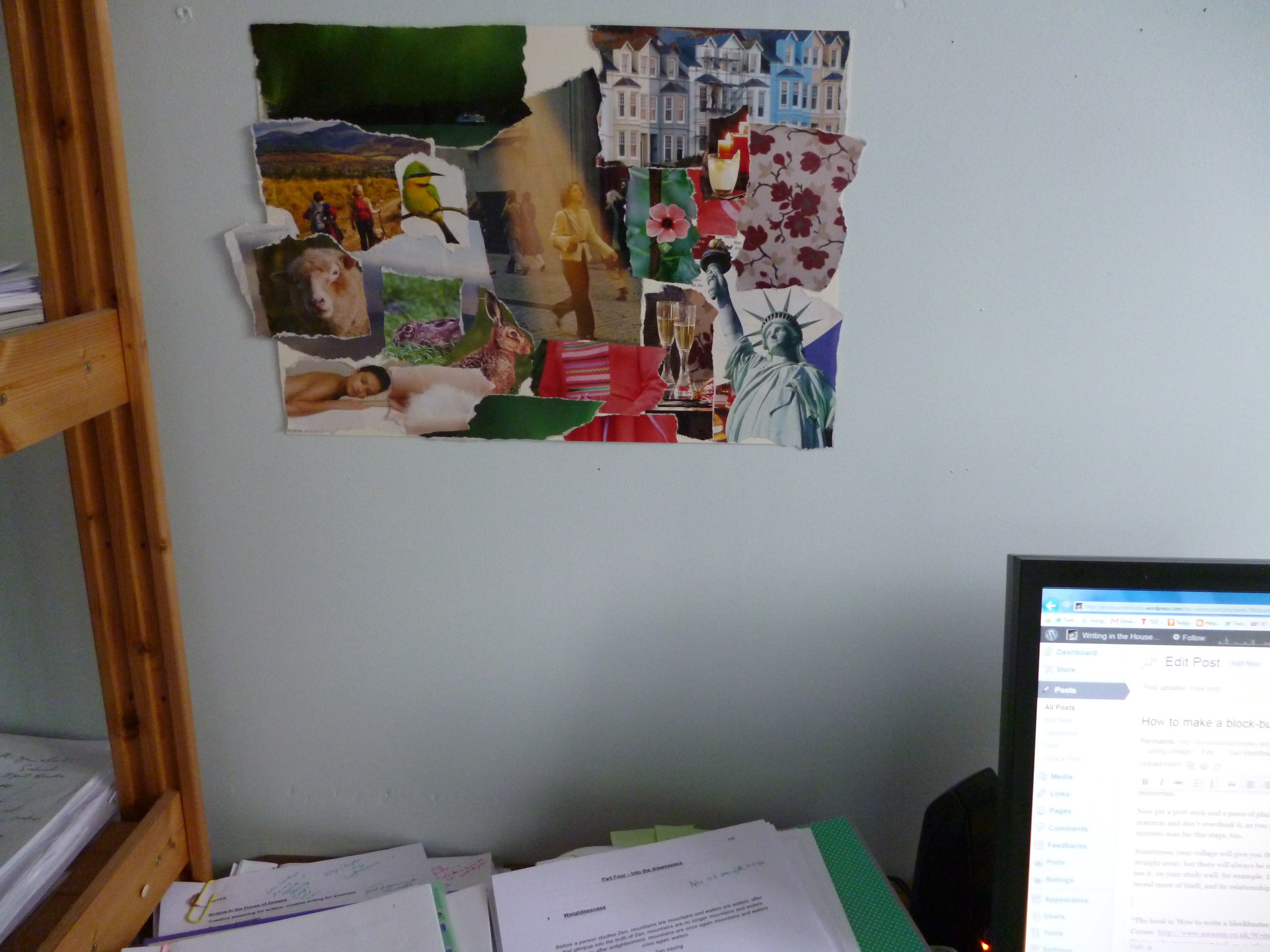
I called that workshop ‘Busting through blocks,’ and it explored a basic collage technique I use a lot in my own writing practice. You can use it to create characters, examine relationships between your characters, develop settings, find titles, spark stories… pretty much anything.
Creating a character using collage
Whatever the issue is, hold it in the back of your mind as you flick through some magazines. Don’t think about which images, colours, patterns, words you need, or how they will relate to your project; just tear out the ones that draw you, and trust they will be the right ones, the ones you need.
This works through synchronicity, like tarot or other divinatory practices; the outer world reflects what is going on in your inner world.
You can use collage to spark a story
Limit the time you spend on tearing out pictures to 10 minutes max, because you don’t want to overthink it. The whole process should feel instinctual.
Now get a pritt stick and a piece of plain paper or card. Again, follow your instincts and don’t overthink it, as you put your collage together. Take 10 minutes max for this stage, too.
Sometimes, your collage will give you the inspiration you’re looking for straight away, but there will always be more, so put it somewhere you will see it, on your study wall, for example. Look at it often. It will gradually reveal more of itself, and its relationship with your writing project.
There are always work-in-progress collages up on the wall in my study!
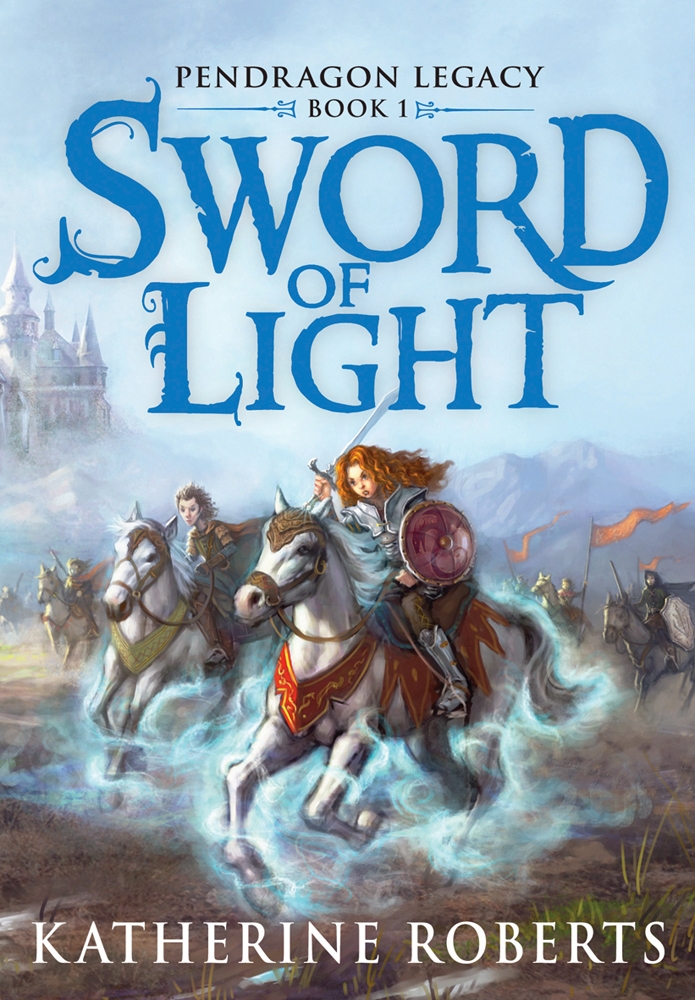
Today, I’m delighted to welcome children’s author, Katherine Roberts, to the House of Dreams, on her blog-tour to celebrate her new book ‘Sword of Light.’
It’s especially exciting for me because this is the first time, as far as I know, that a book has been published which was helped along by one of my workshops, in this case, for the Scattered Authors Society http://www.scatteredauthors.org/
My Heroine’s Journey for SWORD OF LIGHT, by Katherine Roberts
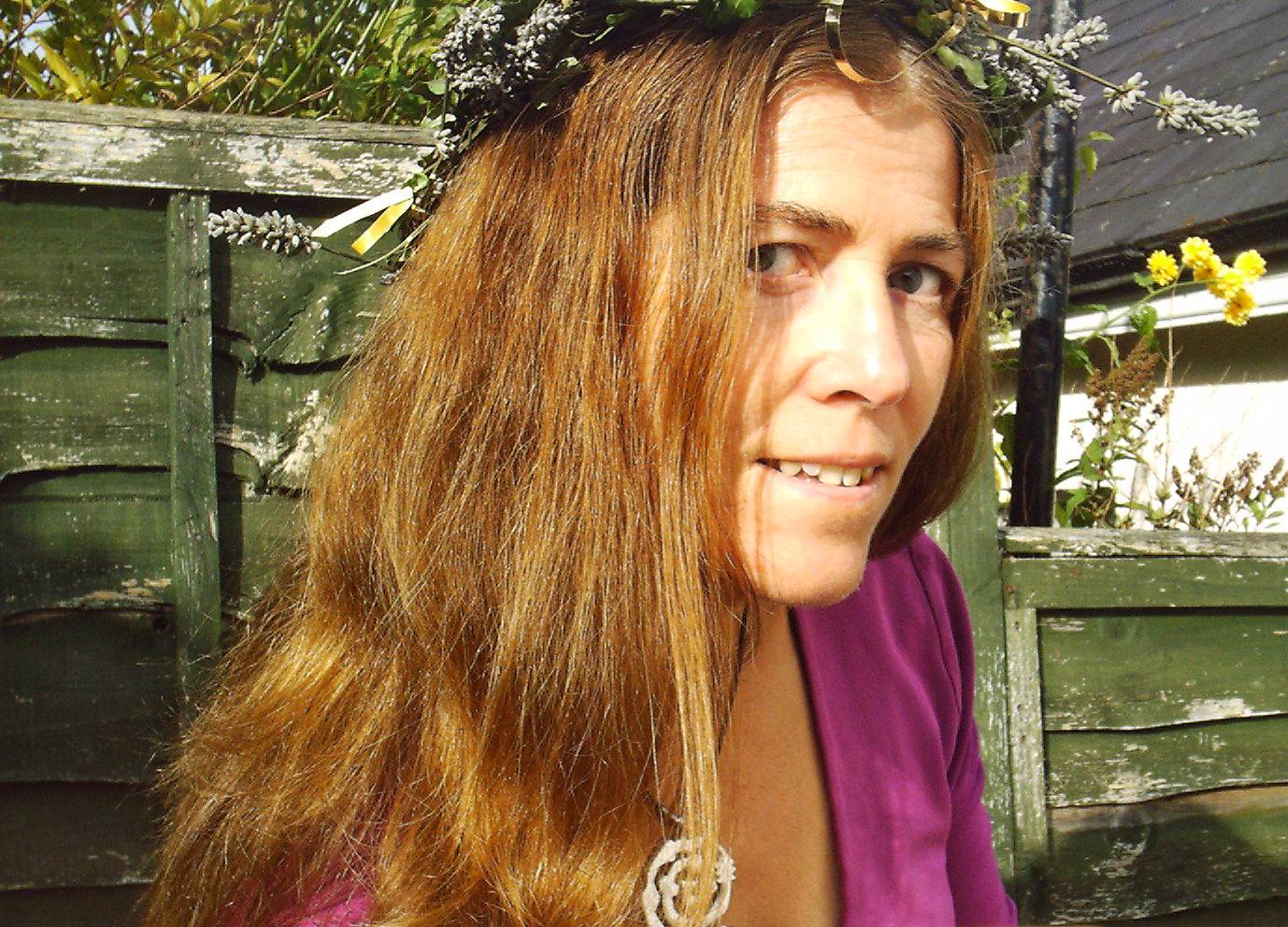
Katherine Roberts
My inspiration for ‘Sword of Light’ came in a waking dream, when I attended a workshop led by the lovely Jenny Alexander, who guided a few of us children’s authors on a ‘Hero’s Journey’ along our personal writing paths. It went like this.
Imagine you are walking in a familiar place, when you see a sign saying, ‘To the Treasure…’
I am in the local wood on the boardwalk, and it is raining so no-one else is walking today. The trees are dripping and the bluebells are out. All smells green and garlicky. I am approaching my favourite bridge over a stream, where I often imagine fairies, when I see a new path twisting through the trees where there are no marked trails. A sign says TO THE TREASURE. I think it is one of the farm’s treasure hunts for children, so I hesitate because it might be something tacky and disappointing. But since no-one is around to laugh at me, I decide to take a look.
You find the path blocked…
I push through some ivy and find the path blocked by a monstrous dragon that some local artists have strung up in the trees by the boardwalk for the annual Arts Trail. It is a fantasy creature made of old grey canvas, black feathers, and a scary triangular beak/snout. It is meant to be a future people’s idea of a bird they have never seen because birds are extinct in the future, and it has come alive. It hisses at me. It has been tied in the trees long enough, and now it has escaped. But it can’t fly because its wings have not been made the right way, and they are soggy with the rain. Also, it has no eyes, so it is blind.
How do you get past the block…?
The ‘future-bird’ cannot see me so I freeze, trying to make no sound. I think about going around it, but the undergrowth is too thick. Also, it’s boggy because I am off the boardwalk. I am too afraid of its huge sharp beak and its powerful claws to try climbing over it, so I decide to fool it. I pick up a stick and throw it into the undergrowth. The dragon hears the stick land and flaps off after it, getting its wings entangled in the bushes and shrieking as it flounders in the bog. I hurry past before it can get free, a bit afraid of meeting it again on the way back.
You find the treasure…
As I leave the dragon behind, the sun comes out and the path emerges in a clearing where there is a barrow covered by greenery. I push aside some leaves and crawl inside, where I find a gleaming sword. This is the treasure! I take the sword, thinking it might be useful if I have to fight the dragon, although I don’t really want to soil the beautiful blade with its blood, nor hurt the ‘future-bird’ because it is the last of its kind. Also, I doubt my fighting skills because I have not been trained to use a blade. So I venture back warily along the dripping path, where the sun now sparkles through the leaves and gleams off my treasure.
What do you do next…?
The dragon is still stuck in the bog, but it has exhausted itself and the sun is drying its feathers. It steams gently, its wings spread in the warmth. It still cannot see me, but the sword is magic so it can see the light coming off it. It crawls towards me, as if hypnotised. It seems less afraid now, maybe because it is no longer lost and alone. I stroke its beak and it does not attack. Murmuring to the creatuire, I climb on its back, and since the sun has dried out its wings it can now fly. Although it is still blind, my eyes will guide us. As we take off and circle above the trees in the sunshine, I see the glint of water below where fairies live. We both feel amazingly free. As long as we continue to trust each other, we can fly anywhere in the world, and my sword of light will defend us from enemies, past or future.
Sword of Light
I was writing the first draft of ‘Sword of Light’ at the time of this workshop, and am quite spooked by how many elements have ended up in the book:
The sword – Excalibur, the Sword of Light that was forged in Avalon.
The dragon/’future-bird’ – a shadrake, a dark dragon from the underworld of Annwn which breathes ice instead of fire.
The heroine – Rhianna Pendragon, King Arthur’s daughter.
***
SWORD OF LIGHT is published this month by Templar in hardcover, and you can follow Rhianna Pendragon on Twitter at www.twitter.com/PendragonGirl
Can dreams inspire a writer to write a novel? Mine did – and they still do.
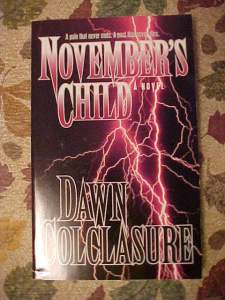
When I was 16 years old, I started having dreams about a man named Jonathan. These dreams happened almost every night and lasted for many years. Two years after the dreams started, I dreamt that all of the dreams combined were turned into a novel titled, ‘November’s Child.’ I even saw the title of the novel in this one dream!
I was 19 years old when I finally completed that novel. During this time, I had to work out how to make the dream ‘story’ work as a believable story. After all, I had no idea what kind of connection Jonathan had to me, the dreamer, so I had to think of what kind of connection he would have to my story’s main character, Malissa.
This name did not come from my dreams; I needed a name for a character that represented ‘me’ in the story, and I decided to use an alternative version of my sister, Melissa’s, name.
As to the connection dilemma, I discussed this with one of my other sisters, who happened to have just seen a movie about Druid characters. She suggested I turn Jonathan into a Druid. After researching Driudism and reading about their belief in the transmigration of souls, I decided that, yes, that could work. Voila! I had my story figured out.
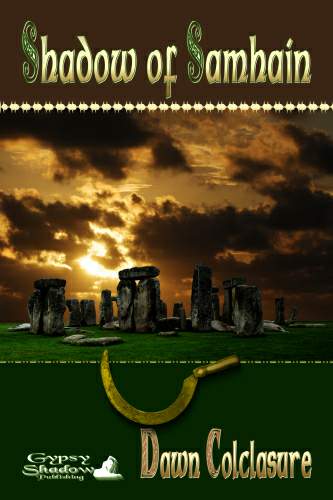
My novel was published when I was 20 years old. Shortly afterward, my publisher went bankrupt and the book went out of print. I rewrote the book and gave it a new title: ‘Shadow of Samhain.’ This new version of my ‘dream novel’ will soon be published by Gypsy Shadow Publishing.
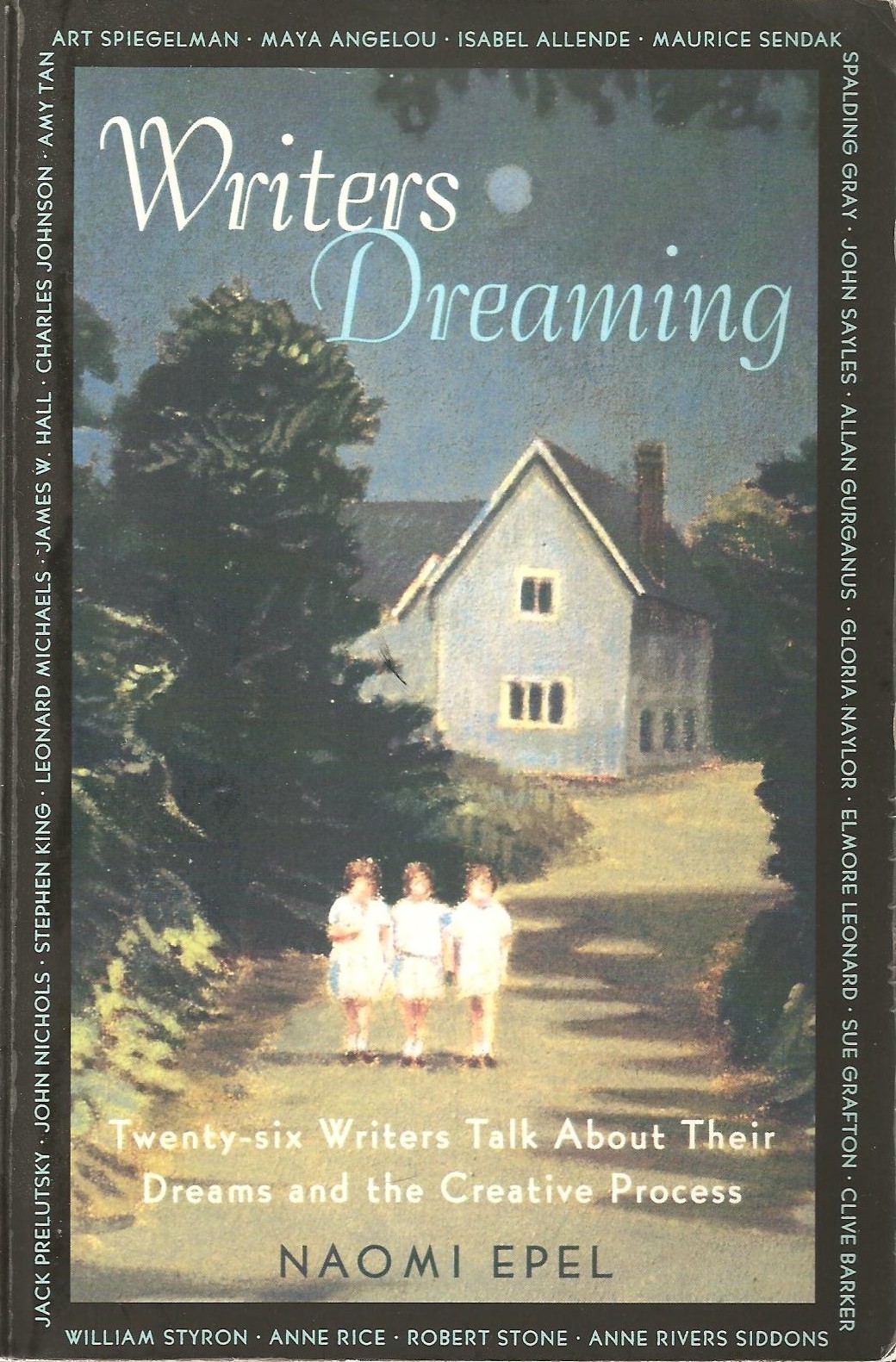
You won’t be surprised to hear that I love this book. It consists of twenty-six interviews with high-profile authors, sharing their thoughts about dreams and the creative process.
Probably my favourite is Sue Grafton, because she talks about the edgy nature of dreams and creative work, the ‘sense of jeopardy’ that comes with handing yourself over completely to the inner world of imagination. She describes the feeling of something mystical powering the writing process. She does not believe that all dreams have psychological meaning.
I love the way Stephen King compares his writing process with dreaming. He talks about his preparations for writing being like a bedtime ritual; of entering the writing being like falling asleep to the world, and finishing like emerging from the dream state in the morning.
Maya Angelou talks about the small mind and the large mind, which is very much my experience of dreaming and writing. They both take you into worlds without limits, and add a new dimension to waking life that makes it feel feel much bigger.
There are so many fascinating insights in this book, and it’s one you can dip in and out of if you’re busy, although I have to say I was so gripped I read it over one sunny day in London, on trains and park benches and in cafes.
Some years ago, I was working on my first poetry collection, Creatures of the Intertidal Zone. The book’s main section, inspired by my journey through Iceland, Greenland and Newfoundland in the footsteps of an intrepid eleventh century female Viking, was complete, but I didn’t yet have a clear vision for the final part of the manuscript.
Until, over a period of several weeks, prompted perhaps by my reading numerous narratives of Polar exploration to both the Arctic and Antarctic, I had a sequence of dreams featuring that most iconic of polar creatures, the penguin. In one dream, I received a penguin delivery – he was shoved and squeezed through my letterbox until he landed with a slap on the tiled hall floor. In another, I was trying to hoist a poorly penguin into a cardboard box so that I could take him to the vet, while in the most surreal dream of all, I was metamorphosing, flipper by flipper, feather by feather, into a penguin myself.
I’d never written poems from dreams before, but the penguins were impossible to ignore. As I wrote, I pondered on all the images of penguins that exist in popular culture, as well as our persistent commodification and Disneyfication of animals, a theme that seemed to fit well with the environmental strands I’d introduced in the main section of the collection. Gradually, over the next six months, my dream penguins swam and waddled their way into a series of poems that enabled the final part of my manuscript to fall into place.
Creatures of the Intertidal Zone was published by Cinnamon Press in 2007. I was delighted by Helena Nelson’s mini-review of the collection in Mslexia and the fact that she singled the penguins out for a special mention – ‘Susan Richardson’s Creatures of the Intertidal Zone offers a marvellously different blend of passion, pathos, poetry – and penguins.’ I have continued to allow my dreams to feed my poetry ever since.
METAMORPHOSIS
To begin with, nothing drastic.
the odd cold bath, air con on max,
the utter absence of shivers.
Then, the skin tingles, each pore forcing
the shaft of a feather forth, like a lid
with a push-through straw.
I go right off garlic, crisps, samosas,
bright red curtains, Gauguin prints.
If I must stay indoors, I want plain
white tiles, a single chilled white porcelain sink.
And oh, the fingers. Useless, as if mittened.
And stretched, the tips skimming the floor.
Scissors, chopsticks, forks – all binned.
Breasts blend with belly, waist, hips.
I’m lugging a two-fifty-litre rucksack
in an outsize black wetsuit and wellies.
My tears taste of fish.
Fresh fears keep me from sleeping.
The fleck throats of bull seals.
Ice melt. Oil slicks.
I make a nest from the last
strands in my hairbrush and what I once
knew as pencils, and string.
Soon I must push
this hard new truth between my legs
and hatch it.
Creatures of the Intertidal Zone is available via Susan’s website www.susanrichardsonwriter.co.uk as is her new collection, Where the Air is Rarefied
Years ago, I had a dream I called ‘Landscapes of the soul.’ It was one of those dreams which doesn’t have a story, but just a voice.
Cornish moorland
The voice of the dream said, ‘The scenery your soul feels at home in never changes. The empty huge spaces of the highlands, always at the mercy of the elements, that is my soul scenery and will not change, but all the less important things have changed…’
Burra Isle in Shetland
It was after this dream that I started to notice the consistency of my dream landscapes, which are most often moors and mountains. In the workshops I do now, I find other people’s dream landscapes also have a surprising consistency.
The mountains of the far North West
I grew up in leafy Wimbledon, but immediately after university I went to Shetland for a holiday and simply couldn’t leave. It was love at first sight, for me, that wild windbeaten landscape of empty hills and wide horizons. I lived in Shetland for nearly ten years before moving to Cornwall, but I still go to the far North most years in the summer.
This week, I read a fascinating post by Abi Burlingham about her relationship with trees and woodland http://abiburlingham.wordpress.com/2011/10/21/21st-october/ It reminded me of my long-ago dream, and made me wonder if everyone is drawn so strongly to one kind of scenery, for pleasure, solace or inspiration.
The dream behind ‘Buttercup Magic’ – by Abi Burlingham
‘A Mystery for Megan’ – the first book in the ‘Buttercup Magic’ series
I have had vivid dreams for as long as I remember, varying from dreams of flying to the truly horrid stick witch who crept out of the plughole. Some of these have sparked off ideas for stories, but generally speaking I hadn’t used them in my writing and they were quite often forgotten.
That is, until a few months ago, following a fascinating article I read in the Spring Mslexia, ‘Dreamwriting’ by Clare Jay, where Clare describes the process of being conscious in your dreams, controlling them, and using them to help your writing.
Fascinated with this idea, I decided to try being more aware in my next dream. The dream that followed was incredibly vivid. I was in a big old house, or rather, my consciousness was. My dream almost told me what was there. It told me there were mice who could tell the time – I could see these in the dream – and there was a black cat.
When I woke, I had the strongest sense of place. The setting and feelings that accompanied it were so incredibly vivid. Luckily, I keep a notebook and pen by the bed, so I quickly wrote down these ideas.
Shortly after, I started to write the book ‘Buttercup Magic’ – under the working title ‘Buttercup House’, featuring mice who could tell the time (all called Whiskers) and black cat called Dorothy. But I knew that a dog should be in the book too, so I wrote in Buttercup, a big golden retriever.
‘Buttercup Magic’ is now to become a series, the first of which, ‘An adventure for Megan’, is due out in Spring 2012. Without the dream, and without that very important article, I have no doubt that this book wouldn’t have been written.
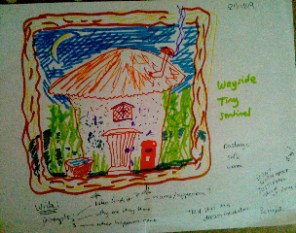
Would you like to know where the dream house picture at the top of this blog came from? I’ll let Mooncakelizzie explain…Picturing the House of Dreams, by Mooncakelizzie I’ve been interested in creative writing for the past eleven years. Attending a multitude of classes and groups freed up a rabble of short stories and some novels, jointly written with someone who’s now a friend, met at one of Jen’s workshop series. These have not the rigidly defined tick-box ‘outcomes’ of formal courses, but are absolutely absorbing and simply fun to take part in. In particular, ‘Writing in the House of Dreams’ opened up a kind of secret garden I’d lived alongside almost unaware. There, for example, I could meet myself at younger ages, and also a hidden self who was growing, maybe pupating under a cabbage-leaf in a homely but boundless place.
The first dream house drawing I made was during a workshop. We all told a dream, and then chose an image from one person’s dream to draw. We wrote three words to describe it. Then we asked three questions to spark a story – ‘Who finds it? Why are they there? What happens next?’
At home, I did more drawings. I began to put daydreams in, of living near the sea in a beautiful Oast conversion. A bit of Kentish beach; a view imagined from my little house.
Then a night scene, an isolated hut on a wild headland with distant lights of other houses far away across the water. I don’t consciously know what’s inside.
Here, I can hold dreams, experiences, events and things I’ve picked up or eavesdropped on while careering openly in and out of that world behind the ‘hedge.’









 Jenny Alexander's blog: Writing in the House of Dreams