Category Archives: Creativity

Are you making the most of your writing?

Last year, I was writing about recycling as part of my new children’s non-fiction work on helping the planet. As we go into this new year, I’m thinking about recycling again, but this time about recycling writing.

There are lots of ways I do this, and if you haven’t been doing it too, you might be missing a trick.

First, there’s recycling rejected manuscripts. Sometimes a book may be rejected simply because the timing isn’t right. One publisher my agent sent a manuscript to turned it down because she had just accepted one on a similar theme. I bumped into her at a conference a few weeks later, and she advised me to send it again in a year or so. I told her I would redraft it and do just that, but she said, ‘No, don’t change it. Send it just as it is.’

Another story I wrote for younger children was about a rabbit. My agent liked it and sent it out, saying that with any luck we might find a publisher that had a ‘rabbit-shaped gap.’ Rejections don’t always indicate that your work is just not good enough.

Then, there’s writing for different readerships. A lot of non-fiction topics can be adapted for children as well as adult readers , and within that for different ages of children. Stories can sometimes be adapted for different kinds of reader by switching the point-of-view character and seeing the situation through their eyes.

You can also write about the same non-fiction topics for different levels of expertise, from beginners to readers with a similar level of knowledge and experience to your own.

Finally, there’s recycling ideas across different genres. When I’m in the zone with a theme, I usually develop fiction and non-fiction around it at the same time. I always submit magazine articles on the themes of my books as well; they’re easy to write, once you’ve got your ideas clear in your mind through writing the book, and they also help to promote it.

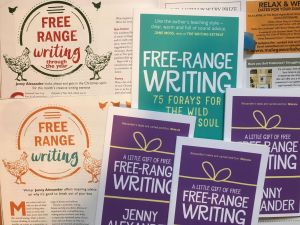
Because this has always been my natural approach to writing, I like to mix things up in my workshops too. That’s where the idea for Free-Range Writing: 75 Forays for the Wild Writer’s Soul came from.
free-range writing

To take that book as an example of recycling, I’ve gone on to write articles about free-range writing for several magazines and now I’ve got a regular monthly column in Writing Magazine, called Free-Range Writing Through the Year.

At the time of publication, I issued an ebook taster, with the idea that people might buy and try, and then go on to get the book itself, but that didn’t sell. So I withdrew it from sale, adapted the introduction and end pages, and recycled it into a lovely little stocking filler, A Little Gift of Free-Range Writing.

I’ve also written a talk about being a free-range writer and a free-range writing workshop, that I’ve been touring round the UK.

Manvers Street Baptist Church


A few days ago, someone who came to one of these workshops emailed me to say she had developed a magazine article from the ideas she explored in the group, and asking if she should submit it to Good Housekeeping. I straight away thought of all the other magazines she could also pitch it to, using the same idea but adapting it to different readerships. And then perhaps, a book… And more than one book! It could be memoir, how-to, local interest, short story collection, novel…

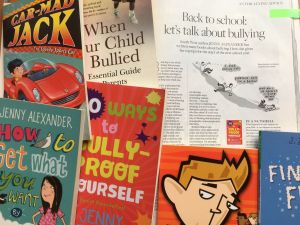
If you write about things that matter to you, then once you’re in the zone, you’ll find there are all kinds of possibilities for the themes and stories you are developing. Writing for different readerships will help you build your profile too. For example, one of the things I’m known for is writing about bullying, because I’ve got fiction, non-fiction and articles about bullying out there aimed at children of all ages, teachers and parents.
bullying2

So whenever you find a subject that engages you enough to write one piece about it, think about how you might develop and recycle your ideas. It makes sense, both economically and creatively.

Are you already recycling writing? If so, I’d love to hear about it in the comments!


Going away and coming back again: how to refresh your writing

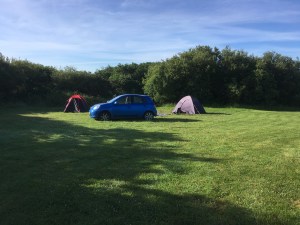
I haven’t been blogging lately because I’ve been away. I was in Arctic Norway for three weeks in June, then home again and away again for a spot of camping on Bodmin moor, then home again and away again to Oxfordshire for the summer gathering of the Scattered Authors’ Society.

I always find it difficult to leave my work-in-progress, so I work right up to the wire and often take some notes with me, half planning to do a bit of writing while I’m away.

That never happens. It didn’t even happen in Norway, although the combination of wintry weather (in June!), bright daylight round the clock and really rugged walking meant I completely overdid it and got worn out by the end of the first week. (Someone on a travel site suggested the guide books should translate ‘Easy’ in the Norwegian descriptions of walking trails as ‘Hard’ in English, ‘Moderate’ as ‘Difficult’ and ‘Difficult’ as ‘Don’t even go there!’)

52
‘Moderate’ walk in the Lofoten Islands – sheer drop, massive rock, helpful chain to hang onto

I did hang out in cafes for a couple of days at that stage, scribbling in my notebook, but I was just jotting down random thoughts and ideas that had nothing to do with anything I’d been working on at home.

79
Great cafe in Lofoten – the artist makes you coffee in her lakeside studio!
30
Cool cafe in the ‘Paris of the North’, Tromso. Strong coffee, Leonard Cohen, everyone reading.

I scribbled some thoughts down in my notebook when I was camping too, but on the Scattered Authors’ retreat, although I took my computer and current work in progress and really thought I was going to crack on with it, I wrote absolutely nothing at all.

2018-06-24 07.57.20
Empty site with fire pits on sunsoaked Bodmin moor
2018-07-06 14.35.14
Children’s authors at play in rural Oxfordshire

I sometimes take work, but I never stress about not doing any, because I know from long experience that going away always means I’ll come home full of new creative energy, enthusiasm and ideas.

I think one of the reasons my trips are fruitful is because I do focus on my work in progress right up until I leave, and hold it in the back of my mind even when my main focus is on the new places I’m seeing and people I’m meeting.

By the time I sit down at my own desk again, I’m coming to my writing completely renewed – a new me, a different me, made up of the old me plus the experience of my adventure. And my work in progress, somewhere out of sight but never entirely out of mind, has been growing and developing too.

I was going to blog about the Scattered Authors’ summer retreat but my friend Sheena Wilkinson has written a great post about it, and I couldn’t do better – you can read it here.


The key to living creatively

My last post was about the royal garden party, which I mentioned was right outside my comfort zone. When I got my invitation, I didn’t even possess a dress, let alone a hat or fascinator, so the dress code felt quite challenging!

But I like going outside my comfort zone – its expansive. Going outside your comfort zone makes your comfort zone bigger.

Trying new things is also the key to living creatively because creativity is, by definition, making something that didn’t exist before and, when we try new things, we create brand new experiences.

Quite often, we may be reluctant to try new things – a different kind of food, book, activity or TV show – and there is indeed a good chance we won’t like the new one as much as our old favourite. But if that’s the worst that could happen, I reckon it’s worth the risk.

2018-05-23 10.48.28_preview
My current notebook – a gift from my ex husband, who knows me well!

It doesn’t have to be a giant leap into the unknown – shaking up the little things can start a creative wave. When was the last time you parked in a different spot at the supermarket, took a different route to work, sat in a different chair in the evening, went out for a walk at a time of day when you usually stay home?

Living creatively by seeking out new experiences puts energy into all your creative work because you carry those attitudes of openness and adventurousness, and also that buzz of pleasure and excitement, into your writing or painting or gardening, or whatever creative activity floats your boat.

Anyone for a seaweed sandwich?


The dreaming writer at the royal garden party

Lots of creative teachers talk about the importance of taking time out from your normal routines and doing new things, to refresh your creative energy. It’s commonly called ‘going down to the well.’

I was way outside my normal routine last week at the Buckingham Palace garden party – frocks and fascinators are not really my thing! In case you’re wondering, my invitation came through the Society of Authors – I’ve been a member for most of my writing career and taught several creative blockbusting workshops for them.

2018-05-19 12.16.20_preview
The afternoon progressed like a well-oiled machine. The queues moved very quickly through the gates, despite the huge number of guests.

20180515_150531

The National Anthem announced the Queen’s arrival and, while the band played and everyone was upstanding, she came out onto the steps, flanked by Beefeaters.

The Beefeaters accompanied her as she walked among the crowds so, although we couldn’t see her, we knew where she was by the tips of their pikes.

2018-05-15 15.53.47_preview
The cakes were divine! After tea my friend and I had a stroll round the gardens, coming back to find staff moving among the guests with trays of lemon barley water and little tubs of ice cream.

2018-05-15 17.08.54_preview
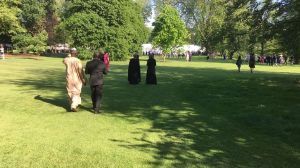
It was a brilliant opportunity to enjoy that most favourite of writerly pastimes, people-watching. A clutch of Bishops, a pair of robed academics, a scattering of groups in African dress, a gaggle of jovial mayors.

2018-05-15 16.50.41_preview
Even the Ladies’ Lavatories were an experience, set as they were beside the big lake, and attended by a woman who checked each cubicle as it became vacant, presumably to make sure the bowl was clean and there was plenty of toilet paper, before personally ushering the next person in.

Very few people actually got to speak to the Queen yet the surprising thing, for me, was that it felt quite personal. Buckingham Palace didn’t feel like a massive public building, but somebody’s home, and the party was just in their garden.

I realise I may be sounding like a royalist, but I’m not. I’m not a republican either.  I think there are good arguments both for and against having a monarchy.

But as a dreamer, it seems to me that kings and queens, princes and princesses do something quite extraordinary. They are like living archetypes, symbolising for us universal qualities, even though they may not, in their own personal lives, be any less complicated, flawed and human than the ordinary person in the street.

I was first struck by this in the outpouring of grief when Princess Diana died. It was so surprising and disproportionate, I felt we were not grieving the person she was but what she symbolised – a quality of caring kindness that seemed to be slipping away in the post-Thatcher era.

It’s the same with the royal wedding last week. We don’t know what Prince Harry and Meghan are like as individuals, whether they row and bicker behind closed doors – but thousands of people enjoyed their wedding because there they stood before a nation as the representing the romantic Hero in all of us, the perfect Princess and the possibility of lifelong romantic love.

Seeing the Queen standing there on the steps of her home, I was really aware of the strangeness of her existence. Through the doors behind her lay her domestic life, where she is just a person like the rest of us, but as soon as she steps outside she is no longer a woman; she becomes absolutely her role, as Queen.

The dreamer in me, like the writer, found the whole experience intriguing.


I’ve chosen the best place to launch my book!

Today is the official publication day for my new book, Free-Range Writing: 75 Forays for the Wild Writer’s Soul, and I think I’ve found the perfect place to launch it.

All my previous book launches have been nibbles-and-bubbles parties, with a lot of mingling, a spot of reading and somebody lovely raising a toast.

IMG_1380
Usually, it’s mostly mingling

I’ve held them in my garden, my local library, the back room of the village pub, an art gallery, the Sterts open air theatre… Every book is different, and so is every launch.

When I discovered that the Looe Literary Festival coincided with publication week I really wanted to launch my new book there. It’s a festival that truly celebrates local writing and grass-roots creativity as well as big name authors, and that’s very much the spirit of Free-Range Writing.

There are readings from the Looe Writing Group and the Liskeard Poets, whose book launch I attended recently, having been invited to select the poems for their anthology. Alongside talks by famous authors like Lord Owen, Adam Hart-Davis and Dr Susan Blackmore, there are lesser-known writers of fiction and non-fiction. There are panels and discussions on topics as various as fisheries policy and self-publishing. There’s plenty for children as well.

I’ve been in the green room at the Cheltenham litfest, mingling with TV stars who’ve written a book and hawk-eyed photographers trying to get photos of them, and felt curiously detached from the whole business. For me, writing is about all of us, ordinary people; we all have something interesting and beautiful to say.

Thinking only famous writing is good writing is a mistake, as anyone who has any experience of writing workshops will know. It’s also harmful because it can make us feel discouraged and reluctant to explore our own innate abilities. My new book is about freeing up your thinking, venturing into every area of your writer self and being surprised by what you find.

So this book is all about the writing, and I’ll be launching it in a different way, with a free-range writing talk at 12.00 on Sunday 19th November and then a workshop after lunch, at 2 o’clock.

I love doing these community workshops, partly because they’re a chance to work with writers of all ages. They’re not just for children, or for adults, or for families – they’re for everyone age 8+. We all have something interesting to say and we so rarely have the chance to write together. (Participants under 18 must be accompanied by an adult).

2017-11-02 15.23.39_preview
Looe island

The Looe Literary Festival is a great event in a gorgeous location and it’s the perfect place to hear about Free-Range Writing, so please come along and help me celebrate if you can. I will hope to see you there!

Using creativity to make life better

We were discussing the Senoi method for tackling nightmares in last week’s session of Writing in the House of Dreams, when someone said, ‘We ought to be teaching this to children in schools!’

The Senoi technique is described by Patricia Garfield in her fascinating book, Creative Dreaming – that’s where I first came across it. When you go to sleep, you intend that if you have a bad dream you will confront the difficulty, face down the enemy, and claim a reward.

If you wake before your dream has reached a positive outcome, you either go back to sleep and continue the dream or else complete it in imagination.

You don’t need to be lucid within the dream, so it’s a very easy practice that anyone can begin, and if you always bring your dreams to a positive outcome you set a track in your mind that your dreams will soon automatically follow, resolving themselves before you awake.

It’s obvious that not having unresolved nightmares is a way of making your dream experience better, but the goal of Senoi dreaming isn’t just to make your dream life better – it’s to make your waking life better as well. So how does that work?

When you deliberately face up to challenges and create positive outcomes in your dreams or imagination, you experience yourself as an effective and courageous person. Then when you’re faced with challenges in waking life, that’s the person you know you can be – someone whose first response to difficulties is ‘I can sort this!’

I shouldn’t think we’ll ever see creative dream skills in the national curriculum but I believe children could get the same benefits from learning to write stories.

The Senoi approach is basically the Hero’s Journey. The hero crosses the threshold into the unfamiliar world, meets enemies and falters, before finally facing up to them and claiming her reward to bring back to the ordinary world.

This story is the mythic template for all our stories. Every new experience starts with crossing the threshold into the unfamiliar and making the hero journey, from starting a new relationship or job to small things such as making a phone call or trying a new restaurant.

In the past, creative writing was part of the school curriculum – I don’t mean analysing styles and all that kind of thing, but properly diving into imagination, every child different, every story unique.

Writing stories is joyful, exciting and empowering. I wish we could have more truly creative writing on the curriculum because, in my view, it wouldn’t only make children’s experience of school better – it would, like creative dreaming, make the rest of their life better too.


The dichotomy in the writing life

Every summer I take off with my tent and drop off the radar for a while. That’s partly why I haven’t been blogging.

I almost always head to the far North, where you feel like you’re in the middle of nowhere and there’s no-one around and there’s nothing to do except walk. Usually, at some stage, it occurs to me to wonder if there might be something wrong with me that I choose these solitary times in solitary places.

But this year I had one of those moments when you know everything is just as it should be.

After 10 days in the Faroe Islands, which lie between Shetland and Iceland…

IMG_4424
In the Northern isles of the Faroes

…and a week in the campsites of Ullapool….

IMG_4686
From the top of Stac Pollaidh

…and Durness…

IMG_4707
Balnakiel beach

…I stopped off at Lotte Glob’s sculpture croft on my way to Scrabster to pick up the boat to Orkney.

The sculpture garden is extensive, full of little trails with sudden nooks and vistas, where the visitor is constantly surprised by weird and lovely little treasures. It was raining hard  but I wanted to see it all and not miss anything, so I just let myself get soaked.

IMG_4714
Weird little objects that seem to spring organically from the peaty Scottish soil

I thought how wonderful it felt, this magical garden in the vast emptiness of the surrounding landscape, and it made me think of the part of the creative process where we leave the world behind and venture alone into the spaces of our mind, looking for unexpected treasures.

I love that time, just as I love my summer wildernesses. I need that feeling of independence and adventure you get when no one else is with you and you don’t know what you will find.

Now I’m easing myself back into the more sociable side of my writing life, reconnecting with my writing friends and networks, planning workshops, organising schedules for the books I’ve currently got in production and talking about ideas for new ones. I need that sociable time too.

That’s the dichotomy in the writing life; writers spend so much time all alone, but the drive is a deep desire for connection. After my wonderful travels in the North I’m always happy to be back here blogging in the House of Dreams.

Do you have a favourite kind of holiday? Do you think it reflects something of your nature too?


A home-made four-poster bed, an out-of-body experience and a flash of inspiration…

I’m delighted to welcome Dutch therapist, Susanne van Doorn, into the House of Dreams today, to tell the fascinating story of how she came to start her dream journal, years ago. She even includes some tips for you if you’d like to try it too.

susanneklein kopie

When Jenny invited me to write something about journalling, I immediately thought about my dream journal. It all started when I was 16.

I had a very romantic self-created Four-poster bed with old curtains that gave me the feeling I was embraced and secure when I retreated at the end of the day. It was all designed so I could secretly read without getting caught by my parents.

When I was 11 I had an out of body experience because I had gotten really ill from undiscovered type one diabetics. That whole experience, of flying around an unknown hospital and seeing (and nurturing) my body from above had ignited a fierce interest in spiritual books.

So, that specific night I want to tell you about, I had the book ‘Creative Dreaming’ from Patricia Garfield in my secret hideaway place to read. It was a revelation to me…

For the first time in my life I read that you have the ability to guide your dreams to give you an answer to a certain topic (and believe me, like any 16 year old, I was an accumulation of questions).

For the first time in my life, I read that you had the ability to ask the persons you meet in a dream for a gift.

I immediately turned out the light and went to sleep. You will not believe what happened…

In my dream I met my deceased aunt An (I am named after her: SusANne). I was thrilled to see her but than I remembered I had to ask her for a gift. So, like in most dreams I communicated telepathically to her and asked for my gift. She gave me a yellow rose, a sign of friendship.

You can imagine that such an experience had me craving for more. So I started writing down as many dreams as I could remember.

IMG_3304

Here is part of a dream I had the night before my first date with the man who would later become my husband.

“I am on a train, looking out of the window and I enjoy the sun very much. All of a sudden a drop of water touched my arm. I am amused and enjoy the coolness of the water.”

Being on a train is a symbol of the journey of life. We are all in it together, you have little influence on its direction after you have chosen a certain destination. But in my dream i enjoy the warmth of the sun.

The water is a symbol, of life, a symbol of the goddess if you will. It is like life gives me support to let me know that I am on the good track. The sun is shining, all the ingredients of fertility are there.

I hope that my blog will encourage the idea that you lay a pen and paper next to your bed, and write down a dream whenever you remember something. You’ll see that the more times you write something down, the better the memory of your dreams will be (I have 10 tips to improve dream memory in an ebook on my site).

And even if you don’t believe dreams have any meaning, you’ll be surprised how many times dreams have pointed out something.

Try to write in the first person’s perspective, even though it can be hard (dreams are often in the third person perspective). In this way the dream keeps its “juiciness”.

Jot down the main emotions you had the day before. Emotions are often the key towards attaching more mening to your dream.

Write down all the symbols in your dream and put your first association behind it.

Now re-write the story, using your associations and see if that gives you some useful insights into your personality.

The great thing about dreams is that they ignite your creativity (for example, I took a course in tarot because of a dream, I organised a trip to England searching for King Arthur also because of a dream). So for me the question if dreams mean anything or not is really not relevant. For me, dreams are a key to creativity.

I want to thank Jenny for giving me the opportunity to tell you something about journaling.


About Susanne

Susanne van Doorn, PhD (The Netherlands) is a Dutch therapist working for Therapeut van Binnenuit and blogging for Mindfunda, where she reviews new books about dreaming, spirituality and mythology, interviews authors and teaches several online courses.

Author of “A dreamers Guide through the Land of the deceased”, Mutual Dreaming: A Psiber Experiment with co-author Maria Cernuto published in Dreamtime spring 2014, translator of “Theory of Dreams” by Vasily Kasatkin (2014).

She is a regular presenter at Iasd conferences since 2013, In the Netherlands she gives presentations about dreams on a regular basis. She has a vibrant internet presence on Twitter: @susannevandoorn, Facebook and Linkedin.

You can read Susanne’s review of my book, Writing in the House of Dreams here.

Amongst it are songs, poems, ideas for stories and life…

I’m delighted to welcome my friend Mel Johnston into the House of Dreams this week, to talk about her journals and diaries, as part of my guest series on personal writing.

IMG_20170318_153727[1]

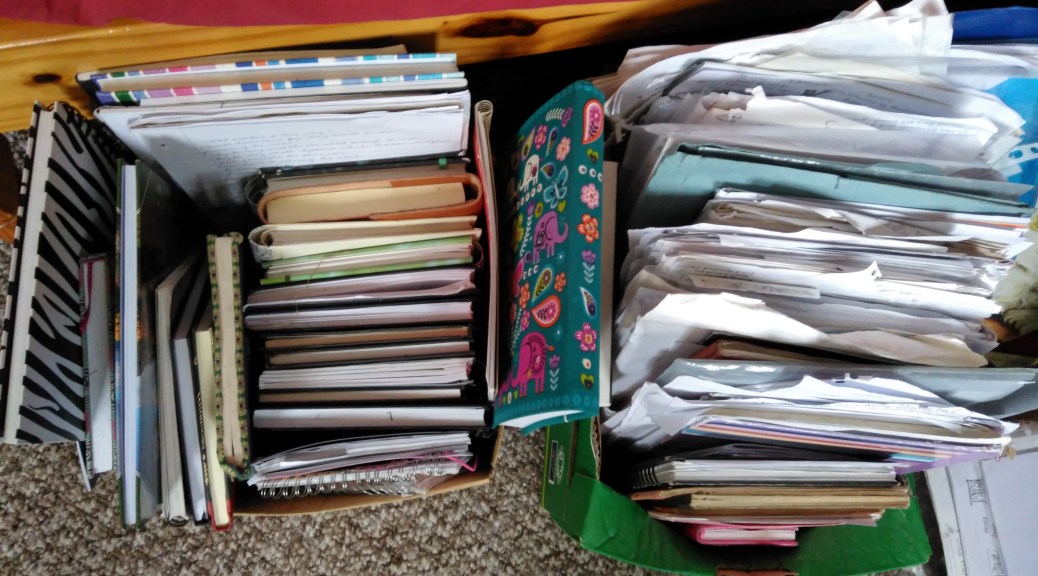
Look at these boxes, bursting with thoughts and experiences! Here’s what Mel has to say.

IMG_20170317_145530

As you can see, I have whittled down my back catalogue of journals and diaries to two boxes – apart from the notebook under my bed, the one in the kitchen and the one in my bag! One reason I keep notebooks and pages upon pages of journaling is because amongst it are songs, poems, ideas for stories and life. Sometimes they contain necessary evidence of this woman’s journey. Occasionally it has felt right to ‘let go’ of certain journals having at times poured negative energy into them in an effort to remain sane.

I loved writing as a child. My first poem ‘Winter’ won me a bar of chocolate at a friend’s 7th birthday party. At one point I kept a notebook and pen in the downstairs loo and was writing a Dick Francis style story about a stolen horse – tragically I lost that epic along the way! My teen diaries didn’t go in for much detail – ‘homework’, ‘church’ and ‘washed hair’ featured a lot! Sadly, leaving Northern Ireland became the escape I craved and creativity was side-lined.

In my twenties – work, sex, drugs and rock’n’roll took precedent and it wasn’t until I was living in rural Devon in my thirties that writing re-entered my life in the form of journaling, although I didn’t know it was called that. I was a single mum, low on money and support and at times struggling to cope. Rather than expose the depths of my despair to friends I began writing it all down in order to self-preserve. A daily gut-spill and vent became a survival strategy which ultimately reconnected me with the wonderful, flowing feel of writing. I could work through a worry on the page and suddenly the writing was coming from a different perspective – a deeper place – and had a more poetic feel to it. Writing my way through problems taught me I don’t have to react immediately to situations – often keeping quiet and taking time to reflect makes for a better response and sometimes no response at all works best. This early morning ‘write’ with a cuppa in bed has helped me to become a more aware human being and that is definitely an ongoing process.

Allowing that rediscovered creative and playful part of myself to flourish has not been easy – it has taken many years to embody the conviction that it must receive priority. Five years ago I made myself ill through the stress of juggling three jobs six days a week in order to keep the roof over my head, the car on the road and support my son at university. Whilst recovering I decided to write two lists – what I wished I could do more of and what I wanted to do less of. I’d attended some wonderful writing courses (thanks Jenny) and poetry workshops and wished for more time to write – but how?   Eventually I gave up my home and much of the contents and moved to Cornwall where I rented a room whilst doing a Creative Writing degree at Falmouth University. Journaling became less stress-relief and more celebration of life. Deadlines for assignments were the new stress! I discovered that academia is not the place for this free spirit – but it afforded me time and space immersed in a world where creativity is being valued daily. I’ll tell you truthfully, as a student those early morning journaling sessions in bed with a cuppa sometimes stretched out till lunchtime!

The challenge now is to stay true to myself and keep the flow flowing. Journaling has an important role in that aspiration.

You can read more about Mel and her writing on her website.

I really relate to the idea that journaling is an important part of keeping the flow flowing. Is that your experience too? 

Creative people are full of contradictions!

I came across an article by Mihály Csíkszentmihályi that I shared on my fb page today, but in case you missed it, here it is in a nutshell, the ten contradictions he identifies in creative personalities.

  1. Creative people have loads of physical energy, but also rest often and sleep a lot. I certainly find this. At some phases in a piece of work, I may work all day and then wake after a few hours’ sleep, get up and work through the night as well while, at other times, I may sleep a sound 8 hours and catnap throughout the day.
  2. Creative people have a mix of wisdom and childishness in the way they think. This might be why I enjoy writing children’s self-help!
  3. They combine playfulness with discipline in their work.
  4. They alternate between imagination and fantasy and a very rooted sense of practical reality.
  5. They may be both extroverted and introverted, although these particular traits are normally the most stable of personality indicators.
  6. They are both humble and proud; humble out of a deep respect for their art and the sure knowledge that luck has played a great part in their contribution to it, and proud in recognition of their own work, because it is the result of great effort.
  7. They don’t fit rigid gender stereotypes, but have a kind of psychological androgyny, having the strengths of both their own gender and the other.
  8. They are both rebellious and conservative, able to take risks but also respectful of traditions.
  9. They are both passionately involved with their work and able to be objective about it.
  10. Their openness and sensitivity may mean they feel both pain and pleasure more acutely.

The article goes on to describe the pain of those times when the art isn’t flowing, and the joy of the times when it is. In my life, that would be last year and this. When I wasn’t writing last year, I felt adrift from myself. Now I’m writing again, I’ve come home.

You can read the whole article here. I personally found it very affirming, because I could so relate to it. I imagine a lot of creative people struggle, as I do, with these contradictions in themselves, and are aware of how their own inner contradictions can impact upon the people around them.

I’ve wished, for the sake of my family and friends, and for my own sake too, that I could be a less complicated person. I’ve tried to be less up and down, less inconsistent; I’ve felt, especially in my younger years, that there was something really wrong with me.

I don’t think so as much now – but it’s still nice to have it affirmed that at least some of the trickiness I navigate through life is down to the simple fact that I am a creative person.

How about you – do you relate to these 10 contradictions? Or do you recognise them in a creative friend or family member?