Category Archives: Dream skills

Using creativity to make life better

We were discussing the Senoi method for tackling nightmares in last week’s session of Writing in the House of Dreams, when someone said, ‘We ought to be teaching this to children in schools!’

The Senoi technique is described by Patricia Garfield in her fascinating book, Creative Dreaming – that’s where I first came across it. When you go to sleep, you intend that if you have a bad dream you will confront the difficulty, face down the enemy, and claim a reward.

If you wake before your dream has reached a positive outcome, you either go back to sleep and continue the dream or else complete it in imagination.

You don’t need to be lucid within the dream, so it’s a very easy practice that anyone can begin, and if you always bring your dreams to a positive outcome you set a track in your mind that your dreams will soon automatically follow, resolving themselves before you awake.

It’s obvious that not having unresolved nightmares is a way of making your dream experience better, but the goal of Senoi dreaming isn’t just to make your dream life better – it’s to make your waking life better as well. So how does that work?

When you deliberately face up to challenges and create positive outcomes in your dreams or imagination, you experience yourself as an effective and courageous person. Then when you’re faced with challenges in waking life, that’s the person you know you can be – someone whose first response to difficulties is ‘I can sort this!’

I shouldn’t think we’ll ever see creative dream skills in the national curriculum but I believe children could get the same benefits from learning to write stories.

The Senoi approach is basically the Hero’s Journey. The hero crosses the threshold into the unfamiliar world, meets enemies and falters, before finally facing up to them and claiming her reward to bring back to the ordinary world.

This story is the mythic template for all our stories. Every new experience starts with crossing the threshold into the unfamiliar and making the hero journey, from starting a new relationship or job to small things such as making a phone call or trying a new restaurant.

In the past, creative writing was part of the school curriculum – I don’t mean analysing styles and all that kind of thing, but properly diving into imagination, every child different, every story unique.

Writing stories is joyful, exciting and empowering. I wish we could have more truly creative writing on the curriculum because, in my view, it wouldn’t only make children’s experience of school better – it would, like creative dreaming, make the rest of their life better too.


A home-made four-poster bed, an out-of-body experience and a flash of inspiration…

I’m delighted to welcome Dutch therapist, Susanne van Doorn, into the House of Dreams today, to tell the fascinating story of how she came to start her dream journal, years ago. She even includes some tips for you if you’d like to try it too.

susanneklein kopie

When Jenny invited me to write something about journalling, I immediately thought about my dream journal. It all started when I was 16.

I had a very romantic self-created Four-poster bed with old curtains that gave me the feeling I was embraced and secure when I retreated at the end of the day. It was all designed so I could secretly read without getting caught by my parents.

When I was 11 I had an out of body experience because I had gotten really ill from undiscovered type one diabetics. That whole experience, of flying around an unknown hospital and seeing (and nurturing) my body from above had ignited a fierce interest in spiritual books.

So, that specific night I want to tell you about, I had the book ‘Creative Dreaming’ from Patricia Garfield in my secret hideaway place to read. It was a revelation to me…

For the first time in my life I read that you have the ability to guide your dreams to give you an answer to a certain topic (and believe me, like any 16 year old, I was an accumulation of questions).

For the first time in my life, I read that you had the ability to ask the persons you meet in a dream for a gift.

I immediately turned out the light and went to sleep. You will not believe what happened…

In my dream I met my deceased aunt An (I am named after her: SusANne). I was thrilled to see her but than I remembered I had to ask her for a gift. So, like in most dreams I communicated telepathically to her and asked for my gift. She gave me a yellow rose, a sign of friendship.

You can imagine that such an experience had me craving for more. So I started writing down as many dreams as I could remember.

IMG_3304

Here is part of a dream I had the night before my first date with the man who would later become my husband.

“I am on a train, looking out of the window and I enjoy the sun very much. All of a sudden a drop of water touched my arm. I am amused and enjoy the coolness of the water.”

Being on a train is a symbol of the journey of life. We are all in it together, you have little influence on its direction after you have chosen a certain destination. But in my dream i enjoy the warmth of the sun.

The water is a symbol, of life, a symbol of the goddess if you will. It is like life gives me support to let me know that I am on the good track. The sun is shining, all the ingredients of fertility are there.

I hope that my blog will encourage the idea that you lay a pen and paper next to your bed, and write down a dream whenever you remember something. You’ll see that the more times you write something down, the better the memory of your dreams will be (I have 10 tips to improve dream memory in an ebook on my site).

And even if you don’t believe dreams have any meaning, you’ll be surprised how many times dreams have pointed out something.

Try to write in the first person’s perspective, even though it can be hard (dreams are often in the third person perspective). In this way the dream keeps its “juiciness”.

Jot down the main emotions you had the day before. Emotions are often the key towards attaching more mening to your dream.

Write down all the symbols in your dream and put your first association behind it.

Now re-write the story, using your associations and see if that gives you some useful insights into your personality.

The great thing about dreams is that they ignite your creativity (for example, I took a course in tarot because of a dream, I organised a trip to England searching for King Arthur also because of a dream). So for me the question if dreams mean anything or not is really not relevant. For me, dreams are a key to creativity.

I want to thank Jenny for giving me the opportunity to tell you something about journaling.


About Susanne

Susanne van Doorn, PhD (The Netherlands) is a Dutch therapist working for Therapeut van Binnenuit and blogging for Mindfunda, where she reviews new books about dreaming, spirituality and mythology, interviews authors and teaches several online courses.

Author of “A dreamers Guide through the Land of the deceased”, Mutual Dreaming: A Psiber Experiment with co-author Maria Cernuto published in Dreamtime spring 2014, translator of “Theory of Dreams” by Vasily Kasatkin (2014).

She is a regular presenter at Iasd conferences since 2013, In the Netherlands she gives presentations about dreams on a regular basis. She has a vibrant internet presence on Twitter: @susannevandoorn, Facebook and Linkedin.

You can read Susanne’s review of my book, Writing in the House of Dreams here.

Get more from your dream life in 2017

As the old year comes to a close, it’s time to take stock and think about what you’d like the new one to bring. Intention is a powerful magnetic force, and focusing on what you want greatly increases your chances of achieving it.

The sharper the focus, the better the chance; having a vague notion of something you might like to achieve is like throwing a dart in the general direction of the darts board and hoping it’ll hit the bullseye. It could happen, but it it’s not very likely.

Once you’ve set a goal, you need to think of practical steps you can take to work towards it. As you’re reading this blog, I guess you’re interested in dreams, so here are my suggestions for anyone who’d like to get more from their dream life in 2017.

  1. Make dreams part of the conversation. Talk about dreams generally, with your family and friends, and share specific ones you happen to remember. Talking about dreams, whether you have regular recall or not, increases dream awareness even for experienced dreamers. The secret of happy dream talk is to treat your dreams like the experiences of waking life; keep it brief, keep it interesting, leave out any long-winded boring bits and, most important of all, don’t try to interpret, either your own or other people’s. One of the reasons we can feel reticent about sharing dreams is because we think they might reveal something about us, and focusing on finding meaning takes our attention away from the actual experience of the dream. Besides, as Alfred Adler wrote, The realm of meanings is the realm of mistakes. 

    img_0088
    Dream sharing in the family whatsapp from one of my children, the day before our Christmas get-together including new addition, one-year-old Daisy.
  2. Let go of psychological interpretation generally. If we value dreams only as a source of information about our waking life, that puts an automatic filter on our recall. We will tend to remember and write down only the dream material that we identify as important or relevant, and miss the good stuff that takes us outside our waking understanding and into the complete unknown. Letting go of trying to interpret dreams could be interesting for more experienced dreamers as well as beginners; try it for a few months, and see if your dream life changes.
  3. Keep a dream diary. I’ve put this one last because it’s what everyone says and I didn’t want you to roll your eyes and abandon me mid-post! But everyone says it for a reason; it works. It’s the power of intention again. By buying a lovely notebook and placing it beside your bed, you’re setting the intention to record something when you wake. At first, you may not have many narrative dreams, but just fragments or single images – however random, uninteresting or irrelevant they feel, write them down. Draw them. Value them. From these little scraps, dream recall will gradually develop. Have faith and stick at it. I recommend you set the intention for a manageable amount of time initially, say 6 weeks, to record something every day. You will need to set your alarm 15 minutes before you have to get up, so that you’ll have time to wake slowly and enjoy that gradual surfacing from sleep.

You can read more about creative dreaming – that is to say, experiencing dreams rather than trying to interpret them psychologically – in Patricia Garfield’s classic book, Creative Dreaming, or in my own Writing in the House of Dreams.

I’ll also be running my Writing in the House of Dreams course in Cornwall later in the year, so sign up for my newsletter if you’d like a heads-up when I set the dates, or contact me, without obligation, to discuss a one-day or residential workshop for your writing group further afield.

That’s one of my New Year intentions in place – to include creative dreaming in my 2017 workshops programme – now time to ponder some more.

Do you set intentions at New Year? Could one of them be to get more from your dream life?


I dream, therefore I am

I enjoy reading about quantum physics because it’s basically an exploration into the nature  of reality – matter, energy, parallel universes – all the things that I myself love to explore through dreaming.

Recently, I stumbled upon an article in Mother Nature Network with the intriguing title, Parallel worlds exist and interact with our world, say physicists

It takes the theory of parallel worlds a step further, because it proposes that they might not only exist, but also affect our lives in this one and, here’s the exciting thing, we might therefore be able to investigate them.

Now there’s a new theory on the block, called the “many interacting worlds” hypothesis (MIW), and the idea is just as profound as it sounds. The theory suggests not only that parallel worlds exist, but that they interact with our world on the quantum level and are thus detectable.

When I read about this, it reminded me of discovering that science had proven matter is actually energy – a fact that dreamers, shamans and other psychic explorers have always taken as read. I feel that science is not about discovering phenomena so much as discovering rational explanations for them.

Of course, when I talk about dreaming, I’m not talking about the psychological – that is, scientific and rational – way of being a dreamer. As soon as you let go of the psychological model, you understand through creative dreaming that the psychological model is far too small.

We are much more than what we think and understand about our self and our life. Our world is much more too. From just this universe, to parallel universes and now to parallel universes that interact with the one we know, the doors of perception are being cleansed.

If the doors of perception were cleansed every thing would appear to man as it is, Infinite. For man has closed himself up, till he sees all things thro’ narrow chinks of his cavern~ William Blake

Dreaming is an opportunity to cross the borders into other worlds. We live in this world as if it’s our one and only life, but for a dreamer like me, it nests among other lives and way beyond, stretching to infinity.

It doesn’t matter to me whether this can be explained, or even whether it’s ‘real’ in the scientific sense. It is real because it makes my reality. I dream, therefore I am.


‘Use your dreams to grow your soul’ – Patti Allen in the House of Dreams

Today, I’m delighted to welcome dream teacher and author Patti Allen MA in the House of Dreams. Patti served on the teaching staff of Seneca College in Toronto in the field of Holistic Health for ten years and currently serves as a mentor for Denise Linn’s online courses for Hay House.

With a specialty in facilitating dream groups, and a frequent guest on radio and TV, she presents lectures and workshops on the topic of dreams and how to work with them. Her dream healing oracle deck, The Abaton Keys® combines creativity, wisdom and dream knowledge to help dreamers access their own wisdom.

Patti Allen
Patti Allen

Patti, when did you first begin to remember and explore your dreams?

The first dream I interpreted was in 1980 after hearing an interview with Gayle Delaney on the radio. It helped me with a decision that was weighing on me. But I didn’t start exploring my dreams deeply until I didn’t my training in the Rubenfeld Synergy Method® in 1991, a technique for integrating body, mind, emotions and spirit. Part of the requirement was to go through the work myself and my dreams became quite vivid and intense. It began my search for meaning and a life-long love of dream exploration.

How do you use dreams in your own life?

Dreams have advised me on relationships, helped me problem-solve and given me access to Source and creative possibilities. They amuse me, educate me, help me learn about myself and those in my life. Quite simply, I am enlightened by my dreams and I am bereft without them.

What is the relationship between dreams and creativity?

I believe that we are created in the image of the Creator and embedded in that is creativity! Dreams provide inspiration in the emotions they convey, the colours they feature and in the stories they tell and visual images they show us. They are just waiting to be mined and used to create our lives… whether we use them in a “creative” project or not.

I’m particularly drawn to your website page on the Abaton Keys. What was your process in creating them?

Thank you! I did my master’s degree on the role of dreams and healing in ancient Greece and I loved the healing practices associated with dreams and the healing temples of Asklepios. Then, Denise Linn, the founder of the Soul Coaching Institute and my teacher in Soul Coaching®, created a course for Hay House on oracle card readings. I served as a mentor for that group and was inspired by the course material to actually create my own deck. It was a creative birthing that couldn’t have happened without the amazing work of collage artist Julia Still. As much as I organized the project, there was something bigger than myself, organizing me! To this day, when I do a reading for a client, I check the book that explains each card. The work came through me but didn’t necessarily lodge in the part of my brain that I can access. An interesting process to say the least!

Is there anything else you would like to say about dreams?

Yes! Explore your dreams, play with them and use them to grow your soul. There is no right or wrong way to start. We spend a 1/3 of our lives sleeping and through dream work, we can be 100% awake!Patti Allen

To learn more or contact Patti, go to www.pattiallen.com

Why enthusiasts share their enthusiasms

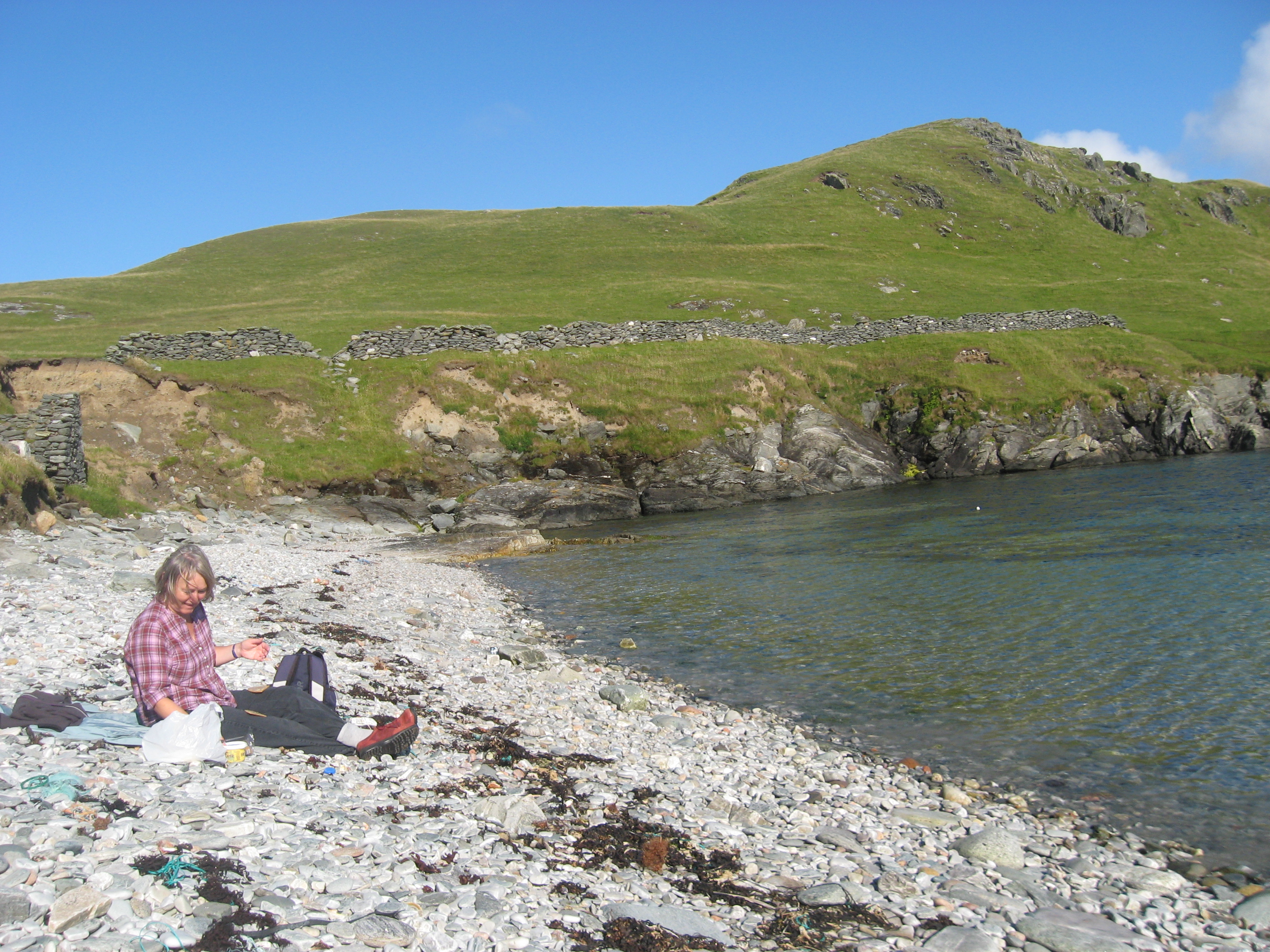
Driving back to the house I was staying in last week, after an afternoon walking the coastline of Shetland, I was listening to an item on Radio 4 suggesting that the wonderful natural history programmes we have these days are putting people off actually going out into the countryside and exploring nature for themselves. The contention was that the natural world feels disappointing compared with the close-up images we can see on our screens.

Walking the coast in Shetland

Chris Packham, one of the Springwatch presenters, was understandably put out by that argument. He said the motivation behind programmes like his was to inspire people to get out and discover the joy of being in nature, by showing how wonderful the natural world is, and all the plants and animals you might see.

I had just seen an otter walk down to the water across the stony beach right in front of me. I would have seen him better in close-up on TV but, having seen the footage of otters on Simon King’s Shetland Diaries a few years ago, I could fill in the detail for myself. I also knew how lucky I’d been to catch a glimpse of such a shy creature.

I’d barely started walking again when i came upon a group of seals lying on a small sandy beach. They were less shy, and allowed me to go down onto the sand and sit watching them. Again, in a close-up on TV, I could have seen every detail, but as Chris Packham said, that would not have come anywhere near the excitement I felt at being so close to the animals themselves.

Just as Chris Packham is an enthusiast for the natural world, I am an enthusiast for the inner world of dreams. Like him, when I share my own experiences, I want to inspire other people to make their own explorations, and I would hate to think it could actually be putting them off.

Not everyone has the time and dedication to devote to one area of experience and most of us like to dip the toe, as I do with my walks in nature. Devoting time and focus will always reap rewards. When I talk about the faceless ones, or numinous dreams, or lucid dreaming I know some people will not have had those experiences, but I hope that simply knowing they exist might inspire them to go looking, or at least recognise them if they chance upon one, and know what they’re looking at, like me and the otter.

How to have dreams that you can understand

Last week I described a dream I had when I was planning my writing projects for 2014, whose meaning was absolutely obvious. In that dream, I diverted from following Deborah Meaden on the path to the station and felt wonderfully happy on the beach.

Happy on the beach
Happy on the beach

I’d been thinking I should pitch some projects for the market rather than follow my writer’s heart into probable penury with a self-publishing project and an idea for a book I almost certainly couldn’t sell to mainstream publishers, so the meaning of my dream was very clear.

Just to make sure I got the message, I had a second dream in which I woke up to find I had been sleeping on the beach, and as I lay there blinking in the bright morning sunshine I saw a baby playing on the sand right in front of me, happily absorbed, the two of us drawn together in a moment of pure magic.

Hearing a sudden sound of voices, I looked round in time to see the big double doors of the public hall at the top of the beach thrown open. A very successful author I know came out, surrounded by press people and fans. She had been doing an event at the literary festival in the hall. She was beaming under a truly fabulous blue hat.

I waved and shouted hello, and she waved back. I felt delighted for her, because she loved doing major events. A second author I know came out, also dressed beautifully and wreathed in smiles. I waved and felt happy for her too, but I was glad it wasn’t me doing festivals in fabulous hats. The sun was warm on my face, and I looked back at the baby, who was now watching me with intense interest. She had a pebble in her little fist that she held out to me.

It was very easy to understand where these dreams came from, as I was totally preoccupied in waking life with what direction to take with my writing this year. Most dreams are story versions of waking-life events and concerns, and if you have one thing in particular that’s occupying your mind the connection is often obvious. People involved in research or creative projects will commonly have dreams that develop and resolve problems they are working on.

In normal life we aren’t usually so intensely preoccupied with one major question or concern – our energies are more dispersed and the connection between the minor ups and downs of waking life and the world of our dreams can be more difficult to spot. One way of having dreams you can understand is if you narrow your focus through dream incubation.

Before you go to sleep, think back over your day and notice anything that’s been bothering you, any decisions you need to make, any problems you need to resolve. Choose one and ask for a dream about it. Promise yourself that whatever dreams you have, you will record in full, because often in the first moments of waking we’ll dismiss a dream without bothering to write it down if we can’t immediately see the meaning or importance of it.

Although the rational mind works instantly, in the symbolic mind, meaning takes time to unfold, and a dream that has seemed random on waking might, on re-reading later in the day, surprise us with its resonances.

Sometimes when you have incubated a dream it will be easy to see the connection between your daytime situation and the dream. Other times, you may ponder it, put the dream to one side and get the a-ha moment later. Or if you ask for another dream about it you may have one the next night that makes things clearer.

Incubating dreams in this way means you are thinking about your day life instead of just living it; you’re noticing the way your mind is organising experience into stories, so that it’s easier to see when dreams are carrying the story on.

Setting up dreaming intentions means your waking ‘I’ is communicating with your dream, and very soon you’ll find your dream is answering back.  If you want to understand the answer to what it means, it really helps to know the question in advance.

You can find a bit more about dream incubation here

Have you ever incubated a dream?

Dreams and the creation of music, by Travis Wernet

Today, I’m delighted to welcome my first musician in the House of Dreams. Travis Wernet is a professional dream teacher with three studio albums under his own name and musical moniker ‘Outlaw Dervish.’

Simone Weil called attention prayer. I think she was onto something. When we listen to music we are paying a special consideration to sound. Over recent years I’ve become increasingly observant of how, when I am dreaming, I seem to be engaged in an attentively mindful space of awareness. As a musician, there are even ways that I see how I’ve got to give attentiveness to the instruments I am playing. This serves the evocation of sounds that feel the most fulfilling as they emerge, seemingly out of the invisible ethers surrounding the instruments in the space where I am creating. How similar this seems to my experience of the way dreams appear!

In my experience, dreams can influence the creation of music, they can feature and contain music and, as it turns out, music also influences the creation of dreams.

While recording the didjeridu tracks for my meditation album, Yoro Yoro,  dreams synergized with the work we did in the studio one day. As we gathered tonalities for various songs, I remembered a dream from the previous night.

In the dream I am in the company of three aboriginal people… The first, a tribal elder, invites me to spear fish with him. Next, I see a woman and a man who are sitting in the ocean meditating. I notice all this and then the scene becomes somehow ethereal. I drift up into space and see the earth, which shape-shifts into what I know are the call letters for a radio station “K Be Radio”. Upon witnessing this I float back down to earth and witness a peaceful scene near the sunny seaside where softly blowing sands mix with waving grasses in the wind.

At the time we were recording, the energy of this dream supported a fluid ability to get what are called “one-takes” for the songs we were crafting. This simply means that in the studio, the first effort to add the didjeridu tracks turned out to be the most satisfying to our ears, minds and hearts. The tone of our collaboration in this sense felt effortless and energizing. Exactly what we wanted for the meditation album! The ambience of connection with the meditators and the vision of the globe, as well as the hint at an aura of pure being, with the “it’s okay to be” radio station, all added a felt dimension to our project.

Beyond this, I can see over recent years how that dream was helping to set the stage for current creative endeavors. I’ve become very fascinated with and involved in musical dream incubation. This is the use of certain kinds of sounds and music to invite and receive helpful, healing dreams. Alas, that’s a story for another time.

Receiving and imagining the dream of “the Three Aboriginals and K Be Radio” has also afforded me the message of a deep spiritual experience which set me on a path of renewed authenticity wherein I have sought to tune myself to the frequencies of who I am at an essential level. In addition the dream has inspired me to share its messages with others, through music and my work with dreams.

Travis Wernet
Travis Wernet

Following years of international travel, co-leading ceremonies from the Great Pyramid in Egypt to the Lotus Temple in New Delhi, Travis shares his work at home in the US and offers online video dream groups, workshops and private sessions. To find out more about his work, check out his blog and website

Can writing make life better?

My favourite chapter in Patricia Garfield’s ground-breaking book, ‘Creative Dreaming,’ is the one about the Senoi dreamers, whose dream-practice is designed ‘to make life better.’

My 1976 copy of the very wonderful 'Creative Dreaming'
My 1976 copy of the very wonderful ‘Creative Dreaming’

In this tradition, if you have an unhappy or disturbing dream, you create a happy outcome for it, either by going back to sleep and dreaming it on, or through creative visualisation when awake.

If every time you have a bad dream you bring it to a satisfying resolution, soon your dreaming mind will start to follow the pattern you have consciously created, and difficult dream situations will always be resolved within the dream.

This practice doesn’t only make your dreamlife happier, it makes your waking life better too, because it works as a kind of rehearsal, an empowering opportunity to experience yourself as someone who confronts their fears and finds their courage and ingenuity in difficult situations.

One of my most common nightmares when I was younger was fear of falling from high places, and that fear was reflected in my waking life. First, I learnt to handle it in my dreams and then, building on that imaginative experience, in my waking life, so that nowadays I love the exhilaration of pushing through the fear to reach the heights.

Up high in Prague last month - hello, Pat!
Up high in Prague last month – hello, Pat!

This is exactly what we do when we write fiction. We put our characters in difficult situations and imagine them forward to a place of resolution. These fictional situations emerge, like dreams, from our deep unconscious, and like the Senoi dreamers, we transform them in imagination in order to triumph over them.

Has your dreaming or writing ever helped you to face a deep fear and feel empowered?

If the doors of perception were cleansed

To round off my blog birthday celebrations, here is ‘the one that got away’ – an article about my spiritual path of dreams which was published on another blog earlier in the year  

When people talk about dreams as spiritual experience, they usually seem to be thinking in terms of what Jung called ‘numinous’ dreams – that is, dreams which have an unmistakably spiritual quality, inspiring awe and wonder, and often bringing revelations.

These ‘big’ dreams do indeed feel like wonderful gifts from outside the self, and they stay vividly with you across the decades, lighting your life. But dreams which feel quite ordinary can also be a doorway to profound changes in consciousness.


For example, I once dreamt I was having coffee with my neighbour. I was fully aware that I was dreaming – lucidity is very common in experienced dreamers.

Normally, in lucid dreams, my waking ‘I’ might be there as an observer or commentator, and occasionally if I didn’t like the way things were going, I might intervene and change the action of the dream.

But this dream didn’t have any action at all. It didn’t have any narrative to distract me – I was just sitting there, drinking coffee, and I was bored. There was a silky cushion beside me, and I ran my hand absent-mindedly across it. I noticed how smooth the fabric felt; I ran my fingers along the hard ridge of the trim.

I thought, ‘Hold on a minute – this is a dream!’ Since nothing much else was going on, I went on testing the evidence of my senses and yes, I really could smell the coffee; I really could feel the crumbly biscuit between my fingers and taste its light vanilla on my tongue. I could hear my neighbour’s voice, talking to me. I knew it was a dream, but it felt exactly the same as ‘real’ life.


When I woke up, I could feel the quilt resting lightly across my body; I could see the light from the gap in the curtains ribboning across it; I could hear my husband’s gentle breathing and smell the warmth of our two bodies. But now I knew that my mind could create a whole different reality which felt as real to my senses as this one. So the senses were unreliable witnesses, and waking life a reality no more substantial than the dream.

When you read back over old dream diaries, you will also find that seemingly ordinary dreams can be precisely predictive, and you may find so many of these that it’s impossible to dismiss them all as flukes and coincidences.

According to our normal understanding of time, it should not be possible to predict the future, but the experience of predictive dreaming shows irrefutably that it is.

So gradually, actively engaging with dreams can dissolve the narrow rational and materialistic viewpoint, through which we normally understand life. In the words of William Blake, ‘man has closed himself up, ’til he sees things thro’ narrow chinks of his cavern.’

The practical, experiential path of dreaming can lead to a falling-away of ideas and illusions, and open you up to the mind-blowing reality. ‘If the doors of perception were cleansed everything would appear to man as it is, infinite.’