I enjoy reading about quantum physics because it’s basically an exploration into the nature of reality – matter, energy, parallel universes – all the things that I myself love to explore through dreaming.
It takes the theory of parallel worlds a step further, because it proposes that they might not only exist, but also affect our lives in this one and, here’s the exciting thing, we might therefore be able to investigate them.
Now there’s a new theory on the block, called the “many interacting worlds” hypothesis (MIW), and the idea is just as profound as it sounds. The theory suggests not only that parallel worlds exist, but that they interact with our world on the quantum level and are thus detectable.
When I read about this, it reminded me of discovering that science had proven matter is actually energy – a fact that dreamers, shamans and other psychic explorers have always taken as read. I feel that science is not about discovering phenomena so much as discovering rational explanations for them.
Of course, when I talk about dreaming, I’m not talking about the psychological – that is, scientific and rational – way of being a dreamer. As soon as you let go of the psychological model, you understand through creative dreaming that the psychological model is far too small.
We are much more than what we think and understand about our self and our life. Our world is much more too. From just this universe, to parallel universes and now to parallel universes that interact with the one we know, the doors of perception are being cleansed.
If the doors of perception were cleansed every thing would appear to man as it is, Infinite. For man has closed himself up, till he sees all things thro’ narrow chinks of his cavern~ William Blake
Dreaming is an opportunity to cross the borders into other worlds. We live in this world as if it’s our one and only life, but for a dreamer like me, it nests among other lives and way beyond, stretching to infinity.
It doesn’t matter to me whether this can be explained, or even whether it’s ‘real’ in the scientific sense. It is real because it makes my reality. I dream, therefore I am.
It’s that time again, and the great thing about buying things for writers is that you can give them something that will provide weeks or months of writing pleasure and inspiration without breaking the bank.
Here are some suggestions for things your writing friends might like – or if you’re a writer, why not treat yourself?
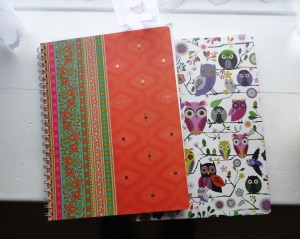
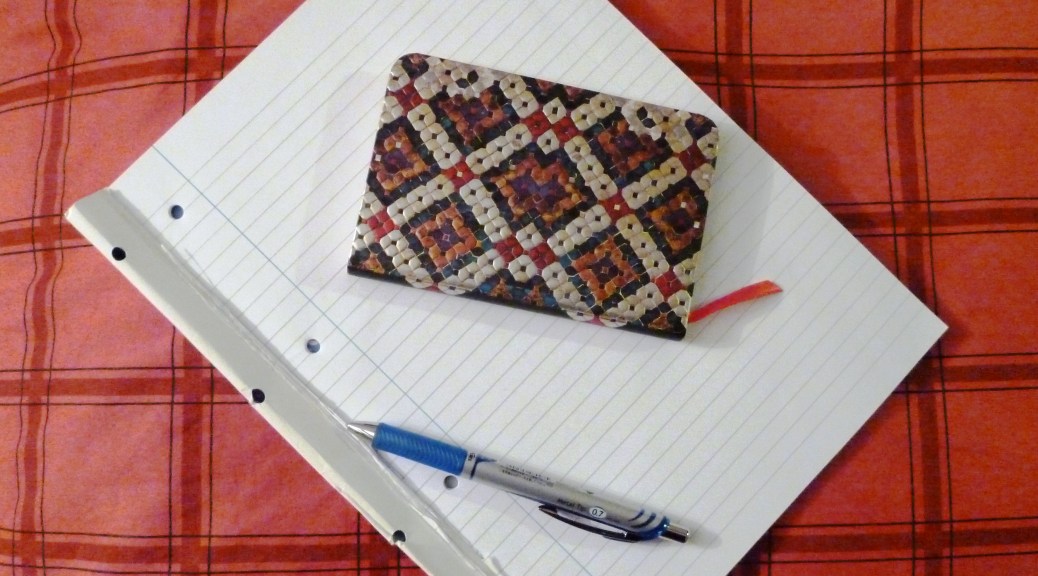
The name says it all, and they really are gorgeous. I’ve been using them for my writing journals for several years now, as readers of my newsletter will know. Great quality paper, beautiful binding, a useful ribbon to mark your place and a handy pocket at the back for bits and pieces.
They write just like a fountain pen but the ink doesn’t smudge, and they come in every colour. If you aren’t keen on sharpies for book-signing, these are a good alternative, as well as being excellent for writing in your gorgeous notebook, of course.
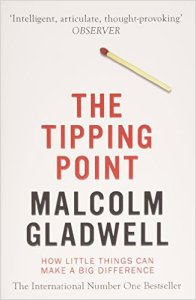
Whatever kind of writing you do, it helps to understand what’s most important to you and create writing goals that fit with your core values. That way, you’re both more likely to succeed and also more likely to enjoy your success when you do. My friend Penny Dolan recommended this book to me a while ago, and I’ve recommended it to other writer friends ever since.
Even in these days of mobile phones, most writers like to carry a notebook somewhere about their person when they’re away from home, and these are perfect – not too big, bulky, or heavy to put in your pocket; soft but not flimsy covers; good quality unlined paper and attractive cover designs.
Not just writers, but everybody in the world can find solace, joy, companionship and inspiration in poetry, and this new book is full of wonderful poems. My thanks to Jackie Kay for recommending it during her brilliant workshop at the North Cornwall Book Festival 🙂
Speaking of Jackie Kay’s workshop, which was pure delight, a place on a writing workshop will please your writer friends or writer self, and it’ll be something to look forward to at the end of the Christmas festivities.
I love going on other people’s workshops, and I’ve yet to meet another writer who doesn’t. (I’ve added the link to mine, but you can just google writing workshops in your area to find ones local to you)
Being a writer isn’t just a way you pass your time – it’s a part of the way you are. Developing a practice of writing is a profound kind of self development, and Natalie Goldberg brings a Buddhist sensibility to it which I love.
Most writers are more excited by experiences than things, so how about a ticket to somewhere that might spark their imagination, such as the Foundling Museum?
Two companionable books for writers from me, which both offer plenty of short writing tasks for you or your writer friends to take refuge in if you need to pace yourselves over the festive period.
Happy Christmas shopping!
Have you got any recommendations for Christmas presents for writers? Please share!
A few days after I last blogged, way back in May, I went to Iceland. I’d always been drawn to the North, so Iceland had been on my must-see list for decades, but what made me actually go this year was a series of dreams I had around the time of my mother’s death last November. They were ‘big dreams’ – dreams that had a momentous quality, a deep sense of mystery and meaning.
They were a call to ancestors, to the place beyond death and, specifically, to Iceland. So like all dreamers, who have learnt how and when to listen, I followed the call of my dreams.
Being in Iceland felt, to me, like being in a dream. I had completely underestimated the size of the island, and the sparseness of the population; I had not expected the vast tracts of volcanic deserts and inaccessible mountains. I hadn’t noticed that the key on my map had only three kinds of terrain – places where something’s growing, places where not much is growing, and places where basically nothing is growing at all, which was about 40 percent of the land.
Ice, water – and fire too. In Iceland, the hot water in your shower smells of sulphur, because it’s piped straight out of the volcanic ground, and when you’re walking in some places, you can hear the gurgle of water boiling and bubbling, breathing out wafts of sulphurous steam, and then the earth feels like a living being. You can absolutely understand why Icelandic people believe in earth spirits – you can believe it yourself.
Land of fire and ice, and of light and darkness too. I visited several art exhibitions which explored the creative sensibility of the peoples of the North, shaped by long dark winters and summer months of continuous light. They made explicit how this environment can drive a psychological rhythm between extremes of celebration and isolation, of joy and depression.
I felt these extremes in myself, the whole time I was there. On the surface, excited and enchanted by everything I saw and everyone I met, but sensing all the time, the darkness moving underneath. A few days in, I had this dream:
The car is packed for the next stage of my journey and I’m having a last cup of tea with my hosts. Looking out over Rekjavik through their big window, I see a sudden darkness coming across the sky – clouds?
I see black clouds rising along the edge of town, pouring up into the air from the ground, and as I watch, a sudden column of sparkling fire shoots up, exploding in a great shower of sparks, orange and red, filling the thick black cloud that’s covering everything.
‘What is that?’ I gasp.
‘The volcano’s erupting.’
Black soot is falling everywhere, covering everything, but it doesn’t matter. This is what I’ve come for. The darkness. Not just fun and distraction. I always knew it.
It was the beginning of what has been, for me, a difficult summer. I went to Iceland following the kind of dreams that will take you deep into your own darkness, as well as bringing you, eventually, to wonder and light.
I had expected to meet the black dog, but black dogs come in different shapes and sizes. This one turned out to be huge and hungry, feral and strong, and he was never going to settle for living in my house like a sad old labrador for just a few weeks or months.
It’s been a long and exhausting trek through his cold darkness but, last week, I woke one morning with a great sense of relief, after my first full night’s sleep for months, and a bright thought filled my mind like a sunrise, ‘It’s over now.’
I’m sorry I was away so long, but very happy to be back.
Last night, I had a dream about the rewards of writing, and when I woke I thought, I can blog about that. When I turned on my computer in the morning, I discovered this quotation in my Facebook timeline, which was a delightful synchronicity to start the day.
I slept and dreamt that life was joy. I awoke and saw that life was service. I acted and behold, service was joy ~ Rabindranath Tagore
Because this was my dream.
I am in a wild, upland place, being taken to see a wonderful plant. I’m given just the briefest glimpse of tall stems with early blooms of the most intense purple, and I realise it’s the colour that I’ve been brought to see. Usually, I am brought to see the indescribable aqua, but this time it’s this purple.
I’ve been writing something, and it’s a test – if I pass, I can come back and see this purple in all its intensity, in full flower. But this time, I have not passed and I will have to go back and start again, and try with another piece of writing.
This is the work, and I’m grateful for it. I don’t feel disheartened by failure, because the work itself is my reward.
It was always like this. I look back at all my writing, so many books I poured my heart and self into that never saw the light of day – real work, hard work – and I never achieved any kind of fame or recognition, but I don’t regret any of it.
Like the family years. I remember the sense of pride I took in the tasks of the household and childcare, which felt important, and a privilege, to be able to live in service to the work. I never felt bored or resentful, or that what I did was unimportant.
I had work, and I wanted to do it as well as I could. Not everybody is given that sense of purpose. I’ve glimpsed the colour, and one day I might see it in full flower, but the glimpse is the gift.
In the long hiatus between my mother’s death on October 19th and her funeral last Friday, I wasn’t able to focus on work much at all, and that felt OK and appropriate. I slept a lot, dreamt a lot, read non-fiction books and wrote in my journal.
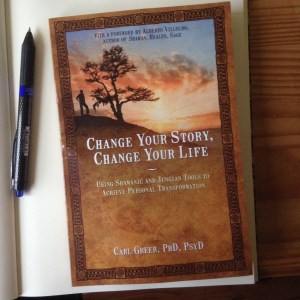
I was working through some of the exercises in Change Your Story, Change Your Life: Using Shamanic and Jungian Tools to Achieve Personal Transformation by Carl Greerone morning, when it occurred to me that anyone reading my journal after I died might not understand, as I do in the writing, that it’s an experiment, and not a report.
Slow start warning: I nearly gave up on this book after the first chapter, which felt like puff and waffle. A few chapters in, I’m glad I didn’t.
Actually, my whole journal is a perpetual work-in-progress. Every page I write is part of a creative exploration. It isn’t me – it’s a kaleidoscope of all the possibilities of me, and I’m aware of that when I’m writing in it in much the same way as when I’m gathering notes for a work of fiction, knowing all the time that many of my ideas won’t fit the story and will have to be discarded.
A journal or diary is a first encounter with ideas and events, before you’ve had a chance to ponder and decide what you think of them. To get a true sense of a person’s life, I guess you’d need to read their autobiography, because there you have a completed work. Where a journal is a mess of notes, often contradictory or inconsequential, an autobiography is an expression of the writer’s identity, his or her choice of what’s important and how they understand what’s happened.
I was struck by something in Natalie Goldberg’s book on memoir-writing Old Friend from Far Away last week; she says we shouldn’t think we have to be old before we can write a memoir. We don’t need the whole story all in one go, at the end. We can write memoirs from time to time throughout a long life, and each one will be the most complete expression of who we are and how we understand our lives up to that point.
In that sense, I guess autobiography could be seen as a work-in-progress too, but the difference is that in autobiography we are writing what we know about ourselves and our life, whereas in journalling we are feeling our way along the borders of our knowledge, and what we find must be judged as me or not-me, accepted or discarded, as part of the process of becoming.
If you read someone’s journal – as well as the obvious problem that it is private writing and they did not intend it to be read – you will not find the person there, and thinking that you will could give you every which kind of wrong impression, like listening to someone’s dreams and believing you can interpret them. A good dream therapist will simply hold the dream so that the dreamer can look at it from different angles, because only the dreamer can find out what it means.
I love my journals
I include all sorts of things in my journals – dreams, ideas, experiences, book reviews, quotations, drawings, writing exercises and creative experiments. I love them, just as I love my dreams, specifically because they don’t define me.
With both, there’s a feeling of infinite possibility, a continuously forming sense of direction, so that even at the end of a lifetime of journalling and dreaming, I’m sure there will be no conclusion, because the conclusion is always up ahead.
My children have strict instructions to burn my diaries without reading them when I die. What would you like to happen to yours?
Today, I’m delighted to welcome dream teacher and author Patti Allen MA in the House of Dreams. Patti served on the teaching staff of Seneca College in Toronto in the field of Holistic Health for ten years and currently serves as a mentor for Denise Linn’s online courses for Hay House.
With a specialty in facilitating dream groups, and a frequent guest on radio and TV, she presents lectures and workshops on the topic of dreams and how to work with them. Her dream healing oracle deck, The Abaton Keys® combines creativity, wisdom and dream knowledge to help dreamers access their own wisdom.
Patti Allen
Patti, when did you first begin to remember and explore your dreams?
The first dream I interpreted was in 1980 after hearing an interview with Gayle Delaney on the radio. It helped me with a decision that was weighing on me. But I didn’t start exploring my dreams deeply until I didn’t my training in the Rubenfeld Synergy Method® in 1991, a technique for integrating body, mind, emotions and spirit. Part of the requirement was to go through the work myself and my dreams became quite vivid and intense. It began my search for meaning and a life-long love of dream exploration.
How do you use dreams in your own life?
Dreams have advised me on relationships, helped me problem-solve and given me access to Source and creative possibilities. They amuse me, educate me, help me learn about myself and those in my life. Quite simply, I am enlightened by my dreams and I am bereft without them.
What is the relationship between dreams and creativity?
I believe that we are created in the image of the Creator and embedded in that is creativity! Dreams provide inspiration in the emotions they convey, the colours they feature and in the stories they tell and visual images they show us. They are just waiting to be mined and used to create our lives… whether we use them in a “creative” project or not.
I’m particularly drawn to your website page on the Abaton Keys. What was your process in creating them?
Thank you! I did my master’s degree on the role of dreams and healing in ancient Greece and I loved the healing practices associated with dreams and the healing temples of Asklepios. Then, Denise Linn, the founder of the Soul Coaching Institute and my teacher in Soul Coaching®, created a course for Hay House on oracle card readings. I served as a mentor for that group and was inspired by the course material to actually create my own deck. It was a creative birthing that couldn’t have happened without the amazing work of collage artist Julia Still. As much as I organized the project, there was something bigger than myself, organizing me! To this day, when I do a reading for a client, I check the book that explains each card. The work came through me but didn’t necessarily lodge in the part of my brain that I can access. An interesting process to say the least!
Is there anything else you would like to say about dreams?
Yes! Explore your dreams, play with them and use them to grow your soul. There is no right or wrong way to start. We spend a 1/3 of our lives sleeping and through dream work, we can be 100% awake!Patti Allen
explore and gain mastery in our inner worlds of emotion and imagination
develop, organise and share our ideas
satisfy our natural yearning to create beautiful objects
make our own entertainment and never get bored
The way children learn to write at school completely ignores all these wonderful benefits and that’s why, ten years ago, I wrote my children’s book,How to be a Brilliant Writerfocusingnot just on the nuts and bolts of how to do it, but also why you might want to, and what writing can do for you.
I knew I’d want to write some books for adults about writing one day too, because I’m a bit of a maven – when I’ve found something great, I just have to share it.
In the spirit of the maven, I’m sharing the fab book I first found the word in
After Writing in the House of Dreams last year, which is about dreams as much as writing, I started work on a new book just about writing, no dreams – writing as a hobby, a spiritual path, a career – the psychology, the process, the question of publication – a distilling down of what I’ve learned from a lifetime of writing and twenty three years of being published. I called it When a Writer Isn’t Writing: How to Beat Your Blocks, Be Published and Find Your Flow.
I didn’t offer the manuscript to my agent or traditional publishers, but decided instead to go straight to self-publishing. The main reason was that I wanted to get a second book out fairly quickly after Writing in the House of Dreams, as I thought two books on different aspects of the same theme might support each other in the market – if someone read one and liked it, they might take a punt on the other.
Writing my book about writing was relatively easy because I’d been thinking about it for several years before I sat down to start. Sending the manuscript out to beta readers – which is really important when a book isn’t going to go through the traditional agent+publishers vetting process – also felt unchallenging, because I was confident in the material.
Working with the editor and then the designer felt like part of the creative process of the book, so I enjoyed that too, but then I had to get to grips with some promotion and pre-publicity, and that certainly didn’t feel like part of the creative process to me.
When the focus lifts from writing to sales, my interest always dips, and with this book I began to sabotage my promotional efforts by thinking ‘what’s the point anyway?’ which made it even harder to feel motivated.
One of the things that got me thinking that way was that my experience with Writing in the House of Dreamshad been mixed. I had struggled to find my elevator pitch, because that book straddled two areas of interest, dream-working and writing, so it didn’t fit neatly into either. (My thanks again to Susan Price, who described the book perfectly in her review of it, and so helped me reframe how I describe it myself)
Not having a clear enough concept, all my efforts to get some pre-publicity for it hadn’t achieved very much, and had felt like a waste of good writing time.
I was on the point of deciding to just press publish and let When a Writer Isn’t Writing sink or swim without a shout, when I had this dream:
I’m thinking about my app Get Writing! and I see that the tasks could be represented by people sitting on a wall, and you could click any one, and they would all take you to a writing task. Just writing, so you could click with confidence, knowing what you were going to get.
When a Writer Isn’t Writing is like that, which means it will be easier to pitch and sell than Writing in the House of Dreams. That book could take a writer places they don’t want to go, but When a Writer Isn’t Writing only takes them into writing.
This dream gave me the energy and confidence to stop messing around and do some promoting, and I managed to place articles in Mslexia and The Author. Mslexia have subsequently approached me to ask if I’d like them to feature the book in their October competition. Er… yes please!
There will be reviews on the book analyst and awfullybigreviews, which I’ll link to here when they go up (if you’re a book blogger and would like a review copy, please get in touch!) I’m also organising a launch party in September.
It’s been a tough couple of months, not because self-publishing, writing press releases, pitching articles and organising events is hard and horrible work – I actually quite enjoy it – but because it takes up so much head-space that it stops you getting stuck into new writing.
My daily dose of writing – every stage from pondering and note-taking to drafting and redrafting – is what normally keeps me feeling happy and grounded. Writing isn’t just amazing – it’s addictive.
A non writing writer is a monster courting insanity | Franz Kafka
Dreams are my therapist when not writing makes me feel a bit crazy – what helps you?
The first time I offered my ‘Writing in the House of Dreams’ workshop series I was slightly concerned that several of the people who signed up were therapists who had worked in an interpretative way with clients’ dreams in their professional life.
I wasn’t sure how they would feel about coming at dreams from a completely new angle, as pure imaginative substance, so you can imagine how relieved I was when, at the end of the first session, one of them told me, ‘I feel excited about looking at my dreams is a different way.’
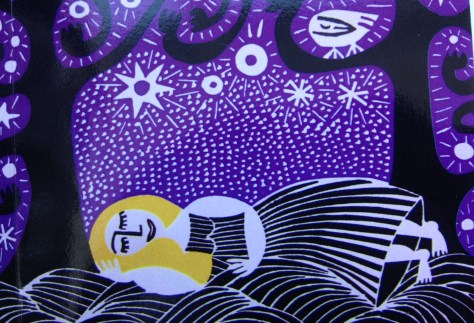
The first ‘house of dreams’ picture I used on this blog, by course participant, Liz
Dreams can be an invaluable source of insight into waking life, but if you only focus on that you can miss the greater opportunity they offer, to enter and engage with the dreamworld on its own terms and experience it as a completely different kind of reality.
In order to do this, in workshops, we share dreams as simply things we have experienced, and don’t try to interpret them any more than we would try to interpret the events of waking life. It’s a discipline, because in Western culture we are so centred in the material life and our first instinct is to try to analyse and make sense of things. A train going into a tunnel? We know what that means!
But what if it’s just a train going into a tunnel? Then the experience of dreaming is fundamentally changed. Dream-working in this way gradually expands the mind to inhabit wider realities, instead of just shedding light into some of the corners of this one.
When I’m mixing dreaming with writing in workshops, we begin by sharing a dream; we take material from the dream to spark a piece of creative writing, and then we share the writing. The dream-sharing and the writing-sharing feel exactly the same, as in neither case do we try to analyse any connection between the dreamer/writer’s personal life and the stories they bring.
There is a connection, of course. A writer shows the tones and colours of their own personality, experience and ways of being in the world in all their writing, but as with dreams, if we try to extrapolate more than that, we are likely to make mistakes based upon our own experiences and assumptions.
Writing and dreams are creative processes, and that’s both the value and the joy of them. They don’t literally tell our story; they don’t all refer to the narrow facts of our life. They can take us anywhere, if we are ready for the adventure.
Susan Price’s ‘Nennius’ blog
I was delighted to discover this review by Susan Price on her ‘Nennius’ blog recently, because she totally gets what I was trying to do in the book that relates to the workshops, Writing in the House of Dreams. Actually, she describes it better than I managed to myself and, with her permission, I’ve changed my amazon book description accordingly!
The last time I blogged I was still on holiday in the Northern Isles, and coming home from holidays can be hard, even if you love the place you live.
The first few nights back home, I had strange dreams which were like series of pictures from my holiday, framed as if they were in an exhibition.
A Shetland sheep on a Shetland beachThe flight to North Ronaldsay, OrkneyCroquet in my daughter’s Orkney garden – we’re so posh!
These dreams reminded me of something my friend Anne used to say about depression, that it was ‘a chance for your soul to catch up.’
I was home, but feeling unsettled and wishing I was still on holiday – so my dreams gave me a chance to take a final look back and enjoy the wonderful memories. The fact that the images were framed gave them distance, so they felt like memories rather than events I was still involved in.
I wonder how often we dream about the places we’ve left, sweet dreams that bridge the gap between where we were and where we are now in the physical, like bridges for our soul to cross when it is ready.
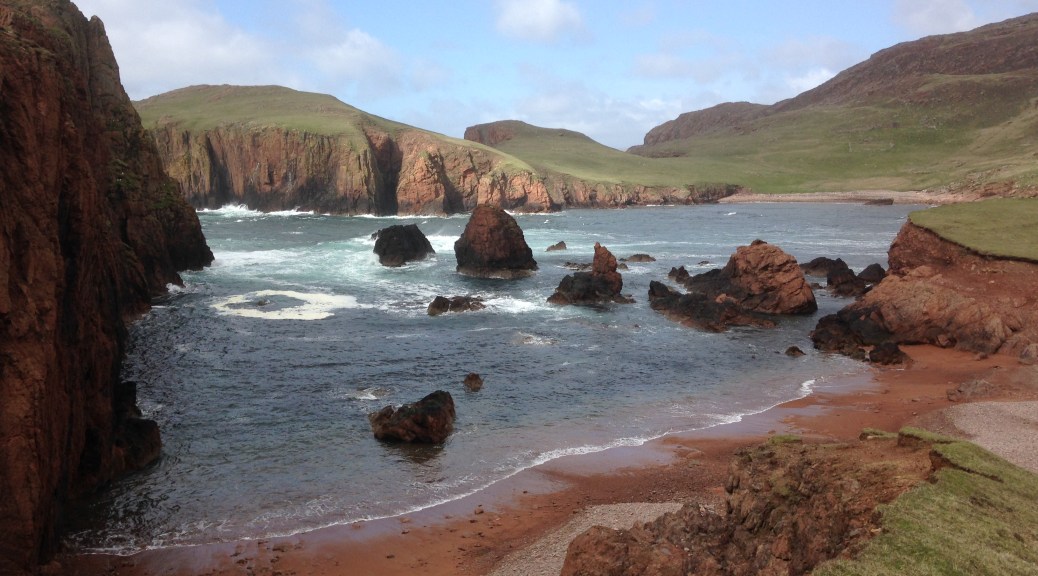
Driving back to the house I was staying in last week, after an afternoon walking the coastline of Shetland, I was listening to an item on Radio 4 suggesting that the wonderful natural history programmes we have these days are putting people off actually going out into the countryside and exploring nature for themselves. The contention was that the natural world feels disappointing compared with the close-up images we can see on our screens.
Walking the coast in Shetland
Chris Packham, one of the Springwatch presenters, was understandably put out by that argument. He said the motivation behind programmes like his was to inspire people to get out and discover the joy of being in nature, by showing how wonderful the natural world is, and all the plants and animals you might see.
I had just seen an otter walk down to the water across the stony beach right in front of me. I would have seen him better in close-up on TV but, having seen the footage of otters on Simon King’s Shetland Diaries a few years ago, I could fill in the detail for myself. I also knew how lucky I’d been to catch a glimpse of such a shy creature.
I’d barely started walking again when i came upon a group of seals lying on a small sandy beach. They were less shy, and allowed me to go down onto the sand and sit watching them. Again, in a close-up on TV, I could have seen every detail, but as Chris Packham said, that would not have come anywhere near the excitement I felt at being so close to the animals themselves.
Just as Chris Packham is an enthusiast for the natural world, I am an enthusiast for the inner world of dreams. Like him, when I share my own experiences, I want to inspire other people to make their own explorations, and I would hate to think it could actually be putting them off.
Not everyone has the time and dedication to devote to one area of experience and most of us like to dip the toe, as I do with my walks in nature. Devoting time and focus will always reap rewards. When I talk about the faceless ones, or numinous dreams, or lucid dreaming I know some people will not have had those experiences, but I hope that simply knowing they exist might inspire them to go looking, or at least recognise them if they chance upon one, and know what they’re looking at, like me and the otter.












 Jenny Alexander's blog: Writing in the House of Dreams