Category Archives: Psychology

The mysterious geometry of writing

In Becoming a Writer Dorothea Brande points out that it isn’t only themes and characters that emerge from the unconscious mind through writing. She says the unconscious is also ‘the home of form.’

So as well as trusting the flow of ideas if we open our mind by entering the ‘writer’s trance,’ we can also trust that the ideas will organise themselves into the shapes of books and stories.

I definitely find this in my own work.

When I’m writing, whether it’s fiction or non-fiction, I start with a sketchy plan and head off from Start in the general direction of Finish, wondering how on earth I’m going to get from one to the other, until suddenly I begin to see the shape of the whole thing in my head like a geometrical figure or a pattern of numbers.

At that point, I become fully engaged. I dash along like a mad thing, joining the dots to make the beautiful shape of the book I’m creating.

This means all my books have a sort of symmetry in the contents – the four Peony Pinkers, for example, all have 17 chapters. Why 17? I’ve no idea, only that that was the number they needed, and I knew each story was on the right track the moment I could see how it could make 17 chapters.


The Peony Pinkers - 4 times 17
The Peony Pinkers – four perfect 17s

Writing in the House of Dreams came out as four parts, each part having three chapters.

4 Parts, 3 chapters each in the House of Dreams

My brand new book, The Binding, has three parts and each one seven chapters.

The Binding - 3 parts, 7 chapters each
The Binding – 3 parts, 7 chapters each

This mysterious geometry is very marked in my own writing practice but not all books divide so obviously into a balance of parts, so it can’t be exactly the same for all writers.

Still I imagine there must come a time for everyone when something clarifies in the mind; you see the finished shape of the whole book, and the writing steps up a notch to engage with it.

If you are a writer, do you recognise what I’m talking about, or am I just weird?!

The dark place, sad dreams, antidepressants and creativity…

Looking back over my blog stats for 2014, I discovered the three posts that got by far the most views were:

  1. Do antidepressants help or hinder creativity?
  2. The dark place where talent leads
  3. How can a really sad dream be a really good thing?

This surprised me at first, but when I thought about it, it seemed less surprising. The people who call by the House of Dreams are almost all dreamers and writers, and dreamers and writers are acquainted with their own inner darkness, and know how powerful it can be.

When you first engage with the darkness, it can be terrifying, and you may look for reassurance that you will not come to harm.

As you explore further, you find the darkness is full of meaning, and then you may look for other explorers who will understand your experience.

Carl Jung said that he stopped trying to cure people of depression when he realised that the way to make your darkness less dark was to accept it and inhabit it.

When creative people and depressives, and dreamers like me, are called to the darkness, that is a gift of opportunity, even though it is a gift nobody wants.

The sick man has not to learn how to get rid of his neurosis, but how to bear it. For the illness is not a superfluous and senseless burden, it is himself.

CG Jung

The darkness holds the keys to the self, and more. On the other side of meaning, where both the dark and the light are dissolved, all is energy and possibility, and we can experience pure creative freedom.

I believe in this journey. It can be long, and bewildering; it can feel unbearable. But if we can learn to bear the darkness, there is treasure to be found.

I hesitate to write about depression because it may sound as if I don’t understand how terrible it can be. I do. I suffered from  depression for many years before I stopped fighting it and, paradoxically, began to win.

These three posts about the darkness brought a wealth of wisdom and experience in the comments, which I hope you will take the time to read.

Has depression or the creative journey ever brought healing and insights for you? 


Have you spotted your guiding symbols and scenes?

Any experienced dreamer will recognise the recurring symbols and scenes that characterise their personal dreamworld, but have you noticed how that happens in your writing life as well?

This has been an unfolding awareness for me because with writing as with dreams, we enter the unconscious world and only see the patterns as they emerge,  often weeks, months or even years later.

I’d written several books before I noticed that there always seemed to be an old person who played an important role, in giving support or guidance to my young protagonist.

In my first book, Looking After Auntie,  it was Great Aunt Fontaine, and in my second, Miss Fischer’s Jewels, it was the lovely old lady who lived next door. In Car-mad Jack, it’s Grannie Bright, and in Peony Pinker, another lovely neighbour, old Mr Kaminski.

I’d noticed also that my protagonists always had certain character traits in common; they often felt disempowered and had to find ways of gaining control. A lot of my stories present some kind of bullying situation, although I wasn’t thinking about bullying as such at the time of writing.

These big ticket items are easy to spot, but this week I’ve been thinking about covers for my YA novel ‘Drift’ and trying to choose an iconic image from one of the scenes or settings.

In doing so, I noticed how even very particular images recur in my writing. In Miss Fischer’s Jewels there is a run down potting shed where the protagonist goes when she feels upset. In ‘Drift’, which I wrote more than 20 years later, there is also an old potting shed. In both books, key scenes are set in the potting shed.

In ‘Drift’ there is a big scene involving a bonfire, where symbolic objects are burnt. Symbolic objects are also put on a bonfire in my upcoming children’s novel, The Binding.

My burning bin
My burning bin

I realise as I’m writing this that in my life as well, I’ve marked endings in the same way, by placing symbolic objects in the flames.

In Writing in the House of DreamsI talk about these recurring symbols as the guiding structure rather than random ornaments in dreams, writing and our individual lives.

I knew from trying to write my autobiography, that life wasn’t a tidy line of events. It was a pattern of themes and characters, plots and subplots, twists and coincidences; of past, present and future, all interwoven.
It was a fabric with a scattering of strong images that stood out from the rest – a dusty ditch, a dead rat, a dancing ballerina. Threads and specks of pink, a jacket, a strawberry. Patches of brilliant aquamarine. An iridescent fleck of dragonfly.

Symbols are not static, but develop in the developing psyche, so uncovering and working with our guiding symbols is a life-long journey, full of new discoveries.

Have you noticed the big and little scenes and symbols that guide your life and writing?

What is your purpose? Try this experiment and see!

When I read Tzivia Gover’s blog post a few days ago about asking a dream symbol, ‘What is your purpose?’ it felt timely for me because I had just dreamt about an image that recurs fairly frequently in my dreams, so I had an obvious one to try the technique on.

In the dream, I was walking along a cliff path, looking out across the clear blue water. I felt happy and full of energy. As I came down towards the bay, I saw a woman in a bright floral summer’s dress  lying languidly in a wide shallow boat, gently rocking.

I noticed an enormous fish, almost as big as the boat, swimming around in the water  nearby. There was no sense of danger. It was, as I recorded in my dream diary, simply ‘extraordinary and remarkable.’

I walked on, and saw several more of these huge colourful fish, as I came down onto the beach and crossed a wide rushing stream.

2013-06-08 18.35.09

These days, I don’t usually try to interpret individual symbols in my dreams, I just enjoy them, but today I asked the enormous fish, ‘What is your purpose?’

Nothing came to me immediately, so while I was waiting for a reply I pondered, ‘What is it about this enormous fish? It’s not scary, it’s just swimming around in its natural element of water. Yet it is a remarkable fish.’

Then I realised, ‘What is the purpose of this remarkable fish? To be remarkable!’

I feel my life is remarkable, as anyone who has close contact with their dreams and imaginary worlds will feel. I seek the remarkable in my work, always trying to break new ground.

My book Bullies, Bigmouths and So-called Friendswas identified by the Independent critic as the first real self-help book for children; Writing in the House of Dreams and the book I’m working on at the moment, When a Writer Isn’t Writing: How to beat your blocks and find your flow, both mix themes to make unusual hybrids.

My fish is an ordinary fish in its ordinary element and yet it feels remarkable. My life is an ordinary life but my purpose is to find the extra-ordinary within it. That’s what brings me pleasure, the same as  when these enormous fishes swim into my dreams.

You can find your symbol too; you don’t have to wait for a dream. Simply sit quietly for a few moments and take a few slow breaths. Still your mind.

Lower or close your eyes, and move into your inner space. Ask, ‘What is my life’s purpose?’ and let the question float away, as you take a few more slow easy breaths.

Now think of an object, and accept the very first thing that drops into your mind. Don’t judge or rationalise it away.

Examine your object from every angle, noticing its particular characteristics. I notice that my huge fish is always brightly coloured, always swimming in clear water and always on its own.

Ask your object, ‘What is your purpose?’

Again, don’t censor or rationalise; go with the first answer that pops into your head.

If you try this, because my purpose is to find and celebrate remarkable things, please share! What was your symbol, and what insight did it bring?


Dreaming, daydreaming and telepathy

Talking to a friend on the phone yesterday, I asked if she’d heard from a mutual friend who had just got back from a trip up-country to visit her family.

‘I dreamt about her while she was away,’ she said. ‘It was just a glimpse, but she was really happy and smiling. I rang her to say welcome home and how did it go, and she said she’d had a wonderful time.’

Last week, I had a similarly short, vivid dream about one of my children, only he wasn’t happy and smiling, so I phoned the next day to touch base with him.

If you dream about close family or friends, it’s always good to follow up that dream with a phone call, visit or email. You don’t have to say why, but just that you’ve been thinking about them. Nine times out of ten, you’ll find your dream has exactly conveyed to you their emotional frame of mind.

Experienced dreamers know that there’s a telepathic connection on the unconscious level, but it doesn’t only work with dreams. Daydreams and random thoughts that pop into your head come from the same source in the self, and can carry the same information.

So if you have a vivid thought about somebody close to you during the daytime, follow it up with a quick call. Something will be happening that means this person wants to make a connection.

Telepathy works on the instinctual level; it isn’t logical, but emotional. It’s a natural ability in all of us which, especially in the developed world, is virtually unused.

The more you use it, the stronger it gets, in the same way that training your rational thinking processes increases your ability to reason.

You aren’t creating connections but simply becoming aware of them, because on the unconscious level we are all connected to our loved ones, swimming in the same streams of consciousness and emotions.

These connections are most obvious and easy to find between family members and close friends, but everything is connected, and being sensitive to the connections makes for a much more joined-up way of living.

Are you aware of telepathic connections between yourself and the people close to you? I’d love to hear your stories.


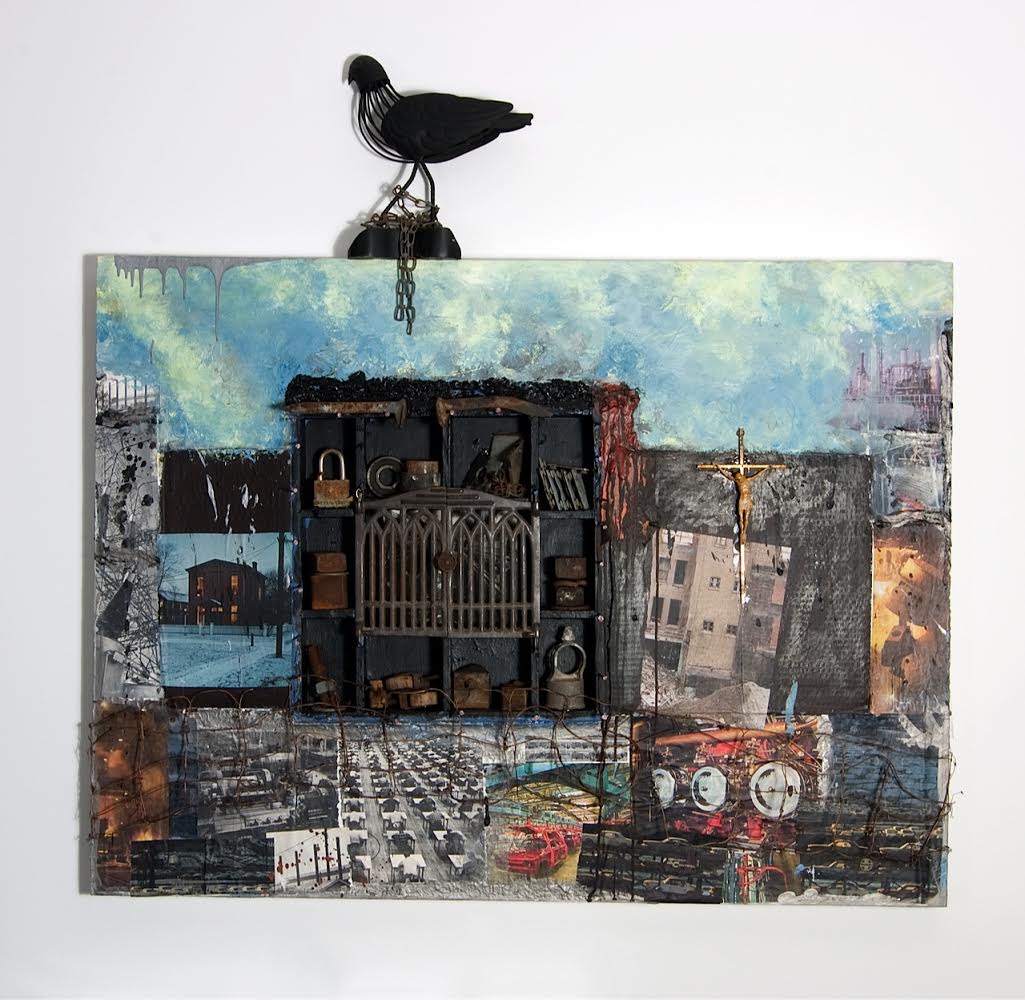
Making art from a dream, by Susan Levin

Yesterday, I reviewed Susan Levin’s book, ‘Art from Dreams’ and I’m delighted to welcome  her into the House of Dreams to talk about the dream behind her artwork, ‘Home.’

HomeI am writing about the piece titled “Home” and the accompanying dream.

Dream: I am on a boat in the Detroit River headed for summer camp. I talk to someone about Detroit—how the city is out of money. We dock briefly along the city’s shore. I go for a walk, barefoot, through the muddy streets. I see little children in slum housing. I walk up the steps to the bank. I clean my feet with water so they will be less muddy.

Dream interpretation: I have to get down with uncovered feet to get close to the truth of my difficult childhood, growing up in a dysfunctional family in Detroit. The city of Detroit is bankrupt—it’s losing its libido for me. I walk barefoot, slogging through the mud of my past. With my uncovered feet, I get close to the truth. The slum of my childhood. Boats are a womb-like container that carry us on our life’s voyage. We all need a sense of security to help us navigate.

Being sent away to summer camp, where I don’t want to go, adds to my sense of being an outcast. By cleaning my feet as I go up to the bank, I am relinquishing my feeling of impoverishment. Something in me has money in the bank. I am coming to a part of myself that is substantial. I have my own resources—my own currency in the bank. I am approaching the SELF, going upstairs to a higher level of understanding.

Cleaning the feet has religious overtones, a rite of purification. I was destined to be barefoot in the mud, living in a slum, when I instead deserve to be in a bank with clean feet and access to money. My inner resources, which were never acknowledged or nurtured, are now accessible.

Have you ever been moved to create a visual image by memories, thoughts and feelings that have been stirred  up in a dream?

Book Review: ‘Art from Dreams’ by Susan Levin

Today, it’s my pleasure to review this new book by Susan Levin, ‘Art from Dreams: My Jungian Journey in Collage, Assemblage and Poetry.’

As a seasoned traveller in the inner world myself, I love reading about other people’s dream adventures, and one of my all-time favourite books is CG Jung’s Memories, Dreams, Reflections, for that  reason.

There isn’t very much to read in Susan Levin’s book,  just a one-page introduction and ten short poems, but I really like the way the brevity of the text brings the focus strongly back to the images and makes the book, in itself, a dreamlike experience. Levin lets the pictures tell their own stories, and give an impression of the  journey overall.

The first half of the book is called ‘My Jungian Dreams.’ Here the poems expand on the images, exploring the artist’s thoughts about consciousness and experience in an open, direct way.

2014-11-05 10.21.00

In the second half of the book, ‘Nocturnes,’ there are no poems, just a set of striking images with intriguing titles such as ‘Message from horse and snake’ and ‘Ship of souls.’

2014-11-05 11.07.49

The mixed media and collage approach feels to me an exactly appropriate way of conveying the quality of a dream, this bringing together of disparate objects into a unified experience of colour, tone and feeling.

The night after I read Art from Dreams I had a very visual dream which reminded me of one of Susan’s collages. At the bottom of the picture, me with a glass of sparkling wine; above that my Writing in the House of Dreams book launch cake, and flying above that in the clear blue sky, a young woman on a brightly-coloured hang-glider.

The book is beautifully produced and bound, a lovely object which readers will return to, and take inspiration.

Tomorrow, Susan will talk about the process of one of the artworks in the book here in the House of Dreams. Don’t miss it!


Two kinds of writer – which kind are you?

I’ve met and chatted with scores of authors and been to dozens of writing conferences and residentials in the course of my career and it strikes me that there are two kinds of writers.

Some writers start from the dreaming, intuitive mind, which creates spaces and populates them with an easy natural flow, and they don’t try to take control of the idea until it’s virtually fully formed in their imagination.

This can be a long process – it sets its own pace, and the author’s task is to watch and wait, and be willing to explore all the paths that open up, and see where they might lead.

This way of writing is rooted in a long period of gestation, when nothing appears to be happening and nothing seems to be achieved, but once the writing stage is reached it tends to come quickly and relatively easily.

Other writers work in a more methodical way, starting with a basic idea and building it up one block at a time. For this kind of writer, fixed work-times and word-counts can be a useful tool, keeping them focused on the task from beginning to end, and the writing progresses at a steady pace.

Either way works, depending upon the writer’s personality. You can find out more about your own natural style by doing the Myers Briggs Personality Types Indicator test.

Culturally, we value the practical, rational approach and mistrust the intuitive, which can mean that the more intuitive type of writer may undervalue the patient pondering stage which is part of their own process.

I write for those writers, to honour and celebrate their way of writing, where that long period of daydreaming, rambling, chatting, reading is as much a practical part of the work as sitting at the computer, producing words.

Which kind of writer are you? Is your process a slow daydreaming and a rapid writing, or a steady progress from start to finish?


Do antidepressants help or hinder creativity?

A while ago, I stumbled upon an interesting article by the novelist, Alex Preston Does Prozac help artists be creative? and reading it reminded me of my own experience of prescription drugs in my teens and twenties.

In his article, Alex Preston interviews a number of successful writers about their experience of taking anti-depressants and one thing that comes to light is that although the pills might help people to overcome blocks and inhibitions so that they can start writing again, that doesn’t mean they’re necessarily producing very good work.

I first experienced depression as a young child and I was receiving treatment by the time I was twelve. Before I started taking the pills I had always thought of my extremes of emotion as being like the weather, some days dark and overcast, some bright and sunny. Sometimes, with a sense of dread, I could feel the storm clouds gathering; other times I could feel the dark clouds lifting away.

Storm clouds gathering

How I dealt with the darkness was through drawing, painting and writing poems. One time, I designed the cover of a poetry book which I called ‘Poems of the Darkness and the Light,’ and my teacher didn’t believe I had made the title up. As if children could not feel the darkness as well as the light.

My darkness and light were part of my nature, they were my micro-climate, and after I started taking anti-depressants I stopped feeling like me. It felt as if someone else was living my life, but doing a better job of it than I would have done in terms of passing exams and doing the work at university.

I stopped taking anti-depressants some ten years after I started, because when my older sister killed herself with prescription drugs it seemed clear to me that they weren’t any kind of cure at all. The withdrawal was terrible.

But in time, I started to write again. I learnt to flow with my own rhythm of highs and lows. It felt like the difference between trying to find your way in the dark within the narrow beam of a torch, then switching it off and waiting until your eyes acclimatise and gradually the dark is less dark, there are stars and glimmers, a faint smudge of hedges, a pale ribbon of road.

All these years later, I remember what it felt like to be numbed out of my own life on a diet of pills. If I hadn’t been shocked out of it by my sister’s suicide I probably would have stayed like that, and never discovered the fertile darkness, or come home to myself.

Walking in the dark
Walking in the dark

The Uses of Sorrow – by Mary Oliver

(In my sleep I dreamed this poem)

Someone I loved once gave me a box full of darkness.
It took me years to understand that this, too, was a gift.

My feelings about anti-depressants have come out of my personal experience and I’m sure other people will have very different views and stories. Have you ever taken anti-depressants? Did you feel they helped or hindered your creativity?

Matt Haig (Reasons to Stay Alive) has written a moving and thoughtful article about depression here. Like me, he believes there isn’t any one size fits all solution.

If you think you may be suffering from depression there’s a balanced guide that’s well worth reading here

You may also like to read Carolyn Hughes’ moving account of her own experience and treatment in The Hurt Healer


The ups and downs of the writing life

The second series of writing workshops I was planning this year didn’t work out because I didn’t get enough interest to make a big enough group. This happens from time to time, and it doesn’t faze me.

The reason why is because I invariably find the timing would have been bad for me, and that life was working in my best interests in overriding what I had planned. On this occasion, I injured my back a few days before the first session would have been and spent the best part or a fortnight laid up in agony. The third session would have clashed with a family get-together; the fourth would have come when I was recovering from a sickness bug we all came down with after we parted.

The course, had it gone ahead, would have been fraught with problems, and that’s the point – we don’t know when we’re making plans what the consequences of success or failure might be.

I need goals to give me a sense of direction, and when I set a goal I go all-out to achieve it. Then, if it doesn’t work out, I know it wasn’t for lack of trying on my part, so it’s easy to let it go and look for the silver lining.

Because there always is a silver lining. Take the three books I completed last year, none of which sold on the first time of offering

  1. ‘The Binding’ is a children’s story set on a remote Scottish island. I wrote the first version fifteen years ago, my agent sent it out, it nearly sold, but not quite. Coming back to it after such a long interval, having a much better grasp of the craft of writing, I loved having the chance to make the story much stronger and more exciting. The book has been accepted for publication in 2015.
  2. ‘Drift’ is a YA novel I also wrote about fifteen years ago – which also came very close to securing a contract at the time, but didn’t. It’s a story about sibling suicide, which is close to my heart – too close, those years ago, for me to be able to fully explore the emotional situation of the protagonist. Writing it again was a deeply satisfying experience which I would not have had if the book had sold in its original version, and the MS is currently out with various publishers.
  3. ‘Writing in the House of Dreams’ is my child-of-the-heart book. It didn’t find a conventional publisher because it’s ‘too niche’ and if I hadn’t loved it so much I would probably have put the MS in a drawer rather than face the complications of trying to self-publish. Because I love it, I’m going the distance with the publishing, doing it properly, and the surprising upside is that the process feels really enjoyable and creative.

Any freelance life involves plans and goals, setbacks and successes. Being a writer, you have to learn how to go with the flow, or else the extraordinary ups and downs would soon make you go under.

How do you cope with the ups and downs of the writing life?