Category Archives: Psychology

A dream of darkness

A few days after I last blogged, way back in May, I went to Iceland. I’d always been drawn to the North, so Iceland had been on my must-see list for decades, but what made me actually go this year was a series of dreams I had around the time of my mother’s death last November. They were ‘big dreams’ – dreams that had a momentous quality, a deep sense of mystery and meaning.

They were a call to ancestors, to the place beyond death and, specifically, to Iceland. So like all dreamers, who have learnt how and when to listen, I followed the call of my dreams.

unspecified-11

Being in Iceland felt, to me, like being in a dream. I had completely underestimated the size of the island, and the sparseness of the population; I had not expected the vast tracts of volcanic deserts and inaccessible mountains. I hadn’t noticed that the key on my map had only three kinds of terrain – places where something’s growing, places where not much is growing, and places where basically nothing is growing at all, which was about 40 percent of the land.

unspecified-13

Ice, water – and fire too. In Iceland, the hot water in your shower smells of sulphur, because it’s piped straight out of the volcanic ground, and when you’re walking in some places, you can hear the gurgle of water boiling and bubbling, breathing out wafts of sulphurous steam, and then the earth feels like a living being. You can absolutely understand why Icelandic people believe in earth spirits – you can believe it yourself.

unspecified-12

Land of fire and ice, and of light and darkness too. I visited several art exhibitions which explored the creative sensibility of the peoples of the North, shaped by long dark winters and summer months of continuous light. They made explicit how this environment can drive a psychological rhythm between extremes of celebration and isolation, of joy and depression.

I felt these extremes in myself, the whole time I was there. On the surface, excited and enchanted by everything I saw and everyone I met, but sensing all the time, the darkness moving underneath. A few days in, I had this dream:

The car is packed for the next stage of my journey and I’m having a last cup of tea with my hosts. Looking out over Rekjavik through their big window, I see a sudden darkness coming across the sky – clouds?

I see black clouds rising along the edge of town, pouring up into the air from the ground, and as I watch, a sudden column of sparkling fire shoots up, exploding in a great shower of sparks, orange and red, filling the thick black cloud that’s covering everything.

‘What is that?’ I gasp.

‘The volcano’s erupting.’

Black soot is falling everywhere, covering everything, but it doesn’t matter. This is what I’ve come for. The darkness. Not just fun and distraction. I always knew it.

It was the beginning of what has been, for me, a difficult summer. I went to Iceland following the kind of dreams that will take you deep into your own darkness, as well as bringing you, eventually, to wonder and light.

I had expected to meet the black dog, but black dogs come in different shapes and sizes. This one turned out to be huge and hungry, feral and strong, and he was never going to settle for living in my house like a sad old labrador for just a few weeks or months.

It’s been a long and exhausting trek through his cold darkness but, last week, I woke one morning with a great sense of relief, after my first full night’s sleep for months, and a bright thought filled my mind like a sunrise, ‘It’s over now.’

I’m sorry I was away so long, but very happy to be back. 


Why you should never read someone else’s journal

In the long hiatus between my mother’s death on October 19th and her funeral last Friday, I wasn’t able to focus on work much at all, and that felt OK and appropriate. I slept a lot, dreamt a lot, read non-fiction books and wrote in my journal.

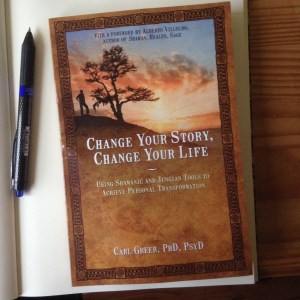
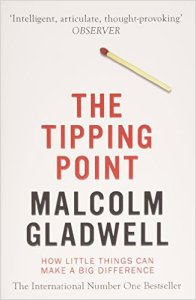
I was working through some of the exercises in Change Your Story, Change Your Life: Using Shamanic and Jungian Tools to Achieve Personal Transformation by Carl Greer one morning, when it occurred to me that anyone reading my journal after I died might not understand, as I do in the writing, that it’s an experiment, and not a report.

Slow start warning: I nearly gave up on this book after the first chapter, which felt like puff and waffle. Glad I didn't.
Slow start warning: I nearly gave up on this book after the first chapter, which felt like puff and waffle. A few chapters in, I’m glad I didn’t.

Actually, my whole journal is a perpetual work-in-progress. Every page I write is part of a creative exploration. It isn’t me – it’s a kaleidoscope of all the possibilities of me, and I’m aware of that when I’m writing in it in much the same way as when I’m gathering notes for a work of fiction, knowing all the time that many of my ideas won’t fit the story and will have to be discarded.

A journal or diary is a first encounter with ideas and events, before you’ve had a chance to ponder and decide what you think of them. To get a true sense of a person’s life, I guess you’d need to read their autobiography, because there you have a completed work. Where a journal is a mess of notes, often contradictory or inconsequential, an autobiography is an expression of the writer’s identity, his or her choice of what’s important and how they understand what’s happened.

I was struck by something in Natalie Goldberg’s book on memoir-writing Old Friend from Far Away last week; she says we shouldn’t think we have to be old before we can write a memoir. We don’t need the whole story all in one go, at the end. We can write memoirs from time to time throughout a long life, and each one will be the most complete expression of who we are and how we understand our lives up to that point.

In that sense, I guess autobiography could be seen as a work-in-progress too, but the difference is that in autobiography we are writing what we know about ourselves and our life, whereas in journalling we are feeling our way along the borders of our knowledge, and what we find must be judged as me or not-me, accepted or discarded, as part of the process of becoming.

If you read someone’s journal – as well as the obvious problem that it is private writing and they did not intend it to be read – you will not find the person there, and thinking that you will could give you every which kind of wrong impression, like listening to someone’s dreams and believing you can interpret them. A good dream therapist will simply hold the dream so that the dreamer can look at it from different angles, because only the dreamer can find out what it means.

I love my journals
I love my journals

I include all sorts of things in my journals – dreams, ideas, experiences, book reviews, quotations, drawings, writing exercises and creative experiments. I love them, just as I love my dreams, specifically because they don’t define me.

With both, there’s a feeling of infinite possibility, a continuously forming sense of direction, so that even at the end of a lifetime of journalling and dreaming, I’m sure there will be no conclusion, because the conclusion is always up ahead.

IMG_1508

My children have strict instructions to burn my diaries without reading them when I die. What would you like to happen to yours?

When was the last time you felt really happy? Write for 10 minutes…

I’m reading Nathalie Goldberg’s book on writing memoir, which goes under the wonderful title of Old Friend from Far Away. As you might expect with Goldberg, it’s full of practical writing exercises, and when I came to this one, I was briefly stalled: When was the last time you felt really, really happy?

IMG_0073

I’ve done the exercise before – I can’t remember now what prompted it – and it was really easy. Having fresh blueberries on my morning muesli – that had made me happy. Watching an old episode of Frasier while I was eating it – happy, happy, happy. My normal approach to life is celebratory and thankful, so happiness always feels close to the surface.

But today I found myself having to cast my mind back, across the numb times of these past few weeks, during which my mother was given a diagnosis of leukaemia, developed pneumonia and died, all within ten days. She approached the end of her life the way she approached every part of it, with stoicism, taking care of the practicalities and being clear about her preferences and decisions.

She was 90 years old, and had been ready to go for several years, as her physical condition deteriorated; she was not at all afraid of dying. She died in her own home, having steadfastly refused all life-extending treatments, with her family at her bedside, on her wedding anniversary, so in many ways it felt like a blessed death.

In this interval between my mother dying and her funeral, I’ve been mostly sleeping, walking and reading – books like the Nathalie Goldberg.

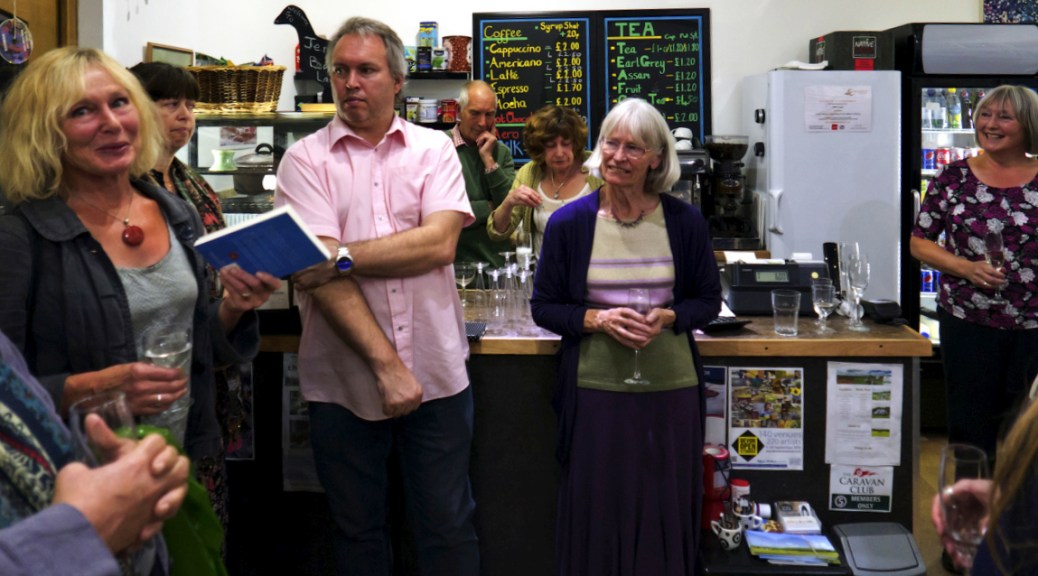
When was the last time I felt really, really happy? I suddenly remembered my book launch, at my friend Gill’s art gallery in Devon. My younger daughter was staying with me, and she raised the toast for one of the books I was launching. One of my oldest friends raised the second toast. I did some readings.

P1290965

It was a stunning, beautiful evening, a full moon over Dartmoor, and a happy throng inside the bright gallery, among the paintings and artefacts. Everything flowed.

A happy throng
A happy throng

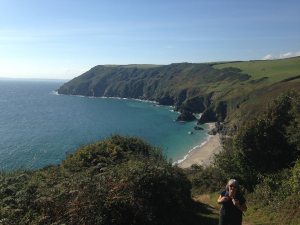
Afterwards, my daughter stayed on for a few days. The weather was hot, as it often is in Cornwall in the last days of September, and we walked the coastal path together.

12019852_10153626600030030_5704215196115227108_n

So that’s what I’ve just written about, and now the last time I felt really happy was half an hour ago.

Such is the transforming magic of writing. When you use all your senses to immerse yourself in the creative experience and allow your body to feel the emotions, you are creating or re-creating real experience for the self.

Right now, I can’t manage to push forward into new worlds with fiction and my current work-in-progress, but writing into the more familiar territory of my own life feels easy and affirming.

I’m looking forward to offering a new course in memoir writing in 2016 

Why my new book is published today

Today is World Suicide Prevention Day.

2015_wspd_banner_english

Years ago, a friend told me she thought that the world was divided into two sorts of people – those who had seriously contemplated suicide, and those who had never even considered it.

At the time, I felt sceptical, because thinking about suicide started for me in early childhood and I’d always assumed that everyone did it, but when I asked around, it turned out maybe she was right. Lots of friends told me it had never even occurred to them, but for others it was like a kind of home base, the place they always returned to in their dark times.

I think young people who have this mindset are particularly vulnerable because they don’t have the experience yet to know those desperate feelings do pass, and things do get better. Most of those who have made serious suicide attempts express gratitude later that they didn’t succeed.

So the message older people want to give to vulnerable young people is ‘Hold on’, as in the classic REM song “Everybody Hurts’ which was written in deliberately straightforward language, for pre-college teens.

Lesbian, gay,bisexual and transgender teenagers have a very much increased risk of suicide, and there’s great work being done for them in the It Gets Better Project, where ordinary LGBT adults share their stories of getting through horrible times at school to go on and lead successful lives in happy relationships.

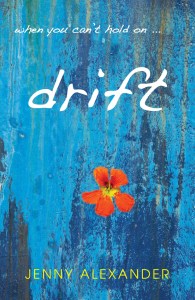
Siblings of suicide are another very high risk group, and they’re the people I wanted to tell, as a survivor of sibling suicide, it does get better. I’ve done it the best way I know how to, in my new Young Adult novel, Drift, the story of a 16-year-old girl whose brother has killed himself.

It’s her story, not mine, but because of my story, I knew how to write it.

9781910300084

Drift is published today.

You can read my first interview about the book on the book eaters site.

‘If I had to summarise this book with just one word, it would be beautiful…’ See the rest of young book blogger Marta’s review here.

On being a ‘veteran author’

A couple of years ago I had the good fortune to teach someone on an Arvon course who, it turned out, was a branding and marketing expert. I needed help with my branding and marketing and she needed help with her writing, so it proved to be the start of a very fruitful friendship.

She helped me to create a new website where I could bring together all the various aspects of my writing and teaching, and develop a much more consistent brand for myself as an author. She’s called Sarah Mackie, and her company is Caxton Bell – I highly recommend her.

It was mostly really interesting and fun working with Sarah, but there were a few sticking points, and the first one for me was her suggestion, when I sent her the draft of my blurb for Writing in the House of Dreams, that rather than describing myself as a ‘much published’, ‘versatile’ or ‘established’ author, I should use the term ‘veteran’.

I argued it. I wasn’t technically a veteran author, as I’d only been published for 23 years and not yet 25. I had had an unusually large number and wide variety of books published in that time, so ‘much published’ and ‘versatile’ were more accurate descriptions. And anyway, I was too young!

She told me of course I was too young, and of course I was prolific and versatile, but the bottom line was there were three kinds of effective author profile, bestselling, award-winning and veteran, and as far as she was aware I hadn’t had a bestseller or won a major award.

So I had to really examine why I’d felt reluctant to acknowledge my age in my professional life, even though in my personal life I celebrate it. I’d never put the year of my birth on my website for example, and had dreaded it appearing somewhere on the net. It has recently done just that, on google search, but according to the bio I’m from the Bronx and was born in 1958, neither of which is the case.

Screen Shot 2015-08-27 at 16.59.31

In our culture, we fear ageing and death and idealise youth. We try to disguise the years and look as young as possible. But that is at odds with my personal values because I’ve always believed that while the energy of youth is essential for social change and regeneration, so is the wisdom of age to temper and direct it.

I feel very grateful to have had more than six whole decades of living and learning. In the fields I’ve been writing about recently – dreaming and writing – I know so much more now in my sixties than I did ten, twenty, thirty or even forty years ago, when I first started to explore them in earnest.

When I thought about the experience I brought to Writing in the House of Dreams and When a Writer Isn’t Writing, and how I should be proud of it, and flag it up, it occurred to me that it’s not just in these books that my main drive has been to share what I’ve learnt from life experience.

I remembered that in an interview in 2007, I was already describing myself as ‘an elder’

I think of myself as an elder in a society which doesn’t really have elders any more, writing the sort of reassuring common sense that grandparents used to be there for when families had more leisure and were less geographically dispersed

So Sarah’s suggestion that I should describe myself as a veteran author, flagging up that the value I bring is experience, didn’t only describe what I was doing in my recent books on dreams and writing, but also caught something of the essence of what I’d always done.

Veteran author… OK, I can live with that!

A therapist for the non-writing writer

Writing. It’s amazing. It can help us to

  • explore and gain mastery in our inner worlds of emotion and imagination
  • develop, organise and share our ideas
  • satisfy our natural yearning to create beautiful objects
  • make our own entertainment and never get bored

The way children learn to write at school completely ignores all these wonderful benefits and that’s why, ten years ago, I wrote my children’s book, How to be a Brilliant Writer focusing not just on the nuts and bolts of how to do it, but also why you might want to, and what writing can do for you.

I knew I’d want to write some books for adults about writing one day too, because I’m a bit of a maven – when I’ve found something great, I just have to share it.

In the spirit of the maven, I'm sharing the fab book I first found the word in
In the spirit of the maven, I’m sharing the fab book I first found the word in

After Writing in the House of Dreams last year, which is about dreams as much as writing, I started work on a new book just about writing, no dreams – writing as a hobby, a spiritual path, a career – the psychology, the process, the question of publication – a distilling down of what I’ve learned from a lifetime of writing and twenty three years of being published. I called it When a Writer Isn’t Writing: How to Beat Your Blocks, Be Published and Find Your Flow.

I didn’t offer the manuscript to my agent or traditional publishers, but decided instead to go straight to self-publishing. The main reason was that I wanted to get a second book out fairly quickly after Writing in the House of Dreams, as I thought two books on different aspects of the same theme might support each other in the market – if someone read one and liked it, they might take a punt on the other.

Writing my book about writing was relatively easy because I’d been thinking about it for several years before I sat down to start. Sending the manuscript out to beta readers – which is really important when a book isn’t going to go through the traditional agent+publishers vetting process – also felt unchallenging, because I was confident in the material.

Working with the editor and then the designer felt like part of the creative process of the book, so I enjoyed that too, but then I had to get to grips with some promotion and pre-publicity, and that certainly didn’t feel like part of the creative process to me.

When the focus lifts from writing to sales, my interest always dips, and with this book I began to sabotage my promotional efforts by thinking ‘what’s the point anyway?’ which made it even harder to feel motivated.

One of the things that got me thinking that way was that my experience with Writing in the House of Dreams had been mixed. I had struggled to find my elevator pitch, because that book straddled two areas of interest, dream-working and writing, so it didn’t fit neatly into either. (My thanks again to Susan Price, who described the book perfectly in her review of it, and so helped me reframe how I describe it myself)

Not having a clear enough concept, all my efforts to get some pre-publicity for it hadn’t achieved very much, and had felt like a waste of good writing time.

I was on the point of deciding to just press publish and let When a Writer Isn’t Writing sink or swim without a shout, when I had this dream:

I’m thinking about my app Get Writing! and I see that the tasks could be represented by people sitting on a wall, and you could click any one, and they would all take you to a writing task. Just writing, so you could click with confidence, knowing what you were going to get.

When a Writer Isn’t Writing is like that, which means it will be easier to pitch and sell than Writing in the House of Dreams. That book could take a writer places they don’t want to go, but When a Writer Isn’t Writing only takes them into writing. 

This dream gave me the energy and confidence to stop messing around and do some promoting, and I managed to place articles in Mslexia and The Author. Mslexia have subsequently approached me to ask if I’d like them to feature the book in their October competition. Er… yes please!

There will be reviews on the book analyst and awfullybigreviews, which I’ll link to here when they go up (if you’re a book blogger and would like a review copy, please get in touch!) I’m also organising a launch party in September.

It’s been a tough couple of months, not because self-publishing, writing press releases, pitching articles and organising events is hard and horrible work – I actually quite enjoy it – but because it takes up so much head-space that it stops you getting stuck into new writing.

My daily dose of writing – every stage from pondering and note-taking to drafting and redrafting – is what normally keeps me feeling happy and grounded. Writing isn’t just amazing – it’s addictive.

A non writing writer is a monster courting insanity | Franz Kafka

Dreams are my therapist when not writing makes me feel a bit crazy – what helps you?

Dreams of the places you’ve left

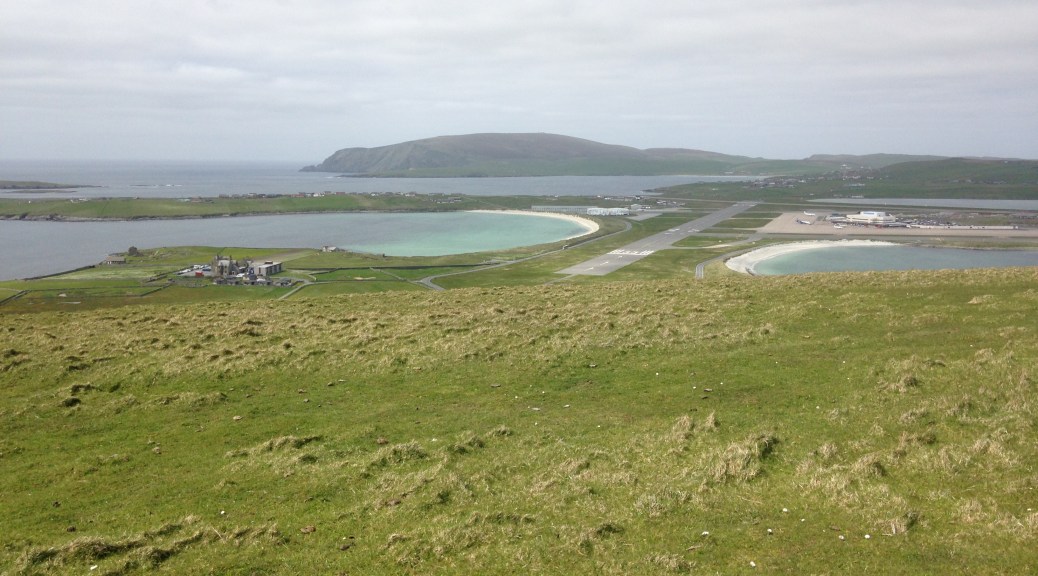
The last time I blogged I was still on holiday in the Northern Isles, and coming home from holidays can be hard, even if you love the place you live.

The first few nights back home, I had strange dreams which were like series of pictures from my holiday, framed as if they were in an exhibition.

IMG_0521
A Shetland sheep on a Shetland beach
The flight to North Ronaldsay, Orkney
Croquet in my daughter's Orkney garden - we're so posh!
Croquet in my daughter’s Orkney garden – we’re so posh!

These dreams reminded me of something my friend Anne used to say about depression, that it was ‘a chance for your soul to catch up.’

I was home, but feeling unsettled and wishing I was still on holiday – so my dreams gave me a chance to take a final look back and enjoy the wonderful memories. The fact that the images were framed gave them distance, so they felt like memories rather than events I was still involved in.

I wonder how often we dream about the places we’ve left, sweet dreams that bridge the gap between where we were and where we are now in the physical, like bridges for our soul to cross when it is ready.

How to get new ideas for life, work and dreams

I’m a great believer in holidays. When you’re away from home, you can see your normal day-to-day life from outside, and it gives you a different perspective. What are you relieved to be away from? How do you chose to pass your days when the constraints of work and other responsibilities are lifted? The answers to these and other questions can surprise you and offer precious insights into fruitful changes you might choose to make when you get home.

As a dreamer, one of the things I enjoy about holidays is that my dream life also shifts perspective. Holiday dreams usually have a different quality, and bring in new kinds of imagery. It was during a holiday many years ago that I first encountered the faceless ones, and began to engage with the archetypes, those images which Jung called ‘pieces of life itself.’

Holidays are times when you can wake slowly and really savour your dreams. You can carry them around with you during the day, and ponder them in quiet moments. The images you bring home with you will have the same sense of time and place as the physical souvenirs you buy.

As a writer, I find the same shift in perspective. Ideas I’ve been working on at home seem different from far away. Sometimes more exciting,  sometimes less. They form up in unexpected ways; they show different aspects of themselves to me. I’m sure that’s why so many writers go on writing retreats.

You don’t have to go to exotic places or spend a fortune in order to feel the benefits of going on holiday. In fact, like many other people, I usually go to familiar places I love. The point is simply to be somewhere else, to look at things from a different angle for a while, and come back to normal life feeling renewed.

Thinking creatively in shop-free North Ronaldsay recently - petits fours made from prunes and dark chocolate. Not something I'd ever have eaten at home, but surprisingly good!
Thinking creatively at the bird observatory hostel in shop-free North Ronaldsay recently – petits fours made from prunes and dark chocolate. Not something I’d ever have eaten at home, but surprisingly good!

Have you ever found that being away from home gave you new ideas about life, work or dreams?

Art for Happiness!

I’m delighted to welcome the artist, author and creativity coach Val Andrews into the House of Dreams today to talk about her new book. I’ve followed her blog for ages, and feel absolutely in tune with the way she links creativity with wellbeing.

Val Andrews
Val Andrews

As a part-time visual artist and creative writer with 30 years of experience working in the healthcare sector, I have a keen interest in the impact that creative expression has on health and wellbeing, and on a person’s capacity to be innovative in their work.

For a number of years, I’ve been exploring this interest by delivering creativity workshops and offering coaching to people who are committed to moving through blockages in their creativity. I’ve also been interviewing professional artists and writers about their creative process and sharing those interviews on my blog in the hope this may inspire my readers: https://artforhappiness.wordpress.com

Over the years, I’ve found there are many reasons why people choose to learn more about their own creativity. Sometimes they’re driven by a desire to approach work tasks in a more creative way, sometimes they wish to ‘be more artistic’, or write a book, or invent something the world has not yet seen. Whatever the motivation, unleashing the creative process certainly seems to boost personal wellbeing, and enhance performance at work.

picture of cover

It’s for this reason I chose to write the book “Art for Happiness: finding your creative process and using it”. Freshly published in March 2015, this book explores the some of the contemporary research on the creative process – what it is, how it works and what it does for a person’s sense of wellbeing. I’ve also included a number of exercises which I’ve found helpful in unlocking the creative process and developing ideas beyond their original naivety. Please feel free to look inside this book on my Amazon page: http://www.amazon.co.uk/Val-Andrews/e/B00HGG15A0

The mysterious geometry of writing

In Becoming a Writer Dorothea Brande points out that it isn’t only themes and characters that emerge from the unconscious mind through writing. She says the unconscious is also ‘the home of form.’

So as well as trusting the flow of ideas if we open our mind by entering the ‘writer’s trance,’ we can also trust that the ideas will organise themselves into the shapes of books and stories.

I definitely find this in my own work.

When I’m writing, whether it’s fiction or non-fiction, I start with a sketchy plan and head off from Start in the general direction of Finish, wondering how on earth I’m going to get from one to the other, until suddenly I begin to see the shape of the whole thing in my head like a geometrical figure or a pattern of numbers.

At that point, I become fully engaged. I dash along like a mad thing, joining the dots to make the beautiful shape of the book I’m creating.

This means all my books have a sort of symmetry in the contents – the four Peony Pinkers, for example, all have 17 chapters. Why 17? I’ve no idea, only that that was the number they needed, and I knew each story was on the right track the moment I could see how it could make 17 chapters.


The Peony Pinkers - 4 times 17
The Peony Pinkers – four perfect 17s

Writing in the House of Dreams came out as four parts, each part having three chapters.

4 Parts, 3 chapters each in the House of Dreams

My brand new book, The Binding, has three parts and each one seven chapters.

The Binding - 3 parts, 7 chapters each
The Binding – 3 parts, 7 chapters each

This mysterious geometry is very marked in my own writing practice but not all books divide so obviously into a balance of parts, so it can’t be exactly the same for all writers.

Still I imagine there must come a time for everyone when something clarifies in the mind; you see the finished shape of the whole book, and the writing steps up a notch to engage with it.

If you are a writer, do you recognise what I’m talking about, or am I just weird?!