Do we dream about past lives?

Babies in the womb display all the physical characteristics of dreaming, which begs the question, what could they possibly be dreaming about? With no experience at all in this life, could they be dreaming about lives they have had before?

I’ve believed in past lives since I was eleven or twelve years old because when I started learning French at school I just knew how to speak it. It felt familiar. I had never been to France, but I was certain I must have been a French person, once upon a time. The belief in past lives has become common in recent decades but back in the early sixties it was something you kept to yourself.

When I visited France for the first time, with an older cousin and her friends, it was not a good experience. I put that down to me being sixteen and them in their twenties. My second visit was also really bad, and my third, but again, there seemed to be logical reasons why I didn’t enjoy them.

It was only in my thirties that I realised this was not to do with individual visits but fundamental to my relationship with France. Every four or five years, driven by our friends’ huge enthusiasm for France, we would take the family across the channel for a few weeks in the summer, and whenever we did that, as the boat pulled out of Plymouth I would start to feel agitated and depressed.

In France, my head said, ‘This is nice. It’s warm and sunny. I like these al fresco cafes, and wonderful patisserie!’ but I felt a great tension inside me, as if I was holding my breath. I felt darkness like a cloud that only lifted when we came in sight of the English coast and I could start to breathe again.

By then, the New Age had arrived in Cornwall, and I saw a palm reader who told me I had lived in France in a previous life. I knew that – but how did she? I asked her for more information and she told me she saw me on the steps of a grand house, in a long blue dress. It was the eighteenth century and I was the lady of the manor.

This felt very disappointing. People always seemed to think that in past lives they had been royalty or had the kind of lives that are the stuff of historical fiction, but I couldn’t personally relate to the scene she described at all.

However, the fact that she had said I’d had a past life in France piqued my curiosity, and I went to see a past life therapist. She took me back to a dusty ditch in the North of France, during the last war. Immediately, I remembered a very vivid dream I had had as a small child, in which I was lying in a dry ditch, with ants crawling all over me.

But I was born less than a decade after the end of the war, and weren’t past lives supposed to be centuries ago? I did some research and discovered a theory that souls rebirthed more quickly after a massive and violent loss of life in war.

That’s as far as I’d taken it. Interesting ideas, thoughts, feelings, about past life possibilities. Then a few weeks ago an astrologer friend, the astro life coach, mentioned she had discovered how to find the date of your most recent past life in your birth chart. We had never spoken about past lives and she certainly didn’t know what I had been thinking about mine, so I was astonished when she told me I had died in 1941.

It’s all just musings and possibilities, but I like the intriguing idea that when we are very young some of our dreams may come from memories of forgotten worlds we lived in once before.

Do you believe in past lives? Have you had vivid dreams about places you’ve never been to in this life but feel you know really well?

If you enjoyed this you might also enjoy What’s the explanation for ‘deja vu’?


Is writing a gift or a curse?

I think the main gift writing brings me is escape from what is happening in my life at the time… I create a fantasy world instead, one which I can control. If I am happy and living life, I don’t feel the need to write so much. If I am writing a lot, I am not really living. There must be a balance somewhere but the writing does take over sometimes… which makes it less a gift, perhaps, and more of a curse?

If you read the comments on this blog you might remember this one from my ‘Three gifts of writing’ series of posts before Christmas. (If you don’t read the comments, you could be missing some thoughtful and thought-provoking responses)


I absolutely relate to the experience of writing as creating other worlds to escape to when this one feels too hard. It’s been a great blessing for me particularly at times when difficult thoughts and emotions are stopping me from sleeping. Then, I get up and make some tea, turn on my computer and slip into the world of stories just as easily as I would normally be slipping into the world of dreams.

All writing takes you away from everyday life to some extent. You can’t socialise and write simultaneously; at times, the world of the story feels far more exciting and interesting than the real world.

But that doesn’t feel to me as if I’m ‘not really living.’ It feels as if I am living, and very intensely, but in another life. The experiences I have in imagination – whether in stories I’m writing or in dreams when I’m asleep – are real experiences.

As the dreamer in our dreams or the protagonist in our story, we access experience through our senses and emotions, the same as in ‘real’ life. We encounter new people and situations, and we are changed by them.

Writing isn’t only an escape from ‘real’ life but also an escape to other lives, and it’s a gift that keeps on giving. Because the story will always, like dreams, be related in some way to whatever is happening in our ‘real’ life, writing is an opportunity to explore and resolve our emotional and practical difficulties in imagination.

Story is always an experience of triumph over adversity. That experience can give us faith and strength to face what has to be faced, and often strategies to deal with it.

What do you think? Is writing a gift or a curse for you?

Book Shaming: ‘You Don’t Read *That*, Do You?’

Write what you want to write! Otherwise, really, what’s the point?

KJ Charles's avatarKJ Charles

A: Hey, what are you reading?

B:  It’s called The Screaming Girls and it’s a thriller about a serial killer who horribly tortures pregnant women to death and then nails their uteruses to the wall. He’s called The Virginia Woolf Killer because he’s creating a womb of his own. I’m really enjoying it. What about you?

A: It’s about two people who fall in love.

B: God, I don’t know how you can read that stuff.

Or, as George Moore said, “I wonder why murder is considered less immoral than fornication in literature.” That was in 1888 and nothing’s changed.

The world is full of people ready to tell you what you should be reading. You should be reading plotless lapidary prose about the slow decline of an aristocratic family in pre-war Hungary. You should be reading books written 150 years ago, at least. You should be reading the…

View original post 599 more words

Acquainted with the night, by Victoria Field

I’m delighted to welcome writer, poetry therapist and tutor Victoria Field into the House of Dreams today. I’ve attended several of her poetry therapy workshops over the past few years, which I can highly recommend, and I always look forward to reading her blog

Victoria Field
Victoria Field

I have always been aware of my dreams.  I still remember one from my pre-school years in which I went to watch a Punch and Judy show at the bottom of the hill where I lived.  I sat on my tricycle and was both drawn and repelled by what I saw happening on the stage of the booth and feared I’d be sucked in.  I’m not sure I’d ever seen Punch and Judy in real life.

It seems dreams are informed by more than direct experience.   I know that on residential courses, participants report shared dreams and that when I was married, my husband and I somehow occupied the same dream space as we shared a bed.  As a student, I often dreamed of tents.  I loved back-packing but there was also something mysterious about my dream tents and when I recently sat in a Bedouin tent in Kuwait, it felt familiar.

Many of my poems begin with a dream image and they find their way into prose too.  Several years ago, I began writing down an exceptionally vivid dream that centred around finding a white horse in my tiny kitchen in a terraced house in Chester.  As I wrote, the dream took on a life of its own and eventually turned into a novella of 16,000 words recounting what happened next.  The white horse can stand for many things in my life and like all dream images is mutable and outside time.  Writing happens in a liminal space and to my surprise, the horse surfaced again in a comic short story. 

I’m also aware that dream-work happens without our conscious mind being involved.  I often tell an anecdote when people ask how I became involved in poetry therapy.   My first encounter with the practice was when John Fox, an eminent practitioner based in the US gave a workshop in London in 1999. It was a two day workshop and on the second day, I felt utterly unable to keep my eyes open, in spite of being fascinated by the work.  I’d had a leg injury and was on pain-killers which I blamed for my sleepiness.  I excused myself and found somewhere to put my head down and went into a deep sleep for a couple of hours. I can’t recall any dreams but I woke up thinking utterly clearly, ‘I want to be a poetry therapist’.  And so began my journey of the past decade and more.

So, if people fall asleep on my courses, I never object.  Important work is being done as we sleep, whether we know it or not!

9781906742614
Victoria’s latest collection

Victoria Field is a writer and poetry therapist.  More information is available here http://www.poetrypf.co.uk/victoriafieldpage.shtml  and she blogs at www.poetrytherapynews.wordpress.com

Not everyone loves ‘morning pages’

I usually mention the idea of ‘morning pages’ in writing workshops because I think a regular writing practice is a really good thing for authors and I know a lot of writers who love doing them, either on the long term or for a few weeks to help them get unstuck when they feel blocked.

I’ve personally never used ‘morning pages’ because my daily practice is my dream journal so I was interested to read ‘Morning pages may not be the artist’s way’ by Maria C McCarthy. She and several commenters suggest that ‘morning pages’ can easily turn into an outpouring of ‘negative and angry stuff’ going over and over the same concerns day after day.

Two great writing books that recommend morning pages

Her criticism of the book that made the idea popular ‘The Artist’s Way’ is that the author, Julia Cameron, offers it as the solution for every writer. My problem with that book is that I don’t think it acknowledges the earlier bestseller, ‘Becoming a Writer’ by Dorothea Brande, which describes exactly the same practice, but that’s a separate issue.

Maria McCarthy suggests adapting the ‘morning pages’ idea by not making it totally free, but rather focusing it around a topic. Specifically, she talks about John Siddique’s idea of free writing around the ideas in Stephen R Covey’s  ‘The Seven Habits of Highly Successful People.’

I sometimes suggest using writing prompts which are self-generated for daily writing and I think this also circumvents the grinding wheels of our discontents, shifting the focus to images and themes that interest us.

Having read that for some people completely free writing may turn into a sump of misery, I may be including a health warning next time I discuss the idea of ‘morning pages’ with a group.

Related posts – ‘Daily pages vs dreams’ , ‘Do you have a daily practice’ and ‘What are the best writing prompts for daily practice?’

Have you ever tried writing ‘morning pages’? Or do you have a different daily practice you could recommend? 

How to have dreams that you can understand

Last week I described a dream I had when I was planning my writing projects for 2014, whose meaning was absolutely obvious. In that dream, I diverted from following Deborah Meaden on the path to the station and felt wonderfully happy on the beach.

Happy on the beach
Happy on the beach

I’d been thinking I should pitch some projects for the market rather than follow my writer’s heart into probable penury with a self-publishing project and an idea for a book I almost certainly couldn’t sell to mainstream publishers, so the meaning of my dream was very clear.

Just to make sure I got the message, I had a second dream in which I woke up to find I had been sleeping on the beach, and as I lay there blinking in the bright morning sunshine I saw a baby playing on the sand right in front of me, happily absorbed, the two of us drawn together in a moment of pure magic.

Hearing a sudden sound of voices, I looked round in time to see the big double doors of the public hall at the top of the beach thrown open. A very successful author I know came out, surrounded by press people and fans. She had been doing an event at the literary festival in the hall. She was beaming under a truly fabulous blue hat.

I waved and shouted hello, and she waved back. I felt delighted for her, because she loved doing major events. A second author I know came out, also dressed beautifully and wreathed in smiles. I waved and felt happy for her too, but I was glad it wasn’t me doing festivals in fabulous hats. The sun was warm on my face, and I looked back at the baby, who was now watching me with intense interest. She had a pebble in her little fist that she held out to me.

It was very easy to understand where these dreams came from, as I was totally preoccupied in waking life with what direction to take with my writing this year. Most dreams are story versions of waking-life events and concerns, and if you have one thing in particular that’s occupying your mind the connection is often obvious. People involved in research or creative projects will commonly have dreams that develop and resolve problems they are working on.

In normal life we aren’t usually so intensely preoccupied with one major question or concern – our energies are more dispersed and the connection between the minor ups and downs of waking life and the world of our dreams can be more difficult to spot. One way of having dreams you can understand is if you narrow your focus through dream incubation.

Before you go to sleep, think back over your day and notice anything that’s been bothering you, any decisions you need to make, any problems you need to resolve. Choose one and ask for a dream about it. Promise yourself that whatever dreams you have, you will record in full, because often in the first moments of waking we’ll dismiss a dream without bothering to write it down if we can’t immediately see the meaning or importance of it.

Although the rational mind works instantly, in the symbolic mind, meaning takes time to unfold, and a dream that has seemed random on waking might, on re-reading later in the day, surprise us with its resonances.

Sometimes when you have incubated a dream it will be easy to see the connection between your daytime situation and the dream. Other times, you may ponder it, put the dream to one side and get the a-ha moment later. Or if you ask for another dream about it you may have one the next night that makes things clearer.

Incubating dreams in this way means you are thinking about your day life instead of just living it; you’re noticing the way your mind is organising experience into stories, so that it’s easier to see when dreams are carrying the story on.

Setting up dreaming intentions means your waking ‘I’ is communicating with your dream, and very soon you’ll find your dream is answering back.  If you want to understand the answer to what it means, it really helps to know the question in advance.

You can find a bit more about dream incubation here

Have you ever incubated a dream?

What would you write if you were writing your life?

A friend emailed me this week about a series of workshops I’m doing in March-April called ‘Writing your Life.’ She said,  ‘I suppose some people might have had lots of exciting adventures they want to tell other people about. For me it’s more about my internal life…’

This reminded me of a dream I had just after the New Year, when I was planning my writing and other work projects for 2014. Specifically, I was thinking I should probably stop messing about with self-publishing my dream book before I actually started spending money on it, and concentrate on writing some proposals for books that might find a publisher and bring some money in.

In my dream, I was walking briskly along a tarmac path towards the station, in a stream of other people who were all wearing suits. I noticed the person in front of me was Deborah Meaden, the millionaire businesswoman from Dragon’s Den.

The path rose to the left over a long wide bridge, but I saw a little dirt track dipping away just before it, and made a diversion. Several people rushing by onto the bridge called me and told me I was going the wrong way and I would miss the train, but by then I could see that the path led down to a long sandy beach.

The sea was coming in and the space under the bridge was under water, but I could paddle along the very edge, and as I did so, I suddenly saw hundreds of brightly-coloured fish swimming around. Stopping to watch them, I noticed there were other creatures swimming in the shallow water too – little crocodiles and lizards, hippos and tiny elephants.

I stood there transfixed, overwhelmed by feelings of wonder and gratitude.


Everyone’s life is particularly lit up by different areas of experience. For me, like my friend, it’s the inner world that feels most exciting. In dreams and imagination I’ve been to wonderful places and seen amazing things, and those travels are as vivid in my memory as other people’s memories of travels in the outer world.

One of the memoirs I’ve found most gripping is Jung’s ‘Memories, Dreams, Reflections’ and the memoir strand in my own ‘Writing in the House of Dreams’ is very much the story of my dreaming, which is the great adventure of my life.

Inner or outer, the adventure’s the thing. Writing is a way of seeing, and understanding where the power that drives your life is, and the joy. I love that some people will bring ‘lots of exciting adventures’ they’ve had in the outer world to these workshops, and others the thoughts and imaginings that have lit up their life from within.

What would you write if you were writing your life?

Mind-magic for writers – harnessing the power of the circle

The circle is an archetype for wholeness and integration, a universal pattern in nature and the human psyche which is also a template for the stories of life and fiction. You can use the  power of the circle archetype in writing, deliberately placing it in your mind by making mandalas.

The Power of the World always works in circles, and everything tries to be round. The sky is round, and I have heard that the earth is round like a ball, and so are all the stars. The wind, in its greatest power, whirls. Birds make their nests in circles, for theirs is the same religion as ours. Even the seasons form a great circle in their changing, and always come back again to where they were. The life of a man is a circle from childhood to childhood, and so it is in everything where power moves ~ Black Elk

003
Ice in a circular hollow

Stories naturally make circles. The protagonist sets off, achieves or learns something in the course of the action, and returns changed. Often the work of redrafting is about refining the beginning and ending to tie everything into a satisfying whole. The crafting of a story is a process of perfecting the circle.

Dorothea Brande (‘Becoming a Writer’) says the unconscious is not only the source of our creativity, but also the home of form. This is why, when you have plot problems, new ways of fitting things together can naturally spring up in your mind as soon as you stop consciously trying to force them.

When I’m planning or redrafting a story I will often draw mandalas while I ponder.

One of my working mandalas

‘Mandala’ comes from the Sanskrit word meaning ‘circle.’ It signifies a geometrical pattern based on a circle, and it’s used in every spiritual tradition as a focus for contemplation, meditation, protection, healing or prayer.

In its most basic form, the mandala is a simple circle, and if you’d like to try making some you can start by drawing circles. I recommend you do this free-hand, although your first attempts may look like lumpy lozenges. Keep working at it until you can do one that looks reasonably round. The process of this will anyway help attune your mind to the archetype.

When you have drawn your circle, you can incorporate other geometrical forms into it and around it. You could put a triangle inside it, crossed by another triangle to make a six-pointed star. You could put your circle inside a square, or squares inside your circle.

Choose any geometrical shapes you like, but try to achieve balance, so that the sides and segments of the circle are the same. Drawing geometric shapes also settles your mind into the beautiful reality of numbers. 

Treat the whole process like doodling, not trying to create art, but simply to play and allow your mind to idle. Keep building mandalas until you get one you really like.

Shading or colouring your mandala is a way of staying with the archetype for longer, and allowing it to work upon you. When you have finished, bring the energy of the circle with you into your writing. Bear it in mind as a template for your story, and see whether it gives you a greater sense of direction and clarity.

 What creative activities do you use as part of your writing process?

Check out these lovely prayer-flag mandalas by Toko-pa Turner http://toko-pa.com/2013/11/29/mandalas/

How tiny dreams can be big openings into writing, by Nicole Tilde

One of the reasons I love having guests in the House of Dreams is because they can surprise me with a new angle on writing and dreams. Here, Nicole Tilde talks about the creative treasure that can be found in what I call dream fragments, or ‘tiny dreams.’

Nicole Tilde
Nicole Tilde

She said to me in a dream, “Give me your knees child!”

And I did.

It got me thinking about poetry And how it starts with the knees

If I were to teach a poetry class

We would begin with the knees

I would teach the importance

Not of kneeling

But in hard work In finding your true north

We would walk through tall grass

And find the mud

That sinks

Deep Into the lines

Of our skin We would clear paths

And uncover ourselves

From beneath the bloodstone

And polished quartz

We would wander in silence

And not write a thing

And wait

Wait for that moment

When the healing of the work

Runs through your skin

Like a shimmering blue skink In the mapled wind

This poem was inspired by a Tiny DreamTiny dreams are the little vignettes or scenes that are often ignored or discarded as random. Tiny Dreams come to me as colors, objects, phrases, or flashes of feelings. They are not always connected to plot, place or scene.

One of the most common comments I hear from people is that their dreams are random or meaningless. But I wonder what a random dreamer might think of someone grabbing their knees and saying, “Give me your knees, child!” For me, the meaning in this short dream segment was large, full and sweeping. It was a window, a door, a threshold into poetry. We can find these openings everywhere if we are open to the experience.

What do I know about knees? Why would I give the power of my knees over to anyone? Unless perhaps, she came to heal me. Unless she was the crone who visits me so often, the Baba Yaga of my personal myth. The one with the faces of many.

I opened myself to the message. I let the window sash fly.

I garden on my knees. I might greet the wonder of the sun on my knees. I might approach someone younger than me on my knees. I could pray on my knees. We get on our knees to do the hard work. When I am full of regret or spinning off my center of conviction, I might lose the strength to stand on my own two feet, become weak in the knees. I might also become weak in the knees when I’m falling in love.

Knees are pretty important. I could see the significance of what I was asked to give in this dream. It was not random at all.

Just as we give ourselves over in our dreams, in poetry there is a moment of giving the writing over to the story beneath the story, to the river of awen. And beyond this there is a process of collecting the objects, events or dream symbols we’ve noticed, and then connecting the pieces.

I went to the river.

During the days prior to this dream I had worked in the yard, cutting paths through a corner of the property. I had been in the garden a lot, and I was reminiscing about how the hard work of gardening was a lot like writing. The pieces from this experience connected with the meaning of ‘giving over my knees,’ and I sat down and wrote this piece, ‘Poetry Class.’

What kind of class would that be, just wandering in silence, not writing a thing? What kind of poetry class offers you the chance to notice the blue skinks, this is what we call the blue lizards here in Georgia, and the maple leaves dancing in the wind? But this is exactly what I would teach. Afterwards, I might send everyone home with the instructions to dream.

Poetry is about noticing, collecting, tiny-dreams, the stories that drift beneath the stories. It’s about being present. It’s not about analyzing, but letting the events of our lives sink in and run all over our skin.

And the hard work? We give over our knees by doing the daily work of being a writer, a poet, an artist, by doing the hard work every day. To find true north we walk every day towards the star of our desire.  One step. One word. One line. One sentence.

She said to me in a dream, “Give me your knees, child!” And I did.

Nicole Tilde is a prose writer. Her work echoes the many storytellers who have gone before her. The storytellers who have unknowingly pitched for emotion by opening readers to feelings they thought were lost.  Her stories are of the everyday, of finding the sacred in the mundane and recognizing everyday objects as talismans. She publishes within her membership site at dream-speak.com You can find samples of her writing at nicoletilde.com or you can connect with her on her Facebook page.  


The new year, synchronicity and my next book

I like to start every new year with a brand new piece of writing so every autumn I put together a short-list of ideas for my next book and then watch for synchronicities to help me decide which one to go with. This year, as usual, life has given me some prompts.

2013 got off to a cracking start for me when I tutored my first ever Arvon course on ‘Writing for Children.’ I had never previously taught children’s writing because it seemed to me that writing for children was pretty much the same as writing for adults – all the elements of fiction such as plot, settings and characters work in the same way, and whoever you’re writing for you have to target your particular reader.

But being asked to teach writing for children meant I had to really think about not only what is the same but also what is different, and teaching the course turned out to be pure pleasure. I enjoyed it so much that I wrote a new series of evening workshops on writing for children which I taught at the end of 2013.

At the first session, I dug out various books I thought people might like to read, including the very latest book on writing for children, by Linda Newbery and Yvonne Coppard.

008
Writing Children’s Fiction, by Yvonne Coppard and Linda Newbery

Flicking through the back matter for more ideas, I discovered that Writing in the House of Dreams is included in the recommended writing blogs, the only one by an individual among half a dozen group blogs. That felt most affirming!

007

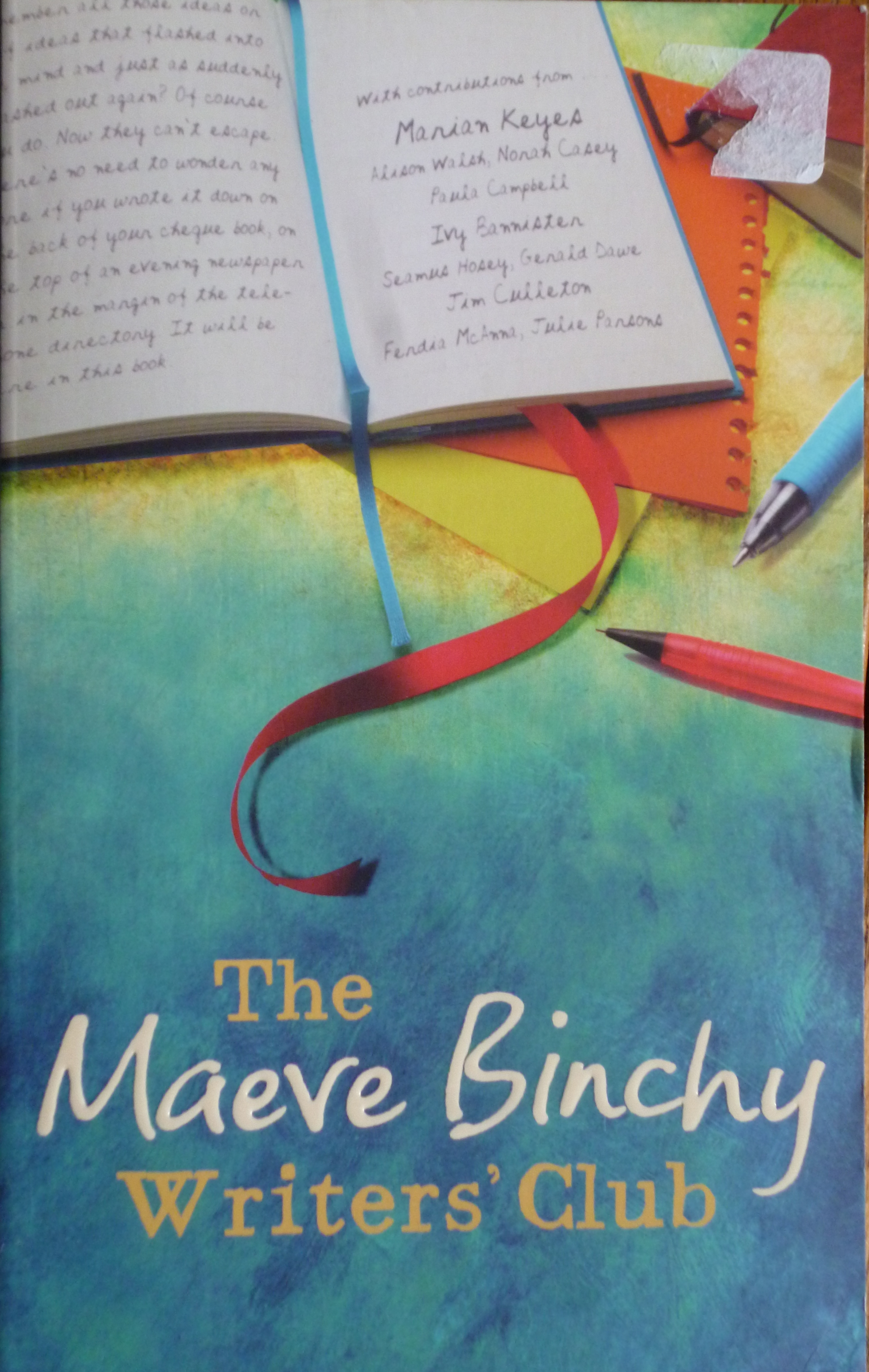
Then, at the last workshop session, one of the participants mentioned that she’d seen my children’s book, ‘How to be a Brilliant Writer’ in Maeve Binchy’s recommended reading list at the back of her book on writing.

004

The Maeve Binchy Writers' Club
The Maeve Binchy Writers’ Club

One of the ideas I’d been mulling over for my next project was a book for adults about writing – just writing, not in relation to dreams. But although I’d wanted to do that for ages, it didn’t seem sensible because there were already so many books out there by writers about writing .

I always follow life’s promptings, however, so with a gleeful click of the heels I’ll be up, up and away writing an adult book about writing to go with my children’s one in the New Year. The various other projects I’ve been mulling over will have to wait until their time is ripe.

What new projects are you looking forward to in 2014? Have you felt prompted by life?