Tag Archives: consciousness

The gifts of writing – 2

In this, the second of my pre-Christmas posts on the three gifts of writing, I’m thinking about the gift of awareness.

In ordinary life, a lot of what we experience is subliminal. We engage with the world through our senses, but barely notice what we are feeling. For example, sitting here at my computer I’m only really seeing the keyboard and screen, unless I take a moment to deliberately notice the four different colours of gel pen right in front of me, one of them a very vibrant green, the particular blue of the walls, the dark grain of the old table, the torn or crumpled bits of paper in the basket beside my chair.

pens

When we write, we picture the scene. We use all our senses to fully imagine it. We notice the detail of our protagonist’s clothing, the colour of their eyes, the quality of their voice. We notice the smell of the air, sharp and clear on a winter’s morning, close and musty in an old drawing-room, or wafting from a warm kitchen carrying cinnamon, or cabbage, or toast.

Our senses are the gateway to the world of our story, and describing what we can see, touch, hear, taste and smell there is how we bring our readers in too.

In writing, in imagination, we can experience life more fully and intensely, and that vibrancy spills over into our experience of real life.

Another thing that we do in writing, which is part of show-don’t-tell, is to notice and describe our characters’ emotions through their bodily sensations. When they are angry, we imagine where they might feel that in their body, and so experience it in our own. Again, this habit in imagination spills over into real life, and we become more aware of how emotion is expressed in the body.


Writing non-fiction also brings an increased awareness, not of what we experience through the body but of what we know, the life of the mind. When you write non-fiction, you become aware of knowledge you don’t normally notice or think about – it’s just there, part of the scenery, like the background details I never notice when I’m working in my study.

How to look after a rabbit; how to write a biography; how to grow plants from pips – these are some of the subjects I’ve written about. Others include the skills you learn just by being alive for a long time, such as cultivating happiness, building self-esteem and handling bullying. I’ve never done much research because I write the things I know about through my own experience, and in writing them, I notice what I know.

Shintie -sweet source of all the know-how in my little book, 'Rabbittalk - How to make friends with your Rabbit'
Shintie -sweet source of all the know-how in my little book, ‘Rabbittalk – How to make friends with your Rabbit’

This increased awareness of the knowledge and experience we normally take for granted and stop noticing is my second great gift of writing. Next week, I’ll close this little series with Gift Number Three.

A vocation of unhappiness?

The prolific Belgian author, Georges Simenon, famously said, ‘Writing is not a profession but a vocation of unhappiness.’

Writing is certainly a vocation. Many professional authors have been doing it for years on top of the nine to five before they start to make any money from it, and most say they’d continue to write even if their income from it completely dried up.

Like any other vocation, this hunger to create comes at a cost; it takes time and energy away from social life and other interests, and puts personal challenges upon us which we might otherwise prefer to avoid, such as developing the ability to deal with criticism and rejection.

But because it’s a vocation, that inner drive enables us to overcome our setbacks and difficulties and keeps us moving forward towards a growing sense of doing what we were born to do.

I used to think that dreaming was a vocation of unhappiness too. It felt like a compulsion which had me in its grip. Over the years, it has taken me to all sorts of places where I’ve felt confused and frightened, and out of my depth. It has given me insights and information I did not want to know.

Ignorance is bliss, and dreams are a road to understanding. Writing is hard, and for most of us it will not lead to a life of material abundance. But if you have a vocation you have to find and follow your inner compass, because that is the only way to achieve the supreme happiness of coming home to the self.

Have you had the Pinkola Estes experience?

Jung said that dreams don’t only happen when we’re asleep, but all the time, waking and sleeping, throughout our lives. The unconscious mind is  continuously producing images and narratives, but we’re only aware of it during sleep because then the distractions of waking life are stilled.

The movement between the conscious and unconscious areas of the mind is like a breathing in and out. Products of the unconscious mind emerge into consciousness – inklings, intuitions, emotions, instincts, senses, desires, before we have had time to formulate them into conscious ideas – and everything you have ever consciously known but don’t currently need to remember sinks into your unconscious mind, where it may lie undisturbed for years.

Because everything you have ever known is in there somewhere, it isn’t uncommon to have the experience of a name or piece of information you vaguely recognise but can’t recall where from suddenly popping up in your mind in response to something that’s happening in your life.

Estes
‘Women who run with the wolves’ – highly recommended

This happened to me recently when I was planning some new courses. One of the ideas I was considering was an all-women group, and another was writing from myths – I do a couple of sessions on myth in my ‘Writing in the House of Dreams’ workshops, but not a whole course. That night, I dreamt about someone called Pinkola Estes.

The name rang a bell, and I looked it up, to discover that Clarissa Pinkola Estes was the author of a book from the nineteen-nineties exploring myths and stories, ‘Women who run with the wolves.’ I recalled a friend recommending the book to me two decades before, but as I didn’t like the title I had never followed it up.

I hadn’t thought of Clarissa Pinkola Estes once in the intervening years – to all intents and purposes, I had completely forgotten about her. She had only ever been, after all, a fleeting mention. But I bought the book, and am finding it very useful as I develop this new workshop series.

I have dreamt the names of books, authors, gods and goddesses, which I may have come across long ago or sometimes can’t recall ever having heard of before, and it always happens at a time when following them up proves to be fruitful.

Have you ever suddenly recalled to mind something you had effectively forgotten?


Writing the bright shadow

Lots of shadows in the House of Dreams lately, but before I leave this theme, an update from Toko-pa has prompted me to write a balancing article about the bright side of the Shadow.

I did mention the bright side in my article ‘It’s the seat of creativity – so how can you find your Shadow?’ but only in passing:

This is not to say the Shadow is only negative. Positive potentials which may have been strong in us can be lost. For example, a strong-willed child may learn to identify that strength as a bad thing, and grow to suppress and deny it.

The Shadow is everything we can’t see directly in ourselves. Toko-pa says 90% of that will be ‘pure gold’, but I feel the percentage will depend upon other aspects of your personality. A person with low self-esteem, for example, will be unconscious of many of their more positive qualities, strengths and potentials, whereas someone who feels they are ‘good’ may be suppressing or projecting out many of their own human weaknesses.

When we write, our protagonists express energies in our Self of which we may or may not be aware, and these are not only the dark energies of our villains but also the bright energies of our heroes.

In our heroes, we experience qualities we may not identify with in life, but which must exist in us because they are finding expression in our stories. My protagonists are usually resourceful, independent and brave, but I’ve only come to see where they are me through writing their stories. I used to think of myself as the very opposite of all that.

So there are bright lights hidden in these shadows which, if we follow them, can lead us into the most wonderful areas of the Self. The process may still feel challenging, because anything that shakes our beliefs about ourselves unsettles our world and forces a readjustment of both our memories and our future dreams.

And we have to walk this path lightly, not trying to understand or interpret, but listening for echoes, being aware.

Have you noticed key characteristics that run through most of your protagonists? Are they qualities you recognise in yourself?

Next week I’ll be giving my answer to a straightforward writing question: Is it easier to write for children?

‘Your dreams were trying to kill you!’

My complete conversation with award-winning author Susan Price – she of the vengeful, spurned daemon – has gone live on her blog today. It’s got darkness and daemons, death and delight… all the stuff you’d expect in a chat about writing and dreaming. Take a look!

Plus the added bonus with Susan’s lovely blog, you get Blott 🙂

Do you notice the hidden connections?

In interpreting dreams, we’re looking for the hidden connections between the dream and waking life. The clue is often in the emotional quality of the dream, which may resonate with the dreamer’s feelings about a waking life situation.

When we find the emotional echoes, we will often notice that the dream is a kind of alternative story-version of a daytime event or situation. ‘I felt shocked and anxious to stumble upon a shallow grave in my dream when I was wandering through a dark wood… and, come to think of it, I felt shocked and anxious to discover something I had previously been in the dark about…’

Wandering through a dark wood

The events of the dream are so different, we won’t usually notice the hidden connections unless we go looking for them, and it’s the same with writing.

The stories we write come from the same layers of the self as dreams, and like dreams they are usually symbolic versions of the stories we’re living in our ordinary life.

If we notice this at all, it will often be years later when we’ve gained some distance on both the real-life events and the story we’ve written. But it can be instant, as I experienced this week with the book I’m working on. I suddenly thought, ‘This character is me!’ and it was not a very sympathetic character (hello Shadow!)

Having clocked the mirror she was holding up to me, I really examined my attitude towards a situation I was struggling with. Then she was free and I changed her in the story.

I think there is a psychologically healing or self-developmental purpose to creative work in exactly the same way as there is to dreaming. Through these imagined stories, we rehearse our real-life problems and dilemmas; we experiment with different paths and processes in imagination, and explore all the possible outcomes.

I’ve used creative writing with children in schools in a deliberately problem-solving way to explore the issue of bullying, where the children will create a character who is being bullied and then develop their story by asking, ‘What can they do to make it stop?’

The character will try lots of ideas, until they find one that works. In the writing, the children are exploring a difficult real-life situation and imagining strategies they might use if they had to deal with it themselves.

When writing is free, and not a directed exercise like in my bullying workshops, writers will naturally put their protagonists in situations where they will be faced with emotional challenges and find solutions which might blaze a trail for the writer in real life.

Does this mean we should feel exposed by what we write? Not at all. Like dreams, our stories have hidden connections only we can see, because only we know the secret processes of our hearts and minds. Even people who know me well would not be able to identify the link between my shadow-character and what I had been thinking about during the week.

As Jung said, an interpretation tells more about the interpreter’s current state of mind than the dreamer’s, and any hidden connections readers might find in your stories will be connections with their own lives, not yours.

Have you ever had one of those a-ha moments about a piece of writing, when you suddenly realise, like waking from an obvious dream, ‘I know what that was about!’

Why you should not spurn your daemon!

The award-winning author Susan Price and I are exchanging emails at the moment for a future entry on the ‘A conversation with’ page on her blog. By a delightful synchronicity, her latest response was a perfect illustration of the blog post I had just written last week, and she has agreed to let me publish it here.

Susan Price
 

There was a time in my life, when I was denying that ‘other’in my head, when I think my subconscious very deliberately worked against me.

I would say something quite innocent to someone – ‘Hello, how are you?’ for instance – and hear myself saying it in a tone, or with an inflexion that completely changed the meaning and made it insulting or aggressive. I had absolutely no conscious intention of insulting anyone, and would be as astonished as the person I’d just offended – but, of course, what could I say? – ‘I didn’t mean it like that! – That came out wrong!’

Sometimes people were polite, but I’d just bitten their heads off for no good reason. It was impossible to explain that the voice they’d just heard wasn’t mine. They would have thought I was mad. I occasionally thought I was mad.

I was at logger-heads with what I now call ‘my daemon’ because I was refusing to acknowledge that it existed, and so it fought me all the way. I would be writing something and would decide to make some change to the plot. What I now call the daemon would object, but I would refuse to listen because I didn’t recognise its voice. I put it down to a mere passing thought, and brushed it off because at that time I was certain that there was only one voice in my head: the ‘I’ voice, which I would now call ‘the editor’.

The daemon took its revenge by withdrawing. The piece of writing I was working on would turn to stone, or dry up, or fall over dead – whatever image you want to use. I had to learn that with writing – or, I think, any art – the daemon does the real work! The Editor may make some great editing decisions, once the real work is finished, but shouldn’t be allowed to interfere with the daemon.

A vengeful, spurned daemon is a dangerous thing, I think. Mine not only stymied my every effort at writing, it played those tricks to embarrass me. It was ingenious at finding ways to make such remarks as,“Yes, please,” and “Yes, I’ve heard of that,” nasty and cutting.

I had to learn that talk of ‘muses’ and ‘daemons’ was not the arty-farty nonsense I thought it, but simply a way of talking about something that we don’t quite understand, and don’t have an everyday vocabulary for. I began to solve problems with writing by summarising the problem and saying to the daemon,‘Solve this for me.’ And it did! The more I trusted it, the faster and more inventively it solved the problems.

I started to give way to it. If it insisted that a particular character should – or shouldn’t – die, I no longer argued, but humbly worked with it to make it so. I discovered that the more I worked with and trusted the daemon, the friendlier it became. It stopped playing those tricks on me!

As a result, I paid it more attention and ‘heard’ it more clearly. I started to see how a piece of writing that I’d ‘made up as I went along’ had sub-texts planted in it, and other subtleties that ‘I’ hadn’t written – so who had? And then I read Kipling’s description of his ‘daemon’ and knew what he was talking about right away.

If you’ve enjoyed reading this taster, watch out for our full conversation on Susan’s blog in the coming weeks. You may also like to check out her ‘Muse Monday’ guest post on Katherine Roberts’ lovely blog, Reclusive Muse, where she descibes her daemon and quotes the passage from Rudyard Kipling she refers to here.

What’s the explanation for ‘deja vu’?

‘Deja vu’ means ‘already seen’ or ‘seen before.’ It’s when we feel a strong sense of recognition in a new place, as if we’ve been there before but can’t remember when.

It can occur even in places we know for certain we have never visited in the past. We may actually find that we know the layout of the rooms, or what’s round the corner in the road.

Often, ‘deja vu’ is accompanied by a strong emotional reaction to the place we recognise – perhaps a warm sense of belonging, or a feeling of sadness, or a desire to get away.

A scientific explanation of this phenomenon is that it’s some kind of blip in the brain – a disturbance in the electrical activity which causes a momentary illusion that we’ve seen the place previously when in fact we’re seeing it for the first time.

A more metaphysical explanation is that ‘deja vu’ is connected with past lives – we recognise a place because we were there in a former life. But how could that account for feelings of ‘deja vu’ which arise in a modern environment?

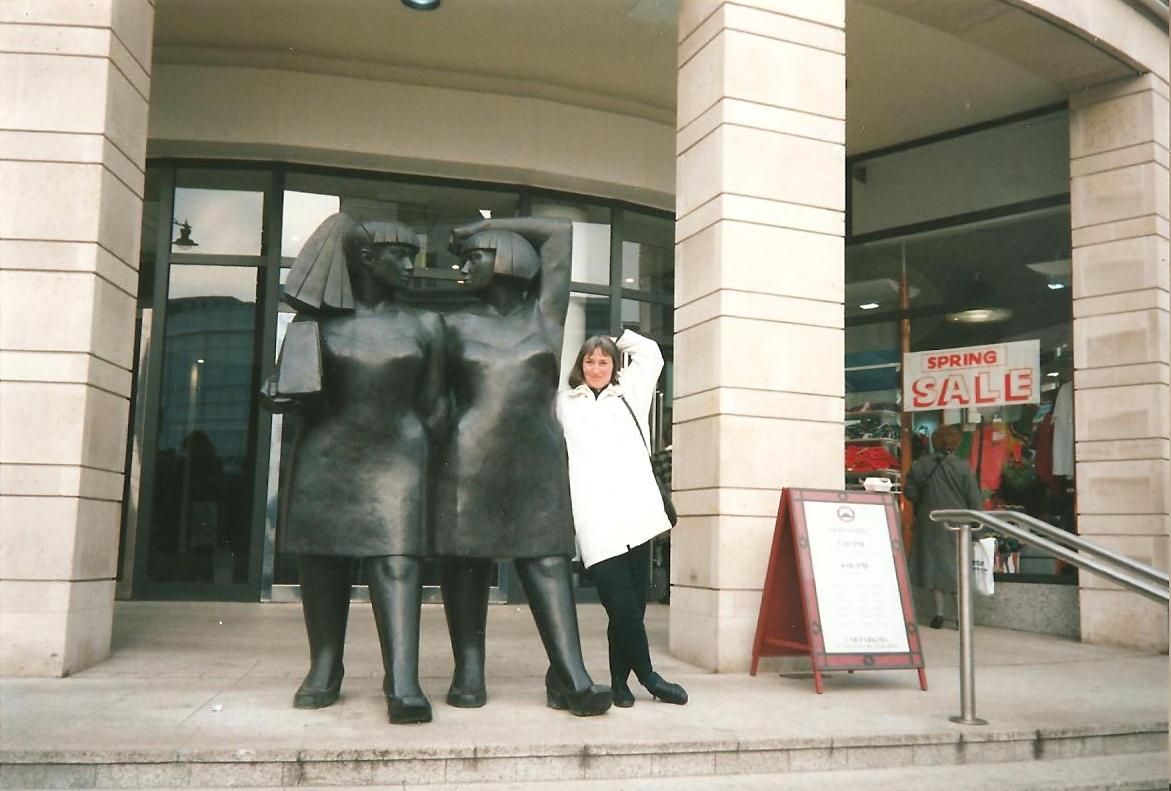
Larking around outside the old Town Hall in Wimbledon – part of a shopping centre now

Years ago, I revisited the town I grew up in, Wimbledon, with an old friend from school. Before the visit, I dreamt I was walking from my childhood home into the town centre, and when I got there, I was surprised to find the old Town Hall was now a shopping centre.

When we arrived, I found the town centre was exactly as I had dreamt it. You may say I must have heard about the redevelopment in the media or something, and simply forgotten. But this sort of thing happens quite often, in relation to places which have never been in the media.

Five years ago, I wanted to move house, and I was looking at cul-de-sac bungalows within a certain area. I happened upon the house I eventually found quite by chance, on an evening out – it was in the wrong place, but I viewed it on a whim, and as soon as I walked in the door, it just felt like my house.

Recently, reading back through some old dream diaries, I discovered that I had dreamt I took a detour on a house-finding mission, to view a little miner’s cottage in the middle of a terrace on the edge of the moor – I had actually dreamt about this house.

I don’t know if there is a definitive explanation for ‘deja vu’, but my own experience suggests that when we feel we have been in a place before, we have – in our dreams.

Have you ever experienced ‘deja vu’? What do you think is the explanantion?

If the doors of perception were cleansed

To round off my blog birthday celebrations, here is ‘the one that got away’ – an article about my spiritual path of dreams which was published on another blog earlier in the year  

When people talk about dreams as spiritual experience, they usually seem to be thinking in terms of what Jung called ‘numinous’ dreams – that is, dreams which have an unmistakably spiritual quality, inspiring awe and wonder, and often bringing revelations.

These ‘big’ dreams do indeed feel like wonderful gifts from outside the self, and they stay vividly with you across the decades, lighting your life. But dreams which feel quite ordinary can also be a doorway to profound changes in consciousness.


For example, I once dreamt I was having coffee with my neighbour. I was fully aware that I was dreaming – lucidity is very common in experienced dreamers.

Normally, in lucid dreams, my waking ‘I’ might be there as an observer or commentator, and occasionally if I didn’t like the way things were going, I might intervene and change the action of the dream.

But this dream didn’t have any action at all. It didn’t have any narrative to distract me – I was just sitting there, drinking coffee, and I was bored. There was a silky cushion beside me, and I ran my hand absent-mindedly across it. I noticed how smooth the fabric felt; I ran my fingers along the hard ridge of the trim.

I thought, ‘Hold on a minute – this is a dream!’ Since nothing much else was going on, I went on testing the evidence of my senses and yes, I really could smell the coffee; I really could feel the crumbly biscuit between my fingers and taste its light vanilla on my tongue. I could hear my neighbour’s voice, talking to me. I knew it was a dream, but it felt exactly the same as ‘real’ life.


When I woke up, I could feel the quilt resting lightly across my body; I could see the light from the gap in the curtains ribboning across it; I could hear my husband’s gentle breathing and smell the warmth of our two bodies. But now I knew that my mind could create a whole different reality which felt as real to my senses as this one. So the senses were unreliable witnesses, and waking life a reality no more substantial than the dream.

When you read back over old dream diaries, you will also find that seemingly ordinary dreams can be precisely predictive, and you may find so many of these that it’s impossible to dismiss them all as flukes and coincidences.

According to our normal understanding of time, it should not be possible to predict the future, but the experience of predictive dreaming shows irrefutably that it is.

So gradually, actively engaging with dreams can dissolve the narrow rational and materialistic viewpoint, through which we normally understand life. In the words of William Blake, ‘man has closed himself up, ’til he sees things thro’ narrow chinks of his cavern.’

The practical, experiential path of dreaming can lead to a falling-away of ideas and illusions, and open you up to the mind-blowing reality. ‘If the doors of perception were cleansed everything would appear to man as it is, infinite.’