Tag Archives: creative writing

The mysterious geometry of writing

In Becoming a Writer Dorothea Brande points out that it isn’t only themes and characters that emerge from the unconscious mind through writing. She says the unconscious is also ‘the home of form.’

So as well as trusting the flow of ideas if we open our mind by entering the ‘writer’s trance,’ we can also trust that the ideas will organise themselves into the shapes of books and stories.

I definitely find this in my own work.

When I’m writing, whether it’s fiction or non-fiction, I start with a sketchy plan and head off from Start in the general direction of Finish, wondering how on earth I’m going to get from one to the other, until suddenly I begin to see the shape of the whole thing in my head like a geometrical figure or a pattern of numbers.

At that point, I become fully engaged. I dash along like a mad thing, joining the dots to make the beautiful shape of the book I’m creating.

This means all my books have a sort of symmetry in the contents – the four Peony Pinkers, for example, all have 17 chapters. Why 17? I’ve no idea, only that that was the number they needed, and I knew each story was on the right track the moment I could see how it could make 17 chapters.


The Peony Pinkers - 4 times 17
The Peony Pinkers – four perfect 17s

Writing in the House of Dreams came out as four parts, each part having three chapters.

4 Parts, 3 chapters each in the House of Dreams

My brand new book, The Binding, has three parts and each one seven chapters.

The Binding - 3 parts, 7 chapters each
The Binding – 3 parts, 7 chapters each

This mysterious geometry is very marked in my own writing practice but not all books divide so obviously into a balance of parts, so it can’t be exactly the same for all writers.

Still I imagine there must come a time for everyone when something clarifies in the mind; you see the finished shape of the whole book, and the writing steps up a notch to engage with it.

If you are a writer, do you recognise what I’m talking about, or am I just weird?!

Live dangerously – do some writing!

A few weeks ago, I received a lovely email from someone who had been here for my Autumn workshop day. Its subject line was ‘Poem inspired by your tablecloth.’

The email was a kind of goodbye, because the writer was about to leave the area and move to Spain. In it, she said,  ‘I think I mightn’t have done all this life changing stuff if it wasn’t for the experiences I’ve shared over the years on your courses and workshops.’

Much as I’d like to think that discovering a new sense of adventure is a particular benefit of my workshops, I imagine it’s a common side-effect of doing lots of writing.

When we write stories, instead of focusing on what is, we’re adjusting our focus to consider ‘what if?’

Any habit of thought creates pathways in the brain; old ways of thinking fall into disuse like overgrown tracks as we favour and carve out new ones.

As well as changing the way we think, writing can change the way we  feel, because when we put our protagonists through trials and troubles which mean they have to be brave and bold, we are experiencing that courage and mastery in our self.

Things we might not previously have dreamt about begin to feel possible and survivable, and simply feeling that we could do something new if we wanted to can make the current status quo feel like a choice, and not a trap. Writing creatively leads to living more creatively too.

Of course, if you dare to dream, there’s always a risk you might just go and make that big life change, and change carries risk. New adventures always involve some element of difficulty, and they can go horribly wrong.

But they will also bring colour and excitement, learning and opportunity. I’m looking forward to following Lizzylarkwhistle’s adventures in Spain when she starts her new blog – all I can tell you so far is that she has met Jesus and Gabriel, and I can’t wait to hear more.

I’ll post the link when I have it but, in the meantime, here is her poem, written in the workshop, at my table. She chose a dead umbellifer from the tray of Autumn offerings I found in my garden.

The Picked Umbellifer

I hope to stay here now.
In some quiet corner, shadowed by firelight
Dreaming of my old roots.

Back on the shifting cliff in Spring,
New, eager growth will push through my old ways.
White, sea scented sprays,
Soon hardened by salty air and beaten by gales and rain,
To a brassy, brittle, bone coloured thing,
A trophy.
As delicate as the cobwebs spun between its flowers,
Flinching from dogs and booted feet
Or a gust that may toss it into the sea.

After all that has passed, I’m glad to be here,
Spun slowly by a gentle hand,
safe in a house, above a table squared
With the colours of summer.

Lizzylarkwhistle

Do you feel writing has helped you to live more creatively?

You and your writing – true love or passing passion?

It’s easy to fall in love with writing, but can you take it to the next level?

A lot of people love the idea of writing, and hold it in their heart for years as ‘a one day when I’ve got  time’ dream. And when they engage, perhaps in workshops or inspired by a book such as Writing down the Bones by Nathalie Goldberg or Julia Cameron’s The Artist’s Way, writing does not disappoint.

Because it really is exhilarating to discover that all you have to do is open the door, and ideas will come pouring through. Characters, settings, stories… it’s astonishing and wonderful what you find inside that you never even knew was there.

This is the honeymoon period. It’s bright, fun and exciting, but it doesn’t last forever. You can abandon it for a while and then start all over again, with another course, another book, loving the romance but not committing, or you can surrender to it fully, and fall properly in love.

002

Love is not easy. As Khalil Gibran says in The Prophet, ‘Even as love crowns you so shall he crucify you. Even as he is for your growth so is he for your pruning.’

When you fall in love with writing, just as when you fall in love with another person, your centre of gravity changes. You are not the only important thing. You are willing to learn, to strive and to make sacrifices in the service of your love.

Loving your writing means making yourself the best possible writer that you can be. It means studying and practising all the skills of writing, so that you can properly honour the wonderful flow of ideas you have found.

Sometimes it might mean giving up things you really liked – ‘killing your darlings’ – if a clever image you were pleased with doesn’t sit well in the larger piece, for example, or if a descriptive passage you’ve worked really hard on has got in the way of the action.

It means curbing your annoying habits, such as using too many abstract nouns or adverbs, or peppering your text with a few favourite words. What you like is not important; you want to do what the writing needs.

Writing is a labour of love – labour and love, both. When you have setbacks, as every writer does – a book idea that doesn’t work after months and months of trying, a rejection from a publisher or agent, an e-book that’s barely sold a copy – it’s only your love for the art and craft of writing that stops you walking away and giving up completely.

I’ve had times when I’ve felt like packing it in, but writing always brings me back. It’s part of who I am now, not just a thing I do. As Khalil Gibran says, ‘think not you can direct the course of love, for love, if it finds you worthy, directs your course.’

What is your relationship with writing? Would you like to commit yourself more fully? Would you like to be able to walk away?


Mind-magic for writers – harnessing the power of the circle

The circle is an archetype for wholeness and integration, a universal pattern in nature and the human psyche which is also a template for the stories of life and fiction. You can use the  power of the circle archetype in writing, deliberately placing it in your mind by making mandalas.

The Power of the World always works in circles, and everything tries to be round. The sky is round, and I have heard that the earth is round like a ball, and so are all the stars. The wind, in its greatest power, whirls. Birds make their nests in circles, for theirs is the same religion as ours. Even the seasons form a great circle in their changing, and always come back again to where they were. The life of a man is a circle from childhood to childhood, and so it is in everything where power moves ~ Black Elk

003
Ice in a circular hollow

Stories naturally make circles. The protagonist sets off, achieves or learns something in the course of the action, and returns changed. Often the work of redrafting is about refining the beginning and ending to tie everything into a satisfying whole. The crafting of a story is a process of perfecting the circle.

Dorothea Brande (‘Becoming a Writer’) says the unconscious is not only the source of our creativity, but also the home of form. This is why, when you have plot problems, new ways of fitting things together can naturally spring up in your mind as soon as you stop consciously trying to force them.

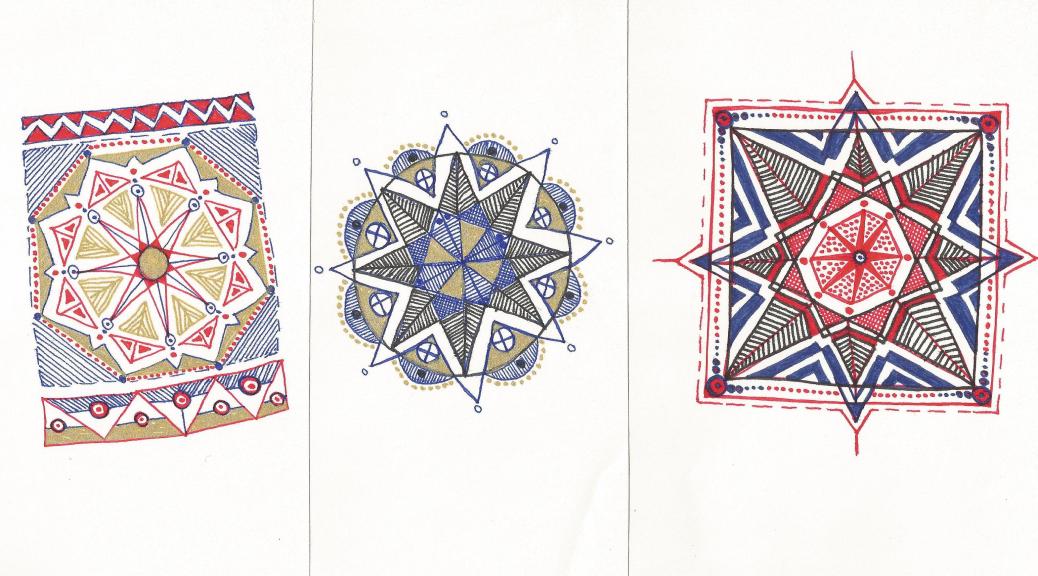
When I’m planning or redrafting a story I will often draw mandalas while I ponder.

One of my working mandalas

‘Mandala’ comes from the Sanskrit word meaning ‘circle.’ It signifies a geometrical pattern based on a circle, and it’s used in every spiritual tradition as a focus for contemplation, meditation, protection, healing or prayer.

In its most basic form, the mandala is a simple circle, and if you’d like to try making some you can start by drawing circles. I recommend you do this free-hand, although your first attempts may look like lumpy lozenges. Keep working at it until you can do one that looks reasonably round. The process of this will anyway help attune your mind to the archetype.

When you have drawn your circle, you can incorporate other geometrical forms into it and around it. You could put a triangle inside it, crossed by another triangle to make a six-pointed star. You could put your circle inside a square, or squares inside your circle.

Choose any geometrical shapes you like, but try to achieve balance, so that the sides and segments of the circle are the same. Drawing geometric shapes also settles your mind into the beautiful reality of numbers. 

Treat the whole process like doodling, not trying to create art, but simply to play and allow your mind to idle. Keep building mandalas until you get one you really like.

Shading or colouring your mandala is a way of staying with the archetype for longer, and allowing it to work upon you. When you have finished, bring the energy of the circle with you into your writing. Bear it in mind as a template for your story, and see whether it gives you a greater sense of direction and clarity.

 What creative activities do you use as part of your writing process?

Check out these lovely prayer-flag mandalas by Toko-pa Turner http://toko-pa.com/2013/11/29/mandalas/

The gifts of writing – 3

So Christmas is nearly here, this great celebration of loving and giving – the perfect time to talk about the third gift that writing gives us, the gift of empathy.

When I wrote my children’s book about writing, How to be a Brilliant Writer, I asked my friends in the Scattered Authors Society if they would like to send me a few sentences on what they loved about writing. This is what Enid Richmont sent me:

A writing game I sometimes play when I’m trying to bring one of my characters to life is body-swapping! I pick a stranger – in the bus perhaps, or the supermarket – then I try to become that person. I feel the wrinkles on my skin, I walk with a limp, I look at my long scarlet fingernails or I run my fingers over my shiny bald head. Right now, I’m being a squirrel! I like to think, as well, that ‘becoming’ other people, or creatures, also helps me to understand them.

In fiction, we create characters and give them big problems to deal with. There’s always going to be struggle, conflict, pain because if everyone’s happy there’s no impulse for change, no movement, no story.

As we imagine what it feels like to be homeless, or orphaned, or bullied, or bereft, we feel everything our character is feeling – we have to, because otherwise we can’t know how they will behave, and our story will feel hollow and unconvincing.

It takes emotional toughness to do this work, and everyone has to find their own way. I personally have usually opted to put my characters in situations that are difficult but not overwhelming, and I use humour to leaven the hard parts. If my reader – and I – feel like crying at times, I want to make them feel like laughing too.

Other authors I know are braver and tougher than me, going into dark areas of experience such as criminal gangs, drugs, self-harming, eating disorders, abuse – which are part of real life that older children need to know about, and reading serious fiction by responsible authors is probably the safest way of gaining this knowledge.

Writers are used to imagining another person’s story, looking beneath the surface, feeling their joys and pains.  We do it in imagination, and that spills over into real life. I think that’s why most writers I know enjoy hanging out in cafes on their own, people-watching.

I like to think, as Enid says, that ‘becoming’ other people might help us to learn to be less quick to judge and more aware that sometimes it can take real courage and faith to get through the vicissitudes of even an ordinary life.

So there they are – stillness, awareness, empathy –  the three greatest gifts I think I get from writing. What does writing give to you?          

The gifts of writing – 2

In this, the second of my pre-Christmas posts on the three gifts of writing, I’m thinking about the gift of awareness.

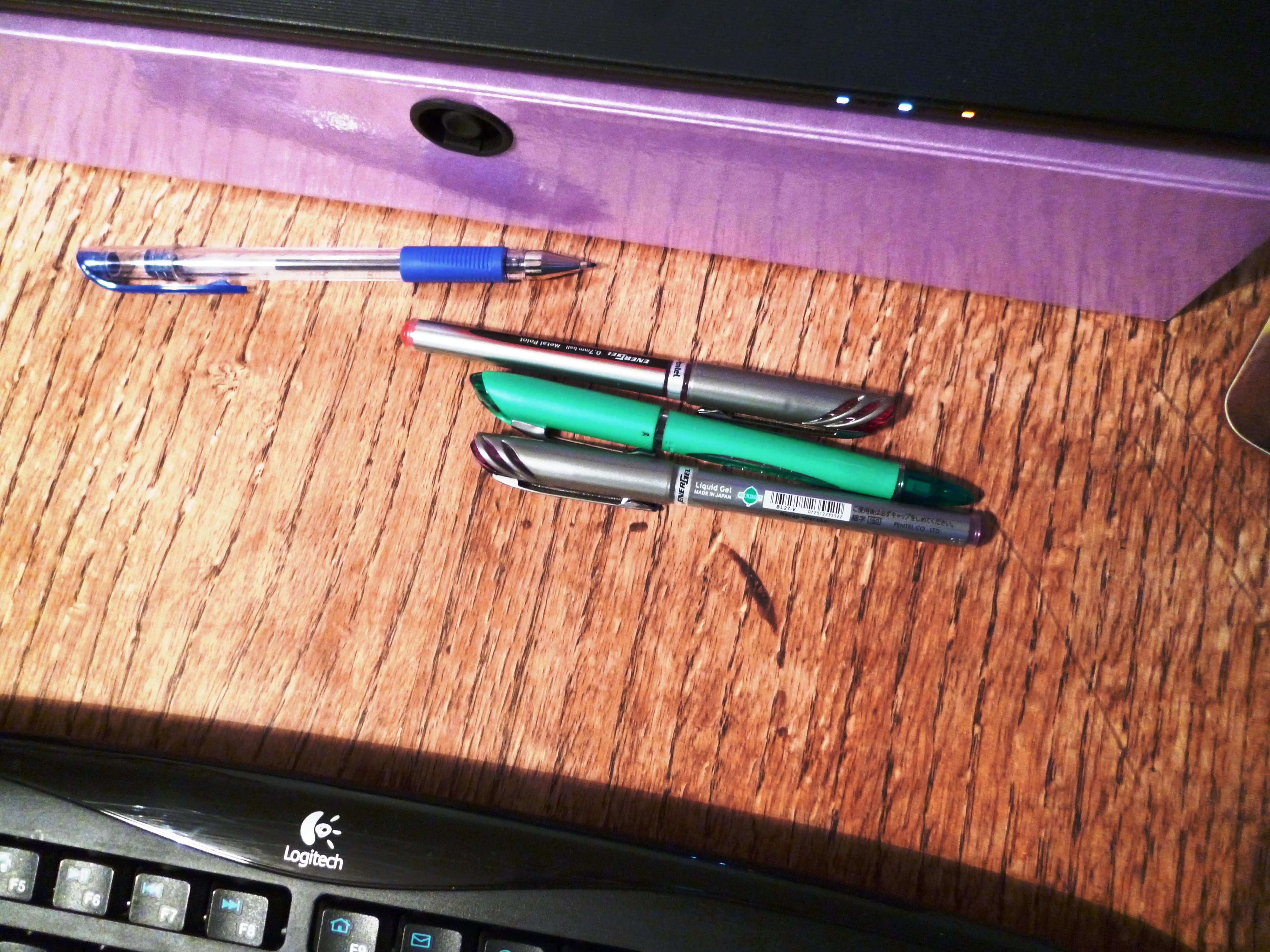
In ordinary life, a lot of what we experience is subliminal. We engage with the world through our senses, but barely notice what we are feeling. For example, sitting here at my computer I’m only really seeing the keyboard and screen, unless I take a moment to deliberately notice the four different colours of gel pen right in front of me, one of them a very vibrant green, the particular blue of the walls, the dark grain of the old table, the torn or crumpled bits of paper in the basket beside my chair.

pens

When we write, we picture the scene. We use all our senses to fully imagine it. We notice the detail of our protagonist’s clothing, the colour of their eyes, the quality of their voice. We notice the smell of the air, sharp and clear on a winter’s morning, close and musty in an old drawing-room, or wafting from a warm kitchen carrying cinnamon, or cabbage, or toast.

Our senses are the gateway to the world of our story, and describing what we can see, touch, hear, taste and smell there is how we bring our readers in too.

In writing, in imagination, we can experience life more fully and intensely, and that vibrancy spills over into our experience of real life.

Another thing that we do in writing, which is part of show-don’t-tell, is to notice and describe our characters’ emotions through their bodily sensations. When they are angry, we imagine where they might feel that in their body, and so experience it in our own. Again, this habit in imagination spills over into real life, and we become more aware of how emotion is expressed in the body.


Writing non-fiction also brings an increased awareness, not of what we experience through the body but of what we know, the life of the mind. When you write non-fiction, you become aware of knowledge you don’t normally notice or think about – it’s just there, part of the scenery, like the background details I never notice when I’m working in my study.

How to look after a rabbit; how to write a biography; how to grow plants from pips – these are some of the subjects I’ve written about. Others include the skills you learn just by being alive for a long time, such as cultivating happiness, building self-esteem and handling bullying. I’ve never done much research because I write the things I know about through my own experience, and in writing them, I notice what I know.

Shintie -sweet source of all the know-how in my little book, 'Rabbittalk - How to make friends with your Rabbit'
Shintie -sweet source of all the know-how in my little book, ‘Rabbittalk – How to make friends with your Rabbit’

This increased awareness of the knowledge and experience we normally take for granted and stop noticing is my second great gift of writing. Next week, I’ll close this little series with Gift Number Three.

Authentically creative, by Carolyn Hughes

Carolyn Hughes is a writer with an interest in addiction and mental health issues. Her popular blog is The Hurt Healer and she has a lively and rapidly growing following on facebook and twitter

Carolyn Hughes
Carolyn Hughes

I must also have a dark side if I am to be whole ~ Jung

Like many writers I want my work to be recognisable by its unique and individual style.  For me, it’s crucial that what and how I write reflects my authentic self.  Anyone who has read my blog The Hurt Healer will be familiar with the fact that I share from the heart. It’s a deliberate approach to enable readers to relate to and hopefully be encouraged by my words.  Authenticity means being genuine and real.  Much as I would love to reveal only my good side, to be true to my work I have to disclose my whole self.

It is no coincidence that I am only now finding my writing voice as it has taken a long time to find myself.  Years of battling with depression and alcoholism meant that I had very little idea of who I was. How I presented to the outside world was very different to how I felt inside. It was only through having the courage to challenge my past at every level that I was able to start the journey to healing and so begin to find personal identity and my authentic self.

My aim though isn’t just to be authentic, but to be authentically creative.  And the key to writing both authentically and creatively lies with the unconscious.  For me the unconscious is a limitless place in my mind where my spirit and soul meet. It is a place where I can visit those painful issues that used to torment me. But instead of being overwhelmed I can now bring them into my conscious, safe from their power to harm me.  So as I communicate from my unconscious, so I hope to reach the unconscious of others and in doing so share a collective moment of authenticity.

The interpretation of dreams is the royal road to a knowledge of the unconscious activities of the mind ~ Freud

Recently I’ve been looking at how I can reach further into the depths of my unconscious and take my writing to a new level of creativity.  I’ve started to look at the constituents of my dreams. This is a wonderful way to tap into those hidden thoughts and images that make up the psyche, as well as exposing my inner truth.

Examining my dreams however has only been possible from a position of emotional recovery and psychological stability. In those dark days of depression and alcoholism my night-time experiences were fraught with darkness and fear. The erratic and terrifying nightmares that emerged reflected my complete inability at the time to manage my physical and mental anguish.

Jung once remarked that nothing was ever lost in the psyche.  That is an horrendous thought for anyone who has tried to block out the past in the hope that the pain would stop. The idea that all thoughts, memories and emotions never disappear but remain forever can be frightening. Yet I found that there was indeed a freedom to be found in allowing the unconscious to simply ‘ be’. I stopped fighting the emergence of the dark side and celebrated the arrival of the good side. By no longer fearing my thoughts and dreams I was free to live authentically and to write openly too.

Il ne faut jamais regarder quelqu’un qui dort. C’est comme si on ouvrait une lettre qui ne vous est pas addressee ~ Sacha Guitry

I couldn’t mention dreams without including one of my favourite quotes. A general translation of this is; “You should never look at someone who is sleeping. It is like opening a letter that isn’t addressed to you.”

It is a quote I came across many years ago at a time when I was experiencing my first love.  After one of those deep conversations that you have in such relationships I remember feeling that he hadn’t been entirely truthful.  As I watched him sleeping I remembered the quote and realised that I had been right to doubt him.  His real emotions were disclosed on his face as he slept.  So dreams aren’t just for the benefit of the dreamer!

Dreams are often most profound when they seem the most crazy ~ Freud

Being new to noting my dreams, I must admit that at first they did appear to be made up of bizarre representations that made little sense and made no contribution to my creativity. But as I made more of a conscious effort to remember them and to focus on not just what they were about but how I felt, they became significant.  

Very often it’s in that winding down time between waking and sleeping that a word, phrase, image that comes into my mind and gives the essence to a piece of writing. Other times it’s a complete dream that a memory from the past, an issue of the present or an aspiration for the future.  

Sometimes this works better than others depending on the obscurity or relevance of my dreams. Yet the importance lies in allowing that writing to happen regardless of whether it makes sense at the time. So although I may have rearranged the words to make them flow, I haven’t messed with the essence of what my soul may have whispered to me.

I may never reach the purest form of authenticity or be famed for my creativity, but I will continue to write from the heart with my unconscious and dreams as my guides.

 How do you write authentically and creatively? 


My top five rules for writers

It’s eighteen years since my first few books were published and I’ve had a very varied and productive writing career ever since. I’ve also got to know lots of other authors, at various stages in their careers; I’ve been on many workshops and read many books about the art and craft of writing.

Books, poems, magazine articles... my varied writing life
Books, poems, magazine articles… my varied writing life

Although I’ve experienced occasional bouts of frustration, stress and despondency over the years in relation to the business side of things, I’ve always felt happy and confident in my writing, and I think that’s largely down to finding and following my five golden rules:

Focus on the big picture

The real work-in-progress is yourself as a writer – every word, draft and manuscript you produce contributes to that. Therefore even if a piece of work is turned down by publishers or agents, that doesn’t mean it’s been a waste of time, because it’s added to the sum of your writing experience. (In fact, rejected MSS will often go on to have their day – they’re eminently recyclable)

Don’t push the river

Creative work has its own rhythm, requiring fallow time as well as pondering, planning, drafting and redrafting. If you try to write a book before it’s ready, you’ll come up against blocks and difficulties; if you learn to be patient, and allow the ideas to fully form up in your mind before you begin, the writing will flow.

Go with the flow
Go with the flow

Don’t expect to please everyone

We’re all different, so we all enjoy different themes and voices in our reading, and that includes publishers and agents. If you get rejections, take notice of constructive criticism but don’t take it personally. Ditto if you get bad reviews.

Understand your soul’s needs

Some people want to write because they have a burning desire to tell their own personal story, or to achieve celebrity, or to become a public speaker. Some people hope to earn a lot of money. Others may simply want to be able to create objects that please them. Identifying what you want from being a writer will help you to create achievable goals and lasting satisfaction. I’ve written about this on the blog, in What kind of writer do you want to be?

Life-coaching techniques could help you to identify your writing goals

Be grateful

As soon as you start to write, whether you are published or not, you begin to see life through a writer’s eyes. You notice everything. Snippets of overheard conversations; the story in a stranger’s face; the movement of light in leaves. You uncover the unconscious narrative streams that flow in your own psyche, and so magnify your experience of everyday life.

The story in a stranger's face
The story in a stranger’s face

These are the rules which have underpinned the whole of my writing life. What are your writing rules?

The joy of writing

Last week I was talking about the comfort of dreams, and how dreaming can provide pleasurable experiences for the self which may be ‘only dreams’ in waking life.

This happens spontaneously, but we can replay and deliberately go back into such dreams either in daytime fantasies or as we fall asleep.

Writing can work in the same way, which I’m particularly thankful for at times when I’m not sleeping well. If I feel out of sorts with the world for any reason, and maybe my mind’s gone into overdrive, I’ll get up and write for two or three hours in the middle of the night.

I’ve had a couple of nights like that this week, when I’ve made myself a cup of tea  and left the cares and irritations of my daily life to immerse myself in Maddy Monday’s, whose world is colourful, lively and distracting.

003
My bright and delightful work-in-progress

The joy of writing is that we can choose the worlds we wish to inhabit during the writing time, and even though we will meet all sorts of challenges and difficulties in those worlds – no problem, no story – we are always able to solve them.

Sweet dreams everyone, this week – or failing that, happy writing!