Category Archives: Creativity

And another thing about blogging…

Someone asked me last week, ‘What makes you want to follow a blog?’ Before I started this one, nearly six months ago, I read a lot of blogs about blogging, and everyone agreed that your goal should be to get people to sign up rather than call in from time to time.

Now that I’m blogging myself, I can feel the difference this makes, because the signed-up members feel like a community, and the result feels more like a conversation.

Most pundits seem to agree that the way to get people to sign up is to offer an incentive, usually in the form of a free download. Following that advice, I offered my printout about dream recalling and recording, which I had been intending to put up on my Tips page.

But when this friend asked me last week why I personally subscribe to the blogs I like, I realised that for me it’s all about content. I subscribe if I like the content enough not to want to miss a post. In fact, free downloads are a disincentive to me, after my experience of them so far.

I’ve only signed up to three blogs because I was curious about the free download, and each time, it’s lead to a slew of nuisance emails about topics I never asked for information about. In two of these cases, they also quickly went on to try to sell me downloads or get me to sign up to courses.

So as of today, my sign-up offer ceases. You can see my recalling-and-recording dreams info on the Tips page, and here’s a heads-up on some great content coming in the next few weeks.

How to use dream material to energise your writing… guest post from one of my fave bloggers, Katherine Roberts… interview with lovely dreamworker, Toko-pa Turner… the Death card and the end of the dream book…

If you haven’t done so yet – I do hope you’ll sign up!

Book Review: Poetry in the Making

Poetry in the making, by Ted Hughes

Written for young people, this has to be the most beautiful and insightful book I’ve ever read about the magical process of creating writing.

As you would expect, the author uses metaphors from nature to express his ideas about where poetry comes from, and what attitudes and skills a poet needs to develop in himself in order to be able to capture it.

He talks about the inner life, which seems equivalent to what I call the dream-world in these pages. It’s the world of imagination, memory and emotion, stories and images, which goes on all the time beneath the surface, ‘like the heart beat.’ We may be aware of it, or we may not. We may become aware of it through dream-recalling or any creative pursuit.

Hughes compares this inner world with a pond, saying that if we don’t learn the focus, patience and stealth to break into it ‘our minds lie in us like the fish in the pond of a man who cannot fish.’

He says you have to care about what you are writing, and if an idea gets stalled it will be because you don’t care enough. You shouldn’t worry about the words, but cleave to the imagination and emotion in your idea, then the words will follow in an organic way.

The review from the Times Literary Supplement, quoted on the back cover, says, ‘He makes the whole venture seem enjoyable, and somehow urgent.’

That’s exactly what the book conveys to me – the sense of venture, pleasure and also the importance of this inner journey, which takes you to the heart of who you are, and what life is.

Like most writers, I love reading about writing. Have you got a favourite book on writing that you’d like to recommend?

Guest post: The dream that sparked the poem

Bicycling in Brighton, by Pat Neill

As a child, I spent a lot of time day-dreaming and it wasn’t until I was in my thirties that I woke up to my night dreams. They came fast and furious, and I diligently recorded as many as I remembered. Analysing them helped me to understand myself in more depth. Now I’m tired of all that self-analysis and I want to follow Jenny’s idea of using them creatively. Here’s a dream that did inspire me to use it creatively.

I was driving down a long, sloping, wide-open road in a town. In front of me, a lorry had stopped. I easily glided out to overtake it and then discovered a car manoeuvring – that was why the lorry had stopped! I felt embarrassed as I stopped to let the car finish. The car moved on, with me following, and the lorry behind me.

Now, I felt myself to be on a bicycle. The ride was smooth and the feeling exhilarating as I sped on down the hill. The street was like those in Brighton/Hove that lead down to the seafront. The weather was slightly grey and misty and the vehicles had their lights on.

I woke from this dream feeling happy, confident and optimistic. In my poem, I seem to have changed the weather. I think it was the feeling after I woke from the dream that carried forward into my writing. I have always set great store in the feeling a dream leaves you with – I reckon it has to be the most important feature of the dream.

Riding High

Georgian pillared terraces sloping to the sea,
I rode my bike between them feeling wild and free.
Swiftly leaning to the right, a stopped truck to miss,
I glided past, confident, riding high.
Oh what bliss!
Once, a sudden car appeared, half blocking my way.
No matter, I had pedal power and was lord of the highway!
Wind whistling, hair streaming, on and on I sped
With salt-sea horizon and cloudless blue skies, all beckoning ahead.

I love the joyful exuberance of this poem, and Pat makes an important point about the feeling a dream leaves you with when you awake. I’ll be blogging about emotions in dreaming and writing next week.  

Pat is an astrological life coach with a brand new blog  http://astrolifecoach.wordpress.com/ She uses astrology as a tool for understanding the issues present in a person’s life and life coaching as a method for moving matters forward to effect positive change. For details email pat.neill@btinternet.com or phone 01566 779792

A second award for the House of Dreams!

I’m delighted to announce that Kath Roberts – she of the delightful Reclusive Muse – has bestowed the coveted Unicorn Glitter Award upon Writing in the House of Dreams.

The beautiful Unicorn Glitter Award
 
You’ll see that, under the unicorn’s rules, I have to tell you some more about the House of Dreams.
 
What is the favourite book on its bookshelves?
‘Creative Dreaming,’ by Patricia Garfield, and ‘Dreams and the Underworld,’ by James Hillman.

 
Favourite film?
Bit of a surprise maybe, but you do get all sorts in the House of Dreams – ‘The Naked Gun’
Favourite poem or song?
Kathleen Raine’s ‘Heirloom’, which so perfectly describes the magical within the mundane.
Favourite myth?
Persephone, because it’s the story of dreaming.
Enchanted creature?
The owl, which knows the secrets of the night.


My little bloggie will wear the award with pride.

Do you follow a blog you think should get an award? Or do you have any more questions for the House of Dreams?

More people want to write than to read – why?

First of all, I must confess I can’t remember where I read that there are more would-be writers than readers, so it’s more of an eye-catching title than a statistical fact. But having said that, it doesn’t sound too preposterous to me.

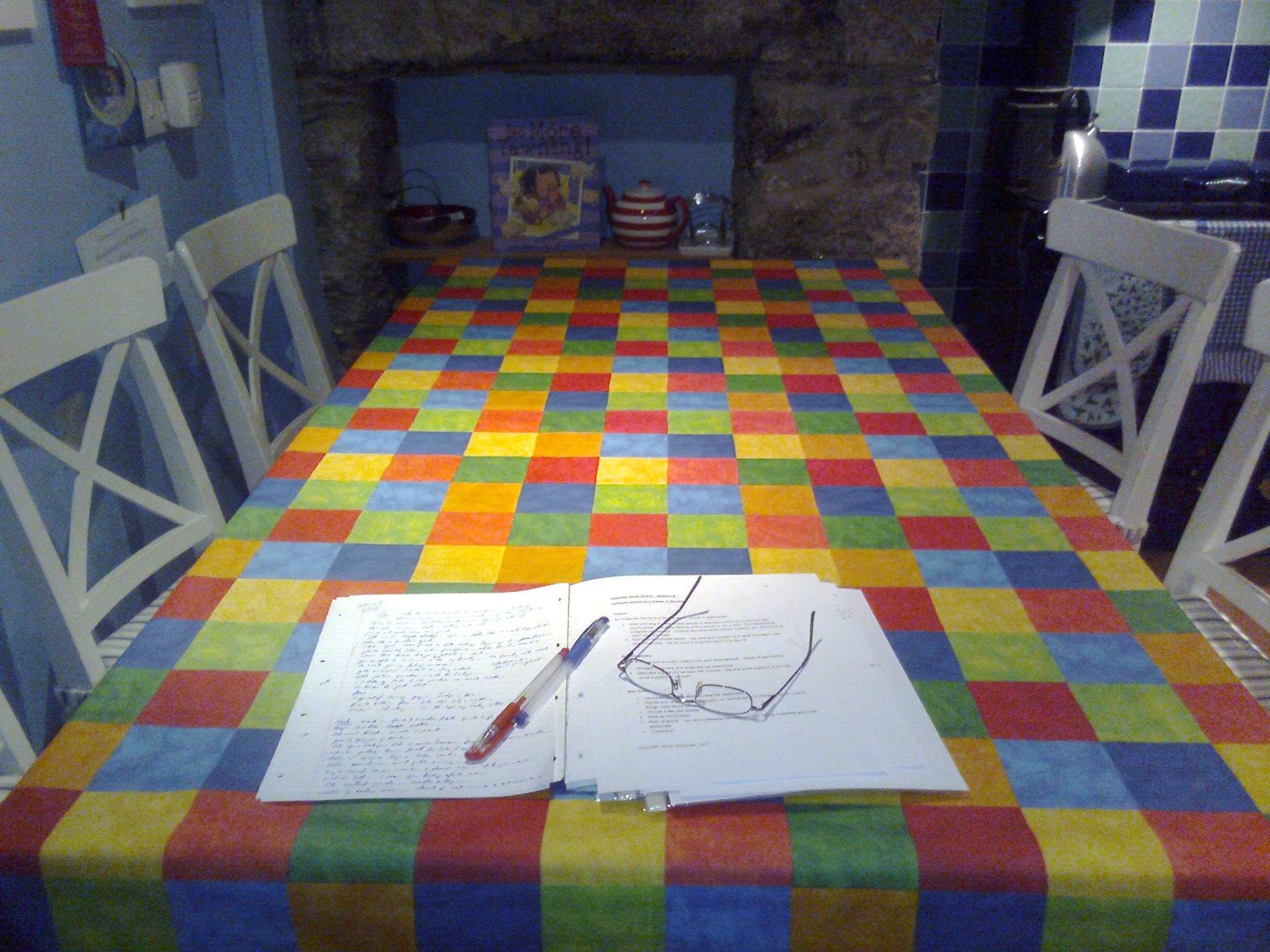
My kitchen table - ready for a writing group

Writing courses are springing up all over the country, from major universities to my kitchen table; online writers’ resources are increasing daily, and in National Novel Writing Month alone participants have already produced a staggering  2,755,787,833 words this year, and counting  http://nanowrimo.org/

You would think the main reason why so many people are interested in writing is because they’d like to be published, perhaps with a view to changing career, or to making a fortune out of a single best-selling book and going to live in the Seychelles. This is certainly true for some.

But I think for a lot of people who want to write, being published is not the main driver. It’s something more primitive and profound. People come to writing because they want to discover and tell their stories, not necessarily to the world, but to each other, like tribal elders gathered under a tree, or children making up games in the playground.

I think there’s a yearning also, in such a material world, to connect with deeper layers of the self, and explore the mysteries of the inner world.

What creative activities of every kind offer is an experience of total absorption and flow, and an opportunity for spiritual experience and community in a very secular world.

I’d love to hear your views, if you’re a teacher or participant in creative writing courses.

Book Review

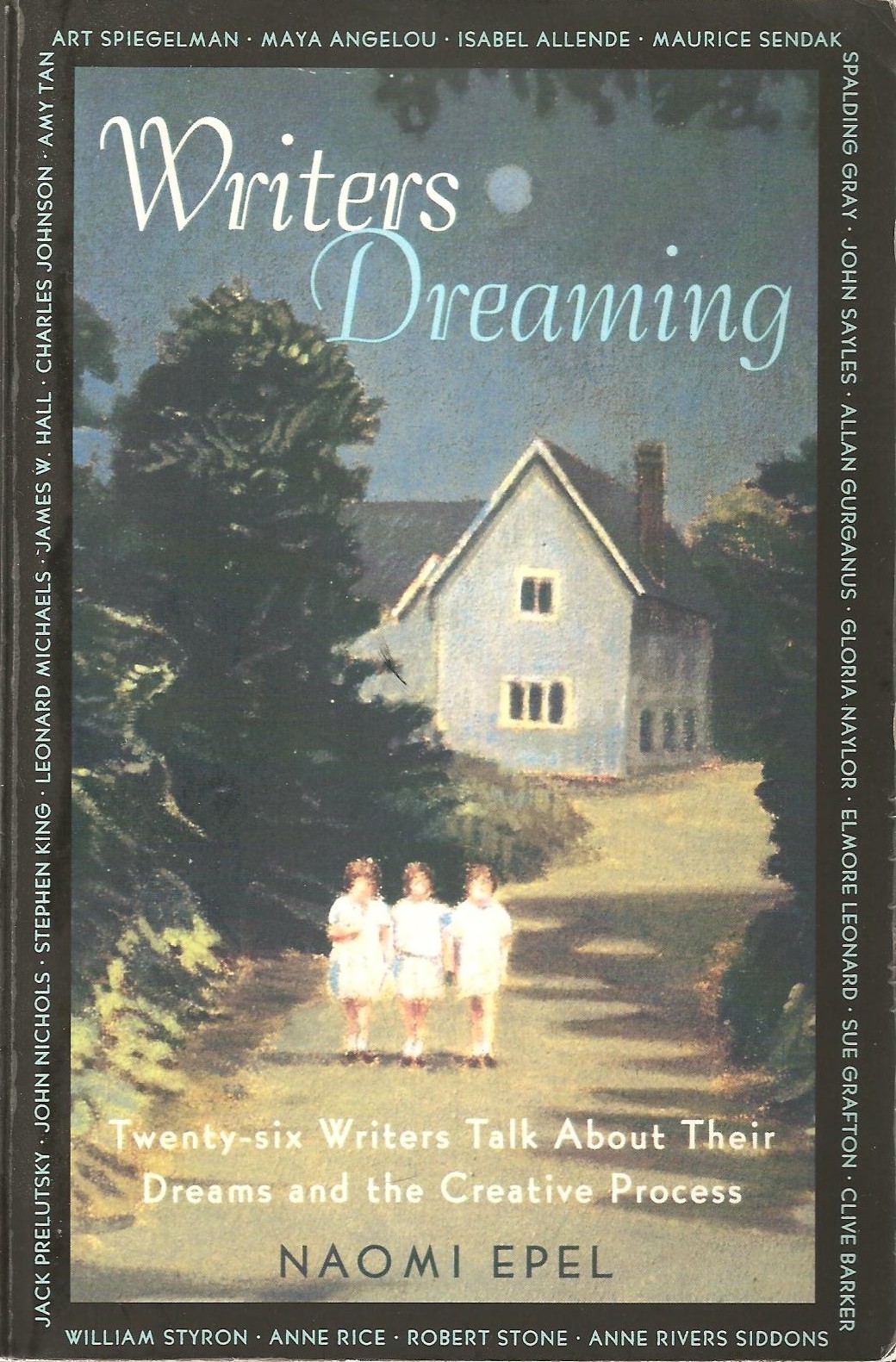
Writers Dreaming, by Naomi Epel

The Vintage paperback cover

You won’t be surprised to hear that I love this book. It consists of twenty-six interviews with high-profile authors, sharing their thoughts about dreams and the creative process.

Probably my favourite is Sue Grafton, because she talks about the edgy nature of dreams and creative work, the ‘sense of jeopardy’ that comes with handing yourself over completely to the inner world of imagination. She describes the feeling of something mystical powering the writing process. She does not believe that all dreams have psychological meaning.

I love the way Stephen King compares his writing process with dreaming. He talks about his preparations for writing being like a bedtime ritual; of entering the writing being like falling asleep to the world, and finishing like emerging from the dream state in the morning.

Maya Angelou talks about the small mind and the large mind, which is very much my experience of dreaming and writing. They both take you into worlds without limits, and add a new dimension to waking life that makes it feel feel much bigger.

There are so many fascinating insights in this book, and it’s one you can dip in and out of if you’re busy, although I have to say I was so gripped I read it over one sunny day in London, on trains and park benches and in cafes.

A five-star read for writers and dreamers.

Guest spot: A poet dreaming

Metamorphosis – By Susan Richardson

Some years ago, I was working on my first poetry collection, Creatures of the Intertidal Zone. The book’s main section, inspired by my journey through Iceland, Greenland and Newfoundland in the footsteps of an intrepid eleventh century female Viking, was complete, but I didn’t yet have a clear vision for the final part of the manuscript.

Until, over a period of several weeks, prompted perhaps by my reading numerous narratives of Polar exploration to both the Arctic and Antarctic, I had a sequence of dreams featuring that most iconic of polar creatures, the penguin. In one dream, I received a penguin delivery – he was shoved and squeezed through my letterbox until he landed with a slap on the tiled hall floor. In another, I was trying to hoist a poorly penguin into a cardboard box so that I could take him to the vet, while in the most surreal dream of all, I was metamorphosing, flipper by flipper, feather by feather, into a penguin myself.

I’d never written poems from dreams before, but the penguins were impossible to ignore. As I wrote, I pondered on all the images of penguins that exist in popular culture, as well as our persistent commodification and Disneyfication of animals, a theme that seemed to fit well with the environmental strands I’d introduced in the main section of the collection. Gradually, over the next six months, my dream penguins swam and waddled their way into a series of poems that enabled the final part of my manuscript to fall into place.

Creatures of the Intertidal Zone was published by Cinnamon Press in 2007. I was delighted by Helena Nelson’s mini-review of the collection in Mslexia and the fact that she singled the penguins out for a special mention – ‘Susan Richardson’s Creatures of the Intertidal Zone offers a marvellously different blend of passion, pathos, poetry – and penguins.’ I have continued to allow my dreams to feed my poetry ever since.

METAMORPHOSIS

To begin with, nothing drastic.
the odd cold bath, air con on max,
the utter absence of shivers.

Then, the skin tingles, each pore forcing
the shaft of a feather forth, like a lid
with a push-through straw.

I go right off garlic, crisps, samosas,
bright red curtains, Gauguin prints.
If I must stay indoors, I want plain
white tiles, a single chilled white porcelain sink.

And oh, the fingers. Useless, as if mittened.
And stretched, the tips skimming the floor.
Scissors, chopsticks, forks – all binned.

Breasts blend with belly, waist, hips.
I’m lugging a two-fifty-litre rucksack
in an outsize black wetsuit and wellies.
My tears taste of fish.

Fresh fears keep me from sleeping.
The fleck throats of bull seals.
Ice melt. Oil slicks.

I make a nest from the last
strands in my hairbrush and what I once
knew as pencils, and string.

Soon I must push
this hard new truth between my legs
and hatch it.

Creatures of the Intertidal Zone is available via Susan’s website www.susanrichardsonwriter.co.uk as is her new collection, Where the Air is Rarefied

Does every writer have a dream book?

An early version was called 'The pink jacket'
An early version of my dream book was called 'The Pink Jacket'

When I came to writing after my last child started school, I experienced a sense of homecoming, as if this was the thing I had been born to do.

My first goal was to be a jobbing writer, someone who could turn their hand to anything, and I found the ideal place to learn that in educational writing, because there the brand was the publisher rather than the author, which meant I was free to try my hand at lots of different kinds of writing, both fiction and non fiction.

The two or three years I spent writing full-time for various educational publishers felt like a brilliant apprenticeship, and I carried the things I had learnt there into the next stage of my writing career, moving back into the high street as a children’s self-help author.

My 8 children’s self-help books were a mix of stories, jokes, quizzes, activities and ideas. They have all received 5-star reviews and enthusiastic reader-feedback. However, I soon learnt that earning your living from non fiction was even harder than from fiction.

So I wrote two children’s fiction series, the 6-book ‘Car-mad Jack’ and my new series, ‘By Peony Pinker.’ I feel very lucky to have had such a long, happy and varied writing career.

But underneath it all, from way back before I was ever published, I’ve always known I wanted to write an adult book about dreams, and for a couple of months in every year, before the latest advance runs out, I have returned to this labour-of-love book, experimenting with it at different times as a novel, workbook, memoir and non-fiction.

This year, I decided to finally put everything else on hold, and actually commit to finishing my dream book. I am experiencing even more of a sense of homecoming than when I first began to write. Not only, ‘Writing is what I was born to do,’ but also, ‘This is the book I was born to write.’

I wonder, does every author have a dream book – the special one they feel they were born to write?

Guest spot: The dream that sparked the book

The dream behind ‘Buttercup Magic’ – by Abi Burlingham

Buttercup magic cover
‘A Mystery for Megan’ – the first book in the ‘Buttercup Magic’ series

I have had vivid dreams for as long as I remember, varying from dreams of flying to the truly horrid stick witch who crept out of the plughole. Some of these have sparked off ideas for stories, but generally speaking I hadn’t used them in my writing and they were quite often forgotten.

That is, until a few months ago, following a fascinating article I read in the Spring Mslexia, ‘Dreamwriting’ by Clare Jay, where Clare describes the process of being conscious in your dreams, controlling them, and using them to help your writing.

Fascinated with this idea, I decided to try being more aware in my next dream. The dream that followed was incredibly vivid. I was in a big old house, or rather, my consciousness was. My dream almost told me what was there. It told me there were mice who could tell the time – I could see these in the dream – and there was a black cat.

When I woke, I had the strongest sense of place. The setting and feelings that accompanied it were so incredibly vivid. Luckily, I keep a notebook and pen by the bed, so I quickly wrote down these ideas.

Shortly after, I started to write the book ‘Buttercup Magic’ – under the working title ‘Buttercup House’, featuring mice who could tell the time (all called Whiskers) and  black cat called Dorothy. But I knew that a dog should be in the book too, so I wrote in Buttercup, a big golden retriever.

‘Buttercup Magic’ is now to become a series, the first of which, ‘An adventure for Megan’, is due out in Spring 2012. Without the dream, and without that very important article, I have no doubt that this book wouldn’t have been written.

www.abiburlingham.talktalk.net

http://www.abiburlingham.talktalk.net/Blog.html