Category Archives: Creativity

Using Freewriting to Take Down Writers Block, by Bryan Cohen

I’m delighted to welcome my guest today, successful self-publisher, creativity coach and actor, Bryan Cohen, who is tapping the unconscious in the House of Dreams.
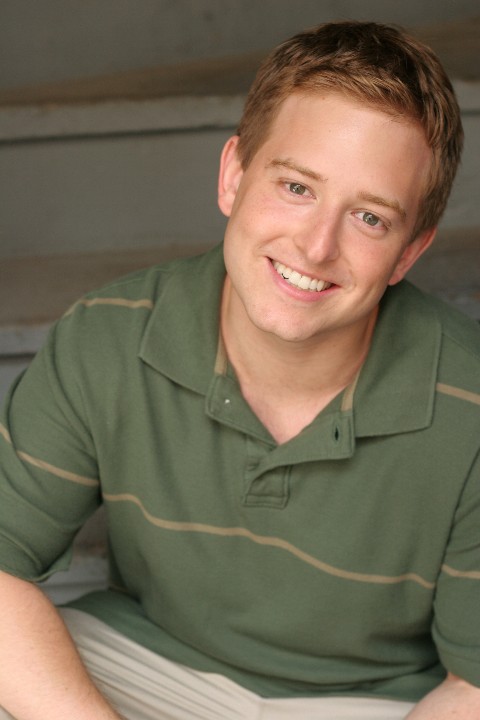
Bryan Cohen
Bryan Cohen

The unconscious mind has ways of making you stop. You have a deadline and only a certain number of hours to write a certain number of words. And yet, despite all that pressure, the cursor or blank page is staring at you with all its emptiness. It’s writer’s block, that all encompassing, vague term describing why you can’t get the thoughts you know are in your head onto the page. Writer’s block can strike, even when you’re in a seemingly perfect writing situation. You can have writer’s block even when you have a comfortable chair, a mahogany writing desk and a closed door to keep out all the distractions. The problem of writer’s block seems to exist in the unconscious mind.

In writing and self-publishing 32 books to Amazon, I’ve found one of the tricks to unearthing this unconscious problem. The trick to stopping your unconscious hurdles to writing is to go into your unconscious to determine how to knock them down.

People use freewriting or stream-of-consciousness writing for all sorts of purposes. Freewriting can be an emotional release or it can be a way to capture your thoughts at a particular moment. This activity can also be used to answer a question. If you’re experiencing writer’s block at a subconscious level, you can use freewriting to ask yourself how to defeat the problem.

Setup your freewriting session by sitting in a quiet place with as few distractions as possible. Turn off your phone and switch off the internet on your laptop. Set a timer for 15 minutes (though you can always write longer if desired). Start with a simple question or a “prompt” if you will. For instance, you can ask something along the lines of, “Why do I have issues writing in the afternoon?” Write the first thing that comes into your mind over and continue to write down the thoughts that naturally follow the first thought. Don’t edit yourself, even to correct spelling errors. Let one thought flow into the other. Even if you get off the topic of writers block, let yourself take the trip to keep yourself in stream-of-consciousness mode. If you find yourself looking at the timer or otherwise not writing, get yourself back in the game as quickly as possible. Don’t stop. Push yourself. Even if what you’re writing doesn’t make any sense, keep going at least until the timer goes off.

Here’s what I find happens in nearly all my free writing sessions that begin with a question. I take at least 3 tangents. I also retread a lot of what I’ve said out loud on that particular subject. But in all of that, I find at least one actionable step I can take to solve the problem. It’s a banner day when I come up with three or four possible solutions, but even one method for solving my issue is good enough. Besides, it’s easier to put just one idea into practice anyway.

When I put one of these steam-of-consciousness-generated solutions into practice, it almost always makes an immediate impact. In my opinion, this proves that most unconscious issues have an unconscious solution lying around in your brain alongside it. You just need to do a little digging.

Try starting a free writing session with a question that’s been nagging at you. It could be about writer’s block, weight loss, your relationships, your bank statement or anything at all. As long as you trust yourself to write without censorship during your session, you’re bound to find at least one solution to your unconscious issue.

Try a session on for size and discuss what you come up with in the comments!

About the Author

Bryan Cohen is an author, a creativity coach and an actor. His new book, 1,000 Creative Writing Prompts, Volume 2: More Ideas for Blogs, Scripts, Stories and More is now available on Amazon in digital and paperback format. His other books include 1,000 Creative Writing Prompts, The Post-College Guide to Happiness, and Ted Saves the World. He has published over 30 books, which have sold more than 20,000 copies in total. Connect with him on his website, Build Creative Writing Ideas, on Facebook or on Twitter

1,000 Creative Writing Prompts Volume 2 Cover

In honor of his new book, Bryan is hosting the “1,000 Prompts, 1,000 Dollars” Writing Contest on his website. Click the link to find out how to enter!  Click the next link to check out the rest of Cohen’s blog tour!


What’s the point in self-publishing?

Someone in the book business recently asked me ‘What’s the point in self-publishing a book, when it won’t get any promotion without a major publisher behind it?’ For me, as a much-published author, this is the point… 

I’ve had scores of books published and worked with a dozen different publishers in the course of my writing career but I’m currently in the throes of self-publishing ‘Writing in the House of Dreams.’

Earlier in the year, my agent sent the MS out to publishers, and their feed-back was overwhelmingly positive. ‘An inspirational idea’ said one; ‘a rich feast that sets off all sorts of sparks and recognitions in the reader’ said another; ‘very readable indeed’ said a third, ‘I read it in one sitting.’

So here are the reasons they didn’t take it on (although it went to an acquisitions meeting with one publisher and another said, ‘It was close.’)

‘Too niche’, ‘Too tough for us to sell enough copies’, ‘with such a niche topic we’d struggle to get a good number of copies into shops’, ‘the sales would be too modest’,’a company the size of ours can’t make enough of a go of books on this subject as they would need to.’

One of the big changes I’ve seen since I started in this business is that where previously the decision to take on a book lay with editors, who were generally driven by a passion for reading and discovering interesting writers, now it rests firmly with marketing departments.

I first came to this realisation a few years ago when I proposed an idea for a children’s series to an editor I’d worked with, and she was blown away by it. Bursting with enthusiasm, she asked for six story outlines, then for twelve, to take to the acquisitions meeting, but the series was not taken up because she couldn’t persuade the marketing department. When she told me how disappointed she felt I realised how tough this situation might be for editors as well as authors.

The thing to bear in mind is that marketing people will not usually have read your manuscript, so your book succeeds or fails on how well they think the concept and title will sell. A yes or no doesn’t necessarily reflect the quality of your writing, but just how easily it will fit into the market.

I know ‘Writing in the House of Dreams’ is a bit off-the-wall and ‘in many ways a brave book’ as one publisher rather unnervingly remarked, but I also feel that it’s good. I’ve worked for a reading agency and have a lot of writing experience now, and my own judgement has been backed up by the half-dozen authors, psychologists and dream-workers who have read it.

I’ve been working on it alongside my children’s books ever since I was first published; it’s my child-of-the-heart book, the secret pearl I’ve been feeding with all the writing skills and experience I’ve worked so hard to build up.

I know my book won’t appeal to millions of readers but hopefully it will appeal to some. Five years ago, no-one would ever have got to read it if no major publisher had taken it on and the MS would have stayed on my shelf forever, gathering dust. It would have felt devastating.

It’s better to have some readers than no readers at all – that is the point of self-publishing. It’s also better to carry on show-casing your work to publishers who may happen upon it on the web, rather than putting it away for several years before sending it out again.

Now that authors can be publishers too we can write our passion in the reassuring knowledge that our work may still bloom surprisingly at the edge of a difficult market like a  little poppy at the edge of a big field of corn.

615px-Poppies_by_field_gate_-_geograph.org.uk_-_846634[1]

If you’re interested in self-publishing, Nicola Morgan (who was one of my lovely readers) is doing a series of interviews with authors who have gone down that road on her blog – well worth a look 

It’s about love

Stephen Fry kept saying in his recent TV programmes Out There ‘It’s about love.’ Today’s post is about love rather than my normal themes of dreams or writing, but I felt I had to write it. You’ll see why.

Last week-end I went to the civil ceremony of two dear friends. The venue was wonderful; the celebrations went on all day and deep into the night.

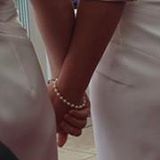
999513_10151664615150925_1993257362_a

Watching these two beautiful brides make their promises to each other, I felt proud and grateful to live in a country where marriage is now an option for everyone.

Although some people argue against gay marriage on religious grounds, I’m personally pretty sure God enjoyed the occasion as much as me. I mean, as God is love it stands to reason that every expression and celebration of love is naturally attuned to the divine vibration.

Some people worry that gay marriage undermines our social values. Any change can spark a reaction of fear, which can turn into aggression, but this change is something we should not fear. Love is good news for society. It’s easier for people who love and feel loved to be generous and kind in their behaviour towards others.

All of us who believe in love, whether we’re gay or straight,  need to speak up for gay rights because, as Stephen Fry warned in his piece about Russia, progress can be reversed.

In Russia, recent anti-gay legislation has lead to a huge increase in homophobic violence, and now they’re debating whether the children of gay couples should be taken away on grounds that growing up in an orphanage would be better.

Progress is a fragile thing. It needs careful nurturing in the early days. That’s why I wanted to write this piece today, and add my small voice of support.

Did you see Stephen Fry’s TV programme? What did you think?

Dreams and the creation of music, by Travis Wernet

Today, I’m delighted to welcome my first musician in the House of Dreams. Travis Wernet is a professional dream teacher with three studio albums under his own name and musical moniker ‘Outlaw Dervish.’

Simone Weil called attention prayer. I think she was onto something. When we listen to music we are paying a special consideration to sound. Over recent years I’ve become increasingly observant of how, when I am dreaming, I seem to be engaged in an attentively mindful space of awareness. As a musician, there are even ways that I see how I’ve got to give attentiveness to the instruments I am playing. This serves the evocation of sounds that feel the most fulfilling as they emerge, seemingly out of the invisible ethers surrounding the instruments in the space where I am creating. How similar this seems to my experience of the way dreams appear!

In my experience, dreams can influence the creation of music, they can feature and contain music and, as it turns out, music also influences the creation of dreams.

While recording the didjeridu tracks for my meditation album, Yoro Yoro,  dreams synergized with the work we did in the studio one day. As we gathered tonalities for various songs, I remembered a dream from the previous night.

In the dream I am in the company of three aboriginal people… The first, a tribal elder, invites me to spear fish with him. Next, I see a woman and a man who are sitting in the ocean meditating. I notice all this and then the scene becomes somehow ethereal. I drift up into space and see the earth, which shape-shifts into what I know are the call letters for a radio station “K Be Radio”. Upon witnessing this I float back down to earth and witness a peaceful scene near the sunny seaside where softly blowing sands mix with waving grasses in the wind.

At the time we were recording, the energy of this dream supported a fluid ability to get what are called “one-takes” for the songs we were crafting. This simply means that in the studio, the first effort to add the didjeridu tracks turned out to be the most satisfying to our ears, minds and hearts. The tone of our collaboration in this sense felt effortless and energizing. Exactly what we wanted for the meditation album! The ambience of connection with the meditators and the vision of the globe, as well as the hint at an aura of pure being, with the “it’s okay to be” radio station, all added a felt dimension to our project.

Beyond this, I can see over recent years how that dream was helping to set the stage for current creative endeavors. I’ve become very fascinated with and involved in musical dream incubation. This is the use of certain kinds of sounds and music to invite and receive helpful, healing dreams. Alas, that’s a story for another time.

Receiving and imagining the dream of “the Three Aboriginals and K Be Radio” has also afforded me the message of a deep spiritual experience which set me on a path of renewed authenticity wherein I have sought to tune myself to the frequencies of who I am at an essential level. In addition the dream has inspired me to share its messages with others, through music and my work with dreams.

Travis Wernet
Travis Wernet

Following years of international travel, co-leading ceremonies from the Great Pyramid in Egypt to the Lotus Temple in New Delhi, Travis shares his work at home in the US and offers online video dream groups, workshops and private sessions. To find out more about his work, check out his blog and website

The healing power of creative writing

Writing can be therapeutic even when it appears to have nothing at all to do with the events of our lives. Here’s how.  

In my last post I was talking about the healing power of dreams to ground us physically and emotionally when we get over-stressed and too much ‘in our head.’ Since then, I’ve been to a Lapidus workshop in Bristol which has made me want to share my thoughts on the healing power of creative writing.

Lapidus - 'words for well-being'
Lapidus – ‘words for well-being’

Lapidus is an organisation for writing therapists; it includes mental health practitioners who use creative writing within their clinical practice and authors who teach writing in non-clinical settings as a route to greater understanding of the self and the world.

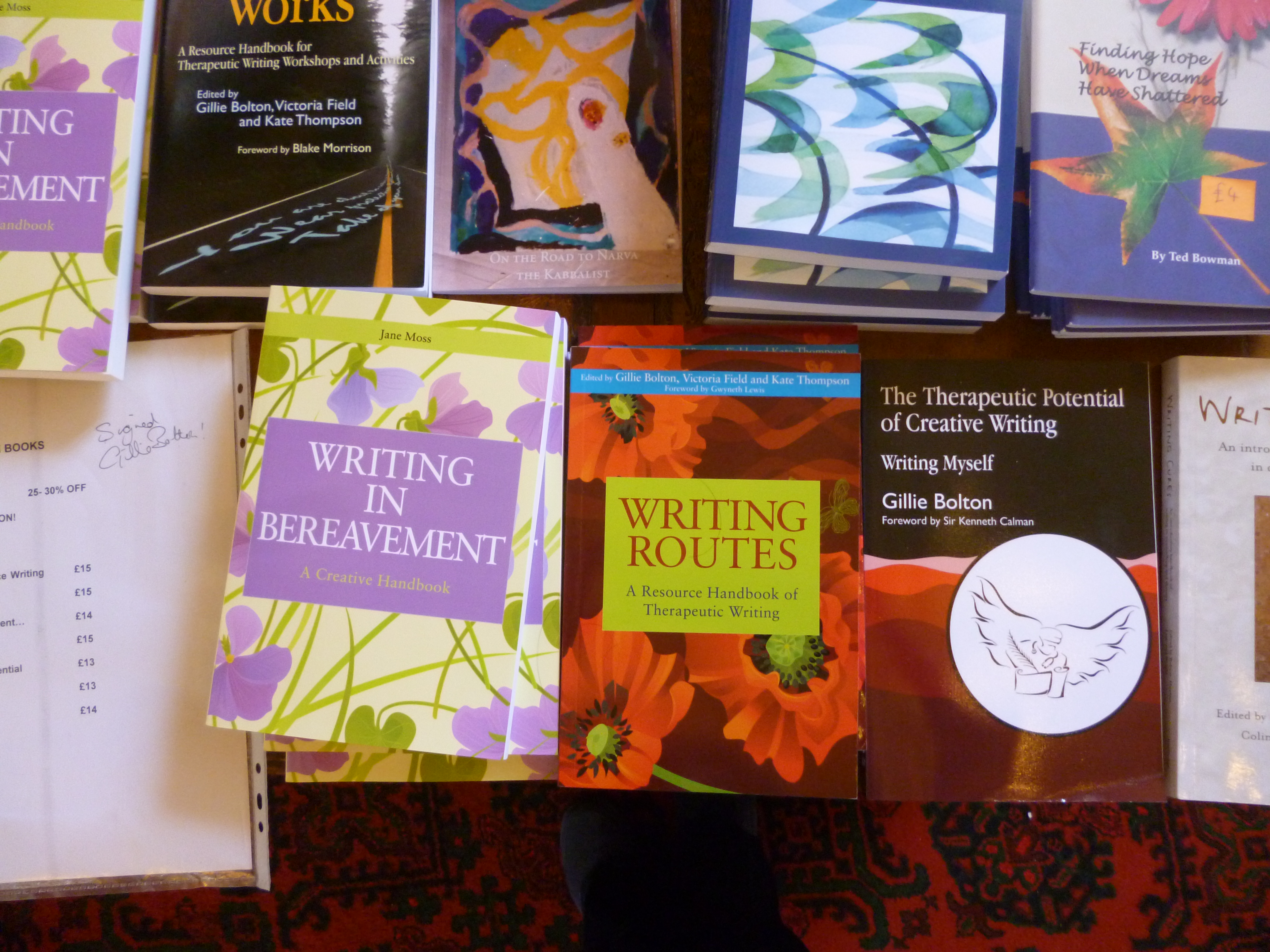
Some of the wonderful books on offer at the Lapidus conference

Most of the Lapidus workshops I’ve attended have involved writing about our real-life personal experiences, and they have felt rather like counselling sessions, where the theoretical base seems to be about moving towards catharsis or reframing difficult life events or relationships.

One of the great tools of writing therapy is ‘journaling.’ This is a regular practice of personal writing reflecting on personal insights, day-to-day experiences, dreams and inspirations; it’s pretty much what my dream-diaries have evolved into over the years and I can highly recommend it.

But creative writing doesn’t have to be autobiographical in order to be therapeutic. Every poem or piece of fiction we write connects us to our authentic emotions, like the sad dream I was talking about in my last post; it takes us beyond the narrow limits of what we are capable of understanding about ourselves and releases us into the wide, fast flow of emotional and imaginal experiences that make us who we are.

Do you keep a writing journal? Or have you experienced the healing power of writing in other ways? I love to hear about your thoughts and experiences

What children’s authors get up to on retreat

I didn’t post last week because I was on retreat at Charney Manor in deepest Oxfordshire with the Scattered Authors Society.

Pimms o'clock in the Charney garden
Pimms o’clock in the Charney garden

As retreats go, this annual adventure is a very lively one – among this year’s sessions we had comedy improv, yoga, e-publishing, drawing, developing the work-in-progress, searching for the iron-age fort and the traditional Charney Quiz.

It's got to be around here somewhere!
It’s got to be around here somewhere!
Quiz night - my team was The Naughty Corner (we lost by less than usual)
Quiz night – my team was The Naughty Corner (we lost by less than usual)

One of my offerings was an afternoon workshop on writing the tarot. Tarot is useful, like dreams, because the cards you draw will be synchronistically connected with your current emotions and preoccupations, so the themes and characters they suggest will feel relevant and immediate to explore in your writing.

However, in an introductory workshop it can be easier if everyone’s working on the same image, so I like to start at the beginning with number 0, The Fool. Katherine Roberts has described the session on her lovely blog, Riding the Unicorn, if you’d like to find out more.

I’ll be offering a one-day workshop in Cornwall on writing the tarot in the autumn. In the meantime, check out the workshops page on this blog if you think you might fancy some dreaming-and-writing in Surrey this October, and please spread the word if you know anyone else who might be interested.

Cheers!

My session, with Celia Rees, on steering a happy course in a difficult market

Our stories, our selves

My work is emotionally autobiographical. It has no relationship to the actual events of my life, but it reflects the emotional currents of my life ~Tennessee Williams

This quotation from Tenessee Williams seems to me to encapsulate where dreams and creative writing are the same.

Being literal-minded, if we try to relate the writing to the author we only do it in a direct way, wondering whether the people in the story are based on real people or the events are things the author has actually experienced.

We do the same with dreams, especially if we focus only on the symbols and not the emotions.

But even where we don’t find any obvious connection between the story and the author, the dream and the dreamer, it is powerfully there because dreams, like fiction, are simply story-versions of the dreamer’s or author’s emotional experiences.

Have you ever written a story that seemed to have nothing to do with your own life, only to realise later that it was ’emotionally autobiographical’?

This is one super sweet blog – it’s official!

Big thanks today to Wyndy Dee for nominating Writing in the House of Dreams for the Super Sweet Blogging Award. How gorgeous! More about Wyndy here http://wyndydee.wordpress.com/about/

The rules: Thank (and link) the person who Awarded it to you (see above!) Nominate 12 people and ask them these simple questions…here they are, with my answers.

  1. Cookies or Cake? Whichever is the most chocolatey (obviously!)
  2. Chocolate or Vanilla? A marriage made in heaven – both at once is best
  3. Favorite Sweet Treat? Rhubarb crumble and Cornish clotted cream
  4. When do you crave sweet things the most? At emotional extremes – when I feel either on top of the world or down in the dumps
  5. Sweet Nick Name? I wish I had one. Today in the Rocky Valley tearooms near Tintagel, the waitress kept calling me honey, and I thought that was nice

Now then, my own nominees for the Super Sweet Award…

This time, I’m going for family and children’s-writer friends – I wish they could all come for cake in the House of Dreams!

Rosie Alexander ‘Adviser on the Edge’ – my daughter, blogging about life and work from her home in Orkney

Friends and fellow children’s authors :

Katherine Roberts ‘Reclusive Muse’

Katherine Langrish ‘Seven Miles of Steel Thistles’

Susan Price ‘A Nennius Blog’ (you can find me ‘in conversation’ over there, and we’re about to take up again where we left off soon)

Abi Burlingham ‘Musings and Mutterings’

Amy Butler Greenfield ‘Alchemy Pie’

Lucy Coats ‘Scribble City Central’

Mary Hoffman ‘The Book Maven’ (very informative blog about the book world)

Saviour Pirotta ‘Pirottablog’

Joe Friedman ‘The Talking Therapist’ (new blog by Joe wearing his other hat, as a psychotherapist)

And finally, the most fabilicious group blog, Girls Heart Books where I’m on the team, blogging on the 18th of every month. Here’s my latest post, ‘School – do you love it or hate it?’

Now then, milk and sugar?

Authentically creative, by Carolyn Hughes

Carolyn Hughes is a writer with an interest in addiction and mental health issues. Her popular blog is The Hurt Healer and she has a lively and rapidly growing following on facebook and twitter

Carolyn Hughes
Carolyn Hughes

I must also have a dark side if I am to be whole ~ Jung

Like many writers I want my work to be recognisable by its unique and individual style.  For me, it’s crucial that what and how I write reflects my authentic self.  Anyone who has read my blog The Hurt Healer will be familiar with the fact that I share from the heart. It’s a deliberate approach to enable readers to relate to and hopefully be encouraged by my words.  Authenticity means being genuine and real.  Much as I would love to reveal only my good side, to be true to my work I have to disclose my whole self.

It is no coincidence that I am only now finding my writing voice as it has taken a long time to find myself.  Years of battling with depression and alcoholism meant that I had very little idea of who I was. How I presented to the outside world was very different to how I felt inside. It was only through having the courage to challenge my past at every level that I was able to start the journey to healing and so begin to find personal identity and my authentic self.

My aim though isn’t just to be authentic, but to be authentically creative.  And the key to writing both authentically and creatively lies with the unconscious.  For me the unconscious is a limitless place in my mind where my spirit and soul meet. It is a place where I can visit those painful issues that used to torment me. But instead of being overwhelmed I can now bring them into my conscious, safe from their power to harm me.  So as I communicate from my unconscious, so I hope to reach the unconscious of others and in doing so share a collective moment of authenticity.

The interpretation of dreams is the royal road to a knowledge of the unconscious activities of the mind ~ Freud

Recently I’ve been looking at how I can reach further into the depths of my unconscious and take my writing to a new level of creativity.  I’ve started to look at the constituents of my dreams. This is a wonderful way to tap into those hidden thoughts and images that make up the psyche, as well as exposing my inner truth.

Examining my dreams however has only been possible from a position of emotional recovery and psychological stability. In those dark days of depression and alcoholism my night-time experiences were fraught with darkness and fear. The erratic and terrifying nightmares that emerged reflected my complete inability at the time to manage my physical and mental anguish.

Jung once remarked that nothing was ever lost in the psyche.  That is an horrendous thought for anyone who has tried to block out the past in the hope that the pain would stop. The idea that all thoughts, memories and emotions never disappear but remain forever can be frightening. Yet I found that there was indeed a freedom to be found in allowing the unconscious to simply ‘ be’. I stopped fighting the emergence of the dark side and celebrated the arrival of the good side. By no longer fearing my thoughts and dreams I was free to live authentically and to write openly too.

Il ne faut jamais regarder quelqu’un qui dort. C’est comme si on ouvrait une lettre qui ne vous est pas addressee ~ Sacha Guitry

I couldn’t mention dreams without including one of my favourite quotes. A general translation of this is; “You should never look at someone who is sleeping. It is like opening a letter that isn’t addressed to you.”

It is a quote I came across many years ago at a time when I was experiencing my first love.  After one of those deep conversations that you have in such relationships I remember feeling that he hadn’t been entirely truthful.  As I watched him sleeping I remembered the quote and realised that I had been right to doubt him.  His real emotions were disclosed on his face as he slept.  So dreams aren’t just for the benefit of the dreamer!

Dreams are often most profound when they seem the most crazy ~ Freud

Being new to noting my dreams, I must admit that at first they did appear to be made up of bizarre representations that made little sense and made no contribution to my creativity. But as I made more of a conscious effort to remember them and to focus on not just what they were about but how I felt, they became significant.  

Very often it’s in that winding down time between waking and sleeping that a word, phrase, image that comes into my mind and gives the essence to a piece of writing. Other times it’s a complete dream that a memory from the past, an issue of the present or an aspiration for the future.  

Sometimes this works better than others depending on the obscurity or relevance of my dreams. Yet the importance lies in allowing that writing to happen regardless of whether it makes sense at the time. So although I may have rearranged the words to make them flow, I haven’t messed with the essence of what my soul may have whispered to me.

I may never reach the purest form of authenticity or be famed for my creativity, but I will continue to write from the heart with my unconscious and dreams as my guides.

 How do you write authentically and creatively? 


My top five rules for writers

It’s eighteen years since my first few books were published and I’ve had a very varied and productive writing career ever since. I’ve also got to know lots of other authors, at various stages in their careers; I’ve been on many workshops and read many books about the art and craft of writing.

Books, poems, magazine articles... my varied writing life
Books, poems, magazine articles… my varied writing life

Although I’ve experienced occasional bouts of frustration, stress and despondency over the years in relation to the business side of things, I’ve always felt happy and confident in my writing, and I think that’s largely down to finding and following my five golden rules:

Focus on the big picture

The real work-in-progress is yourself as a writer – every word, draft and manuscript you produce contributes to that. Therefore even if a piece of work is turned down by publishers or agents, that doesn’t mean it’s been a waste of time, because it’s added to the sum of your writing experience. (In fact, rejected MSS will often go on to have their day – they’re eminently recyclable)

Don’t push the river

Creative work has its own rhythm, requiring fallow time as well as pondering, planning, drafting and redrafting. If you try to write a book before it’s ready, you’ll come up against blocks and difficulties; if you learn to be patient, and allow the ideas to fully form up in your mind before you begin, the writing will flow.

Go with the flow
Go with the flow

Don’t expect to please everyone

We’re all different, so we all enjoy different themes and voices in our reading, and that includes publishers and agents. If you get rejections, take notice of constructive criticism but don’t take it personally. Ditto if you get bad reviews.

Understand your soul’s needs

Some people want to write because they have a burning desire to tell their own personal story, or to achieve celebrity, or to become a public speaker. Some people hope to earn a lot of money. Others may simply want to be able to create objects that please them. Identifying what you want from being a writer will help you to create achievable goals and lasting satisfaction. I’ve written about this on the blog, in What kind of writer do you want to be?

Life-coaching techniques could help you to identify your writing goals

Be grateful

As soon as you start to write, whether you are published or not, you begin to see life through a writer’s eyes. You notice everything. Snippets of overheard conversations; the story in a stranger’s face; the movement of light in leaves. You uncover the unconscious narrative streams that flow in your own psyche, and so magnify your experience of everyday life.

The story in a stranger's face
The story in a stranger’s face

These are the rules which have underpinned the whole of my writing life. What are your writing rules?