Dreams and the creation of music, by Travis Wernet

Today, I’m delighted to welcome my first musician in the House of Dreams. Travis Wernet is a professional dream teacher with three studio albums under his own name and musical moniker ‘Outlaw Dervish.’

Simone Weil called attention prayer. I think she was onto something. When we listen to music we are paying a special consideration to sound. Over recent years I’ve become increasingly observant of how, when I am dreaming, I seem to be engaged in an attentively mindful space of awareness. As a musician, there are even ways that I see how I’ve got to give attentiveness to the instruments I am playing. This serves the evocation of sounds that feel the most fulfilling as they emerge, seemingly out of the invisible ethers surrounding the instruments in the space where I am creating. How similar this seems to my experience of the way dreams appear!

In my experience, dreams can influence the creation of music, they can feature and contain music and, as it turns out, music also influences the creation of dreams.

While recording the didjeridu tracks for my meditation album, Yoro Yoro,  dreams synergized with the work we did in the studio one day. As we gathered tonalities for various songs, I remembered a dream from the previous night.

In the dream I am in the company of three aboriginal people… The first, a tribal elder, invites me to spear fish with him. Next, I see a woman and a man who are sitting in the ocean meditating. I notice all this and then the scene becomes somehow ethereal. I drift up into space and see the earth, which shape-shifts into what I know are the call letters for a radio station “K Be Radio”. Upon witnessing this I float back down to earth and witness a peaceful scene near the sunny seaside where softly blowing sands mix with waving grasses in the wind.

At the time we were recording, the energy of this dream supported a fluid ability to get what are called “one-takes” for the songs we were crafting. This simply means that in the studio, the first effort to add the didjeridu tracks turned out to be the most satisfying to our ears, minds and hearts. The tone of our collaboration in this sense felt effortless and energizing. Exactly what we wanted for the meditation album! The ambience of connection with the meditators and the vision of the globe, as well as the hint at an aura of pure being, with the “it’s okay to be” radio station, all added a felt dimension to our project.

Beyond this, I can see over recent years how that dream was helping to set the stage for current creative endeavors. I’ve become very fascinated with and involved in musical dream incubation. This is the use of certain kinds of sounds and music to invite and receive helpful, healing dreams. Alas, that’s a story for another time.

Receiving and imagining the dream of “the Three Aboriginals and K Be Radio” has also afforded me the message of a deep spiritual experience which set me on a path of renewed authenticity wherein I have sought to tune myself to the frequencies of who I am at an essential level. In addition the dream has inspired me to share its messages with others, through music and my work with dreams.

Travis Wernet
Travis Wernet

Following years of international travel, co-leading ceremonies from the Great Pyramid in Egypt to the Lotus Temple in New Delhi, Travis shares his work at home in the US and offers online video dream groups, workshops and private sessions. To find out more about his work, check out his blog and website

The healing power of creative writing

Writing can be therapeutic even when it appears to have nothing at all to do with the events of our lives. Here’s how.  

In my last post I was talking about the healing power of dreams to ground us physically and emotionally when we get over-stressed and too much ‘in our head.’ Since then, I’ve been to a Lapidus workshop in Bristol which has made me want to share my thoughts on the healing power of creative writing.

Lapidus - 'words for well-being'
Lapidus – ‘words for well-being’

Lapidus is an organisation for writing therapists; it includes mental health practitioners who use creative writing within their clinical practice and authors who teach writing in non-clinical settings as a route to greater understanding of the self and the world.

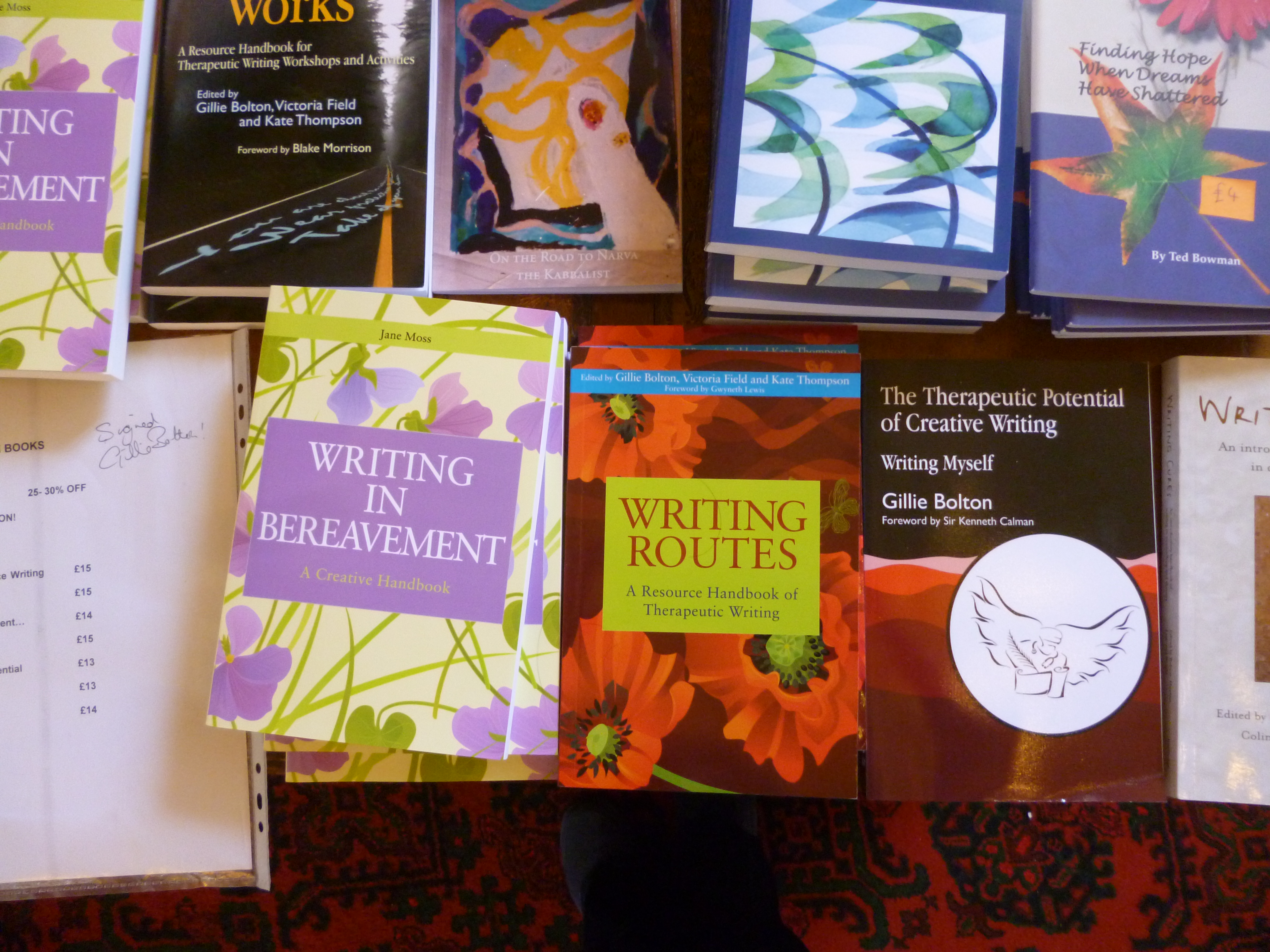
Some of the wonderful books on offer at the Lapidus conference

Most of the Lapidus workshops I’ve attended have involved writing about our real-life personal experiences, and they have felt rather like counselling sessions, where the theoretical base seems to be about moving towards catharsis or reframing difficult life events or relationships.

One of the great tools of writing therapy is ‘journaling.’ This is a regular practice of personal writing reflecting on personal insights, day-to-day experiences, dreams and inspirations; it’s pretty much what my dream-diaries have evolved into over the years and I can highly recommend it.

But creative writing doesn’t have to be autobiographical in order to be therapeutic. Every poem or piece of fiction we write connects us to our authentic emotions, like the sad dream I was talking about in my last post; it takes us beyond the narrow limits of what we are capable of understanding about ourselves and releases us into the wide, fast flow of emotional and imaginal experiences that make us who we are.

Do you keep a writing journal? Or have you experienced the healing power of writing in other ways? I love to hear about your thoughts and experiences

How can a really sad dream be a really good thing?

A sad dream can make you feel out of sorts all through the following day, but it may be Nature’s way of helping you to cope with stress. Here’s how it worked for me.

As I mentioned in my last post back in July, I decided to take the whole of August off, and headed North for four glorious weeks living mostly under canvas. All that fresh air and freedom… when the time came, I did not want to come back.

Paddling across to Oransay from Colonsay at low tide with Barbara Gay from New Zealand. Fun!

I had been redrafting 24:7 right up until the day before I went on holiday, so I arrived home to a messy house and a garden full of weeds, as well as a stack of paperwork in my study that I had been putting off for months.

Top of my to-do list was my tax return. Enough said. Two days of hair-tearing and tedium.

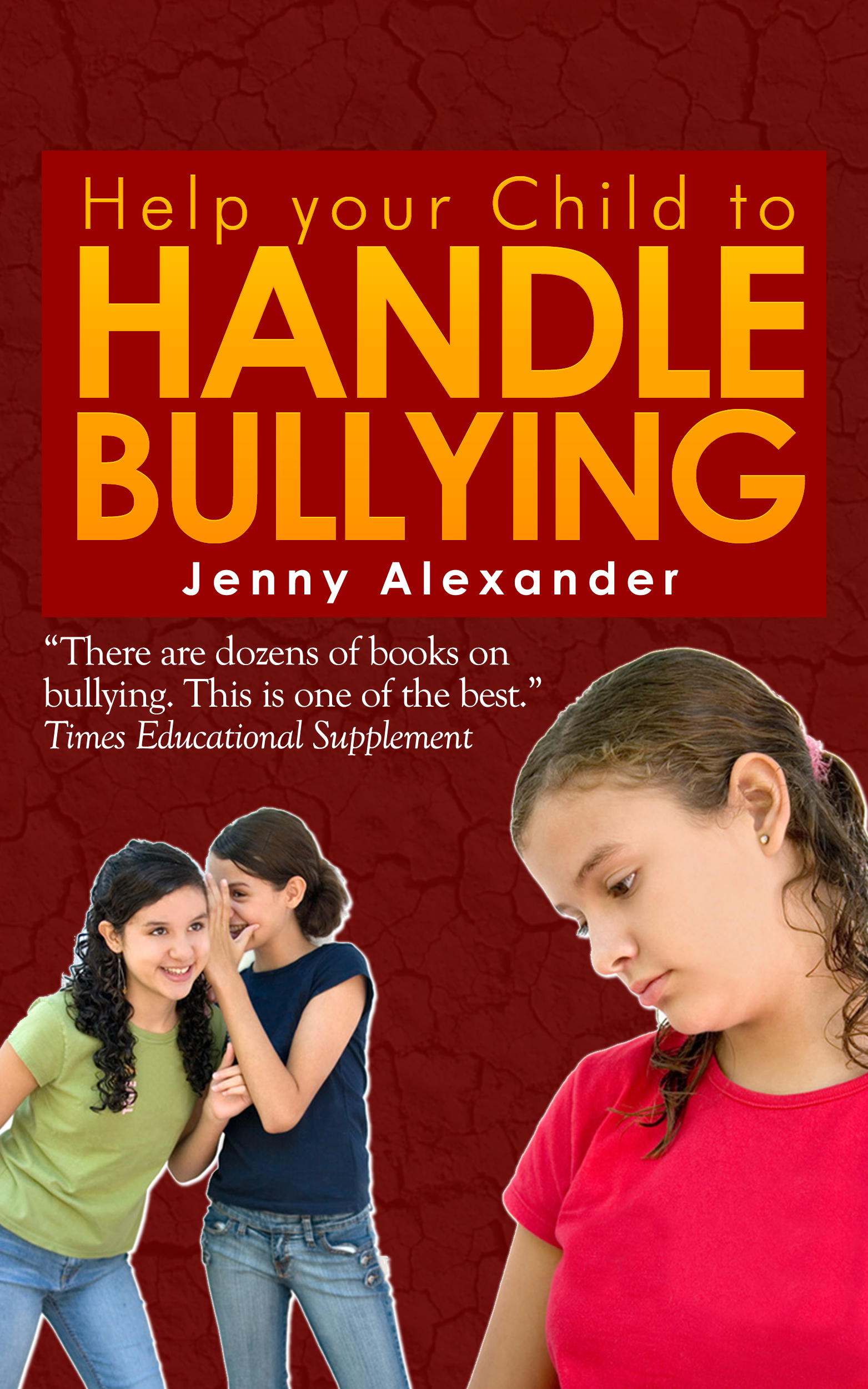
Second was my self-publishing venture, a new e-book edition of Help your child to handle bullying, which I had abandoned back in June. Everything about it made me feel anxious, and there were endless technical problems with the formatting that had to be ironed out (thank-you draft2digital – you were very patient)

Even deciding which endorsement to use on the cover was stressful

Frazzled and still fed up about not being still on holiday, I moved on to seeking copyright permissions for the forty or so quotes I want to use in my child-of-the-heart book, ‘Writing in the House of Dreams.’ This entailed days and days of tracking down publishers and agents, writing emails and filling in lengthy forms.

More stress. Would I be able to trace all the copyright holders? Would they grant permission? Would they demand a fee I couldn’t afford?

And what was the best way of producing the book and bringing it to market? Alongside seeking permissions I began doing research, which turned up a bewildering array of possibilities. I opened discussions, asked questions, discovered even more possibilities. More stress.

All the time, I was aware of the other things on the list, including coming back to my blog. I decided to quit the team on girlsheartbooks, where I’d been blogging once a month, and thought about taking this one down.

There were lots of lovely things on the calendar, as usual, those first weeks home from my holiday, but I was still cross about being back at work and stressed out by all the things I had to get through on my list.

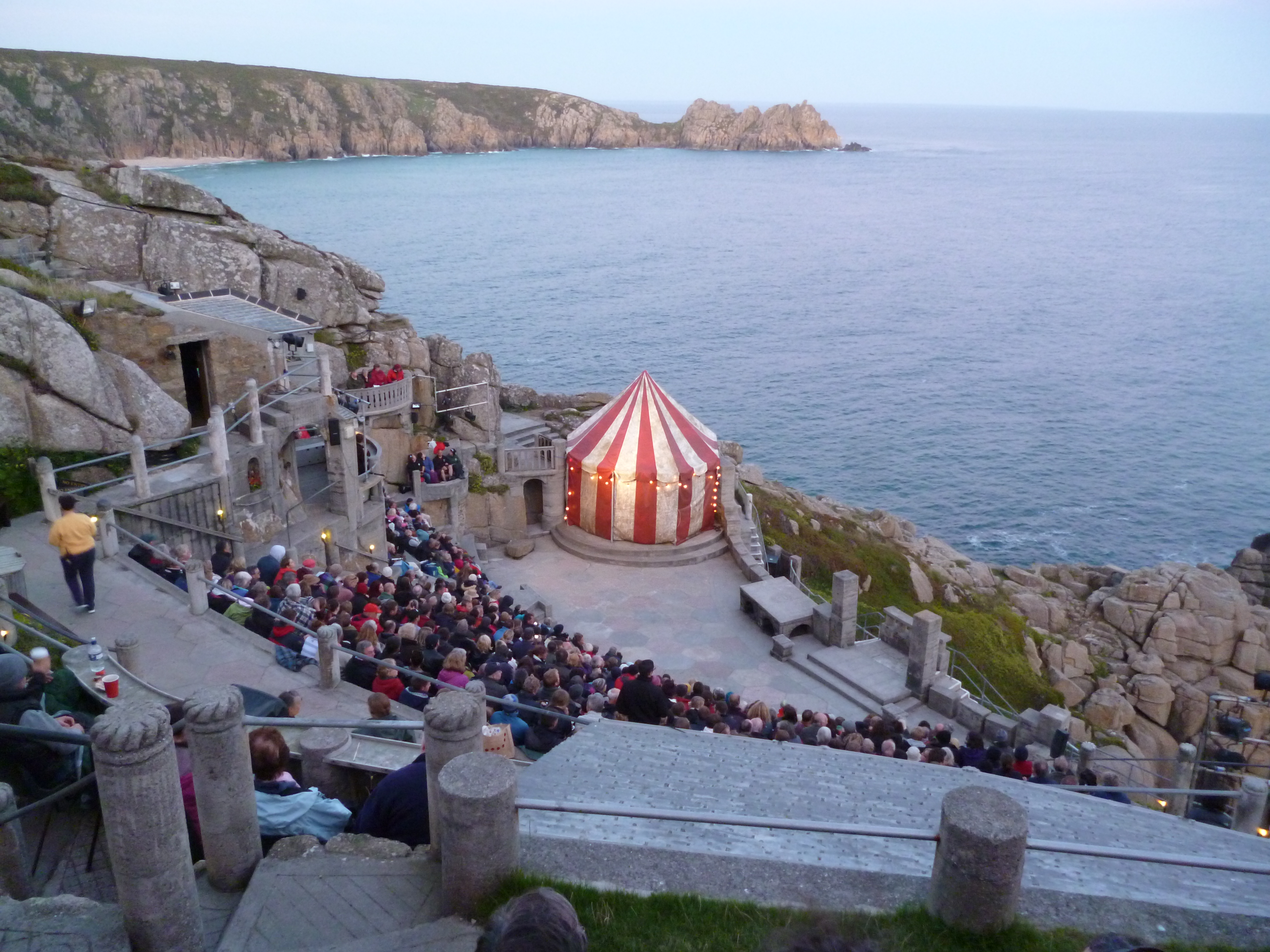
'The Taming of the Shrew' by an all-female cast at the Minack theatre - one of the lovely things on the calendar
‘The Taming of the Shrew’ by an all-female cast at the Minack theatre – one of the lovely things on the calendar

Then one morning I woke up in tears, from a really, really sad dream. I don’t remember now what it was about, just that the sadness carried over into the day. I lost the will to start work, or the energy to stick at it. I read a bit, walked a bit, sat in the garden. Sighed and cried. Watched the birds.

That night, I slept better than I had for weeks and woke up feeling calm and clear, like the rain-washed sky after a storm.

Stress, like drink and drugs, can be an avoidance of ‘legitimate suffering.’ Life is hard sometimes, as well as wonderful, and one way of coping is by shutting the feelings out.

When you’re stressed, your whole focus is in your head; you spiral up into thoughts and ideas about what you should be doing, and push yourself so hard that you have no time to think about anything else.

Dreams connect you with your emotions, whether they are sad, frightening or euphorically happy ones. When you’re spiralling into stress and stuck in your head, it may take a very powerful dream that spills over into your waking life to slow you down and bring you back into your heart and body.

Instead of letting myself wallow as I had wanted to when I got home from my amazing holiday, I decided to ‘pull myself together’ and ‘stop being silly’ and get on with what needed to be done. My dream forced me to feel the feelings I had been avoiding.

Coming back to my blog after, as it’s turned out, two months away, feels really lovely. I’ve given it a new look, which I hope you’ll like, and got lots of lovely articles planned which I’m looking forward to writing.

The list can wait.

Have you ever had a dream that’s brought you down or lifted you up when you really needed it? I love to hear your thoughts and comments.

Too sunny to blog!

The title says it all – I’ve decided to take the whole of August off from blogging/facebookpaging/tweeting and everything else that keeps me at the computer.

desk

I worked 24:7 redrafting my YA novel when the sun was shining last week, and now it’s delivered I intend to get some serious beach time!

019

It’s important for writers to ‘go down to the well’ and allow fallow time between projects, and being out and about with a notepad and pen is pure joy when the weather’s so warm.

A stroll from Looe to Polperro brought me ‘Peony Pinker’ a few years ago, and camping on a Shetland beach last summer brought me back to ‘The Binding.’ I wonder what this summer’s time out will bring.

I’ll be back in House of Dreams in September, starting with my blog birthday on the 4th, when I’ll be reflecting on my second full year of blogging.

In the meantime, happy holidays everyone. May the sun shine on you, wherever you are!

See you in September 🙂

What children’s authors get up to on retreat

I didn’t post last week because I was on retreat at Charney Manor in deepest Oxfordshire with the Scattered Authors Society.

Pimms o'clock in the Charney garden
Pimms o’clock in the Charney garden

As retreats go, this annual adventure is a very lively one – among this year’s sessions we had comedy improv, yoga, e-publishing, drawing, developing the work-in-progress, searching for the iron-age fort and the traditional Charney Quiz.

It's got to be around here somewhere!
It’s got to be around here somewhere!
Quiz night - my team was The Naughty Corner (we lost by less than usual)
Quiz night – my team was The Naughty Corner (we lost by less than usual)

One of my offerings was an afternoon workshop on writing the tarot. Tarot is useful, like dreams, because the cards you draw will be synchronistically connected with your current emotions and preoccupations, so the themes and characters they suggest will feel relevant and immediate to explore in your writing.

However, in an introductory workshop it can be easier if everyone’s working on the same image, so I like to start at the beginning with number 0, The Fool. Katherine Roberts has described the session on her lovely blog, Riding the Unicorn, if you’d like to find out more.

I’ll be offering a one-day workshop in Cornwall on writing the tarot in the autumn. In the meantime, check out the workshops page on this blog if you think you might fancy some dreaming-and-writing in Surrey this October, and please spread the word if you know anyone else who might be interested.

Cheers!

My session, with Celia Rees, on steering a happy course in a difficult market

Our stories, our selves

My work is emotionally autobiographical. It has no relationship to the actual events of my life, but it reflects the emotional currents of my life ~Tennessee Williams

This quotation from Tenessee Williams seems to me to encapsulate where dreams and creative writing are the same.

Being literal-minded, if we try to relate the writing to the author we only do it in a direct way, wondering whether the people in the story are based on real people or the events are things the author has actually experienced.

We do the same with dreams, especially if we focus only on the symbols and not the emotions.

But even where we don’t find any obvious connection between the story and the author, the dream and the dreamer, it is powerfully there because dreams, like fiction, are simply story-versions of the dreamer’s or author’s emotional experiences.

Have you ever written a story that seemed to have nothing to do with your own life, only to realise later that it was ’emotionally autobiographical’?

Can writing make life better?

My favourite chapter in Patricia Garfield’s ground-breaking book, ‘Creative Dreaming,’ is the one about the Senoi dreamers, whose dream-practice is designed ‘to make life better.’

My 1976 copy of the very wonderful 'Creative Dreaming'
My 1976 copy of the very wonderful ‘Creative Dreaming’

In this tradition, if you have an unhappy or disturbing dream, you create a happy outcome for it, either by going back to sleep and dreaming it on, or through creative visualisation when awake.

If every time you have a bad dream you bring it to a satisfying resolution, soon your dreaming mind will start to follow the pattern you have consciously created, and difficult dream situations will always be resolved within the dream.

This practice doesn’t only make your dreamlife happier, it makes your waking life better too, because it works as a kind of rehearsal, an empowering opportunity to experience yourself as someone who confronts their fears and finds their courage and ingenuity in difficult situations.

One of my most common nightmares when I was younger was fear of falling from high places, and that fear was reflected in my waking life. First, I learnt to handle it in my dreams and then, building on that imaginative experience, in my waking life, so that nowadays I love the exhilaration of pushing through the fear to reach the heights.

Up high in Prague last month - hello, Pat!
Up high in Prague last month – hello, Pat!

This is exactly what we do when we write fiction. We put our characters in difficult situations and imagine them forward to a place of resolution. These fictional situations emerge, like dreams, from our deep unconscious, and like the Senoi dreamers, we transform them in imagination in order to triumph over them.

Has your dreaming or writing ever helped you to face a deep fear and feel empowered?

Dreaming, death, love and grace

Last night, I dreamt about Anne. She was my closest friend in Shetland, where I lived for most of my twenties, and when I moved away we spoke maybe once or twice a year on the phone and met up every five years or so. That was enough to keep the connection alive, because it was a very strong connection.

Anne with me and my youngest child, on a visit to Shetland (you can tell I'd got de-acclimatised by then!)
Anne with me and my youngest child, on a visit to Shetland (you can tell I’d got de-acclimatised by then!)

When we first met, I had been estranged from my family for several years, and my big sister had recently killed herself. I was in the middle of a meltdown; Anne was warm and kind.

I’m sitting on the grass opposite a house, but rather than a road between us, there’s a channel of water. Two seals swim up to the house and a young woman comes out to play with them. For several minutes, I watch this magical scene.

The woman comes across and I ask if the seals will let me play with them too, and she says why not? So I go, and we play, and then she invites me into her house for tea.

Inside her house, the young woman is Anne. She gives me a long, lovely hug and I tell her I love her. ‘We go way, way back,’ I say to her new partner, who seems a bit wary of me…

The rest of the dream was our tea-time together in her chaotic house, with her children running around – just exactly as our visits used to be. When I left to go on with my journey, we hugged again, such a comfortable hug, and when I woke I could still feel the warmth of her body and the smell of her hair.

It took me several moments to realise it had been a dream, and several more to remember that Anne was dead – she died nearly ten years ago.

Then I thought, what a wonderful gift that dream was, because it was as real as if we had really met; it was just as pleasurable and loving as at any other time we were together. It was also a complete surprise. I hadn’t asked for this dream, or expected it – it was given to me, by grace.

When I first met Anne, those decades ago, I had no concept of karma or past lives, but I felt that I had always known her. It wasn’t a spark of interest and a getting to know, but a moment of recognition and a reconnecting.

Now, I probably see her once every five years or so in my dreams, just as we saw each other when she was alive, and I expect I’ll meet her in some other future life… if that doesn’t sound too mad.

Have you ever had a vivid dream about someone who’s died? Or felt a karmic connection?

This is one super sweet blog – it’s official!

Big thanks today to Wyndy Dee for nominating Writing in the House of Dreams for the Super Sweet Blogging Award. How gorgeous! More about Wyndy here http://wyndydee.wordpress.com/about/

The rules: Thank (and link) the person who Awarded it to you (see above!) Nominate 12 people and ask them these simple questions…here they are, with my answers.

  1. Cookies or Cake? Whichever is the most chocolatey (obviously!)
  2. Chocolate or Vanilla? A marriage made in heaven – both at once is best
  3. Favorite Sweet Treat? Rhubarb crumble and Cornish clotted cream
  4. When do you crave sweet things the most? At emotional extremes – when I feel either on top of the world or down in the dumps
  5. Sweet Nick Name? I wish I had one. Today in the Rocky Valley tearooms near Tintagel, the waitress kept calling me honey, and I thought that was nice

Now then, my own nominees for the Super Sweet Award…

This time, I’m going for family and children’s-writer friends – I wish they could all come for cake in the House of Dreams!

Rosie Alexander ‘Adviser on the Edge’ – my daughter, blogging about life and work from her home in Orkney

Friends and fellow children’s authors :

Katherine Roberts ‘Reclusive Muse’

Katherine Langrish ‘Seven Miles of Steel Thistles’

Susan Price ‘A Nennius Blog’ (you can find me ‘in conversation’ over there, and we’re about to take up again where we left off soon)

Abi Burlingham ‘Musings and Mutterings’

Amy Butler Greenfield ‘Alchemy Pie’

Lucy Coats ‘Scribble City Central’

Mary Hoffman ‘The Book Maven’ (very informative blog about the book world)

Saviour Pirotta ‘Pirottablog’

Joe Friedman ‘The Talking Therapist’ (new blog by Joe wearing his other hat, as a psychotherapist)

And finally, the most fabilicious group blog, Girls Heart Books where I’m on the team, blogging on the 18th of every month. Here’s my latest post, ‘School – do you love it or hate it?’

Now then, milk and sugar?

Authentically creative, by Carolyn Hughes

Carolyn Hughes is a writer with an interest in addiction and mental health issues. Her popular blog is The Hurt Healer and she has a lively and rapidly growing following on facebook and twitter

Carolyn Hughes
Carolyn Hughes

I must also have a dark side if I am to be whole ~ Jung

Like many writers I want my work to be recognisable by its unique and individual style.  For me, it’s crucial that what and how I write reflects my authentic self.  Anyone who has read my blog The Hurt Healer will be familiar with the fact that I share from the heart. It’s a deliberate approach to enable readers to relate to and hopefully be encouraged by my words.  Authenticity means being genuine and real.  Much as I would love to reveal only my good side, to be true to my work I have to disclose my whole self.

It is no coincidence that I am only now finding my writing voice as it has taken a long time to find myself.  Years of battling with depression and alcoholism meant that I had very little idea of who I was. How I presented to the outside world was very different to how I felt inside. It was only through having the courage to challenge my past at every level that I was able to start the journey to healing and so begin to find personal identity and my authentic self.

My aim though isn’t just to be authentic, but to be authentically creative.  And the key to writing both authentically and creatively lies with the unconscious.  For me the unconscious is a limitless place in my mind where my spirit and soul meet. It is a place where I can visit those painful issues that used to torment me. But instead of being overwhelmed I can now bring them into my conscious, safe from their power to harm me.  So as I communicate from my unconscious, so I hope to reach the unconscious of others and in doing so share a collective moment of authenticity.

The interpretation of dreams is the royal road to a knowledge of the unconscious activities of the mind ~ Freud

Recently I’ve been looking at how I can reach further into the depths of my unconscious and take my writing to a new level of creativity.  I’ve started to look at the constituents of my dreams. This is a wonderful way to tap into those hidden thoughts and images that make up the psyche, as well as exposing my inner truth.

Examining my dreams however has only been possible from a position of emotional recovery and psychological stability. In those dark days of depression and alcoholism my night-time experiences were fraught with darkness and fear. The erratic and terrifying nightmares that emerged reflected my complete inability at the time to manage my physical and mental anguish.

Jung once remarked that nothing was ever lost in the psyche.  That is an horrendous thought for anyone who has tried to block out the past in the hope that the pain would stop. The idea that all thoughts, memories and emotions never disappear but remain forever can be frightening. Yet I found that there was indeed a freedom to be found in allowing the unconscious to simply ‘ be’. I stopped fighting the emergence of the dark side and celebrated the arrival of the good side. By no longer fearing my thoughts and dreams I was free to live authentically and to write openly too.

Il ne faut jamais regarder quelqu’un qui dort. C’est comme si on ouvrait une lettre qui ne vous est pas addressee ~ Sacha Guitry

I couldn’t mention dreams without including one of my favourite quotes. A general translation of this is; “You should never look at someone who is sleeping. It is like opening a letter that isn’t addressed to you.”

It is a quote I came across many years ago at a time when I was experiencing my first love.  After one of those deep conversations that you have in such relationships I remember feeling that he hadn’t been entirely truthful.  As I watched him sleeping I remembered the quote and realised that I had been right to doubt him.  His real emotions were disclosed on his face as he slept.  So dreams aren’t just for the benefit of the dreamer!

Dreams are often most profound when they seem the most crazy ~ Freud

Being new to noting my dreams, I must admit that at first they did appear to be made up of bizarre representations that made little sense and made no contribution to my creativity. But as I made more of a conscious effort to remember them and to focus on not just what they were about but how I felt, they became significant.  

Very often it’s in that winding down time between waking and sleeping that a word, phrase, image that comes into my mind and gives the essence to a piece of writing. Other times it’s a complete dream that a memory from the past, an issue of the present or an aspiration for the future.  

Sometimes this works better than others depending on the obscurity or relevance of my dreams. Yet the importance lies in allowing that writing to happen regardless of whether it makes sense at the time. So although I may have rearranged the words to make them flow, I haven’t messed with the essence of what my soul may have whispered to me.

I may never reach the purest form of authenticity or be famed for my creativity, but I will continue to write from the heart with my unconscious and dreams as my guides.

 How do you write authentically and creatively?