Category Archives: Writing

A therapist for the non-writing writer

Writing. It’s amazing. It can help us to

  • explore and gain mastery in our inner worlds of emotion and imagination
  • develop, organise and share our ideas
  • satisfy our natural yearning to create beautiful objects
  • make our own entertainment and never get bored

The way children learn to write at school completely ignores all these wonderful benefits and that’s why, ten years ago, I wrote my children’s book, How to be a Brilliant Writer focusing not just on the nuts and bolts of how to do it, but also why you might want to, and what writing can do for you.

I knew I’d want to write some books for adults about writing one day too, because I’m a bit of a maven – when I’ve found something great, I just have to share it.
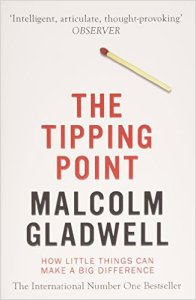
In the spirit of the maven, I'm sharing the fab book I first found the word in
In the spirit of the maven, I’m sharing the fab book I first found the word in

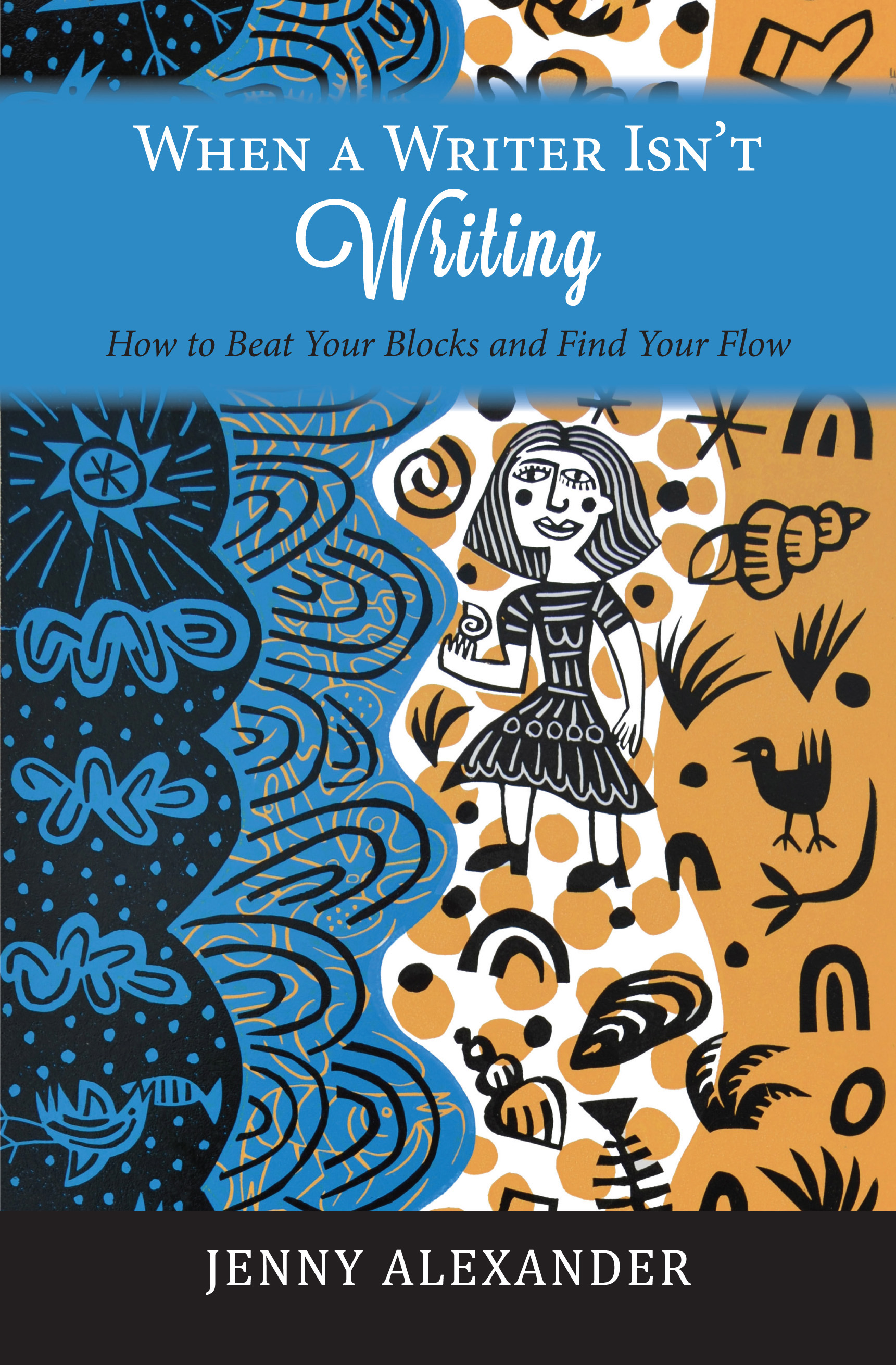
After Writing in the House of Dreams last year, which is about dreams as much as writing, I started work on a new book just about writing, no dreams – writing as a hobby, a spiritual path, a career – the psychology, the process, the question of publication – a distilling down of what I’ve learned from a lifetime of writing and twenty three years of being published. I called it When a Writer Isn’t Writing: How to Beat Your Blocks, Be Published and Find Your Flow.

I didn’t offer the manuscript to my agent or traditional publishers, but decided instead to go straight to self-publishing. The main reason was that I wanted to get a second book out fairly quickly after Writing in the House of Dreams, as I thought two books on different aspects of the same theme might support each other in the market – if someone read one and liked it, they might take a punt on the other.

Writing my book about writing was relatively easy because I’d been thinking about it for several years before I sat down to start. Sending the manuscript out to beta readers – which is really important when a book isn’t going to go through the traditional agent+publishers vetting process – also felt unchallenging, because I was confident in the material.

Working with the editor and then the designer felt like part of the creative process of the book, so I enjoyed that too, but then I had to get to grips with some promotion and pre-publicity, and that certainly didn’t feel like part of the creative process to me.

When the focus lifts from writing to sales, my interest always dips, and with this book I began to sabotage my promotional efforts by thinking ‘what’s the point anyway?’ which made it even harder to feel motivated.

One of the things that got me thinking that way was that my experience with Writing in the House of Dreams had been mixed. I had struggled to find my elevator pitch, because that book straddled two areas of interest, dream-working and writing, so it didn’t fit neatly into either. (My thanks again to Susan Price, who described the book perfectly in her review of it, and so helped me reframe how I describe it myself)

Not having a clear enough concept, all my efforts to get some pre-publicity for it hadn’t achieved very much, and had felt like a waste of good writing time.

I was on the point of deciding to just press publish and let When a Writer Isn’t Writing sink or swim without a shout, when I had this dream:

I’m thinking about my app Get Writing! and I see that the tasks could be represented by people sitting on a wall, and you could click any one, and they would all take you to a writing task. Just writing, so you could click with confidence, knowing what you were going to get.

When a Writer Isn’t Writing is like that, which means it will be easier to pitch and sell than Writing in the House of Dreams. That book could take a writer places they don’t want to go, but When a Writer Isn’t Writing only takes them into writing. 

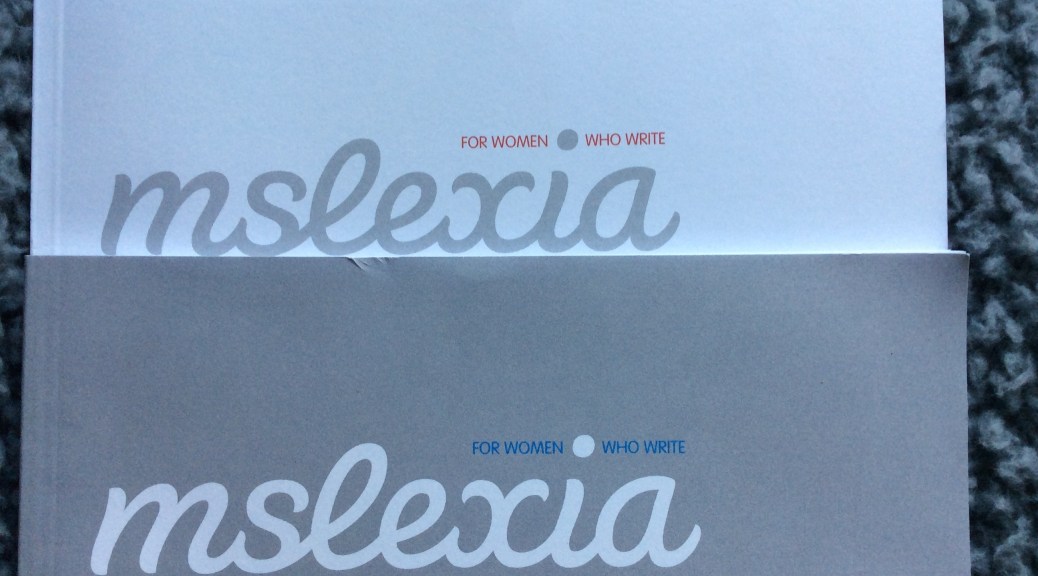
This dream gave me the energy and confidence to stop messing around and do some promoting, and I managed to place articles in Mslexia and The Author. Mslexia have subsequently approached me to ask if I’d like them to feature the book in their October competition. Er… yes please!

There will be reviews on the book analyst and awfullybigreviews, which I’ll link to here when they go up (if you’re a book blogger and would like a review copy, please get in touch!) I’m also organising a launch party in September.

It’s been a tough couple of months, not because self-publishing, writing press releases, pitching articles and organising events is hard and horrible work – I actually quite enjoy it – but because it takes up so much head-space that it stops you getting stuck into new writing.

My daily dose of writing – every stage from pondering and note-taking to drafting and redrafting – is what normally keeps me feeling happy and grounded. Writing isn’t just amazing – it’s addictive.

A non writing writer is a monster courting insanity | Franz Kafka

Dreams are my therapist when not writing makes me feel a bit crazy – what helps you?

‘I feel excited about looking at my dreams in a different way…’

The first time I offered my ‘Writing in the House of Dreams’ workshop series I was slightly concerned that several of the people who signed up were therapists who had worked in an interpretative way with clients’ dreams in their professional life.

I wasn’t sure how they would feel about coming at dreams from a completely new angle, as pure imaginative substance, so you can imagine how relieved I was when, at the end of the first session, one of them told me, ‘I feel excited about looking at my dreams is a different way.’

The first 'house of dreams' picture I used on this blog, by course participant, Liz
The first ‘house of dreams’ picture I used on this blog, by course participant, Liz

Dreams can be an invaluable source of insight into waking life, but if you only focus on that you can miss the greater opportunity they offer, to enter and engage with the dreamworld on its own terms and experience it as a completely different kind of reality.

In order to do this, in workshops, we share dreams as simply things we have experienced, and don’t try to interpret them any more than we would try to interpret the events of waking life. It’s a discipline, because in Western culture we are so centred in the material life and our first instinct is to try to analyse and make sense of things. A train going into a tunnel? We know what that means!

But what if it’s just a train going into a tunnel? Then the experience of dreaming is fundamentally changed. Dream-working in this way gradually expands the mind to inhabit wider realities, instead of just shedding light into some of the corners of this one.

When I’m mixing dreaming with writing in workshops, we begin by sharing a dream; we take material from the dream to spark a piece of creative writing, and then we share the writing. The dream-sharing and the writing-sharing feel exactly the same, as in neither case do we try to analyse any connection between the dreamer/writer’s personal life and the stories they bring.

There is a connection, of course. A writer shows the tones and colours of their own personality, experience and ways of being in the world in all their writing, but as with dreams, if we try to extrapolate more than that, we are likely to make mistakes based upon our own experiences and assumptions.

Writing and dreams are creative processes, and that’s both the value and the joy of them. They don’t literally tell our story; they don’t all refer to the narrow facts of our life. They can take us anywhere, if we are ready for the adventure.

Susan Price's 'Nennius' blog
Susan Price’s ‘Nennius’ blog

I was delighted to discover this review by Susan Price on her ‘Nennius’ blog recently, because she totally gets what I was trying to do in the book that relates to the workshops, Writing in the House of Dreams. Actually, she describes it better than I managed to myself and, with her permission, I’ve changed my amazon book description accordingly!

Got 20 minutes a day? Get Writing!

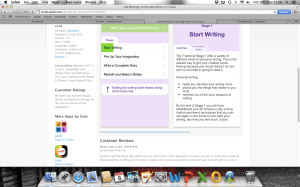
Several months ago, I put a call-out via my newsletter for volunteers to test my new writing app and, having taken their feedback on board and made various adjustments, I’m happy to report that Get Writing! is now available in the Apple store. Woohoo!

The concept is simple. The app takes the traditional method of busting through writer’s block by writing for 20 minutes a day – which you may remember from a previous post Not everyone loves ‘morning pages’ I’m slightly equivocal about – but focuses it so that, after 28 days, instead of a heap of random jottings, you end up with a finished and redrafted story.

There are four sections, each consisting of seven sessions

  1. establishing a daily practice
  2. playing with ideas for characters and settings
  3. writing a short story
  4. crafting and redrafting it

When you have finished, you can go back to the beginning and start again, working your way right through towards a whole new story, or you can use the various sections to dip into as and when you need a nudge with getting going or finding ideas, starting a new story or redrafting one that’s already written.

First review in the Apple store

Depending on sales and reviews, I’d love to develop further writing apps, because the process has been thoroughly enjoyable, and I think an app is a perfect device for delivering daily tasks. As there’s a text box within the app, you don’t even need to be near the computer or have a paper and pen on you – you can dip in any time and anywhere.

Got 20 minutes to spare? Any time, any where!
Any time, anywhere!

Huge thank-you again to all my testers and, if I do develop another one, I’ll be asking for testers via my newsletter again.

Why enthusiasts share their enthusiasms

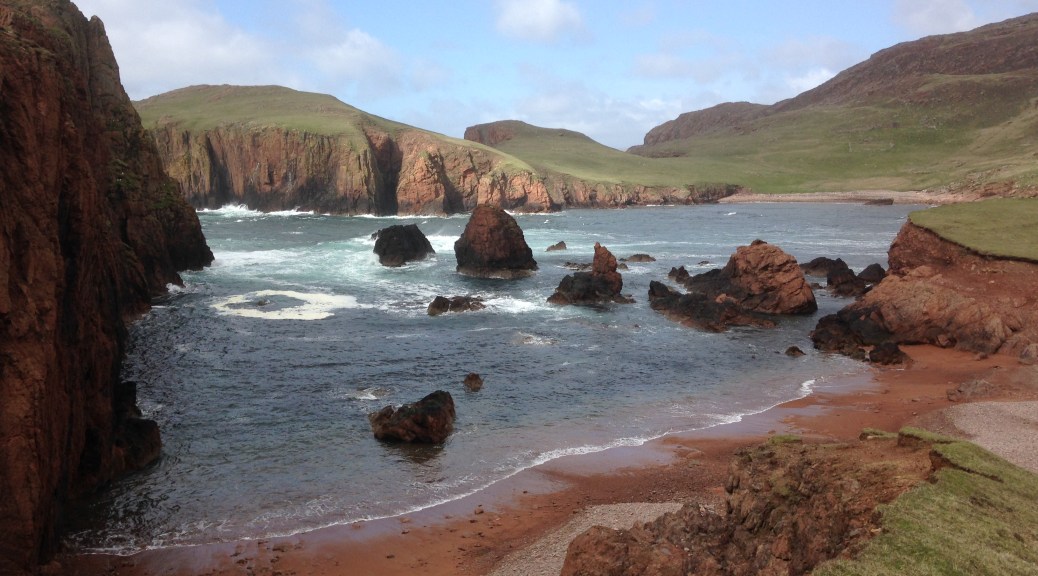
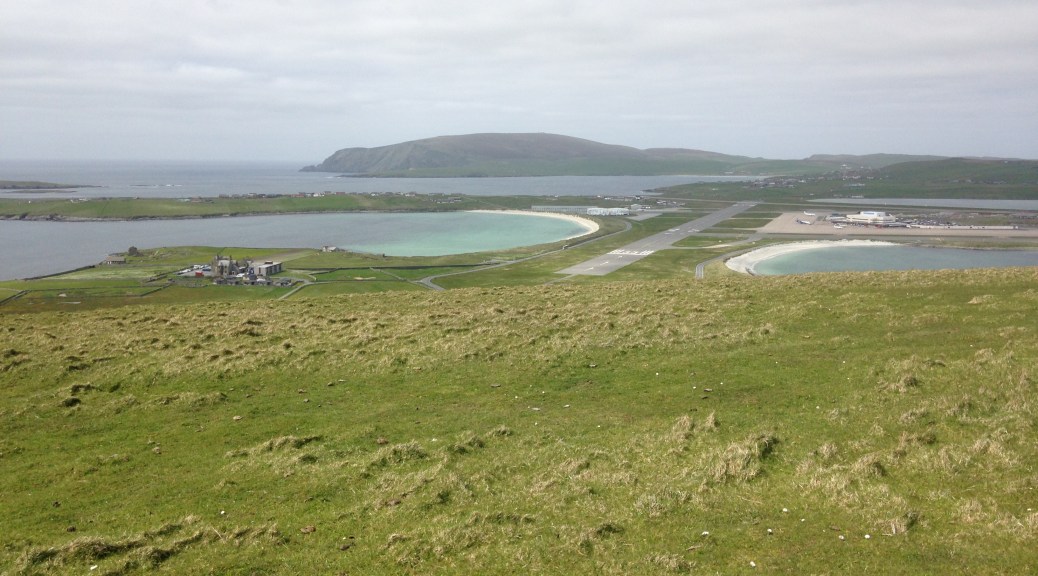
Driving back to the house I was staying in last week, after an afternoon walking the coastline of Shetland, I was listening to an item on Radio 4 suggesting that the wonderful natural history programmes we have these days are putting people off actually going out into the countryside and exploring nature for themselves. The contention was that the natural world feels disappointing compared with the close-up images we can see on our screens.

Walking the coast in Shetland

Chris Packham, one of the Springwatch presenters, was understandably put out by that argument. He said the motivation behind programmes like his was to inspire people to get out and discover the joy of being in nature, by showing how wonderful the natural world is, and all the plants and animals you might see.

I had just seen an otter walk down to the water across the stony beach right in front of me. I would have seen him better in close-up on TV but, having seen the footage of otters on Simon King’s Shetland Diaries a few years ago, I could fill in the detail for myself. I also knew how lucky I’d been to catch a glimpse of such a shy creature.

I’d barely started walking again when i came upon a group of seals lying on a small sandy beach. They were less shy, and allowed me to go down onto the sand and sit watching them. Again, in a close-up on TV, I could have seen every detail, but as Chris Packham said, that would not have come anywhere near the excitement I felt at being so close to the animals themselves.

Just as Chris Packham is an enthusiast for the natural world, I am an enthusiast for the inner world of dreams. Like him, when I share my own experiences, I want to inspire other people to make their own explorations, and I would hate to think it could actually be putting them off.

Not everyone has the time and dedication to devote to one area of experience and most of us like to dip the toe, as I do with my walks in nature. Devoting time and focus will always reap rewards. When I talk about the faceless ones, or numinous dreams, or lucid dreaming I know some people will not have had those experiences, but I hope that simply knowing they exist might inspire them to go looking, or at least recognise them if they chance upon one, and know what they’re looking at, like me and the otter.

How to get new ideas for life, work and dreams

I’m a great believer in holidays. When you’re away from home, you can see your normal day-to-day life from outside, and it gives you a different perspective. What are you relieved to be away from? How do you chose to pass your days when the constraints of work and other responsibilities are lifted? The answers to these and other questions can surprise you and offer precious insights into fruitful changes you might choose to make when you get home.

As a dreamer, one of the things I enjoy about holidays is that my dream life also shifts perspective. Holiday dreams usually have a different quality, and bring in new kinds of imagery. It was during a holiday many years ago that I first encountered the faceless ones, and began to engage with the archetypes, those images which Jung called ‘pieces of life itself.’

Holidays are times when you can wake slowly and really savour your dreams. You can carry them around with you during the day, and ponder them in quiet moments. The images you bring home with you will have the same sense of time and place as the physical souvenirs you buy.

As a writer, I find the same shift in perspective. Ideas I’ve been working on at home seem different from far away. Sometimes more exciting,  sometimes less. They form up in unexpected ways; they show different aspects of themselves to me. I’m sure that’s why so many writers go on writing retreats.

You don’t have to go to exotic places or spend a fortune in order to feel the benefits of going on holiday. In fact, like many other people, I usually go to familiar places I love. The point is simply to be somewhere else, to look at things from a different angle for a while, and come back to normal life feeling renewed.

Thinking creatively in shop-free North Ronaldsay recently - petits fours made from prunes and dark chocolate. Not something I'd ever have eaten at home, but surprisingly good!
Thinking creatively at the bird observatory hostel in shop-free North Ronaldsay recently – petits fours made from prunes and dark chocolate. Not something I’d ever have eaten at home, but surprisingly good!

Have you ever found that being away from home gave you new ideas about life, work or dreams?

Art for Happiness!

I’m delighted to welcome the artist, author and creativity coach Val Andrews into the House of Dreams today to talk about her new book. I’ve followed her blog for ages, and feel absolutely in tune with the way she links creativity with wellbeing.

Val Andrews
Val Andrews

As a part-time visual artist and creative writer with 30 years of experience working in the healthcare sector, I have a keen interest in the impact that creative expression has on health and wellbeing, and on a person’s capacity to be innovative in their work.

For a number of years, I’ve been exploring this interest by delivering creativity workshops and offering coaching to people who are committed to moving through blockages in their creativity. I’ve also been interviewing professional artists and writers about their creative process and sharing those interviews on my blog in the hope this may inspire my readers: https://artforhappiness.wordpress.com

Over the years, I’ve found there are many reasons why people choose to learn more about their own creativity. Sometimes they’re driven by a desire to approach work tasks in a more creative way, sometimes they wish to ‘be more artistic’, or write a book, or invent something the world has not yet seen. Whatever the motivation, unleashing the creative process certainly seems to boost personal wellbeing, and enhance performance at work.

picture of cover

It’s for this reason I chose to write the book “Art for Happiness: finding your creative process and using it”. Freshly published in March 2015, this book explores the some of the contemporary research on the creative process – what it is, how it works and what it does for a person’s sense of wellbeing. I’ve also included a number of exercises which I’ve found helpful in unlocking the creative process and developing ideas beyond their original naivety. Please feel free to look inside this book on my Amazon page: http://www.amazon.co.uk/Val-Andrews/e/B00HGG15A0

Impatience is a form of resistance

Sometimes, I look fondly back on my early days as an author, when the whole job was simply writing books, and the wheels moved very slowly indeed.

The act of writing was slower because, in the days of typewriters, even a minor change such as choosing a different name for a character could be a long-winded redrafting task, searching through reams of paper armed with a tippex brush.

When the manuscript was finally finished and neatly packaged up, it made its leisurely way to the agent or publisher via the Royal Mail, and some weeks later, their response would eventually come back.


In those days, I was blissfully unaware of sales figures and marketing, publicity and self-promotion, and I certainly didn’t have anything at all to do with the publishing process.

In many ways, being an author twenty years ago was far less stressful, but there are lots of things I love about being an author now:

  • Word processing has made every stage of writing much easier and quicker. It means I can make manuscripts that look brilliant and are a pleasure to work on from the earliest outline to the final draft.
  • The internet means I can have frequent contact with readers who follow my blogs or read my books. Their feedback and ideas are both encouraging and inspiring to me.
  • Self-publishing means I don’t have to have unsold manuscripts languishing on my shelves, out of print books consigned to obscurity or projects I want to work on having to be abandoned because they’re unlikely to find a mainstream publisher.

The only problem is that, while I positively enjoy all the opportunities this new way of being an author presents, there’s an awful lot on my to-do list, and if I have to take unexpected time out because of illness, as has happened recently, things can quickly get out of hand.

IMG_0017

On my to-do list right now, I’ve got:

  • redraft my YA novel Drift from editor’s suggestions
  • ditto my next adult non-fiction When a Writer Isn’t Writing
  • write design and cover brief for Drift and When a Writer for designer
  • redraft my iPhone and iPad app Get Writing! following testers’ suggestions
  • plan my workshop for the home educated group
  • write my commissioned article for The Author
  • pitch further mag articles in time for the September launches of Drift and When a Writer
  • write blog articles for writinginthehouseofdreams and girlsheartbooks
  • write my guest blog article for Val Andrews’ Art For Happiness blog
  • write the new children’s fantasy novel that I’ve had in outline since New Year

All those years ago when I started out, and everything seemed so slow, I had a postit on my study wall to remind me, ‘Impatience is a form of resistance.’

When  writing my new book can’t seem to get off the bottom of the list, I still have to remind myself of that today.

A funny thing happened on the way to the Writing Retreat

I was looking forward to being the guest speaker at The Writing Retreat a few weeks ago and giving a workshop the next morning, not least because the venue looked amazing and the organisers seemed very friendly, although I had never met them.

The coast at Lamorna, close to the Writing Retreat at Rosemerryn

I was looking forward to it, but with that slight feeling of trepidation I always get when I’m about to speak in a new place or teach a new group. However, as often happens, those feelings were blown away by a funny dream a few days before the event that made me wake up laughing.

I shared the dream on Facebook with one of the organisers, Jane Moss.

I dreamt the group included Steph and Dom from Gogglebox, a Bear Grylls lookalike, the young playwright I chatted to on the beach yesterday and two mums with half a dozen unruly kids between them. My workshop had to take place in a bus shelter in the grounds because Jane and Kath were teaching a group of local children a musical dance routine in the main room, and Kath was dressed from top to toe in vibrant aquamarine silk, with matching bandana. The workshop went pretty well, all things considered!

This dream planted bright funny images in my mind which I recalled whenever I thought about the upcoming event; it put me in a happy mood, because there is nothing like laughter to relieve stress and anxiety and, as someone has commented here on the blog before, even if you can’t remember the detail of a dream, the emotional tone can stay with you for days.

I used to have stressful dreams in the run-up to potentially stressful situations, dreams in which I was unprepared or distracted or trapped. The received wisdom is that those dreams prompt you to make sure you’re properly prepared. Maybe that’s why these days, when I generally do feel properly prepared, my dreams in the run-up to new events more frequently give me a laugh than a warning.

If you’ve had a dream that made you laugh, do share!

Money from self-publishing – it’s not just about how many books you sell

Just after I self-published Writing in the House of Dreams I blogged about my financial outlay in Self-publishing: What are the actual costs? Five months on, I thought you might like a progress report.

I initially registered the book in the amazon Select programme, which meant I couldn’t publish through any competing outlets for at least 90 days. The benefit of Select is that you can offer your book either free or on a sliding scale of reduced rates in a promotion which, while not making you any money, should make your book more visible and improve its amazon sales ranking.

I didn’t realise that you could only do one promotion in the 90 day period, and I don’t think the one I did really achieved anything for my book, so I wouldn’t personally enrol a book in the Select programme again.

As soon as the 90 day period was up, I took Writing in the House of Dreams out of the programme and made it available as an ebook via all the major online retailers, including Nook and apple, as well as amazon.

I’m thinking of publishing the paperback through Ingram Spark as well as Createspace (which is part of amazon), though I haven’t investigated whether amazon allow this (does anyone out there know?) I’m happy with the quality of the paperback, but apparently some bookshops are reluctant to sell books published by amazon. Happily, I have had orders from several independents as well as book wholesalers Bertram’s and Gardner’s.

Sales have been slow, and that hasn’t come as a surprise because the very reason the book didn’t secure a traditional deal was that publishers deemed writing about dreams as a creative resource rather than from the psychological angle ‘too niche to achieve bulk sales.’

But I’ve had some wonderful emails from readers and a big boost in demand for workshops, which my agent predicted would happen. The book includes lots of writing exercises I use in my general writing workshops, not just the ones which involve working with dreams.

I’ve also hand-sold a fair number of copies through events and workshops. All in all, I’ve recovered less than half my costs through book sales so far, but I’ve had enough extra workshop bookings on the back of it to make up the difference several times over, as well as an article on creative image-work for authors in the next edition of Mslexia.

This reflects the fiscal facts of being traditionally published, because very few authors indeed can make a living from royalties these days. Most have to supplement their income from books with some kind of day job, or spin-off work on the back of their books, such as teaching and speaking engagements.

I’m hoping sales will gradually build, through workshops and word of mouth, but I don’t want to annoy my twitter and facebook followers by over-promoting, so my strategy now is to bring out a second much more mainstream book on writing as soon as possible. If readers enjoy either one of these two books, maybe they might take a punt on the other.

Writing and dreams
Writing and dreams
Just writing - no dreams!
Just writing – no dreams!

This second book is called When a Writer Isn’t Writing: How to beat Your Blocks and Find Your FlowI’m going straight to self-publishing with it because

  1. it’s much quicker – I can bring the book out in September this year
  2. I can create a brand look with Writing in the House of Dreams
  3. I will only need to sell a fraction of the number of copies to make the same amount of money as I would if the book was traditionally published, and i have plenty of opportunities for hand-selling at writing events and workshops

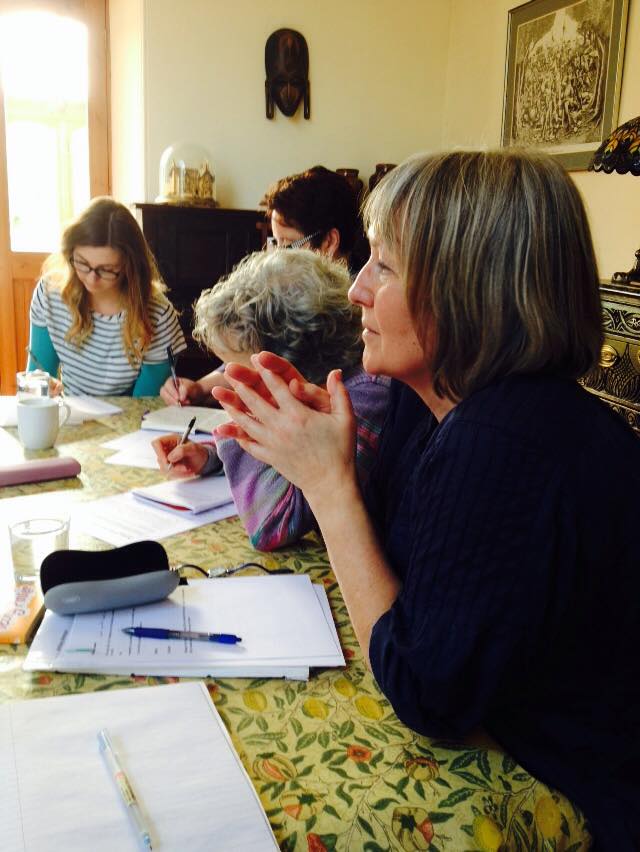
Speaking of workshops, check out these pics from last week’s residential at The Writing Retreat in beautiful Lamorna, where I was invited to speak and teach a session on writing dialogue. Good times!

Rosemerryn - The Writers' Retreat
Rosemerryn – The Writing Retreat
Writing dialogue round the table at Rosemerryn

The mysterious geometry of writing

In Becoming a Writer Dorothea Brande points out that it isn’t only themes and characters that emerge from the unconscious mind through writing. She says the unconscious is also ‘the home of form.’

So as well as trusting the flow of ideas if we open our mind by entering the ‘writer’s trance,’ we can also trust that the ideas will organise themselves into the shapes of books and stories.

I definitely find this in my own work.

When I’m writing, whether it’s fiction or non-fiction, I start with a sketchy plan and head off from Start in the general direction of Finish, wondering how on earth I’m going to get from one to the other, until suddenly I begin to see the shape of the whole thing in my head like a geometrical figure or a pattern of numbers.

At that point, I become fully engaged. I dash along like a mad thing, joining the dots to make the beautiful shape of the book I’m creating.

This means all my books have a sort of symmetry in the contents – the four Peony Pinkers, for example, all have 17 chapters. Why 17? I’ve no idea, only that that was the number they needed, and I knew each story was on the right track the moment I could see how it could make 17 chapters.


The Peony Pinkers - 4 times 17
The Peony Pinkers – four perfect 17s

Writing in the House of Dreams came out as four parts, each part having three chapters.

4 Parts, 3 chapters each in the House of Dreams

My brand new book, The Binding, has three parts and each one seven chapters.

The Binding - 3 parts, 7 chapters each
The Binding – 3 parts, 7 chapters each

This mysterious geometry is very marked in my own writing practice but not all books divide so obviously into a balance of parts, so it can’t be exactly the same for all writers.

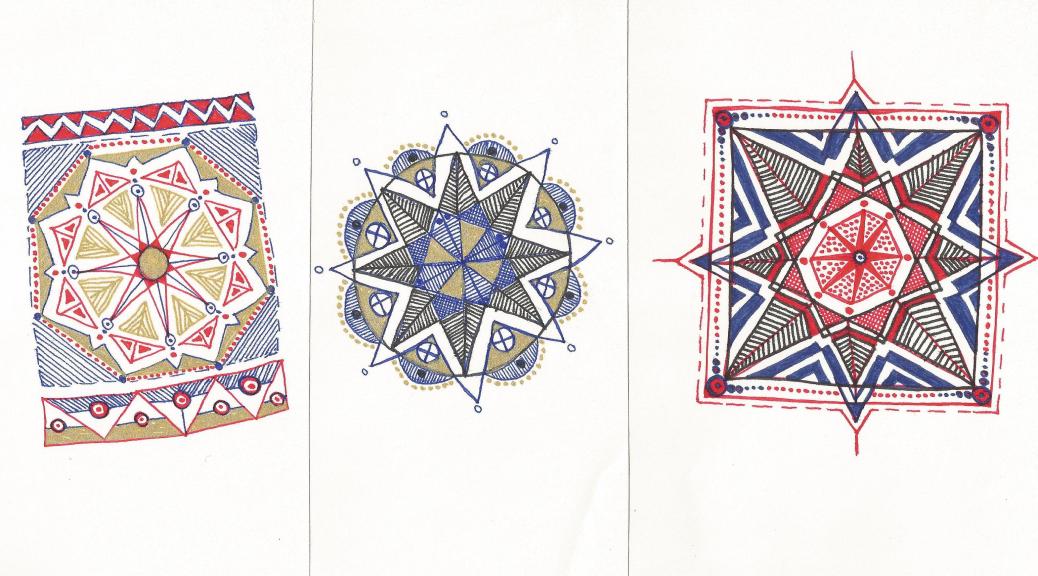
Still I imagine there must come a time for everyone when something clarifies in the mind; you see the finished shape of the whole book, and the writing steps up a notch to engage with it.

If you are a writer, do you recognise what I’m talking about, or am I just weird?!